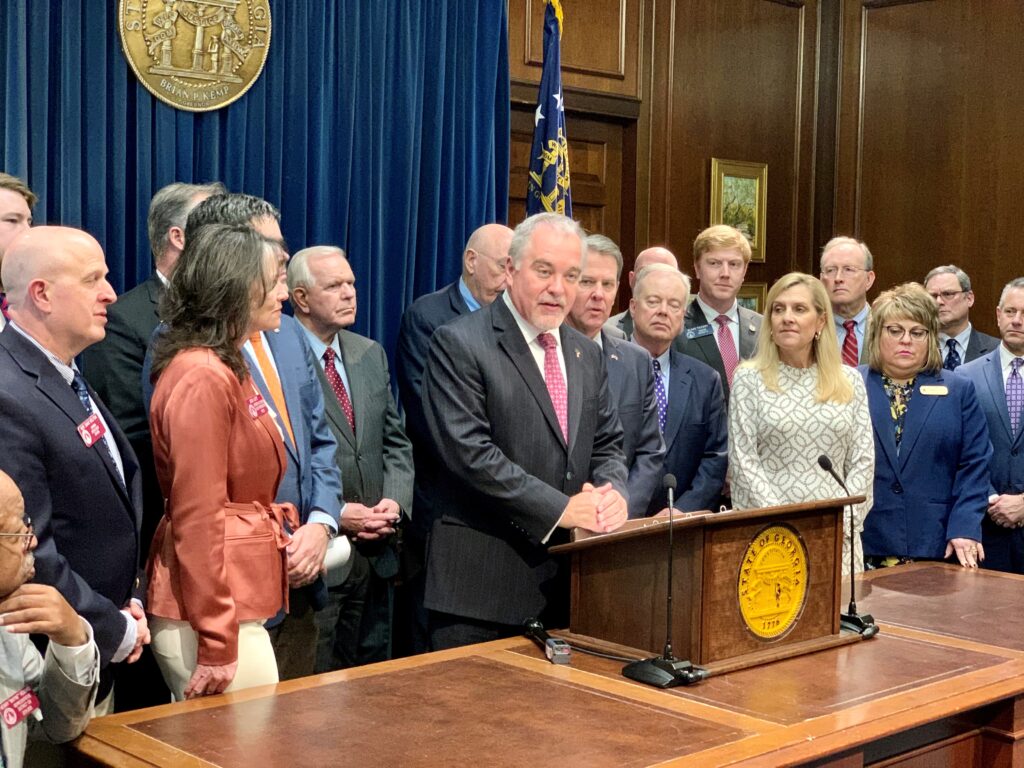
ATLANTA – Gov. Brian Kemp unveiled legislation Tuesday that would reduce the number of standardized tests public school students must take in Georgia and untie the link between scores earned on those exams to their final grades.
The changes figure into the governor’s
push to roll back some standardized tests instituted over the past decade, both
at the federal and state levels.
Kemp’s announcement followed a series of
meetings last fall with teachers who raised concerns over the rigor of the
state’s standardized tests.
At a news conference Tuesday, Kemp said the
testing changes aim to ease the amount stress put on students, teachers and
parents. He said the tests do not best reflect student learning progress and place
a “substantial burden” on teachers who already have heavy workloads.
“When you look at the big picture, it’s
clear,” Kemp said. “Georgia just tests too much.”
Four tests would be yanked from the
roster of exams Georgia high schoolers have to take. Another test in social
studies would be nixed for fifth graders.
Tests to be eliminated would include
American literature, geometry, physical science and economics.
Kemp’s legislation would also give the
Georgia Board of Education “flexibility” to decide whether end-of-the-year
exams would affect a student’s final grade in a course.
The tests would also have to be given sometime
within the last five weeks of the school year instead of at any time, so that
teachers can focus more on teaching class subjects rather than preparing for
exams.
Additionally, the changes would include
extending the amount of time high school students have to complete a required
writing test, discontinue a practice of comparing Georgia’s testing standards
with other states and let school districts abstain from “formative assessments”
meant to see how much students learned in a school year.
Legislation to make the testing changes
is being carried by Senate Education and Youth Committee Chairman P.K. Martin
IV, R-Lawrenceville.
Georgia Superintendent Richard Woods talks about the proposed changes to standardized tests. (Photo by Beau Evans)
Georgia Superintendent Richard Woods
fully backed the test trimming Tuesday. He said the changes will free up time
for teachers to dive more into subjects and avoid focusing on redundant material
only for the sake of an end-of-year test.
“Our children remember our teachers,”
Woods said. “They do not remember the tests that they took.”
Woods added after Tuesday’s news
conference that he believes the lessened test load should not affect graduation
requirements or lower graduation rates.
Kemp and Woods previously announced
changes ending tests for the courses that gain college credits, including the
state’s dual enrollment program and advanced-placement classes.
The legislation announced Tuesday also follows a bill filed in the 2020 legislative session that would put new restrictions on the state’s popular dual enrollment program by capping the number of course hours students could take for free. The legislation, House Bill 444, cleared the Senate floor last week.
Kemp is also pushing for a $2,000 salary raise for teachers, following up on a $3,000 raise lawmakers approved last year. Some influential lawmakers, however, have cast doubt on whether another teacher salary increase should be passed this year amid budget cuts Kemp has ordered for many state agencies.
ATLANTA – The Georgia Senate unanimously passed a bill Tuesday that would let city and county governments decide how to regulate e-scooters in their own backyards.
A Senate study committee considered last fall whether to
apply statewide rules to the motorized scooters, which have proliferated in
cities across the country including Atlanta.
A dozen Georgia cities have banned e-scooters recently.
Atlanta, which still allows them, has placed a ban on riding the devices at
night and on sidewalks following several deaths involving vehicles and scooter
riders.
Ultimately, state lawmakers went with a hands-off approach
in Senate Bill 159, which would only limit the devices to speeds of up to 20
miles per hour and to a maximum weight of 100 pounds.
Sponsored by Sen. Steve Gooch, R-Dahlonega, the bill
approved Tuesday explicitly gives cities the authority for regulating
e-scooters.
The bill has fewer provisions than when it was originally
filed such as allowing e-scooters to use bicycle lanes and imposing caps for
impound fees.
The light touch is meant to let e-scooters and other transit
technology develop further in order to help ease traffic congestion, Gooch
said.
“We didn’t want to overregulate the industry. We didn’t want
to put a lot of barriers in the way,” Gooch said Tuesday from the Senate floor.
“In fact, we wanted to encourage the development of this technology.”
An amendment was added Tuesday calling for local governments
to consider requiring e-scooter companies to hold liability insurance.
“There’s a consideration that needs to be taken into account
when the local governments set their regulations,” said Sen. Lindsey Tippins,
R-Marietta, who authored the insurance amendment.
The bill passed by 47-0 in the Senate. It now heads to the
state House.
Gooch hashed out the hands-off approach during the study
committee hearings last fall. He and other lawmakers decided fewer state rules
would be best for e-scooters.
At the time, Gooch said he agreed the scooters needed some
regulating but that he wanted to “offer a private-sector solution to a problem
that’s been around for years.”
E-scooter proponents have said the devices help ease traffic
congestion in heavily crowded areas like Atlanta and provide a more environmentally
friendly mode of transportation than cars.
ATLANTA – A push to give Georgians the legal ability to sue the state and local governments has been revived in the General Assembly, but it may not go as far as some lawmakers would like.
Legislation sponsored by Rep. Andrew
Welch, R-McDonough, would ask voters whether they should be allowed to sue
government agencies to overturn unconstitutional actions.
As a constitutional amendment, his
measure would need two-thirds approval from the legislature before going on the
ballot.
Currently, Georgia law prohibits the state
or local governments from being sued for most reasons under a legal protection
called “sovereign immunity.”
Under Welch’s proposed amendment,
Georgians could sue their government to secure a judge’s order blocking an
unconstitutional law. It would not allow winning plaintiffs to collect monetary
awards.
“We are trying to look at a very concise
approach to this waiver,” Welch said Monday during a meeting of a House
subcommittee he chairs.
If passed, the amendment also would
require citizens to sue the government or agency itself, not an individual.
Government officials themselves would have to be sued by other provisions under
state law besides constitutional grievances.
Rep. Mary Margaret Oliver, D-Decatur,
took issue with that limitation but said she still supported the constitutional
amendment.
“I’m a little concerned that we seem to
be taking a step back” just to get some sort of legislation passed, Oliver said
at the subcommittee hearing.
The measure passed unanimously Monday and
now moves to the full House Judiciary Committee with jurisdiction over civil
law.
Welch brought similar legislation last
year that both the state House and Senate passed unanimously. But Gov. Brian
Kemp vetoed it, arguing the waiver would hurt the government’s ability to
function.
Former Gov. Nathan Deal also vetoed a
similar bill that passed in 2016.
Bids to undo sovereign immunity stem from
Georgia Supreme Court rulings that gave state and local governments broad
leeway in claiming sovereign immunity. But the high court also opened the door
for lawmakers to pass a waiver removing that legal protection.
“Put simply, the constitutional doctrine
of sovereign immunity forbids our courts to entertain a lawsuit against the
state without its consent,” Justice Keith Blackwell wrote in his opinion in a
2017 ruling.
Lucrative tax exemptions and credits in
Georgia could come under close watch from independent auditors under a bill
that passed out of a Senate committee on Monday.
Senate Bill 302 comes after a scathing
set of audits the state Department of Audits and Accounts released last month
that found Georgia’s film tax credit has been poorly managed while being touted
as having more economic impact on the state than it actually does.
Sponsored by Sen. John Albers, the legislation
would let the governor’s budget office contract with outside auditors to
scrutinize up to five tax-incentive programs each year, upon request from state
lawmakers.
Auditors would dive into the economic
pros and cons of the state’s many tax credits, exemptions, rebates, deferrals
and other business incentives.
“All the things that each one of us would
do if we were investing our money,” Albers, R-Roswell, said Monday of the
audit’s scope.
The bill passed unanimously out of the
Senate Finance Committee and heads to the floor for a vote of the full Senate.
Sen. Chuck Hufstetler, the committee’s
chair, said tightening oversight of tax programs would help put Georgia on par
with other states that do a better job tracking the performance of their incentives.
“We can do better here at making sure
we’re making the best use of taxpayers’ dollars,” Hufstetler, R-Rome, said
Monday.
Albers’ bill follows similar legislation
he brought last year that Gov. Brian Kemp vetoed since it did not give his
office authority to hire independent auditors.
Albers and Hufstetler both sat on a
Senate study committee in 2017 that found shortcomings in monitoring whether a
given tax incentive is spurring business and job creation as it was intended to
do.
The committee’s report looked at several
different tax credits, including the film tax-credit program, and found some of
them were either too tough to evaluate or were potentially not spurring
economic growth.
It recommended creating the kind of
auditing oversight that Albers’ bill proposes, as well as for all tax-incentive
measures in the state to sunset after five years.
That 2017 report seemed to predict the
harsh criticism state auditors heaped on Georgia’s film tax credit program last
month.
In two back-to-back reports, the state
auditing agency found the credit program generates about $1 billion less in
statewide economic impact than estimates from the state Department of Economic
Development had claimed.
That agency and the Department of Revenue
have also kept shoddy controls over the program, leading to many credits being
doled out improperly to companies that should not actually qualify, according
to state auditors.
The pair of reports put the film-credit
program under fire in the early days of the 2020 legislative session as the General
Assembly began tackling tough budget issues. But prominent lawmakers like House
Speaker David Ralston have pledged to block any efforts to abolish the credit.
Senate Majority Leader Mike Dugan,
R-Carrollton, reiterated in an interview last week that the film tax credit
might be tweaked eventually but will not be outright discarded.
“Nobody wants to get rid of film tax
credits,” Dugan said.
Georgia Secretary of State Brad Raffensperger wants to wait until next year before making any changes to the state’s special elections. (Credit: Secretary of State’s office)
ATLANTA – Georgia Secretary of State Brad Raffensperger has come up with a plan to avoid a flap among Republican leaders over a free-for-all “jungle” primary to fill out the remainder of resigned U.S. Sen. Johnny Isakson’s seat.
The secretary of state’s move came as
legislation that would overhaul the special-election process stalled in the
state House of Representatives.
House Speaker David Ralston backed the bill when it was introduced but reversed course on Thursday and said he would support holding off on the rules change until after newly appointed Sen. Kelly Loeffler defends the seat in November.
“We agree with Speaker Ralston that jungle elections are problematic,” Raffensperger said in a statement. “That is why we propose a bipartisan commission to review and propose legislation to rationalize the special-election process for future elections after 2020.”
Georgia Senate Majority Leader Mike Dugan said earlier in the week that he planned to seek Raffensperger’s opinion on the matter first if the bill were to pass out of the House and reach his chamber.
Isakson, who resigned at year’s end due
to health complications, was replaced by Loeffler to hold the seat until the
November special election. She was appointed by Gov. Brian Kemp in December.
The election-changes bill would separate
Democratic and Republican candidates into party primaries in May before pitting
the nominees against each other in November. That change could shake up the
crowded U.S. Senate contest.
With Collins in the race, restoring the primary format would let Republicans rally support and start raising campaign funds for a single nominee months before the November election, potentially to Collins’ benefit. It could also help Democrats, who have historically faired poorly in runoffs.
Without the changes, the November
free-for-all election would likely lead to a runoff in January. Special
elections require the leading candidate to secure more than 50% of votes to
avoid a runoff.
Aside from Loeffler, Collins and Warnock,
the U.S. Senate race has drawn two other Democratic challengers so far: Matt
Lieberman, the son of former U.S. Sen. Joseph Lieberman of Connecticut, and Ed
Tarver, a former U.S. attorney and state senator from Augusta.
Republican U.S. Sen. David Perdue faces
three Democratic challengers in his bid for a second term.
Three seats for the U.S. House of
Representatives are wide open, with the incumbents either stepping aside or
seeking election elsewhere. Democratic state leaders are also pushing to flip
the Georgia House in their favor.
ATLANTA – Gov. Brian Kemp has signed legislation imposing state sales taxes on online purchases facilitated by large retailers like Amazon, Google and Uber.
The tax is projected to raise hundreds of
millions of dollars annually in Georgia.
Lawmakers in Georgia’s House and Senate hashed out a compromise measure early in this year’s legislative session to collect the tax from so-called “marketplace facilitators,” which allow third-party companies to conduct business on their websites.
The measure, House Bill 276, stalled in
the Senate last year amid pushback from ride-share companies like Uber, which
wanted a tax exemption. Lawmakers involved in negotiating the compromise bill
expect separate legislation to be filed that would give Uber an exemption or
require them to pay a fee.
Senate Finance Committee Chairman Chuck
Hufstetler, R-Rome, said state revenue experts estimate the tax could raise $10
million a month – though he thinks that’s a conservative estimate.
“It’s great for cities, counties, schools
and Georgia businesses that the playing field will be more level now,”
Huftstetler said Thursday.
A report last year from the advocacy
group Faith, Truth and Justice Project estimated the tax could raise upwards of
$750 million a year.
Kemp’s office confirmed Thursday that the
governor had signed the bill. Tax collections will start April 1.
An Uber spokeswoman previously warned
collecting the tax could hit Georgian ride-share users with higher trip costs
and decrease earnings for drivers. The company prefers lawmakers institute a
“reasonable fee structure” instead.
The bill’s passage comes as lawmakers
look to fill a budget shortfall caused by sluggish state tax revenues and
budget cuts that Kemp ordered for most state agencies. The online-sales tax
marks the most significant revenue-raising effort to plug the state funding gap
so far this legislative session.
Some lawmakers opposed passage of the
bill over opposition to raising taxes. They favor lowering the state’s
income-tax rate for a second time in the last three years. But several
influential lawmakers, including Hufstetler, have sounded wary of lowering
income taxes at a time when state budget cuts are being made.