Bottoms’ affordability plan: encourage cities and counties to eliminate their taxes on groceries
ATLANTA — With voters upset about the cost of living, both candidates for governor are rolling out affordability plans to woo them.
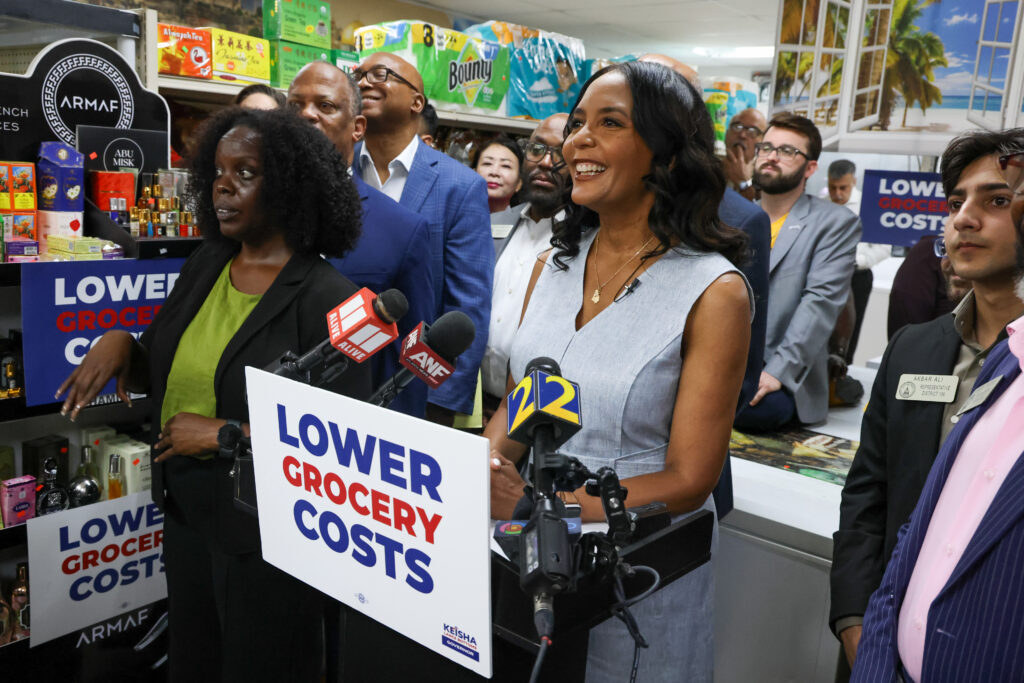
After Republican Rick Jackson pitched cuts to income and energy taxes last month, Democrat Keisha Lance Bottoms unveiled her proposal Wednesday to lower grocery bills by cutting the sales tax.
The state already exempts groceries from its 4% sales tax. Her new plan would give cities and counties the option of waiving theirs, too.
The former Atlanta mayor said that if voters make her the first Democratic governor of Georgia in more than two decades — and the first Black woman ever — she will ask lawmakers to let cities and counties opt out, too.
Speaking at a campaign stop in a small grocery store in Lawrenceville, Bottoms framed rising costs as an existential crisis.
Whether she goes to the hair or nail salon, the grocery store or church, Bottoms said, “people are talking about how expensive it is just to exist.”
President Donald Trump has endorsed Jackson, and Jackson has said he would be Trump’s favorite governor.
The Bottoms campaign hopes that alliance hurts Jackson more than it helps him.
“Donald Trump ran on lowering grocery costs, specifically the cost of eggs, immediately when he came into office,” Bottoms said. “Well, we are still waiting on him to deliver on that.”
Bottoms’ affordability plan offers local leaders two options: permanently eliminate their sales taxes on groceries and other eligible essentials, or temporarily suspend those taxes when prices rise sharply.
She would establish a one-year $250 million state fund to subsidize communities for revenue losses in excess of 5% of the prior-year grocery-tax collections.
Bottoms could not do this alone as governor. Her plan is predicated on a major assumption: that Democrats will win control of both the state House and Senate, long controlled by Republicans.
She would need the cooperation of the General Assembly to get enabling legislation approved.
Bottoms said she hopes Democrats seize control of the Legislature but said she was prepared to collaborate with Republicans if they remained in power.
The Jackson campaign dismissed Bottoms’ plan, asserting that Atlanta became unaffordable when she was mayor from 2018 through 2021.
“Rick Jackson has treated it as a crisis since day one, and his plan doesn’t need permission from 159 county commissions,” Jackson campaign spokesman Garrison Douglas said in an email.
Speaking at an Atlanta barbershop in mid-August, Jackson said he would address the cost of living by attacking other types of taxes.
He said he would gradually cut the state income tax in half, eliminate state taxes on the electricity and natural gas delivered to residences and suspend the motor fuels tax during gasoline price spikes.
Jackson also pledged to freeze the rising home valuations that are driving up property tax bills.
The Bottoms campaign has labeled her opponent “Slick Rick,” an insult she used at her Al Huda Grocery stop Wednesday.
When a reporter asked her why Lt. Gov. Burt Jones, the Republican who lost to Jackson in the GOP primary runoff, had not endorsed Jackson, Bottoms said she thought it was because Jones did not trust Jackson, in part due to the money Jackson’s healthcare staffing company has earned from the state.
“Slick Rick received a $700 million no-bid contract in the middle of COVID, and he stood before cameras like this and said if he were elected, he wouldn’t continue to do business with the state of Georgia,” Bottoms said. “And then he just extended that contract three weeks ago.”
Jackson addressed the issue last month.
During his campaign stop at Tommy’s Barbershop, Jackson said any contracts his company held with the state could and would be canceled if he were elected governor.