ATLANTA — Problems with the communications system used by air traffic controllers grounded departing flights across the country starting Friday afternoon, including at Georgia’s Hartsfield-Jackson Atlanta International Airport.
“FAA Ground Stop Alert,” read a red banner atop the Hartsfield-Jackson website. The message said the Federal Aviation Administration suspended departures from Atlanta and other major airports.
The airport urged travelers to check with their airlines for updates, promising to provide information as it becomes available.
U.S. Transportation Secretary Sean Duffy posted on X at 4:16 p.m. Eastern time blaming the stoppage on a “communication issue” affecting all air route traffic control centers. His post said that FAA technicians were investigating.
About 45 minutes later, the FAA posted on X that the agency had, “out of an abundance of caution,” grounded flights due to a “temporary telecommunications outage.”
“Every flight has been accounted for and international flights will be handled on a case by case basis,” the post added.
By 7:30 p.m., there were about 10,000 delays within, into or out of the United States on Friday, according to FlightAware, a flight-tracking website. The site counted more than 4,000 cancellations.
Around the same time, the site reported 151 delays and 95 cancellations at Hartsfield-Jackson between 5 p.m. and 9 p.m. It reported more than 2,100 delays and nearly 1,200 cancellations nationally for the same four-hour span.
ATLANTA — Georgia’s net tax collections in October rose marginally over the same month last year, up $6.7 million, for an increase of 0.2%, according to Gov. Brian Kemp’s office.
Total net collections in October were $2.71 billion.
The nearly flat change comes after three months of year-over-year gains of 2.3% to 3.5%.
The biggest drop was in net individual income tax collections, which fell $115.1 million, or 8.6%, from October 2025 to about $1.22 billion. Withholding payments fell $106.6, also 8.6%.
Kemp has raised the possibility of another special legislative session this year, this time to address the budget.
“I will not be calling a special session of the Georgia General Assembly in order to curtail executive branch powers or debate redistricting changes,” Kemp said in a statement on Nov. 4, the day after the election.
“There are, however, budgetary issues that may need to be addressed before the convening of the regular session in January.”
Individual income taxes aside, some other revenue categories grew in October.
Corporate income tax collections climbed $29.7 million, or 48.7%.
Gross sales and use tax collections rose $135.3 million year over year, or 8.5%.
But motor fuel tax collections fell for a seventh straight month, dropping $8.3 million or 4.3% from October of last year because of Kemp’s executive order to suspend the tax through Nov. 30.
That is more than the $422,000 year-over-year decline in September and the $6.6 million drop in August but a bit less than the $10.6 million drop in July.
It is far less than the $73.3 million decline in April and the more than $196 million drops in both May and June.
Kemp has suspended the 33.3 cent-a-gallon excise tax on gasoline (37.3 cents for diesel) repeatedly since March to help Georgians cope with rising prices.
ATLANTA — For the first time in more than two decades, Democrats in the Georgia House of Representatives nominated new leadership as a majority caucus.
For the first time in the 238 years since Georgia joined the United States, a pending House majority caucus also nominated a Black person as speaker. That person, Rep. Carolyn Hugley, D-Columbus, is also the first woman nominated to a full term as speaker, after Rep. Jan Jones, R-Milton, stepped into the role as acting speaker from late 2022 into the start of the 2023 legislative session.
Assuming the unofficial results from Election Day do not change before Georgia Secretary of State Brad Raffensperger certifies the results next week, Democrats will hold four more House seats than Republicans.
Hugley said expanding Medicaid would be “first and foremost” on the House agenda.
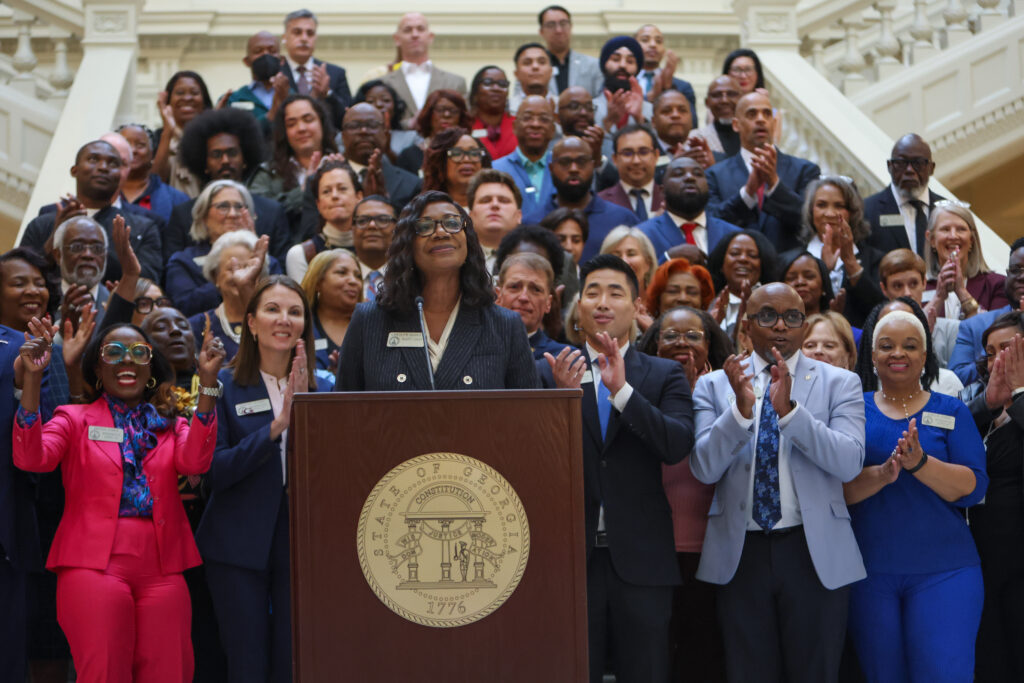
Rep. Carolyn Hugley, D-Columbus, announced her nomination as the next speaker of the Georgia House of Representatives, at the Georgia Capitol in Atlanta, on Thursday, Nov. 12, 2026. She is in line to become the first Black woman to hold the position upon confirmation by the full House when lawmakers return in January for their legislative session. Hugley also announced the other future leaders of the pending Democratic House majority. (Caroline Newbern/Capitol Beat)
She said Democrats were excited to work with Democratic Gov.-elect Keisha Lance Bottoms to accomplish that goal as part of a broader agenda to address the cost of living.
Incumbent Rep. Gerald Greene, R-Cuthbert, had seemingly lost to Democrat Harry James, but the 388 ballots on the memory card that were uploaded Nov. 6 put Greene back in the lead.
That narrowed Democrats’ majority to 92 seats in the 180-member House. The Georgia Constitution requires 91 votes, a majority of the chamber at full capacity, to pass legislation. So, the updated outcome in Greene’s race, if it holds, will leave Democrats with a one-seat cushion, although a runoff between a Democrat and a Republican in a race that involved an independent could expand the Democrats’ majority.
Raffensperger has until Nov. 20 to certify the results after local election officials certified them Monday.
In addition to nominating Hugley as speaker on Thursday, the House Democratic caucus nominated Rep. Billy Mitchell, D-Stone Mountain, as speaker pro tempore.
Both Hugley and Mitchell, who is also Black, await confirmation votes by the full House when lawmakers convene for the next legislative session in January.
The Democratic caucus also named the rest of its leadership during its meeting on the House floor. It is a diverse group that includes three women, two of whom are Black, and four men, two of whom are Black and one of whom is Asian American.
Rep. Stacey Evans, D-Atlanta, was named majority leader. Rep. Sam Park, D-Lawrenceville, was named majority whip. Rep. Spencer Frye, D-Athens, was named majority caucus chair. Rep. Imani Barnes, D-Tucker, was named majority caucus vice-chair. Rep. Anissa Jones, D-Macon, was named majority caucus secretary. Rep. Robert Flournoy, D-Hampton, was named majority caucus treasurer. Rep. Bryce Berry, D-Atlanta, was named majority caucus chief deputy whip.
“We built a team that looks like Georgia,” Hugley said. “It listens to Georgia. And we intend to fully represent all Georgians.”
The speaker selects chairs of the House committees, which currently number 44. Naming committee chairs would be among Hugley’s first tasks after her confirmation.
Hugley is in line to succeed House Speaker Jon Burns, R-Newington, when the Legislature convenes in January and Democrats take over the House for the first time since 2004.
ATLANTA — The Republican majority in the Georgia Senate chose two new leaders after Democrats ousted two incumbent leaders in the Nov. 3 election, according a Senate announcement and unofficial election results.
Sen. Tim Bearden, R-Carrollton, will become majority caucus chairman for the 2027-28 biennium that starts in January.
Bearden will succeed Sen. Shawn Still, R-Suwanee, who lost reelection to Democrat Laura Murvartian.
Sen. Drew Echols, R-Gainesville, will become majority caucus vice chairman. He will succeed Sen. Clint Dixon, R-Buford, who lost reelection to Democrat Scott Tippetts.
The rest of the majority caucus’s leadership team will carry over from the current term, according to the Senate announcement on Monday. Sen. Larry Walker III, R-Perry, is the Republican nominee for president pro tempore, with the full Senate expected to elect him to a new term in January.
Sen. Jason Anavitarte, R-Dallas, will remain as majority leader. Sen. Randy Robertson, R-Cataula, will remain as majority whip. Sen. Kay Kirkpatrick, R-Marietta, will remain as majority caucus secretary.
One major change in the Senate is who will preside over it.
Sen. Josh McLaurin, D-Sandy Springs, defeated Sen. Greg Dolezal, R-Cumming, in the race for lieutenant governor.
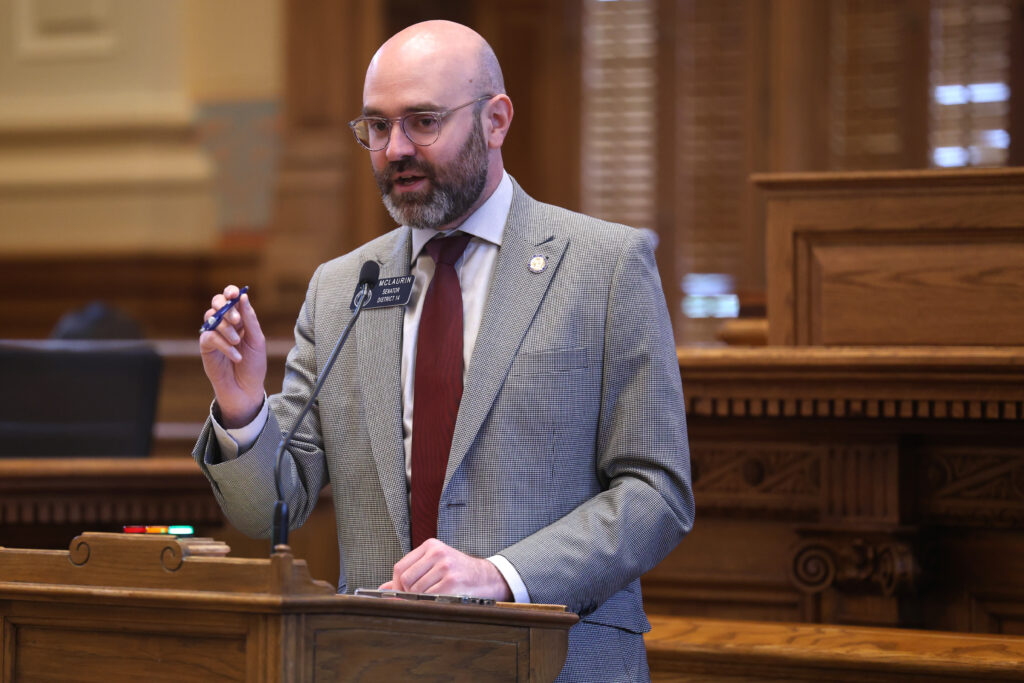
Sen. Josh McLaurin, D-Sandy Springs, on the Senate Floor during the final day of the 2026 Legislative Session, Sine Die, on Thursday, April 2, at the Georgia Capitol in Atlanta. McLaurin won election for lieutenant governor, according to the unofficial results of the Nov. 3 election. (Ashtin Barker/Capitol Beat)
The position came open after Lt. Gov. Burt Jones ran for governor. Jones lost his bid for the Republican nomination in a June runoff against businessman Rick Jackson, who in turn lost the general election to Democrat Keisha Lance Bottoms.
Democrats also flipped four Senate seats, leaving Republicans with the narrowest possible majority.
There are 56 members of the Senate, and passing legislation requires a majority of the full membership, or 29 votes. Republicans have no cushion after winning 29 seats to Democrats’ 27.
Republicans will not be able to pass bills without support from at least one Democrat whenever a Republican is not present.
In addition to losing the seats held by Dixon and Still, Republicans lost seats held by Sen. Ed Setzler, R-Acworth, and Sen. Brian Strickland, R-McDonough.
Setzler lost to Democrat Darcy Castro.
Strickland’s seat was open because he ran for attorney general instead of seeking reelection. He lost to Rep. Tanya Miller, D-Atlanta. Bret Dunn, the Republican who ran to succeed Strickland, lost to Democrat Eric W. Lee Sr.
ATLANTA — A previously missing election machine memory card in Seminole County has reversed the apparent outcome of a legislative race where early results showed a Republican incumbent losing his seat.
After election night, the state’s unofficial tally showed Rep. Gerald Greene, R-Cuthbert, trailing Democrat Harry James by fewer than 100 votes.
That changed on Friday, after the missing memory card was found and its contents uploaded.
Secretary of State Brad Raffensperger’s office said in a statement that Greene was now leading by 262 votes.
(On Friday night, the secretary of state’s website showed Greene with 10,193 votes to Democrat Harry James’ 9,932, a difference of 261 votes.)
Democrats appear to have flipped 13 other Republican seats. They appear to have lost two of their own but still appear on track to win 92 seats without Greene’s, enough for them to control the House for the first time in two decades. But the apparent reversal in Greene’s race means Democrats could have only a 1-vote cushion.
There are 180 seats in the House, and it takes a majority of them to pass legislation — a minimum of 91 votes.
Even if the reversal of Greene’s apparent loss does not affect control of the House, it affects who represents voters in the nine counties touched by Greene’s district in the southwest corner of the state.
“This oversight didn’t just affect the numbers — it changed who was leading an election,” Raffensperger said in a statement. “That is unacceptable, and we intend to find out exactly how it happened.”
The secretary of state’s office said the discrepancy was discovered when the count of the number of voters who checked in was compared against the number of votes, showing about 388 more voters than ballots. The discrepancy triggered a search for the missing memory card.
Another unresolved race could change the overall numbers.
Rep. Mike Cheokas, R-Americus, failed to win a majority in a three-way contest for his seat. With the independent eliminated, Cheokas must now face the second-highest vote-getter, Democrat Ethan Wolfe, in a runoff.
If Cheokas loses, Democrats could have a 2-vote cushion.