ATLANTA — Republican leaders rallied behind U.S. Rep. Mike Collins and his bid to unseat U.S. Sen. Jon Ossoff Friday, after a news report that the GOP was moving money to other states to support candidates thought to be more competitive.
“I wouldn’t be here if I didn’t think that we can win the state of Georgia,” U.S. Senate Majority Leader John Thune said.
Politico reported Wednesday that anonymous sources who had been briefed by the leader of the National Republican Senatorial Committee had said the top Republican super PAC was shifting its focus from Georgia.
But Thune, R-S.D., said there had been “significant investment” made to encourage voter turnout for Collins and that the fund had been the biggest spender to date on that effort.
Thune, speaking with Collins at the Cross Creek Cafe in Atlanta, also dismissed Democrats’ long-running attacks against Collins over his reported connections to white supremacists.
“In any campaign there are a lot of allegations, and a lot of them turn out to be unfounded,” Thune said, adding that Ossoff’s focus on the issue was a “desperate attack” to draw attention away from his own voting record.
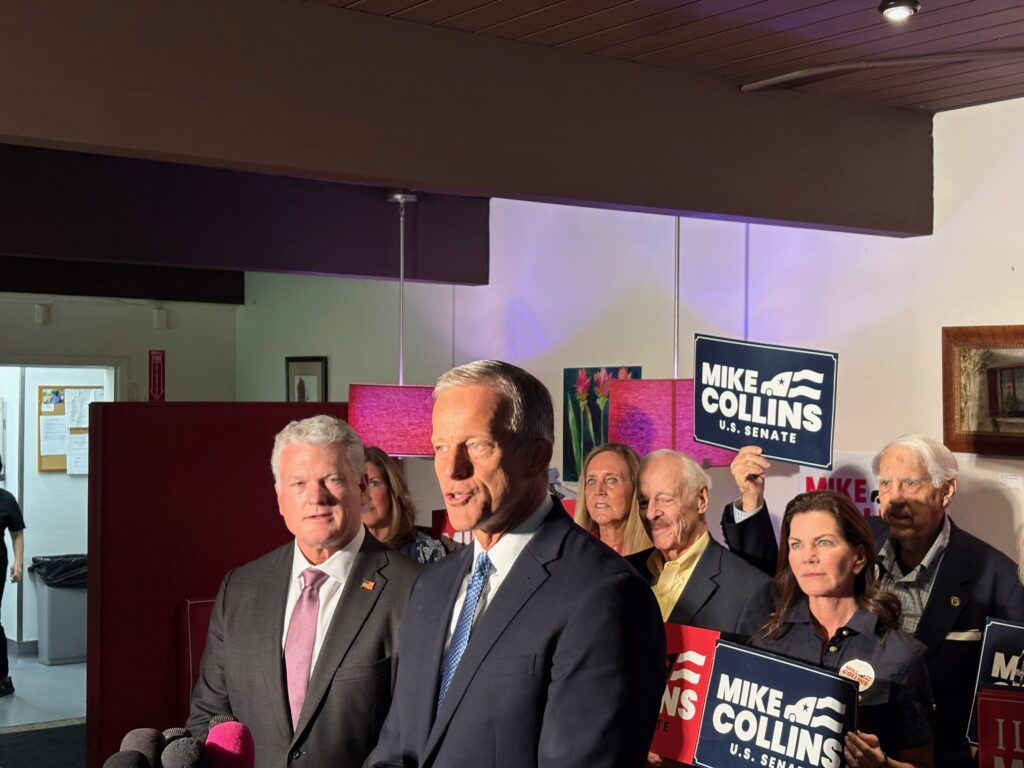
U.S. Rep. Mike Collins (left), Republican nominee for U.S. Senate in Georgia, speaks to reporters with Senate Majority Leader John Thune of South Dakota at the Cross Creek Cafe in Atlanta on Friday, Sept. 25, 2026.
News outlets have reported that a former Collins chief of staff tried to use his position to get a Holocaust denier released from prison, that a former Collins staffer posted a swastika and shared an image of himself in what appeared to be a Ku Klux Klan robe, and that Collins’ son-in-law, who lives on Collins’ property, has repeatedly made social media posts that promoted white nationalism and antisemitism, sometimes with Nazi imagery.
For weeks, Ossoff has been hammering Collins over those reports. Ossoff routinely brings them up in interviews, pivoting back to the issue when answering nearly every question.
In a virtual press briefing Thursday, Ossoff responded to a reporter’s query about whether Collins had a winning strategy by running with President Donald Trump rather than distancing himself from the president like some Republican candidates in other states.
Ossoff said Collins had voted to support Trump’s war in Iran, his tariffs, and policies that he said had made health insurance premiums unaffordable.
“He is Donald Trump’s puppet, and we will be sure to remind voters of that over the next 40 days,” Ossoff said, before pivoting back to his criticism of Collins’ associations: “In addition to being Donald Trump’s puppet, Congressman Mike Collins is a known bigot with extensive ties to white nationalism and neo-Nazi ideology.”
In early August, Collins addressed the issue by saying no one speaks for him, including his son-in-law, who Collins said had no role in his campaign. Collins also said he did not “believe or support those views” and that he condemned antisemitism and racism.
Before he and Thune talked with reporters Friday, they both attended a fundraiser for Collins Thursday.
Democrats welcomed Thune to Georgia by sending a vehicle with a billboard to roll around Hartsfield-Jackson Atlanta International Airport.
“Thune: Denounce Collins’ neo-Nazi ties,” the billboard said.
The war with Iran is one reason Republicans elsewhere have backed away from Trump. The related rise in fuel prices have been hitting voters in the pocketbook, particularly the rise in diesel prices. Farmers use diesel to run equipment, and trucks use it to deliver produce to market.
The price increases have been hitting agricultural areas that have been strongholds for Trump. Many Republican candidates reportedly see the increases as an election problem while many Democratic candidates, Ossoff included, see a political opportunity.
“We need to end this war. And it’s a war that Donald Trump and Mike Collins lied us into,” Ossoff said.
They were lying that Iran’s nuclear program posed an imminent threat, he said. “And now Georgians are paying the price.”
Collins said Friday that he backs Trump and the attacks on Iran.
“I support the administration’s efforts to make sure that Iran never has a nuclear weapon,” Collins said. “I’ve got seven grandkids. The last thing we need to do is hand them an Iran with a nuclear weapon.”
Collins pushed back against Ossoff, blaming rising costs on the senator’s support for the policies of former President Joe Biden.
State Republican Party Chairman Josh McKoon reinforced Thune’s message about ongoing support for Collins.
“I think there’s been a lot of loose talk — as there often is around this time of year — about reshuffling of funds and priorities,” McKoon said. “But it doesn’t get any better than having the Senate majority leader in your state, in this city, letting people know he’s 100% in support of Mike Collins.”
McKoon, talking outside the cafe where Collins and Thune had just spoken with reporters, said Republicans were committed to executing the same “battle plan” they used to put Trump back in the White House in 2024.
“We’ve got hundreds of thousands of voters that voted for Donald Trump in 2024 that have never voted in a midterm election,” McKoon said. “And at the Georgia Republican Party, we are laser-focused on getting those people off the couch and in the voting booth. If we turn those people out, we’re going to win these elections.”
ATLANTA — Pledging to fight for farmers, Republican Rick Jackson unveiled his plan to support Georgia’s agricultural industry as the sector gets squeezed by rising prices for diesel, fertilizer and other essentials.
“I want our farmers to know that as governor I will be in the fight to help them in any way I can,” the healthcare executive said at a small gathering of supporters and media at Cagle’s Farm in Canton, a tourist destination.
Democrat Keisha Lance Bottoms fired back, with her campaign saying that she had already met with farmers and unveiled her own plan. The former Atlanta mayor also pointed to Jackson’s alliance with President Donald Trump, noting that the rising prices for diesel and fertilizer that were hurting farmers had occurred during Trump’s watch.
“Slick Rick Jackson has proven he is too afraid to stand up to Trump and fight for Georgia’s farmers,” TaNisha Cameron, the Bottoms campaign spokesperson, said in a statement.
Jackson’s plan would preserve an agricultural tax exemption and suspend the state tax on diesel fuel during price spikes. It also would connect family farms with “cost-effective capital,” recruit fertilizer makers, oppose cheap imports from countries with weak regulatory requirements, and establish an emergency water reserve of 250 million gallons a day.
Jackson said he also would foster co-op meat and produce processing centers to bring down costs.
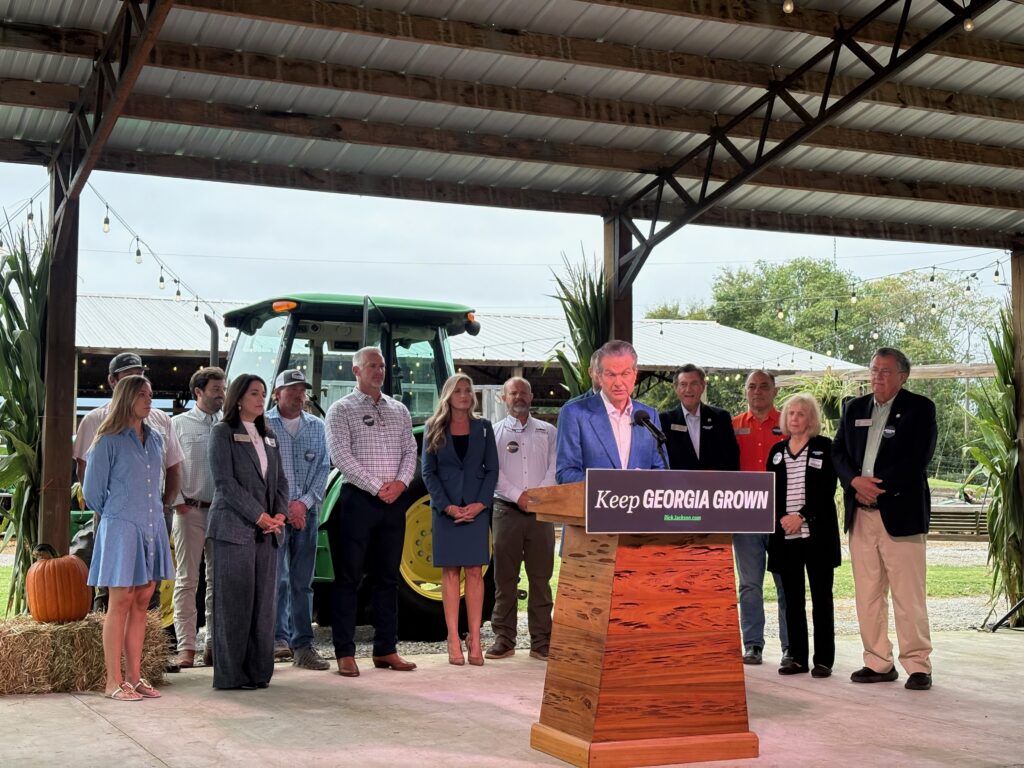
Rick Jackson, Republican nominee for Georgia governor, outlines his plans for agriculture at Cagle’s Farm in Canton on Thursday, Sept. 24, 2026. (Ty Tagami/Capitol Beat)
Bottoms and Jackson align on that idea. Her plan encourages cooperatives allowing farmers to pool resources while sharing equipment and processing capacity.
Like Jackson, Bottoms also would target taxes, in her case by supporting property tax relief for heirs. She also would push for more agricultural education — in schools and through free pathways to technical college. And she would help farmers fill out paperwork for federal programs.
Bottoms’ campaign said she would oppose Trump’s tariffs, yet she slammed Trump for announcing temporary relief from certain beef tariffs.
State Agriculture Commissioner Tyler Harper, a Republican, pushed back on that Trump policy last month, warning on social media that it could harm cattle producers.
“Increasing our reliance on imported food is not a long-term solution to Americans’ affordability concerns,” Harper posted. “We can lower costs for consumers while supporting the farmers and ranchers who produce our food here at home.”
Neither Bottoms nor Jackson offered many details about how they would execute their plans.
On restricting agricultural imports from countries with lax regulations, for instance, Jackson basically said to trust him.
“I don’t know all of the ways,” he said, “but if there’s any way to do it, I’ll get it done.”
Bottoms and Jackson will have a chance to attack the other’s platform at 8 p.m. on Oct. 6, during a town hall hosted by Atlanta News First.
So far, it is their only scheduled debate before early voting starts Oct. 13. Bottoms and nearly every other statewide candidate except Jackson have confirmed attendance at the Atlanta Press Club debates at Georgia Public Broadcasting on Oct. 12 and 13.
ATLANTA — It might not be a lucky number, but Georgia’s political leaders are celebrating the state’s ranking as the top location for corporate expansions for the 13th year in a row.
The designation was based on a survey of 50 corporate site selection consultants nationwide.
“Georgia’s 13th consecutive year as Area Development’s No. 1 Top State for Doing Business is an extraordinary achievement and reflects a level of consistency that few states have been able to match,” Dennis Shea, president and publisher of Area Development, said in a statement.
The quarterly magazine, founded in 1965, covers corporate site selection and relocation.
States were scored on more than a dozen factors. Georgia took the top spot in several, including access to workers with manufacturing skills, government cooperation and responsiveness, and help in expediting the development process.
“That consistency is exactly what has allowed Georgia to sustain its position as Area Development’s top state for doing business,” Shea said.
Gov. Brian Kemp said in a statement Wednesday that the ranking showed Georgia was core to “the American comeback story across a wide range of industries, including manufacturing.”
Fellow Republican, Lt. Gov. Burt Jones, credited tax cuts and efforts to develop the workforce. House Speaker Jon Burns, R-Newington, echoed those sentiments and noted the Legislature’s investments in early literacy.
This year, Kemp signed House Bill 1193 into law, giving schools $70 million a year to put about 1,300 literacy coaches into classrooms.
Kemp’s office credited $28 million in funding to help rural communities prepare industrial sites.
Earlier this week, Pirelli, a global tire producer based in Italy, announced a $1.2 billion expansion of its U.S. operations base in northwest Georgia, adding as many as 1,000 jobs at its Rome facility over seven years.
Last month, German industrial giant Siemens announced plans to create 1,400 jobs in northeast Georgia. Siemens Group USA already employs more than 1,700 people at two plants and six offices across Georgia. The company said it planned to invest $185 million to establish a half-million-square-foot facility near Pendergrass.
ATLANTA — New research from a Georgetown University policy organization reports that people in Georgia are struggling more than the nation as a whole to pay for food and healthcare.
The new Family Economic Well-Being Index, out Thursday, reports that more than a third of Georgians are burdened or severely burdened by food costs and nearly half are similarly struggling to pay for healthcare.
Their hardship is not captured by traditional poverty statistics, said Lelaine Bigelow, executive director of the Georgetown Center on Poverty and Inequality.
“While families in poverty face the greatest difficulty affording the basics, this struggle reaches well into the middle class,” Bigelow said in a statement. “Millions of people are working hard and still can’t get ahead of these costs.”
The center, based at the Georgetown University Law Center, used the federal government’s 2023 American Community Survey and other data to classify people in four categories based on their ability to cover four essential needs: childcare, food, healthcare and housing.
Those who were best off were categorized as meeting needs or getting by. Those who were struggling were sorted into burdened or severely burdened.
Georgia was on par with the U.S. as a whole for housing, with about a third either burdened or severely burdened.
But 36% of Georgians struggled with food costs versus 32% nationwide. With healthcare, 48% of Georgians were burdened or severely burdened, compared to 41% nationally.
One bright spot, sort of: the cost of childcare for children under 6.
The percentage of Georgia households that were burdened or severely burdened paying for it was 8 percentage points below the national percentage. But it was still more than half of Georgia parents, at 53%.
The numbers underscore the salience of affordability as an issue with just weeks to go before the Nov. 3 election.
“Affordability is the defining economic issue of the moment,” Bigelow said.
ATLANTA — After federal prosecutors charged three noncitizens with voting illegally in Georgia, the man who oversees voting in the state pointed to an audit he ordered four years ago.
Last week, the U.S. attorney’s office in Atlanta announced that three people from other countries had been charged with voting in federal elections in recent years despite not being U.S. citizens.
The cases were investigated by two federal agencies, with “valuable” assistance from the Office of the Georgia Secretary of State.
This week, Secretary of State Brad Raffensperger pointed to that credit, explaining that in 2022 he had ordered an audit that found 1,634 people had tried to register to vote in Georgia though their citizenship could not be verified through the federal Systematic Alien Verification for Entitlements program.
“These cases show exactly why citizenship verification matters,” Raffensperger said in a statement.
Pauline Lewis, 65, of Dawsonville, allegedly a citizen of Antigua and Barbuda who entered the United States on a student visa in 1979, voted by absentee ballot in 2020, 2021 and 2024, the office of U.S. Attorney Theodore S. Hertzberg said in a statement.
Gabriel Covarrubias, 44, of Lawrenceville, allegedly used a false name to vote in the 2024 general election, Hertzberg’s office said. Covarrubias is allegedly a citizen of Mexico who claimed he was from Puerto Rico.
And Analiea Milliscent Eccles, 43, of Morrow, allegedly voted nine times between 2008 and 2024 despite being a citizen of Venezuela, Hertzberg’s office said, adding that she allegedly entered the United States on a temporary visitor visa in 1991 and remained in the country, applying for and receiving Deferred Action for Childhood Arrivals status in 2013.
“Voting in federal elections is a sacred right reserved to U.S. citizens, and every vote illegally cast by an alien cancels out a legal vote,” Hertzberg said in a statement. “Maintaining the integrity of our elections and protecting the voting rights of citizens are among the highest priorities of my office.”
The penalty for voting as a noncitizen is a fine, up to a year in prison or both. The penalty for making a false claim of citizenship to register to vote includes imprisonment for up to five years.
The penalties are rarely applied because relatively few are caught committing the crime.
In late 2024, Raffensperger announced the results of an audit that found 20 noncitizens had illegally registered to vote, with nine of them actually casting ballots.
That year, nearly 5.3 million Georgians cast a ballot in the general election.
The Bipartisan Policy Center in Washington, D.C. has noted that 0.04% of voter verification cases had found noncitizens.
Now, as Georgians prepare to head to the polls for the general election, more than 8.2 million are registered to vote.