ATLANTA — Things were looking grim for Georgia’s wild pigs during this year’s legislative session, but they found partial salvation in lawmakers who larded their own budget with too much pork.
Gov. Brian Kemp, in his effort to balance the budget, cut hundreds of millions of dollars in new spending when he signed it earlier this month.
He highlighted some of the major cuts at that time but did not mention the pig eradication projects nestled deep within the 171-page document.
A $1 million public-private pilot program to manage feral hogs was a victim of his line-item veto, as was a $200,000 wild pig eradication program.
The latter sounded like a bounty program to Nick Atwood, an Atlanta volunteer with a loose-knit group called Rooting for Pigs.
Studies have shown bounty programs are ineffective at wildlife control, whether for prairie dogs, raccoons or feral hogs, Atwood said. His group sent Kemp a letter in mid-April explaining all this and suggesting that cutting the programs could save taxpayers some money.
Atwood does not know whether the message led to Kemp’s line-item vetoes, but he thinks it might have.
Asked about this, Kemp’s office did not want to engage in the specifics, referring instead to Kemp’s comments on May 12 when reporters gathered in his office to watch him sign the budget.
The governor said then that he had to fix a “structural deficit” that had left a roughly $1 billion hole in the budget. He said he could have left it alone but that he did not want to leave “a mess” for whoever succeeds him as governor next year, or for the next Legislature.
“So what we’re doing now is making some tough choices,” he said.
The eradication programs had been something of a priority for lawmakers, especially in the House.
Owing to limited time (and attention spans), Rep. Matt Hatchett, R-Dublin, could only detail a small number of items in the $38.5 billion fiscal year 2027 budget when he presented it on the House floor on March 10.
Hatchett, who chairs the House Appropriations Committee, talked about money for big issues, such as education, health care, prisons and poverty.
But he left time to talk about wild pigs, and the money in the budget to get rid of them.
“Feral hogs are wreaking havoc statewide,” he said, “causing millions of dollars of damage to crops and farms each year.”
The next week, the Senate sent House Bill 946 to Kemp, a measure that authorizes the use of drones to locate feral pigs while hunting them and allows their capture without a hunting or trapping license if they are killed on site.
ATLANTA — Georgia Power customers will see a slight reduction in power bills after the state agency that regulates the monopoly utility approved rate changes Thursday.
The Public Service Commission, an elected body with five members, had previously frozen the company’s electricity rates for three years. But that decision in early 2025 did not apply to rate adjustments to cover the changing cost of fuel and storm damage.
Rather than raising rates, the agreement Georgia Power made with the commission will cut typical residential customer bills by about $4 a month, or about $285 million collectively per year.
“After recent rate increases caused by inflation, the war in Ukraine and other global phenomenon, it’s great to be able to offer some relief to Georgia Power ratepayers,” Chairman Jason Shaw said in a written statement after the vote approving the changes.
Georgia Power is reducing the rates in part by using federal tax credits for nuclear power production.
Although the vote for approval was unanimous, two new Democrats on the panel voted unsuccessfully to amend the rate agreements, with the three Republicans opposed.
Commissioner Peter Hubbard, one of the Democrats, said his four amendments would have saved ratepayers another $50 million.
“Instead, the majority put the company first,” he said in a statement.
Hubbard said he voted for the unamended agreements to lock in “as much relief as possible” ahead of summer, with the revised rates taking effect in June.
During the hearing, critics said Georgia Power was still getting a deal because the company secured authority to purchase more coal than usual at above-market prices.
Under Georgia law, the company can pass along fuel prices to customers if they are “just and reasonable.”
Commission staff said during the hearing that Georgia Power had historically purchased about a tenth of its coal at above-market rates. The deal approved Thursday allowed it to purchase up to 15% at higher prices.
Environmentalists had wanted the limit set at 5% but acknowledged the commission staff had negotiated a better deal for ratepayers than Georgia Power had first offered.
The company’s initial rate proposal earlier this year would have saved customers only about $1.30 a month.
Georgia Power will make another fuel rate adjustment request in less than three years, in February 2029.
The storm damage portion of the costs being passed to consumers was mostly from Hurricane Helene. Georgia Power has said the historic hurricane caused $800 million in damage to about 12,000 power poles, 1,500 miles of power lines and more than 5,000 transformers.
The Republican-led commission has become a target for angry voters after allowing Georgia Power to make a half dozen rate increases in recent years. The commission also approved a 10 gigawatt expansion in December, largely to serve anticipated demand from data centers.
In a special election last year, Hubbard unseated Republican Fitz Johnson. Johnson is back on the ballot and will try to retake the seat from Hubbard in the November general election.
Likewise, Democrat Alicia Johnson unseated a Republican last year, winning a spot on the commission through 2030. Another seat is in play after Republican Tricia Pridemore opted not to run for reelection, creating the possibility of Democratic control next year.
ATLANTA — Voters recovering from the long list of candidates that greeted them on their primary election ballots last week will have to return to the polls soon for runoff elections.
The Atlanta Press Club will help voters make informed choices with a final round of livestreamed debates Sunday and Monday.
It is the latest installment in a two-decade tradition that “provides the most comprehensive, timely and widely viewed series of political debates during every election year in Georgia,” according to the press club, which has been hosting the forums with Georgia Public Broadcasting.
Their forums in late April featured crowded fields, with each candidate receiving minimal airtime. Now, with some primary races decided and others whittled to two candidates from each party, each office seeker who accepts an invitation to debate will get more time.
Sunday’s schedule features the remaining two Republicans vying for U.S. Senate and hoping to contest incumbent Democratic Sen. Jon Ossoff in the November general election, along with the two Republican candidates for Public Service Commission District 5 to succeed Tricia Pridemore, a Republican who did not seek reelection.
Also on Sunday, the press club will host forums for the two surviving candidates from each party running for lieutenant governor and secretary of state.
Monday’s schedule features the governor’s race. Lt. Gov. Burt Jones and billionaire Rick Jackson were the top vote-getters in last week’s GOP gubernatorial primary.
The winner of their June 16 runoff will run against former Atlanta Mayor Keisha Lance Bottoms, a Democrat. She won her primary outright last week.
Also on Monday are two Republicans for state school superintendent, one of them incumbent Richard Woods, and the final two GOP candidates for the 11th Congressional District in north metro Atlanta, where incumbent Rep. Barry Loudermilk, a Republican, is retiring.
On the Democratic side Monday are debates for candidates seeking their party’s nominations for labor commissioner and insurance commissioner; the winners will face the Republican incumbents in November. Also on the schedule is a debate for the remaining two Democratic candidates for the 1st Congressional District, a coastal post held by Rep. Buddy Carter, a Republican who lost his bid for U.S. Senate last week.
The forum lineup also includes the Fulton County Commission chair race, in which Democratic incumbent Robb Pitts was invited to debate his remaining Democratic challenger, Mo Ivory.
No runoff was required for attorney general, agriculture commissioner, Public Service Commission District 3 or for the congressional races in the 10th, 13th and 14th districts.
ATLANTA — The policies that Georgia uses to approve or deny services for children enrolled in Medicaid fail to satisfy federal requirements for adequate care, according to a new federal court ruling.
A three-judge panel of the U.S. Court of Appeals for the Eleventh Circuit upheld a federal district judge’s order requiring the Georgia Department of Community Health (DCH) to provide nearly five times more in-home nursing care to a child at risk of dying than the state had approved through a contractor.
The 3-year-old boy, referred to by the court as L.W., has a rare metabolic disease that interrupts his body’s ability to store and use glycogen, a kind of fuel.
He must be fed every three hours through a tube inserted into his stomach.
Before moving to Georgia from Virginia, Medicaid was paying for 56 hours of nursing care per week while paying the boy’s mother to provide another 40 hours.
After moving to Georgia in 2023, Alliant Health Solutions, a contractor that manages Medicaid for the state, approved only 21 hours of nursing services with no supplement for the mother, since Georgia lacks such a program.
“Over the months that L.W.’s parents and physician were asking Georgia to increase L.W.’s nursing hours, L.W.’s parents managed to keep L.W. alive,” the judges wrote in their May 18 opinion. “But their success came at a tremendous cost to L.W.’s parents and L.W.’s health.”
The boy’s fatigued mother often slept through the alarms she set to wake herself up so she could feed him in the middle of the night. Several times she awoke to find his glucose readings dangerously low. Once, when his parents could not maintain his glucose levels, L.W. had to be hospitalized for about a week.
In 2024, his mother requested a change in the number of nursing hours. When Alliant denied it, she sued in federal court in the Northern District of Georgia. Federal Judge Thomas W. Thrash Jr. decided 21 hours of weekly nursing care was inadequate and ordered the state to pay for at least 100 hours.
DCH appealed. The agency’s failure to win that appeal produced a ruling that could influence how Medicaid is administered in Georgia and in the rest of the Eleventh Circuit’s jurisdiction, which includes Alabama and Florida.
“This is telling DCH, ‘your responsibility is to ensure that care gets provided’,” said Roland Behm, co-founder of the Georgia Mental Health Policy Partnership.
“As long as it’s medically necessary and it can go to correct or ameliorate, then you have to say yes to that because that’s the obligation that you took on as the state Medicaid agency and that you contracted with these other entities to do,” he said.
Under the federal Early and Periodic Screening, Diagnostic and Treatment standard, states must cover medically necessary services for children that “correct or ameliorate” a physical or mental condition.
A spokeswoman for DCH said Tuesday that the agency was still reviewing the court decision and had no comment.
The agency’s lawyers had contended in court that the decision to limit L.W.’s nursing hours was legal because it followed agency policy. But the three-judge panel ruled that the policy had failed L.W. and his parents and that the state had an obligation to review the facts of each case to provide the minimum level of care required under the federal Medicaid Act.
One of the Eleventh Circuit judges wrote a concurring opinion that criticized DCH’s policy as “poorly drafted and hard to make sense of.” The policy was written with a “repetitive structure and odd phrasing,” Judge Britt C. Grant wrote.
Her critique also noted that DCH had not included the relevant policy in the court record and that she could not find it in the agency’s manual.
“Given these discrepancies,” she wrote, “I am unsure about what the Department’s real policy is. Nor do I have any idea what policy, if any, was applied to L.W.’s change request.”
ATLANTA — Scott Sells traveled to Macon last week to watch his son’s friends graduate from Mercer University.
That same day, on May 11, Gov. Brian Kemp signed a bill into law that Sells had testified for during this year’s legislative session. Senate Bill 399, the “Mason Sells AED Coordination Act,” will require everyone with an automated external defibrillator to notify 911 of its location.
Sells said an AED would have saved his son’s life.
Mason Sells was 20 when his heart stopped beating during an intramural soccer match at Mercer, where he was studying accounting.
Both Sells loved the game. They had played together more than a year on an indoor team when Mason was in high school.
The last game of his life ended with a soccer ball kicked to his chest.
His father said he later learned that Mercer had an AED near the field but that it was in a locked office and no one on the field knew about it or had the key.
A spokeswoman for Mercer declined to comment.
The Telegraph in Macon reported soon after Sells’ death that a university spokesman said there were more than 40 AEDs on campus but that no AED was used on Mason Sells until emergency responders arrived.
The newspaper said both the spokesman and the local coroner said cardiopulmonary resuscitation (CPR) was administered quickly after Sells collapsed.
Mason Sells scoring a goal at age 2. (Contributed by Scott Sells)
Sells’ death came after two other Macon college students died of sudden cardiac arrest.
Less than a year and a half before, Baba Agbaje collapsed on a Mercer field during a soccer pickup game and was later pronounced dead.
And just two days before Sells died, Wesleyan College student Nefertari Holston died after suffering cardiac arrest while running in a cross country meet at Middle Georgia State University in Macon.
Sudden cardiac death is rare, but the rates are highest among athletes during competition, particularly males, according to the American Heart Association.
In a 2023 report, the organization said survival rates had been rising, possibly due to better health screening or “thanks to more widespread education on the importance of CPR training, AED availability and emergency action plans.”
After his son’s death, Scott Sells connected with Georgia lawmakers at the Capitol last year. He said Sen. Marty Harbin, R-Tyrone, listened to his story. Sells did not think anything would come of it until he said Harbin called him in February to tell him he had introduced SB 399. He asked Sells to testify for his bill.
In addition to the 911 notification requirement, the new law will require all 911 operators to receive training by the end of next year in how to coach callers through CPR and AED use.
A 2024 state law required all K-12 schools to acquire at least one AED and to have at least one person on hand who is responsible for maintaining the device and locating and retrieving it in an emergency.
Many college campuses voluntarily acquire AEDs but there is no similar state law applying to them. Sells said he wants to change that.
Sells, 51, manages properties with his wife and said that on a recent weekend they trained 100 members of a homeowners association how to use an AED. Sells said they also acquired AEDs for a half-dozen homeowners associations they manage.
Sells said he also paid about $1,400 for an AED that he carries in his vehicle. He said he advises parents to make sure an AED is available on any field where their kids compete.
Sells said he had been watching the parents of his son’s friends post their graduation pictures on social media.
Mason had a younger sister, now a rising junior at Auburn University, and Sells said watching her grow up and reach landmarks in life will be bittersweet.
“Our daughter, pray that she outlives us, she goes and gets married,” he said. “There’s going to be an empty chair.”
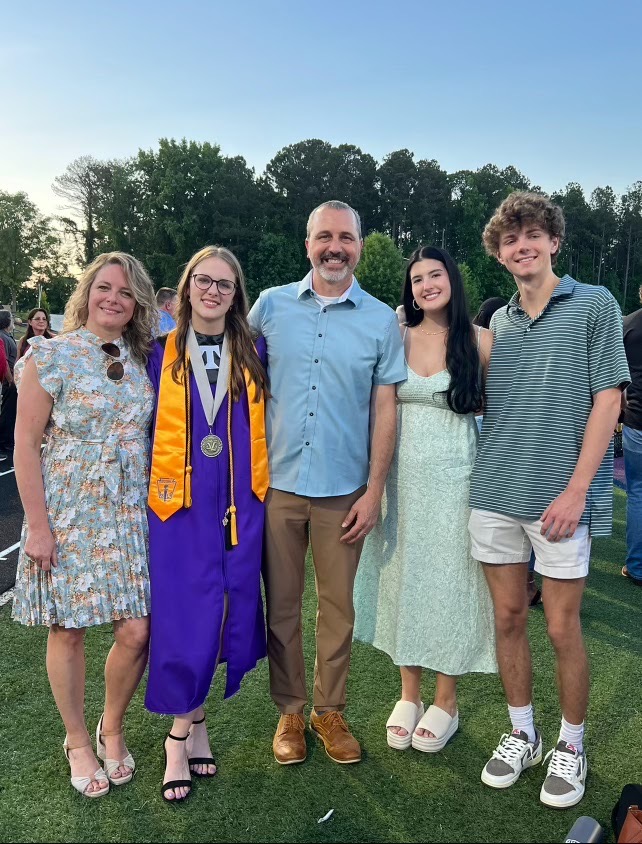
Mason Sells (right) with his girlfriend, Laura Grace Groover, his father Scott and his mother Rachel (left) at his sister Abigail’s (second from left) high school graduation in May 2024. It was four months before Mason Sells would die on a soccer field at Mercer University in Macon. (Contributed by Scott Sells)