ATLANTA — Scott Sells traveled to Macon last week to watch his son’s friends graduate from Mercer University.
That same day, on May 11, Gov. Brian Kemp signed a bill into law that Sells had testified for during this year’s legislative session. Senate Bill 399, the “Mason Sells AED Coordination Act,” will require everyone with an automated external defibrillator to notify 911 of its location.
Sells said an AED would have saved his son’s life.
Mason Sells was 20 when his heart stopped beating during an intramural soccer match at Mercer, where he was studying accounting.
Both Sells loved the game. They had played together more than a year on an indoor team when Mason was in high school.
The last game of his life ended with a soccer ball kicked to his chest.
His father said he later learned that Mercer had an AED near the field but that it was in a locked office and no one on the field knew about it or had the key.
A spokeswoman for Mercer declined to comment.
The Telegraph in Macon reported soon after Sells’ death that a university spokesman said there were more than 40 AEDs on campus but that no AED was used on Mason Sells until emergency responders arrived.
The newspaper said both the spokesman and the local coroner said cardiopulmonary resuscitation (CPR) was administered quickly after Sells collapsed.

Sells’ death came after two other Macon college students died of sudden cardiac arrest.
Less than a year and a half before, Baba Agbaje collapsed on a Mercer field during a soccer pickup game and was later pronounced dead.
And just two days before Sells died, Wesleyan College student Nefertari Holston died after suffering cardiac arrest while running in a cross country meet at Middle Georgia State University in Macon.
Sudden cardiac death is rare, but the rates are highest among athletes during competition, particularly males, according to the American Heart Association.
In a 2023 report, the organization said survival rates had been rising, possibly due to better health screening or “thanks to more widespread education on the importance of CPR training, AED availability and emergency action plans.”
After his son’s death, Scott Sells connected with Georgia lawmakers at the Capitol last year. He said Sen. Marty Harbin, R-Tyrone, listened to his story. Sells did not think anything would come of it until he said Harbin called him in February to tell him he had introduced SB 399. He asked Sells to testify for his bill.
In addition to the 911 notification requirement, the new law will require all 911 operators to receive training by the end of next year in how to coach callers through CPR and AED use.
A 2024 state law required all K-12 schools to acquire at least one AED and to have at least one person on hand who is responsible for maintaining the device and locating and retrieving it in an emergency.
Many college campuses voluntarily acquire AEDs but there is no similar state law applying to them. Sells said he wants to change that.
Sells, 51, manages properties with his wife and said that on a recent weekend they trained 100 members of a homeowners association how to use an AED. Sells said they also acquired AEDs for a half-dozen homeowners associations they manage.
Sells said he also paid about $1,400 for an AED that he carries in his vehicle. He said he advises parents to make sure an AED is available on any field where their kids compete.
Sells said he had been watching the parents of his son’s friends post their graduation pictures on social media.
Mason had a younger sister, now a rising junior at Auburn University, and Sells said watching her grow up and reach landmarks in life will be bittersweet.
“Our daughter, pray that she outlives us, she goes and gets married,” he said. “There’s going to be an empty chair.”
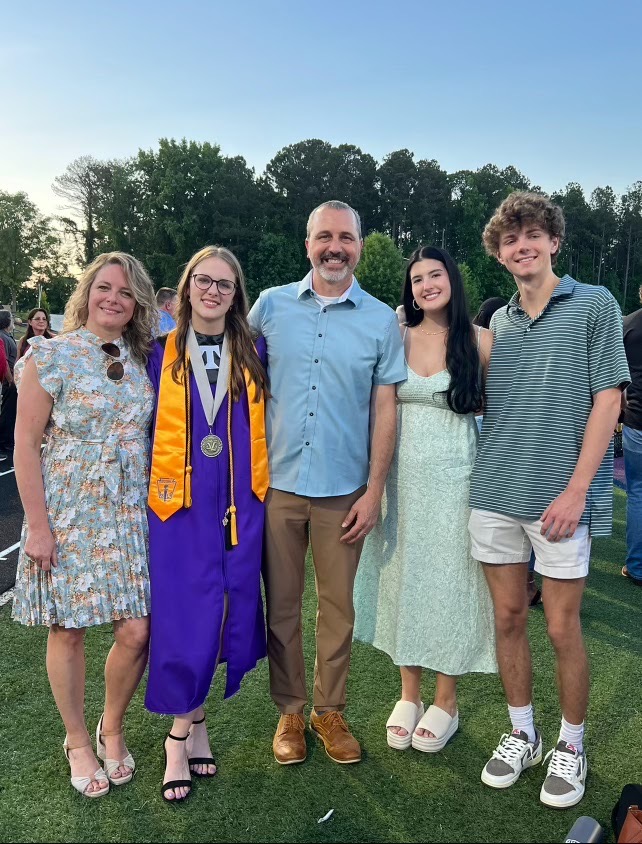
in Macon. (Contributed by Scott Sells)