ATLANTA — One Georgia college will get a new president while another loses him, as Gordon State College President Donald J. Green moves to Valdosta State University.
Green will become president of Valdosta State effective Aug. 1, the University System of Georgia announced Friday, succeeding interim President William R. “Bill” Crowe.
Crowe has led Valdosta State since the start of the year after former President Richard Carvajal resigned to take the presidency of California State Polytechnic University, Humboldt.
Green, who earned a Doctor of Educational Leadership degree from Western Michigan University, was named Gordon State’s fifth president in November 2023. There, he implemented a three-year plan to reduce the time it was taking students to graduate and to better align courses with employer demand.
The college in Barnesville surpassed many of the plan’s goals a year ahead of schedule, according to the university system.
Green said in a statement that he looks forward to aligning Valdosta State’s courses with industry needs, too.
“I’m eager to get to campus, build strong partnerships with the community and local industries and create new workforce pathways that will help both Blazer Nation and the entire region grow,” he said.
Valdosta State was founded in 1906 as a women’s college but is now coeducational, with more than 10,000 undergraduate and graduate students from nearly every county in Georgia, all 50 states, the District of Columbia and over 60 countries.
ATLANTA — More Democrats than Republicans turned out to vote in Tuesday’s primary election, flipping the outcome in the midterm primary election of four years ago when the GOP dominated.
The strong showing could be a singular incident, or a trend that endures to the November general election and the head-to-head contests between the two parties.
Democratic turnout in this year’s governor’s race was up by half from the 2022 primary, while Republican turnout fell by a quarter.
Granted, four years ago, Stacey Abrams had no Democratic challengers for governor, so her supporters had one less reason to turn out, perhaps suppressing Democratic numbers.
But this year U.S. Sen. Jon Ossoff had no Democratic challengers, yet turnout for him increased by more than 40% compared to the Senate race in 2022 when fellow Democrat, U.S. Sen. Raphael Warnock, had a challenger. GOP turnout fell by nearly a quarter this year in that race, too.
Voters line up outside Ormewood Church in Atlanta to cast ballots in Georgia’s primary election on Tuesday, May 19, 2026. (Ashtin Barker/Capitol Beat)
The proportions were similar across the board in statewide races, no matter how far down the ballot one looked. In the contest for attorney general, Democratic turnout was up by more than 350,000 while Republican turnout fell by more than 280,000.
“It’s not a good sign for Republicans,” said Andra Gillespie, a political scientist at Emory University.
The outcome in Georgia tracked national sentiment, she said.
Costs are rising. The country is in a conflict with Iran. President Donald Trump’s poll numbers are sagging.
However, she said, polling shows the state still has more Republican than Democratic voters.
“So Democrats still have to work hard, and harder, to be able to win even under favorable national conditions,” she said.
On Tuesday evening, Trey Conley, 37, exited the Dianne Wright Innovation Center in Hiram and rejoined his 15-year-old daughter, Mattison, who had been waiting for him to vote.
Conley said he selected Jason Esteves among the seven Democrats running for governor. He picked Sen. Josh McLaurin, D-Sandy Springs, for lieutenant governor.
The outcome at that polling place skewed 2-to-1 for President Donald Trump two years ago, and Conley said most of his family votes Republican.
But he said he and his wife share many of the same ideals and voted the same way: for Democrats.
“We’re trying to flip the state one person at a time,” he said.
The next day, Democrats were celebrating. Their party had drawn 1.1 million voters to the polls, about 53% of all votes cast. Republicans, by comparison, had drawn about 940,000, or just over 45%.
“Georgians overwhelmingly voted for Democrats Tuesday night, sending Republicans, billionaires, special interests, and massive corporations a clear message: Georgians won’t let you push them around anymore,” the state Senate Democrats said in a statement.
Although the turnout on Tuesday favored Democrats, it was only a primary election, a time when more committed voters typically show up at the polls. Although nearly 2.1 million made the trip, that is just 28.1% of active voters.
Meanwhile, the GOP saw an upside in the decisive victory by former Atlanta Mayor Keisha Lance Bottoms near the top of the ticket. She won 56% of the vote in the Democratic contest for governor, a strong showing that propelled her to the general election as the party nominee.
“Keisha Lance Bottoms is a defund-the-police lunatic who did her best to destroy Atlanta, then took that same failed agenda to the Biden-Harris White House,” a regional spokeswoman for the Republican National Committee said in a statement on Wednesday. “Georgians don’t want another far-left politician who puts criminals, illegals, and the radical left first, and they’ll reject her in November.”
Republicans think Bottoms’ name atop the ticket may cause some Democrats to stay home in November.
On Tuesday afternoon, Chris Heller went to his polling place in Atlanta’s Ormewood Park neighborhood, which skews Democratic. Like Conley would do later in the day in Hiram, Heller voted for Esteves for governor.
Heller, who had his 6-year-old daughter, Lucy, with him, said he liked Esteves’ “progressive mindset.”
Heller’s outlook could pose a challenge for the Democratic Party as it tries to draw voters back to the polls in November.
Heller does not identify as a Democrat. He called the party “pathetic,” although he added that he could not remember ever voting for a Republican. And he said part of his vote for Esteves was grounded in the reality of voter turnout in November.
“I’m not convinced that Keisha Lance Bottoms is going to be able to pull enough votes to get us back into the blue,” he said.
ATLANTA — Several Georgia lawmakers saw their careers end Tuesday night while others got a chance to climb the ladder to higher office after all the unofficial votes were tallied in the primary election.
Some secured a majority of the vote in their respective races and can look ahead to the general election in November.
Others, including political newcomers, met with some success but not enough to avoid the runoff election on June 16.
Some voters may feel fatigued by the repeat trips to the polls, but Valaria Kee saw it as an opportunity to do more homework and pick the right candidates.
She preferred former football coach Derek Dooley as the Republican nominee to take on Democratic incumbent Jon Ossoff for his U.S. Senate seat. But Dooley captured only about 30% of the Republican vote and must face off against U.S. Rep. Mike Collins, who got nearly 41%.
It takes winning a majority of ballots cast to avoid a runoff, which did not happen often in Tuesday’s crowded fields.
Kee wanted Secretary of State Brad Raffensperger for governor, but he was eliminated as Lt. Gov. Burt Jones and billionaire Rick Jackson advanced to the runoff in their GOP primary with about 38% and 33% of the vote respectively.
Kee moved to Paulding County from California, a state that does not hold runoff elections. So Georgia’s peculiar routine has been a learning experience for her.
“I’m not upset at all,” she said of the extra legwork required. “That gives me a second chance to do my research on the people I did choose, and on the people I didn’t.”
Dooley must fight to keep her vote in June while Jones and Jackson scramble to secure it.
Keisha Lance Bottoms, who won the Democratic primary outright with 56% in a field of seven, likely has no chance with Kee.
But nearly 150,000 more Democrats than Republicans cast a ballot for governor on Tuesday.
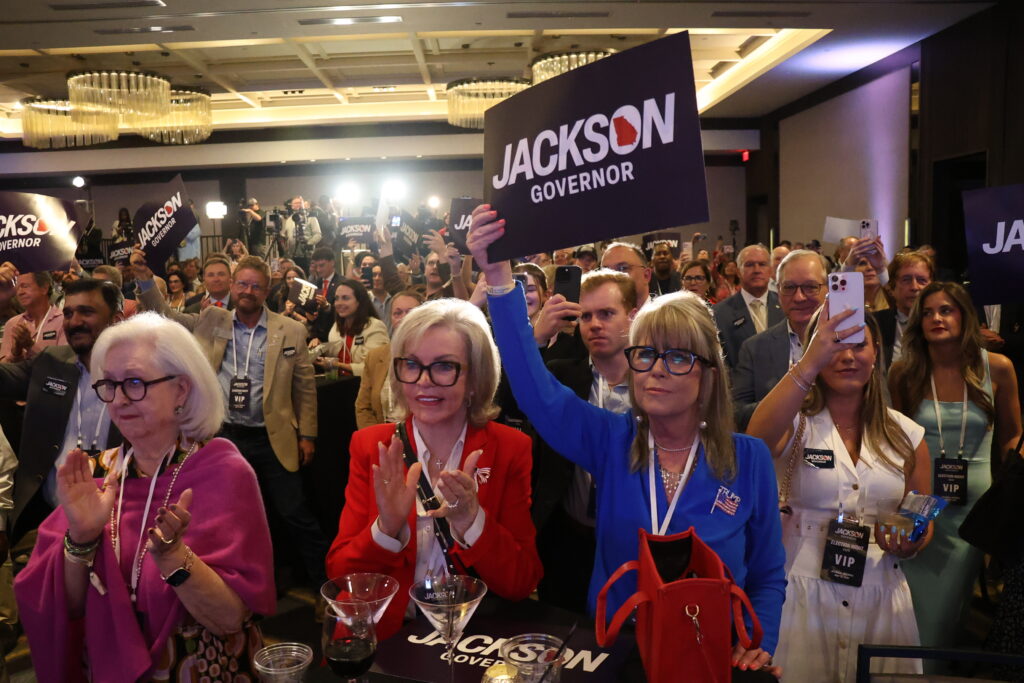
Supporters of Georgia Republican gubernatorial candidate Rick Jackson gather at the Omni Hotel at The Battery Atlanta for his primary election campaign celebration on Tuesday, May 19, 2026. (Ashtin Barker/Capitol Beat)
Some races felt like the movie Groundhog Day, as familiar names reappeared on ballots.
U.S. Rep. Clay Fuller, a Republican former district attorney, had just won a special election last month to succeed Republican Marjorie Taylor Greene in Congress. He had to beat back many of the same contestants again in this primary for a full two-year term, leading a field of eight with 81% of the vote.
But in November, Fuller will again have to fight Democrat Shawn Harris, after sparring with him in the special election. Harris ran uncontested Tuesday.
Likewise, the Public Service Commission, a statewide office, will feature two familiar names in November, after Republican Fitz Johnson squeaked an outright victory for the District 3 nomination with 50.2% of the vote. In November, he will go up against recently seated Democrat Peter Hubbard, who had no challengers.
The tables were turned last November, when Johnson was the incumbent and Hubbard unseated him in a special election.
In PSC District 5, Shelia Edwards won the Democratic nomination. But engineer Josh Tolbert and Bobby Mehan, a partner at a private equity firm, must face each other in the GOP runoff on June 16 before one of them can battle her in November.
There were more than half a dozen other statewide races down the ballot, with so many candidates that several voters interviewed Tuesday could not remember whom they had selected.
“Most of them I didn’t know,” said Josh Harris after voting at J.A. Dobbins Middle School in Powder Springs. He said he scanned his ballot for familiar names. “I don’t follow politics that much,” he said. “I just try to put my little two cents in there for a Democrat.”
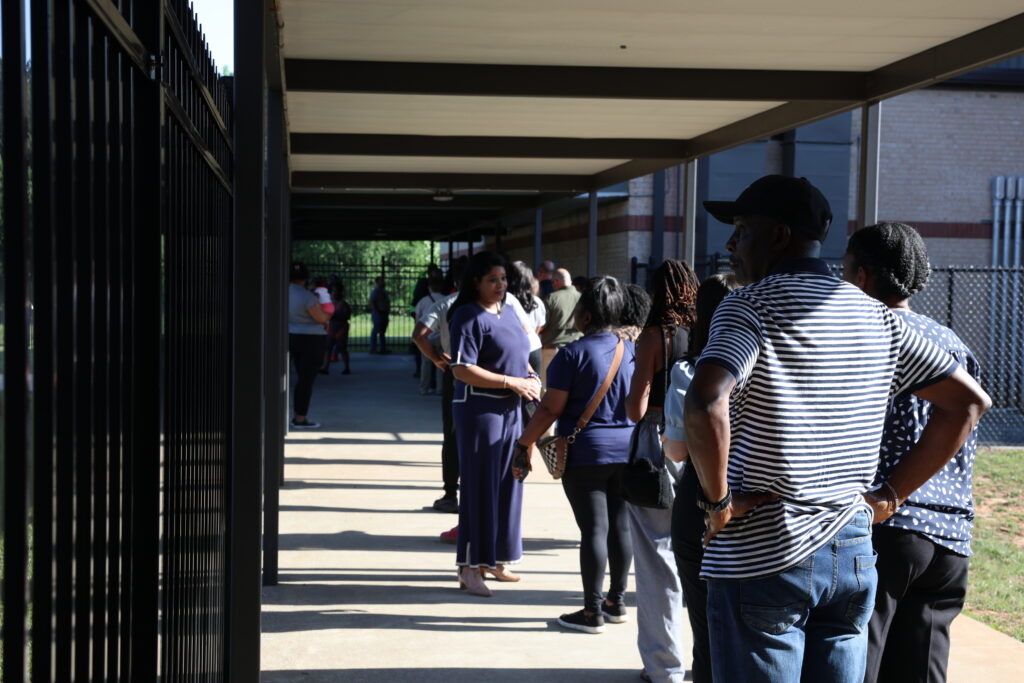
The line outside J.A. Dobbins Middle School in Powder Springs as voters await their turn to cast a ballot in the Georgia primary election on Tuesday, May 19, 2026. (Ashtin Barker/Capitol Beat)
In the race to succeed Jones in the lieutenant governor’s office, former state Sen. John F. Kennedy, R-Macon, who resigned in December to focus on his campaign, will contest the runoff against Sen. Greg Dolezal, R-Cumming. Each got about a quarter of the Republican vote.
Sen. Josh McLaurin, D-Sandy Springs, will continue sparring with former state Sen. Nabilah Parkes, D-Duluth, in round two of their contest after each taking about 40% of the vote and knocking a third contender out of their race for lieutenant governor.
In the election to succeed Raffensperger for secretary of state, Rep. Tim Fleming, R-Covington, will go to the runoff against Vernon Jones, who was a Democrat when he was CEO of DeKalb County but switched to the Republican Party. Fleming captured 39% of the GOP vote while Jones won 27%.
Voters will get a break in the attorney general’s race. There were only two candidates for each major party, and the outcomes were decisive.
Sen. Brian Strickland, R-McDonough, bested Sen. Bill Cowsert, R-Athens, for the GOP nomination, with nearly 72% of the vote. And Rep. Tanya Miller, D-Atlanta, walked away with 85% of the vote in her contest against former state lawmaker Bob Trammell.
Strickland and Miller can now focus on their general election in November.
The same goes for the candidates for state agriculture commissioner, after Democrat Katherine E. Juhan-Arnold defeated a contender and will meet the unchallenged GOP incumbent Tyler Harper in November.
But voters still have more work to do in three other statewide races.
In the insurance commissioner’s race, it will be Democrats who must choose their contender, as former Atlanta City Councilwoman Keisha Sean Waites faces off against DeAndre Mathis in the runoff. Incumbent John King, a Republican, had no challengers.
But in the state school superintendent’s race, it is Republicans who must study up after three-term incumbent Richard Woods missed an outright win by a whisker, taking 49.89% of the vote. He will face off against second-place finisher Bubba Longgrear. The former superintendent for the Candler County School District won 29% of the vote in their five-way race. On the Democratic side, Lydia Powell squeaked a win in a three-person contest with 50.5% of the vote.
Finally, Democrats will have to decide between Nikki Porcher and Michelle Michi Sanchez for labor commissioner, while GOP incumbent Barbara Rivera Holmes, who had no challengers, watches to see who she will go up against in November.
That long statewide ballot for voters will be longer still when adding local races and unresolved primary contests for Congress.
There were a few open U.S. House seats, due to several events: the decisions by Collins and U.S. Rep. Buddy Carter to run for the GOP nomination for Senate, the retirement of Republican U.S. Rep. Barry Loudermilk, and the death last month of Democratic U.S. Rep. David Scott.
Democrats must choose their candidate to succeed Carter in U.S. House District 1, after Joyce Marie Griggs and Amanda Hollowell emerged from a field of eight without taking a majority of the votes. But the Republican race for Carter’s seat was decided when Jim Kingston, son of longtime former Congressman Jack Kingston, secured more than 52% of the vote against five other Republicans.
In Loudermilk’s District 11, Republicans John Cowan and Rob Adkerson will face off June 16 before campaigning against Democrat Chris Harden, who beat one other candidate with 75% of the vote.
But the primary to succeed Collins in District 10 is over, after state Rep. Houston Gaines, R-Athens, and Democrat Pam Delancy won their primaries outright.
And the contest to succeed Scott in District 13 is settled until November, after Rep. Jasmine Clark, D-Lilburn, bested five other Democrats with 56% of the vote. She will face the lone GOP candidate, Jonathan Chavez, in the metro Atlanta district next November.
ATLANTA — Republican voters winnowed their field of candidates for U.S. Senate Tuesday, sending U.S. Rep. Mike Collins and former college football coach Derek Dooley to the June 16 primary runoff election.
Collins had the most votes in the field of five candidates, with Dooley and U.S. Rep. Buddy Carter vying for second place.
Just before 11 p.m., Dooley told supporters at Park Bench Battery at The Battery Atlanta that Carter had given him a call.
“Tonight, guys, we punched our ticket to the runoff,” Dooley told the cheering crowd.
Dooley’s wife, Allison, stood by his side, along with Gov. Brian Kemp and his wife Marty.
Last year, the term-limited governor bucked expectations, announcing he would not run for U.S. Senate against the incumbent Democrat, Jon Ossoff.
Instead, he backed Dooley, son of famed University of Georgia football coach Vince Dooley.
Ossoff’s team had a tart retort after seeing the outcome.
“After Brian Kemp’s crushing refusal to run for Senate, Trump puppets Collins and Dooley have made themselves terminally inseparable from the toxic president,” the Ossoff campaign said.
ATLANTA — Georgians who pulled a Democratic ballot Tuesday had a clear preference for governor, giving former Atlanta Mayor Keisha Lance Bottoms a commanding early lead over six challengers Tuesday night before all votes had been counted.
But Republican voters were divided, giving no GOP contender for governor a majority. They mostly went for two candidates out of the field of eight, putting Lt. Gov. Burt Jones and billionaire entrepreneur Rick Jackson in the lead with a similar number of votes.
With Fulton County and nearly two dozen other counties remaining to be counted, Jackson took the stage and looked ahead to the June 16 primary runoff election.
“The job is not done. We have 28 days to finish it,” he told supporters at the Omni Hotel at The Battery Atlanta.
Jackson, who founded and leads a health care staffing and services company, dropped tens of millions of dollars of his own money on political ads, and quickly took a lead in polling, in a race that had seemed to be Jones’ to lose.
Jones, a former state senator who won the lieutenant governor’s office four years ago, had something no other candidate did: an endorsement from President Donald Trump.
The pair go back many years. Jones faced the risk of prosecution after supporting Trump’s effort to overturn his 2020 presidential election loss to Joe Biden. Jones served as one of 16 fake electors for Trump and was investigated by Fulton County District Attorney Fani Willis until the courts disqualified her from the case due to a conflict of interest.
Earlier this month, Trump held a “tele-rally” to boost Jones’ campaign.
He “has my complete and total endorsement,” Trump said in the May 6 call. “He blows his competition away.”
Even so, Jackson pitched himself in Trump’s image, telling supporters Tuesday that he opposed “illegals” and “woke ideology” and supported law enforcement, working moms and foster children, having been one himself.
“I’ll be President Trump’s favorite governor,” Jackson said.
Jones pushed back Tuesday night, issuing a statement that noted his slight edge in the results.
“Tonight Georgia sent a clear message — you can’t buy this state and now, Georgia, it’s time to finish the drill,” the Jones campaign said in a statement. “Georgia is too important to risk handing it to a billionaire Never Trumper with a checkbook.”
He was referring to Jackson.
No one on the Democratic side came close to Bottoms’ lead late Tuesday, with the caveat that Fulton, Georgia’s most populous county, had not yet reported results due to delays at a polling site.
The former Atlanta mayor turned off many voters when she declined to run for a second term, instead choosing to serve in the Biden administration.
But she was a known quantity and all but one of the others in the Democratic field were men, which was a factor for voters such as Juliette Morgan.
The retired public health worker emerged from Ormewood Church in Atlanta Tuesday afternoon and said she had considered voting for Geoff Duncan, a former Republican who had switched parties after clashing with Trump. She had seen him a lot on CNN and said he seemed amiable.
“Of all people, I would have (voted for) him,” Morgan said. “I just, I don’t know, I’m inclined to vote for women lately.”
Her husband, Bob Maxfield, a high school science teacher, followed her lead and cast another vote for Bottoms.
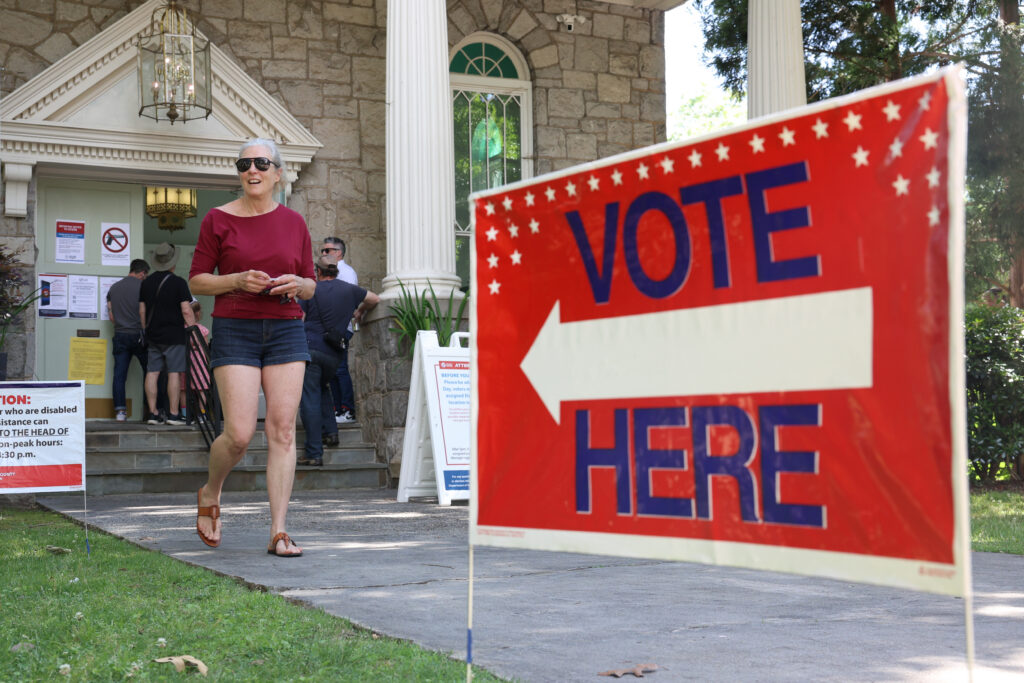
Juliette Morgan walks out of Ormewood Church after casting her vote in the Georgia Primary Election on Tuesday, May 19, 2026, in Atlanta, Georgia. Morgan is a retired public health worker who voted for Keisha Lance Bottoms in the 2026 Georgia Democratic Primary for governor. (Ashtin Barker/Capitol Beat)