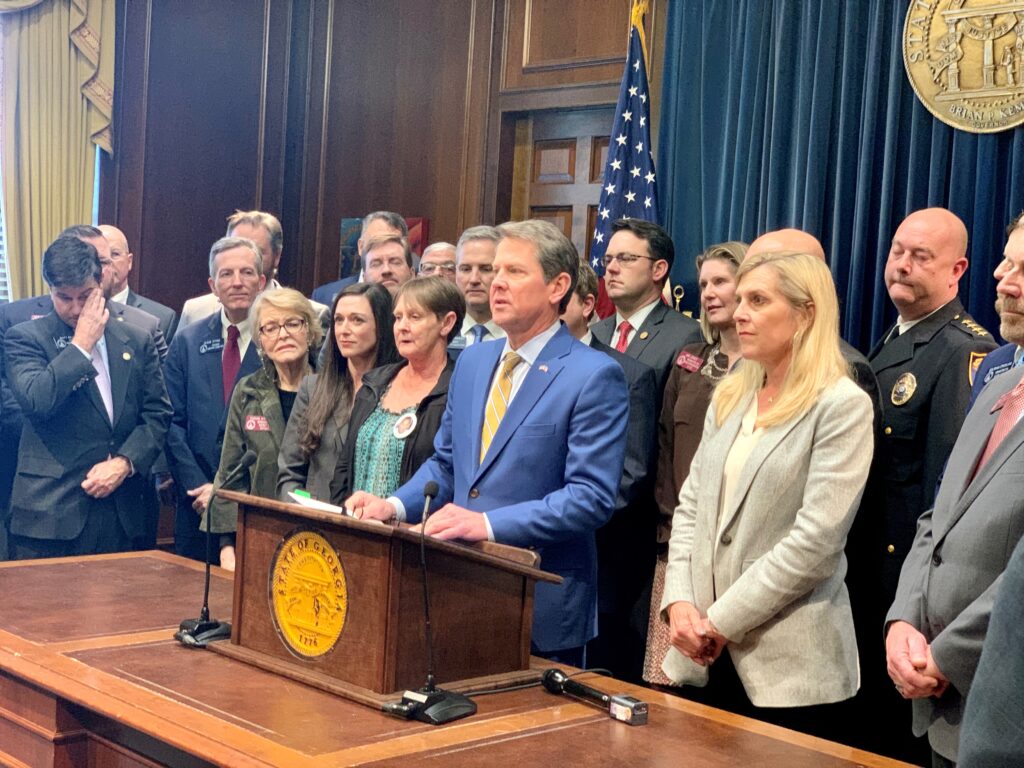
Gov. Brian Kemp talks about legislation for tougher anti-gang laws in Georgia at the Capitol on Jan. 30, 2020. (Photo by Beau Evans)
ATLANTA – Gov. Brian Kemp unveiled legislation Thursday aimed at toughening Georgia’s anti-gang laws by lengthening prison sentences, extending the reach of law enforcement agencies across county lines and adding the death penalty as an option for gang-related murder convictions.
Bills to be filed in the 2020 legislative
session would also create a new felony law for gang members who commit sex
crimes, allow Georgia Bureau of Investigation officials to serve as special
prosecutors in local gang cases and let security officers make arrests up to 880
yards outside school campuses.
Also, the legislation would empower
prosecutors to seize property used by gangs or anyone convicted under the
state’s anti-gang laws.
Cracking down on criminal gangs has been
a major plank of Kemp’s agenda since his gubernatorial campaign in 2018. The
governor and his wife, Marty, have also focused on fighting human trafficking.
“Simply put, there will be no safe haven
for criminal gang members in our state,” Kemp said at a news conference
Thursday.
Georgia anti-gang law already sets prison
sentences of up to 20 years for a conviction. It’s among the toughest penalties
in the country, officials say.
Earlier this week, top state law enforcement officials urged lawmakers to boost funding for a new gang task force Kemp launched last year and a database to track tens of thousands of gang members in the state.
Georgia has more than 71,000 gang members
at large plus another roughly 30,000 in prison or on parole, according to
Georgia Bureau of Investigation Director Vic Reynolds. It’s likely the actual
number of gang members is higher, he said.
“This is the major issue facing law
enforcement today,” Reynolds told a joint hearing of the House and Senate
Public Safety committees on Monday.
Kemp’s budget calls for nearly $1.6
million this fiscal year and next to add seven agents and analysts to the gang
task force, more than doubling its current staff. He launched the new task
force last year under the Georgia Bureau of Investigation.
The budget would also pump $420,000 into
a gang database created in 2010 that has gone unfunded. The database would
allow local sheriff’s offices and city police departments to better share
information on gang activity in the state, officials say.
Those additional funds come as Kemp has
proposed budget cuts for several criminal justice areas like
alternative-sentencing courts and the Georgia Public Defender Council.
The governor-driven anti-gangs
legislation drew pushback from some criminal justice advocacy groups Thursday,
including the nonprofit Southern Center for Human Rights. Public Policy
Director Marissa McCall Dodson said state officials should focus more on
helping local communities discourage people from joining gangs in the first
place, instead of meting out stricter punishments.
“Unfortunately, instead of proposing
proven methods which reduce violence and increase opportunity, Governor Kemp
has chosen to simply increase penalties – which are already harsh and
ineffective – for people accused of gang involvement,” said Dodson.
Alongside criminal justice advocacy
groups, some state lawmakers are also wary of beefing up Georgia’s already
strict anti-gang laws. Early in the 2020 legislative session, Senate Minority
Whip Harold Jones II argued more funding for judges and prosecutors is needed
to enforce existing statutes.
“The key right now is not the fact that
we don’t have tough gang laws,” Jones, D-Augusta, said Jan. 16. “The key is
that we’re not able to actually enforce them.”
Sen. Valencia Seay, D-Riverdale, said
schools especially need more attention because they have become recruiting
grounds for gangs.
“We do not need our young kids out here
being recruited when they do not know the difference,” Seay said Monday.
Reynolds said he supports increasing
support for school resource officers and including them in the new gang task
force. The state cannot “arrest your way out of” the problem of gangs in
Georgia, he said Monday.
“There has to be a joint effort by
communities, by churches, by schools, by everyone else to make sure these young
kids … have a different option,” Reynolds said.
Kemp, responding to criticism Thursday,
said the state should help community organizations like schools and churches
reach young people before they join gangs but did not elaborate on how to do
so.
“We need to let young people know that there are better options, a brighter future for those who work hard, stay out of trouble and embrace the opportunities in front of them,” Kemp said.
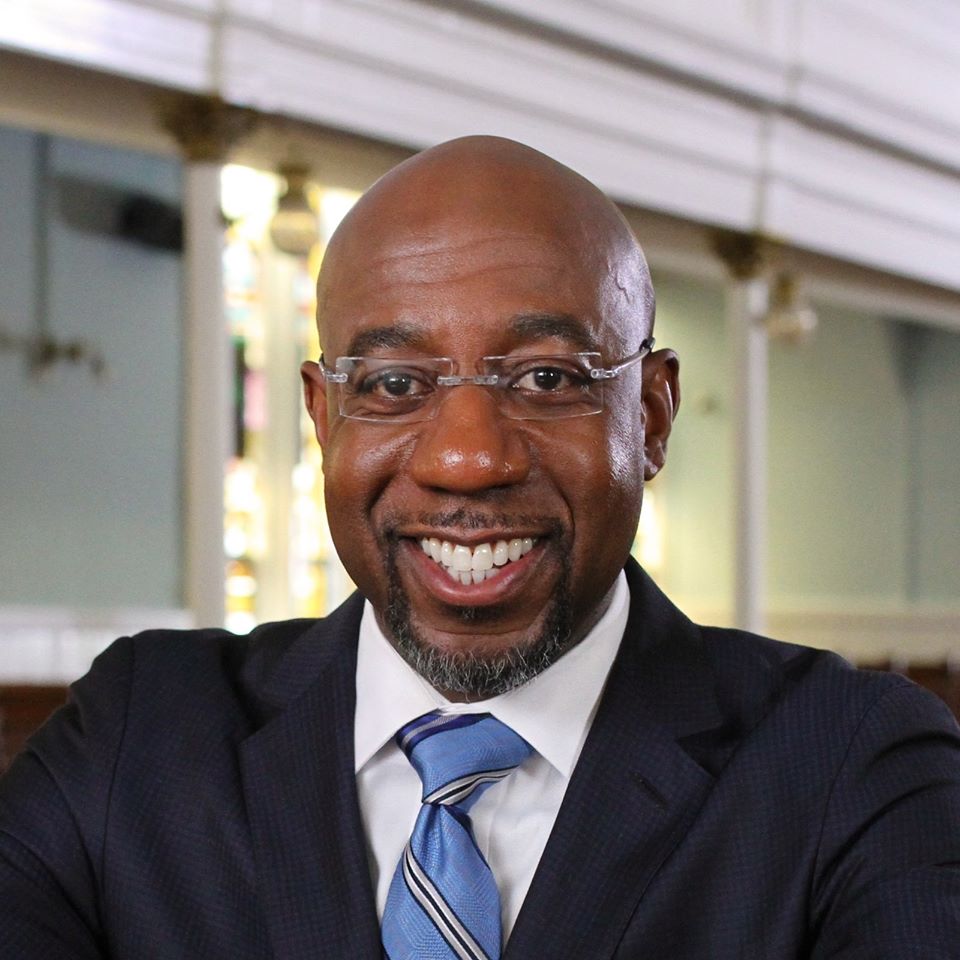
Rev. Raphael Warnock of Ebenezer Baptist Church (Credit: Warnock for Georgia)
ATLANTA – Rev. Raphael Warnock, the senior pastor of Atlanta’s Ebenezer Baptist Church, Martin Luther King Jr.’s congregation, has entered the race for U.S. senator from Georgia.
A Democrat, Warnock joins the fray
against appointed Republican U.S. Sen. Kelly Loeffler and, now, GOP Congressman
Doug Collins. They will compete to fill the last two years of former U.S. Sen.
Johnny Isakson’s term, after the longtime Georgia statesman resigned at year’s
end due to health issues.
In a video Thursday morning, Warnock
traced his life’s journey from the Kayton Homes housing projects in Savannah to
Ebenezer’s historic pulpit. His first advertisement focused on social issues
like health-care expansion and voter registration, marking a messaging contrast
to Loeffler and Collins’ strong support for President Donald Trump.
“I’ve committed my whole life to service
and helping people realize their highest potential,” Warnock said. “I’ve always
thought that my impact doesn’t stop at the church door. That’s actually where
it starts.”
Warnock joins Matt Lieberman, son of
former U.S. Sen. Joseph Lieberman of Connecticut, and Ed Tarver, a former U.S.
attorney and state senator from Augusta, on the Democratic side of the contest
slate.
The race to succeed Isakson has become the marquee contest of an already intense year for Georgia politics featuring campaigns for both U.S. Senate seats and Trump’s re-election.
Republican U.S. Sen. David Perdue faces
three Democratic challengers in his bid for a second term.
Three seats for the U.S. House of
Representatives are wide open, with the incumbents either stepping aside or
seeking election elsewhere. Democratic state leaders are also pushing to flip
the Georgia House in their favor.
Warnock has presided over Ebenezer
Baptist since 2005, when he became the historic church’s youngest senior pastor
at age 35. He considered running against Isakson in 2016 but decided against
it.
While sticking to his humble upbringing
in Thursday’s message, Warnock in recent speeches has gone on the offensive
against Trump and his policies. He has also lashed out against voter
suppression, gender and economic inequality, racial injustice and student debt.
Speaking at the Democratic Party of
Georgia’s annual fundraising dinner in October, he said that “there is an
attack on the very soul of our country and all that it represents.”
“In this moment in our nation, we need
political leadership with a moral bearing,” Warnock said. “This is an unusual
time and we must be about the unusual business of winning back our democracy,
standing for what is best and truly right in the American spirit.”
Warnock’s announcement drew an immediate
backlash from the National Republican Senatorial Committee, which backs
Loeffler as the incumbent. Its spokesman, Nathan Brand, called Warnock’s
platform too radical.
“Warnock’s far-left positions are out of
touch with Georgia voters and stand in sharp contrast with Kelly Loeffler’s
conservative values,” Brand said.
The Republican group also jabbed at
Collins on Wednesday after his own campaign announcement. A Baptist pastor and
U.S. Air Force Reserve chaplain, Collins risks splitting Georgia’s conservative
voters at a critical moment when Democratic leaders see a path to victory.
As it stands, all the candidates from
every party in the U.S. Senate race will compete in a free-for-all “jungle”
primary scheduled for November. That format would likely lead to a runoff in
January if left unchanged.
But a bill in the Georgia General
Assembly could return the election to a traditional party primary, which would
set up a more decisive contest between the Republican and Democratic nominees.
The measure, House Bill 757, looks to be
headed soon for a vote on the House floor.
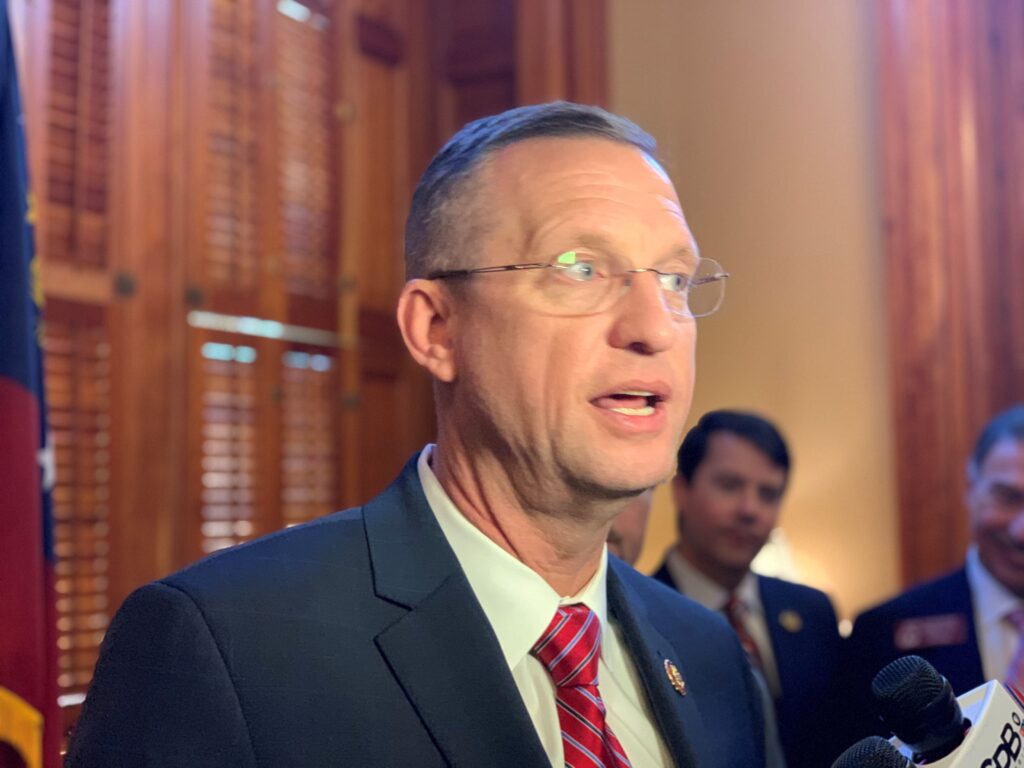
Congressman Doug Collins speaks outside the Georgia House of Representatives on Jan. 28, 2020. (Photo by Beau Evans)
ATLANTA – The big announcement came as no shock to state Sen. Mike Dugan as he strolled into the Georgia Senate chamber Wednesday morning.
U.S. Rep. Doug Collins, a Gainesville
Republican with a rising national profile and plenty of friends in the Georgia
General Assembly, had just launched his campaign to unseat Gov. Brian Kemp’s
handpicked U.S. senator, Atlanta businesswoman Kelly Loeffler.
Threatening to split conservative voters
at a critical moment in Georgia’s political history, the news of Collins’
candidacy sparked worry among many Republicans and glee from hopeful Democrats.
But Dugan, the majority leader in the state Senate, was unfazed.
“It’s the most non-surprising surprise ever,” he said. “I don’t think it’s a problem.”
But behind the scenes, many observers wondered if a battle between Collins and Loeffler could spell trouble for the Republican push to hold retired U.S. Sen. Johnny Isakson’s seat.
A Baptist pastor and U.S. Air Force Reserve chaplain, Collins hails from a staunchly conservative part of the state and was President Donald Trump’s pick to succeed Isakson. But Loeffler, who was chosen by Kemp last month to fill the Senate seat until a November special election, has millions of dollars at her disposal to wage a tough campaign.
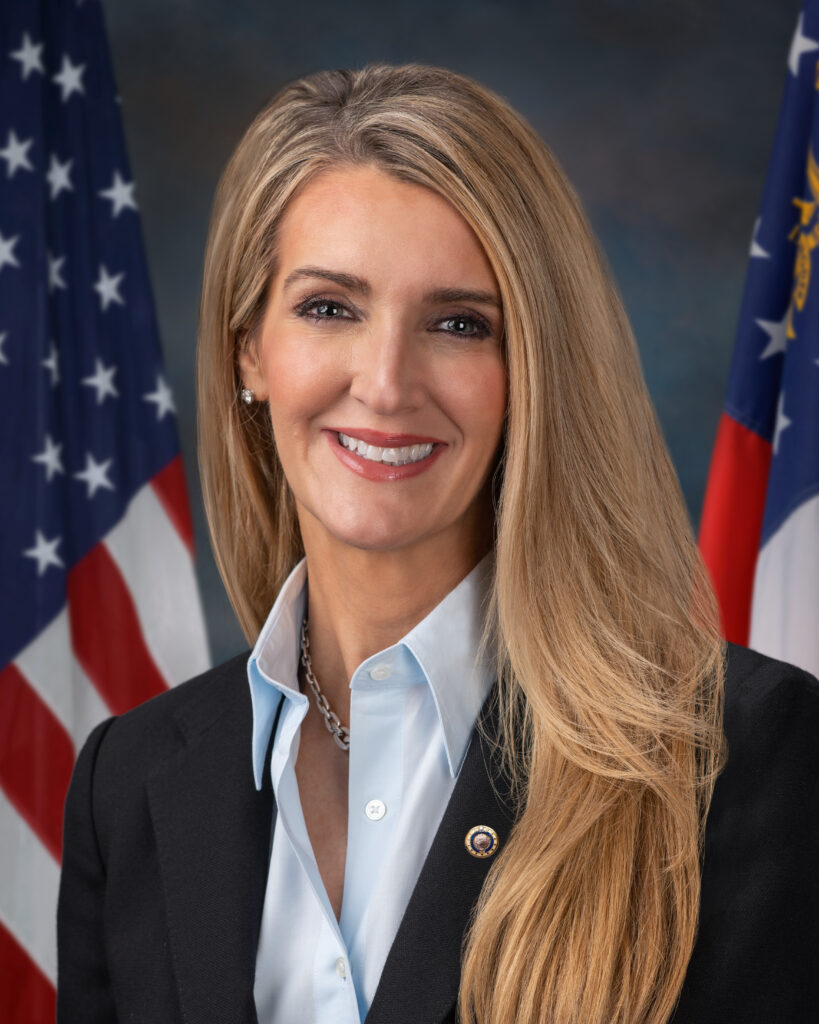
U.S. Sen. Kelly Loeffler
Charles Bullock, a longtime University of
Georgia political science professor, said he’s never seen anything in Georgia
history quite like the race forming between Collins, Loeffler and whoever
emerges as the Democratic frontrunner, on top of the other big-ticket battles
in the 2020 elections this fall.
With Collins running for U.S. senate,
three seats from Georgia will be up for grabs in the U.S. House of Representatives.
Democratic state leaders are also pushing to flip the state House in their
favor. Trump faces reelection as well.
More so than any other campaign, the
battle between Collins and Loeffler could have deep ramifications for Georgia
Republicans, according to Bullock.
“I would expect that once the dust
settles, the loser will put on a good face and endorse the person who won,” Bullock
said. “But that might not satisfy the rank-and-file voters who continue to hold
a grudge.”
Amid much private consternation,
Republican lawmakers at the state Capitol Wednesday kept up an air of
confidence. Rep. J Collins, R-Villa Rica, said he supports Collins’ decision
and favors letting voters settle the matter.
“I think it’s great,” J. Collins said
Wednesday. “If that’s what he wants to do, I support him.”
Powerful Georgia House lawmakers like Speaker
David Ralston and Appropriations Chairman Terry England also had glowing words
to say about Doug Collins when he appeared Tuesday in the chamber to deliver
the morning prayer.
“He has stood by me when few would,” said
Ralston, R-Blue Ridge. “I don’t forget things like that.”
Meanwhile, Kemp and his allies in the
state legislature stood behind Loeffler on Wednesday. She drew an endorsement
from state Sen. Brian Strickland, R-McDonough, who is one of the governor’s
floor leaders.
“The last thing I want to do is join the
Democrats to win an election,” Strickland said.
Kemp himself rallied support for his pick
in Loeffler, framing her as a businesswoman with a farming background and a
political newcomer with “outsider” status similar to Trump’s.
“She doesn’t owe anybody anything in
Washington, D.C.,” Kemp said in remarks to the conservative Faith and Freedom
Coalition Wednesday. “What she owes is her fighting for this state of Georgia,
and that is what I told her to do when she got up there.”
Circling the political fray is House Bill
757, a measure that could pave an easier path for Collins to best Loeffler by
returning the race to a traditional party primary election.
Currently, special elections in Georgia are decided by free-for-all “jungle” primaries in which all candidates – Democratic and Republican alike – compete on the same ballot. If left unchanged, that election format has a high chance of leading to a runoff next January.
House leaders have not yet sent the bill
to the floor after it passed out of committee Tuesday. Kemp has vowed to veto
the bill if it clears the General Assembly, setting up what could be a major
test of his support among state lawmakers.
On Wednesday, Dugan told reporters he
wants Secretary of State Brad Raffensperger to weigh in on the matter first if
the bill reaches the Georgia Senate. He added he has not yet taken the
temperature of state Senate lawmakers to gauge whether they would vote
favorably.
“How can we have the temperature when we
haven’t been in the room yet?” Dugan said.
For his part, Collins urged passage of
the bill out of concern a November free-for-all election could hurt
Republicans.
“Fighting ourselves and the left at the
same time is a bad strategy,” Collins said on Twitter.
Privately, some Democratic lawmakers said
Wednesday they believe a traditional party primary would bolster chances for
their Senate candidate to win – especially if the Republicans advance Collins,
a partisan figure potentially less able to sway moderate voters.
But publicly, Democratic leaders said
they’re prepared for any scenario. State Sen. Nikema Williams, who chairs the
Democratic Party of Georgia, said she supports the party-primary bill but only
because she believes the change would give voters the most say in choosing the
state’s next U.S. senator.
“I think what 2018 showed us is that Democrats are ready to compete statewide,” said Williams, D-Atlanta. “It doesn’t matter what we’re up against.”
Congressman Doug Collins speaks outside the Georgia House of Representatives on Jan. 28, 2020. (Photo by Beau Evans)
ATLANTA – Georgia’s wild year of politics just got wilder.
After much speculation, U.S. Rep. Doug
Collins announced Wednesday morning that he will challenge appointed U.S. Sen.
Kelly Loeffler to fill the remainder of former U.S. Sen. Johnny Isakson’s term.
Collins’ decision risks splitting
Republican support in Georgia at a time when Democratic leaders see their
prospects growing to flip seats in Congress and the state legislature.
The campaign comes as Republican U.S. Sen.
David Perdue of Georgia also seeks to keep his seat. He has drawn three
Democratic challengers.
Along with Collins and Loeffler, the race
for Isakson’s old Senate seat includes Democratic candidate Matt Lieberman, the
son of former U.S. Sen. Joseph Lieberman of Connecticut.
The move also opens the race for a third
congressional seat in Georgia covering Collins’ Gainesville-based district,
following the decisions of U.S. Reps. Tom Graves and Rob Woodall – also
Republicans – not to seek re-election.
A Baptist pastor and U.S. Air Force
Reserve chaplain, Collins hails from a staunchly conservative part of the state
and was President Donald Trump’s pick to succeed Isakson. His tirades against
congressional Democrats in defending the president against charges of Russian
collaboration and impeachment over Ukraine have raised his national profile
over the past year.
“We’re getting ready for a good time down
here to keep defending this president, keep working for the people of Georgia,”
Collins said in announcing his candidacy Wednesday morning on the “Fox and
Friends” television program.
Loeffler, an Atlanta businesswoman, was chosen by Gov. Brian Kemp last month to finish Isakson’s term. Isakson stepped down at year’s end due to health complications from Parkinson’s disease.
Loeffler has the governor’s strong
support, as well as backing from other powerful and well-financed groups like
the National Republican Senatorial Committee.
“The shortsightedness of this decision is
stunning,” said NRSC Executive Director Kevin McLaughlin. “Doug Collins’
selfishness will hurt David Perdue, Kelly Loeffler and President Trump.”
The wife of a billionaire financier and
herself formerly head of a bitcoin company, Loeffler has millions of dollars at
her disposal to wage a tough campaign. She has already begun pouring money into
campaign ads in recent weeks.
Collins dismissed questions that his
candidacy could split the Republican base or fall flat in the face of
Loeffler’s financial might.
“We just need to have a process that lets
people decide, lets them choose for themselves how they want to see this
vision,” Collins said on “Fox and Friends” Wednesday.
Collins’ entry in the race also puts him
and powerful supporters like Georgia House Speaker David Ralston on a collision
course with Kemp. Ralston threw his political weight behind Collins in the
House on Tuesday, calling him a steadfast friend.
“He has stood by me when few would,” said
Ralston, R-Blue Ridge. “I don’t forget things like that.”
Meanwhile, Kemp rallied support for his
pick in Loeffler in an emailed statement Tuesday, touting her anti-abortion
stance and support for Trump’s agenda.
“Kelly is a life-long Republican who
shares our conservative values and vision for a safer, stronger Georgia,” the
governor said.
Circling the political fray is House Bill
757, a measure that could pave an easier path for Collins to win the race
against Loeffler.
Currently, special elections in Georgia
are decided by free-for-all “jungle” primaries in which all candidates –
Democratic and Republican alike – compete on the same ballot. The House measure
would restore the traditional party primaries in May, followed by a November
general election between the primary winners.
If passed, the special-election bill
moving through the state legislature would greatly reduce chances for a runoff
in a jungle primary, which likely would result in votes being split between
several strong candidates all competing at once. The top candidate in the
free-for-all format would need more than 50% of the vote to avoid a runoff with
the second-highest vote getter.
The bill looks headed soon for a vote on
the House floor. Kemp has already said he will veto it.
ATLANTA – Youth offenders in Georgia would need to be at least 18-years old to be tried in adult court for all except the most serious violent crimes under a bill filed in the 2020 legislative session.
Georgia is one of three states that try 17-year-olds as adults for misdemeanors charges in criminal court. The minimum age would be raised to 18 years under House Bill 440, sponsored by Rep. Mandi Ballinger, D-Canton.
Supporters say 17-year-old offenders should not be jailed with
violent adults, both for their own physical safety and to remove them from
constant contact with criminal behavior. Skeptics worry the change could let more
crime-prone juveniles go free.
Teenagers would still be tried as adults for violent crimes
like murder and rape under the bill.
Most 17-year-olds in Georgia are arrested for theft, drug, assault and disorderly-conduct crimes, said Joshua Rovner, a senior advocacy associate with the nonprofit Washington, D.C.-based Sentencing Project. Keeping them out of the adult justice system would help reduce the chances they commit more crimes as an adult.
“We have the opportunity to shape their futures…by providing
them with the services they need even when they mess up,” Rovner said at a House
Juvenile Justice Committee meeting Tuesday.
The number of teenagers arrested in Georgia has fallen
sharply over the past decade, Rovner said. He presented figures showing roughly
30% of the the total 24,037 juveniles arrested in Georgia in 2017 were aged 17.
Despite the decline, some lawmakers want a deeper dive on
how much it would cost juvenile courts and detention centers to take on 17-year-olds
before moving forward on the bill.
“I think there’s universal agreement that this is the right
thing to do,” said Rep. Wes Cantrell, R-Woodstock. “We just need to look at it
more so we don’t have fiscal impacts that we didn’t consider.”
The bill stalled in last year’s legislative session. Ballinger chairs the House Juvenile Justice Committee where the bill needs approval to reach the full House.
This story has been updated to clarify information presented by Joshua Rovner,
ATLANTA – A bill restricting student dual enrollment in high school and college classes in Georgia cleared the Senate floor Tuesday.
Sponsored by state Rep. Bert Reeves, R-Marietta, House Bill 444 would limit dual enrollment to 30 hours per eligible student for college or technical college courses the state-run student-finance agency funds. Beyond that, students would pay for classes out of their own pockets.
“We see how much this program has grown with no guardrails
in place, with no end in sight,” said Sen. Brian Strickland, R-McDonough, one
of Kemp’s floor leaders in the Senate.
But opponents argued the changes would be too restrictive,
causing students to start college with fewer class credits and more debt.
“The bottom line is students who are seeking higher
education are going to end up with more debt,” said Sen. Nan Orrock, D-Atlanta.
The bill passed out of the Senate by a 34-18 vote.
Costs for the program allowing high-school students to take
post-secondary classes swelled from around $23 million when the program was
launched in 2015 to around $140 million in 2018. The bill would cap enrollment
enough to keep the program within its roughly $100 million budget for this
year, officials say.
The proposal would nix free college-level classes for
freshman high schoolers and limit 10th graders to courses at technical schools
unless they qualify for the state’s Zell Miller scholarship, which requires
students to maintain a 3.7 grade point average or better.
Only upper-class students in the 11th and 12th grades could
take classes at colleges and universities in Georgia. Currently enrolled
students would not be affected if the bill is signed into law.
The legislation would also trim some course offerings to
keep the focus more on helping students gain technical certificates for future
jobs. Supporting lawmakers have pointed out the program’s tax-funded offerings
have evolved beyond their original intent to include exercise classes like
Zumba.
Because of changes the Senate Higher Education Committee
made to the bill, it now must return to the House before gaining final passage.