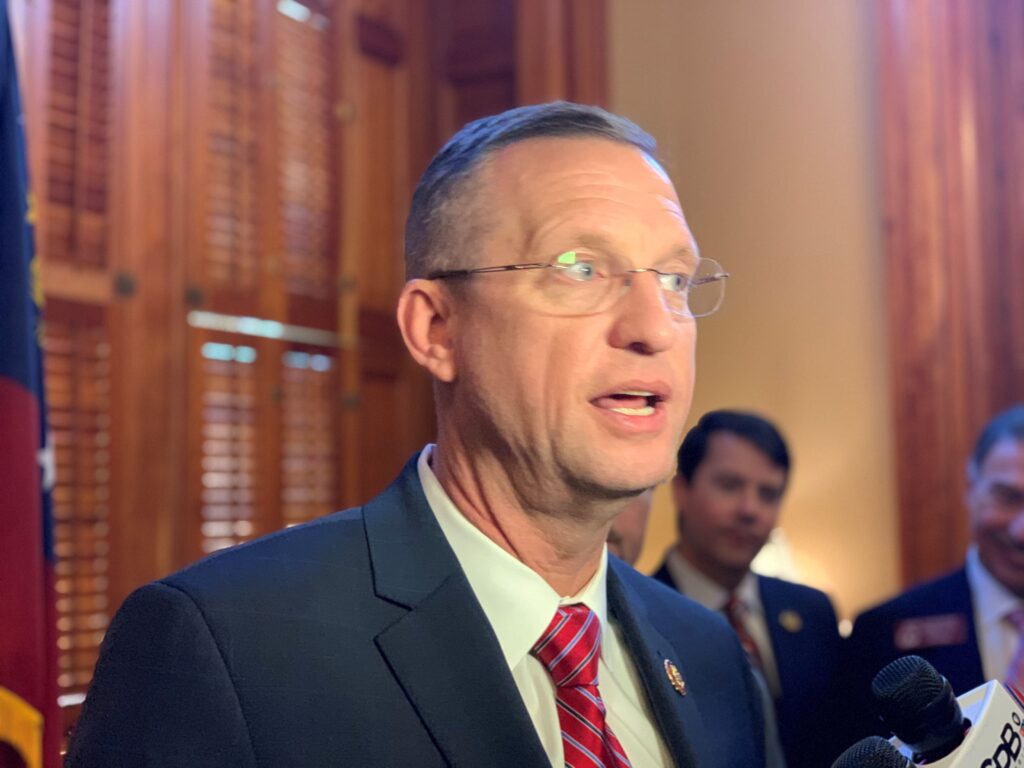
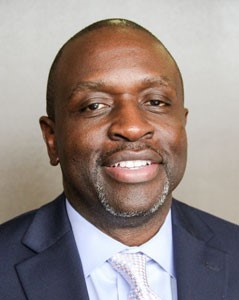
Congressman Doug Collins speaks outside the Georgia House of Representatives on Jan. 28, 2020. (Photo by Beau Evans)
ATLANTA – High-stakes rule changes for a U.S. Senate election in Georgia sped through a state House committee Tuesday morning, hours after news broke that a major contender is poised to enter the race against appointed U.S. Sen. Kelly Loeffler.
Congressman Doug Collins, a Gainesville
Republican who is among President Donald Trump’s staunchest allies, will likely
enter the race to complete former Sen. Johnny Isakson’s term, several media
outlets reported Monday night. Isakson resigned at year’s end due to health
complications from Parkinson’s disease.
A Baptist pastor and U.S. Air Force
Reserve chaplain, Collins did not announce his candidacy when asked Tuesday
morning at the Capitol. He was there to deliver the morning sermon in the
Georgia House of Representatives.
“There’ll be more coming later,” he said.
Collins’ entry in the race would put him
and powerful supporters like Georgia House Speaker David Ralston on a collision
course with Kemp. While Ralston hailed his Collins as a steadfast friend in the
House, Kemp rallied support for his pick in Loeffler in an emailed statement
touting her anti-abortion stance and support for Trump’s agenda.
“Kelly is a life-long Republican who
shares our conservative values and vision for a safer, stronger Georgia,” the
governor said.
Introduced on Monday, House Bill 757
would do away with the free-for-all “jungle” primary that Georgia law requires
for special elections, in which all candidates – Democratic and Republican
alike – compete on the same ballot. The measure would restore the traditional
party primaries in May, followed by a November general election between the
primary winners.
The wife of a billionaire financier and
herself formerly head of a bitcoin company, Loeffler has millions of dollars at
her disposal in the campaign to keep her appointed seat. But Collins hails from
a conservative stronghold in the state, has elevated his national profile over
the past year and was Trump’s favored pick for the Senate seat.
If passed, the special-election bill
moving through the state legislature would greatly reduce chances for a runoff
in a jungle primary, which likely would result in votes being split between
several strong candidates all competing at once. The top candidate in the
free-for-all format would need more than 50% of the vote to avoid a runoff with
the second-highest vote getter.
The rule change revises a less sweeping
bill as an amendment brought by House Governmental Affairs Committee Chairman
Shaw Blackmon, R-Bonaire. At a committee meeting Tuesday, Blackmon said
avoiding a runoff would cost Georgia taxpayers less money.
“We are absolutely certain to have an
extra cost for a runoff” with a jungle primary, Blackmon said.
The measure faced opposition from Rep.
Scot Turner, R-Holly Springs, who said revising the election format is
unnecessary and would prompt harmful “inter-party squabbling.”
“There are going to be a lot of hard
choices to make because of the sides lining up on this issue,” Turner said.
The amended bill passed and is on track
for debate on the House floor.
GBI Director Vic Reynolds talks about criminal gangs at the State Capitol on Jan. 27, 2020. (Photo by Beau Evans)
Georgia law enforcement officials are urging
state lawmakers to boost funding for a new criminal gang task force and
database to track tens of thousands of gang members in the state.
Gov. Brian Kemp’s budget calls for nearly
$1.6 million this fiscal year and next to add seven agents and analysts to the
gang task force, more than doubling its current staff.
It would also pump $420,000 into a gang
database created in 2010 that has gone unfunded. The database would allow local
sheriff’s offices and city police departments to better share information on
gang activity in the state, officials say.
Georgia has more than 71,000 gang members
at large plus another roughly 30,000 in prison or on parole, according to
Georgia Bureau of Investigation Director Vic Reynolds. It’s likely the actual
number of gang members is higher, he said.
“This is the major issue facing law
enforcement today,” Reynolds told a joint hearing of the House and Senate
Public Safety committees on Monday.
The gang-member figures were collected
from most of the state’s local jurisdictions by the Georgia Gang Investigators
Association, Reynolds said.
Georgia anti-gang law sets up to 20 years
in prison for a conviction. It’s among the toughest penalties in the country,
officials say.
Senate Public Safety Committee Chairman
John Albers said lawmakers have not yet settled on what, if any, new anti-gang
bills should be introduced during the 2020 legislative session.
Speaking Monday, Reynolds also said the
state needs to pay more attention to gang-intervention efforts and provide more
funding for school resource officers.
Sen. Valencia Seay agreed, saying schools
serve as prime training grounds for youth gang involvement along with juvenile
detention centers.
“They are recruiting from the schools,”
said Seay, D-Riverdale. “So we do need to have that.”
Sen. Randy Robertson, a retired major
with the Muscogee County Sheriff’s Office, said last week he supports cracking
down on gangs in Georgia but worries that could prompt a spike in juvenile
arrests. Tougher enforcement should be paired with legislation to deal with the
potential juvenile inmate increase, he said.
“What we’ll see is an influx on an
already taxed justice system,” said Robertson, R-Cataula.
Tougher state anti-gang law enforcement
has been a major plank of Kemp’s agenda since his gubernatorial campaign in
2018. He launched the new task force last year under the Georgia Bureau of
Investigation.
This legislative session, the governor
wants lawmakers to back giving prosecutors more tools to target gangs and to
boost funding for the statewide gang database.
“While Georgia already has tough gang
statutes on the books, there’s more that we can do to stop violence in our
state,” Kemp said in his Jan. 16 “State of the State” speech.
ATLANTA – Georgia House Speaker David Ralston has warned his legislative colleagues repeatedly this month the need for painful spending cuts means the 2020 General Assembly session likely will last longer than usual.
Three days of hearings Jan. 21-23 on Gov. Brian Kemp’s proposed mid-year budget adjustments for this fiscal year and his $28.1 billion fiscal 2021 budget plan dramatically demonstrated Ralston’s point.
One after another, state agency heads
painted a bleak picture of what across-the-board budget cuts Kemp is
recommending to offset sluggish state tax collections would do to programs and
services under their jurisdiction.
“Many budget cuts will have debilitating
effects on services, especially in rural communities,” said Taifa Smith Butler,
president and CEO of the Georgia Budget and Policy Institute, an Atlanta-based
public policy nonprofit.
With state revenues growing much slower
than projected during the past year and actually declining in some months, Kemp
ordered state agencies last summer to reduce spending by 4% during the current
fiscal year and 6% in fiscal 2021, beginning July 1.
Department heads submitted more than $210
million in cuts in their mid-year budgets and another $300 million in
reductions for fiscal 2021.
Some agency heads told members of the Georgia House and Senate Appropriations committees last week they could hit those targets without hurting programs and services by not filling vacant positions, eliminating most travel and through various efficiencies.
But others said the first mandatory spending cuts in state government since the Great Recession would deprive Georgians of vital services, particularly low-income families and people suffering from mental illness.
“What it takes us to is that need to take
cuts in painful places,” said Commissioner Judy Fitzgerald, who oversees state
mental health services at the Department of Behavioral Health and Developmental
Disabilities. “The safety net is stretched to the max.”
While some of the budget austerity
results from slower economic growth in Georgia, a major culprit is the tax cut
the General Assembly passed two years ago. Lawmakers reduced the state’s income
tax rate for the first time since 1937 from 6% to 5.75%.
Then-Gov. Nathan Deal steered the tax cut
through the legislature to make sure taxpayers received the benefit of a
revenue windfall the state was expecting as a result of the federal tax reforms
Congress passed late in 2017.
But Kemp has been cool to the idea,
citing the tight budget climate. Passing the second phase of the tax cut this
year would cost about $500 million.
Senate Finance Committee Chairman Chuck
Hufstetler, said the state can’t afford that kind of revenue hit this year.
“We’re looking at some severe budget
cuts,” Hufstetler said Friday. “I don’t see the math there right now.”
Lawmakers would be “wise to look before
they leap” when considering cuts to sensitive programs like accountability
courts and mental health, said Kyle Wingfield, president of the conservative
Georgia Public Policy Foundation.
But keeping those programs funded should
not be done by raising taxes, he said, especially as Georgia’s economy rebounds
from hurricane-caused crop losses in 2018 and easing trade tensions with China.
“This is an economy that’s running really
fast right now,” Wingfield said. “It would be better to trim back where we can
in the short term than to raise taxes.”
Nearly $9 million would be pulled from several programs aimed at training doctors to help close a severe physician shortage in Georgia, particularly in rural areas.
That caught the attention of several
influential Republican lawmakers, including Senate Appropriations Committee
Chairman Jack Hill. He noted the legislature singled out those programs in
recent years to receive more money, not less.
“It was obvious that the cuts focused on
new money, on things that had been put into practice recently,” said Hill,
R-Reidsville. “For them to cut those out in the beginning, it certainly got the
attention of folks in the rural areas.”
County health agencies would lose out on
roughly $17.5 million in cuts to grants funded by the Department of Public
Health, which Director Kathleen Toomey said might be covered by other sources
like private and federal grants. But many lawmakers worry counties could still
suffer.
“Some of these counties have a difficult
time keeping their lights on,” said Rep. Clay Pirkle, R-Ashburn. “Cuts of this
magnitude to our county health departments will be difficult.”
Officials also said cuts of about $80 million for mental health programs would force more money to be pumped into handling crisis emergency health situations instead of working to prevent them.
Other reductions between $80 million and $100 million would affect the state’s prisons, courts, police and public-defender agencies.
Particularly troubling for criminal justice advocates are proposed cuts of about $3.5 million to the state’s accountability courts, a popular program created under Deal that provides alternative sentencing for thousands of inmates.
“These cuts symbolize a big step backward,” said Sara Totonchi, executive director of the nonprofit Southern Center for Human Rights. “I’m deeply concerned about the short-sighted approach toward criminal justice.”
Amid concerns, many lawmakers praised the
agencies for homing in on non-personnel spending cuts like eliminating vacant
staff positions and upgrading technology. Those sorts of cuts were what Kemp
called on agencies to make shortly after ordering reductions last summer.
“Overall, I’ve heard a lot about smart things the departments have done to reduce waste,” said Sen. Brian Strickland, R-McDonough, one of the governor’s floor leaders. “It’s a good exercise.”
Kemp’s office pushed back on criticism of
some of the cuts. Candice Broce, a spokeswoman for the governor, noted the cuts
were presented after state budgeting staff “conducted an in-depth,
comprehensive analysis of every agency’s budget submission.”
Meanwhile, budget veterans stressed that it’s
still early in the process. The state’s longest-serving lawmaker, Rep. Calvin
Smyre, said the trick will be to make cuts that steer clear of affecting
everyday Georgians.
With luck, state revenues will climb back
up and perhaps many of the cuts won’t be needed, he said.
“I think a lot of these things will take care of themselves,” said Smyre, D-Columbus. “I’d just like to continue to look at it in a very responsible manner as we go along.”
__________
BY THE NUMBERS
The following state agencies would absorb
the largest spending cuts under Gov. Brian Kemp’s $28.1 billion fiscal 2021
budget plan:
$54 million: Department of Corrections
$35 million: Department of Behavioral Health and Developmental Disabilities
Student athletes in Georgia could see
their pockets a little more packed if a pair of bills filed by state House
Democratic lawmakers clear the 2020 legislative session.
One bill would allow college athletes to
be paid for having their image or name used in advertisements. Another would
set up an escrow fund students could draw from after graduating.
If passed, the Georgia bills would follow
California’s “Fair Pay to Play Act” compensating athletes for commercial uses
of their likeness. That act, which the California State Legislature passed last
fall, takes effect in 2023.
House Bill 743, sponsored by Rep. Billy Mitchell, would overturn a ban in Georgia on paying student athletes for marketing work. The bill would not require schools to provide compensation, but it would let students sign marketing contracts and hire agents for business and legal representation.
“This an idea whose time has come,” said
Mitchell, D-Stone Mountain. “Georgia schools would be at a decisive
disadvantage when it comes to recruiting with other states that join California
in implementing this act, if we fail to do the same.”
The student-athlete escrow account created under House Bill 766 would collect 33% of all revenues from college and university athletic competitions in Georgia, payable after graduation. Its sponsor, Rep. Sandra Scott, said the bill aims to give a square deal and graduation incentive for student athletes whose efforts have raised big revenues for schools.
“These young athletes make millions of
dollars for our colleges and universities,” said Scott, D-Rex. “Now it is time
that we make it right for them.”
Opposition to similar
athlete-compensation bills in other states has stemmed from concerns that
wealthier colleges could wage bidding wars to lure prospective students and
distract from the overall learning experience. Several California universities
opposed that state’s legislation, as did the National Collegiate Athletic
Association.
“The bill threatens to alter materially
the principles of intercollegiate athletics and create local differences that
would make it impossible to host fair national championships,” NCAA President
Mark Emmert wrote in a letter to California lawmakers in June.
The legislative session in Georgia begins
its second week on Monday.
Judy Fitzgerald talks about budget cuts for Georgia mental health services at the Capitol on Jan. 23, 2010. (Phot by Beau Evans)
ATLANTA – State budget cuts could hit mental health services hard in Georgia, forcing behavioral health officials to pump more money into handling crisis situations instead of programs to prevent those situations, the state’s mental health chief said Thursday.
In three days of budget hearings this week, state agency heads said they plan to meet Gov. Brian Kemp’s orders for spending cuts mostly by eliminating vacant staff positions, upgrading technology and shifting funds between programs. Those cuts target behind-the-scenes work and, for the most part, would make little difference to the general public.
That’s not the case for the Department of
Behavioral Health and Developmental Disabilities, said Commissioner Judy
Fitzgerald. She told lawmakers Thursday that cuts totaling about $80 million
through June 2021 would be felt by more than 200,000 people with mental health
issues in Georgia the agency served last year.
“It was not possible for us to take the
cuts without a reduction of services to individuals in the state,” Fitzgerald
said.
The department drafted a memo last fall warning that some of the proposed cuts could risk “impacting increased suicidality, substance abuse disorders and demand on crisis services.” The memo highlighted how the cuts would especially hurt community service boards, which contract with the state to provide local mental health services in counties, cities and towns.
The cuts would largely affect so-called “core services” that fund programs to help mentally ill people stay in their homes and hold down jobs. Those services, done mostly by community service boards, aim to prevent health and behavioral emergencies that could land someone in jail or a psychiatric ward.
That preventative work has been the agency’s focus since 2010 under a settlement agreement with the U.S. Department of Justice to curb lengthy stays in psychiatric hospitals for Georgia’s mentally ill. Since then, admissions to the state’s five psychiatric hospitals have stopped. And lawmakers have approved more than $270 million to bolster the agency over the past decade.
But along with the cuts, Fitzgerald said
the agency plans to shift $13 million to fund a growing demand for private
psychiatric beds. Those funds were earmarked last year for preventative
services but had to be diverted to the crisis beds as more of the state’s
mentally ill seek intensive treatment, she said.
“The safety net is stretched to the max,”
Fitzgerald said. “But we feel like we’re in this together.”
In August, a report from a federal monitor for the DOJ settlement urged state officials to boost funding for mental health services, not cut it. Fitzgerald declined to elaborate after Thursday’s meeting on whether the cuts and the $13 million shift to hospital beds might run afoul of the federal government.
“We’ll leave it to [the] Department of Justice and the lawyers to determine how that impacts compliance,” she said.
The governor’s office pushed back on Fitzgerald’s assessment of the cuts, arguing that staff in charge of the budgeting process reached different conclusions about the impacts.
“Commissioner Fitzgerald’s claims are not supported by our analysis, nor would we allow such a significant disruption in service to Georgians,” said Kemp’s communications director, Candice Broce.
Fitzgerald’s rundown of the cuts alarmed lawmakers on the House and Senate Appropriations committees.
Rep. Katie Dempsey, who chairs the House
Appropriations subcommittee overseeing mental health, said she was startled to
learn about details of the cuts and see the stark language used in last fall’s
internal agency memo.
“The loss of services, it’s hard to even
imagine right now how we’re going to deal with this,” said Dempsey, R-Rome.
Rural Georgia communities especially could suffer from fewer state dollars for mental health, said Rep. Darlene Taylor, R-Thomasville. She said crisis episodes involving mentally ill people in rural areas are on the rise, and budget cuts that hinder getting help for those people should not move forward.
“This budget, I cannot see how this is going to work,” Taylor said. “A spoonful of sugar is not going to make this go down.”
This story was updated to include comment from Gov. Brian Kemp’s office.
ATLANTA – Georgia’s education chief sought to calm concerns Wednesday over ending the short-lived chief turnaround office, assuring state lawmakers that other Department of Education officials will pick up the slack to help bolster the state’s struggling public schools.
State lawmakers passed a bill creating
the chief turnaround office in 2017 under then-Gov. Nathan Deal. Headed up by
Savannah native Eric Thomas, the office was tasked with improving the state’s
worst-performing schools with help from “turnaround coaches” and outside
specialists.
Thomas, who has actively been looking for
jobs outside Georgia, resigned as chief turnaround officer last Friday amid an
internal audit and reports of workplace discrimination. He disputed the
allegations, claiming instead he was ousted for political reasons after clashes
with state School Superintendent Richard Woods’ office.
Eric Thomas.
Now, the chief turnaround office will be
folded into a different arm of the education department run by Stephanie
Johnson, the deputy superintendent for school improvement. Woods said the
change should not cause any hiccups for 13 low-performing schools the office was
supporting.
“I don’t foresee we will miss anything at
all with that,” Woods said. “In fact, I think we will probably be stronger.”
But several lawmakers seemed unconvinced
Wednesday at a budget hearing for the education department. They complained the
turnaround office’s short tenure makes the state’s focus on low-performing
schools seem fickle and risks letting disadvantaged students slip through
bureaucratic cracks.
“We’ve spent millions of dollars trying
to provide for struggling schools,” said Sen. Freddie Powell Sims, D-Dawson.
“It’s just not happening, especially in the rural areas. We’re still not
getting adequate results.”
Funding for the chief turnaround office was among a handful of budget cuts for the department meant to comply with Gov. Brian Kemp’s spending reduction orders. Lawmakers also highlighted funding cuts to specialized state schools for physically and developmentally disabled students, as well as state-run regional education programs.
“I have a pretty grave concern about the
depth of these cuts,” said House Appropriations Committee Chairman Terry
England, R-Auburn. “I just fear that it may be harmful and backward and
regressive from where we’ve tried to go over the last several years.”
The cuts would not affect teacher salaries or core educational programs for students, funding for which would actually increase by about $114 million this fiscal year if lawmakers pass the budget as is. Kemp’s budget also includes about $357 million in additional funding for a $2,000 teacher pay raise, fulfilling a campaign promise.