ATLANTA – Senate lawmakers Thursday batted down a push to test digital license plates in Georgia that law enforcement agencies could turn off when a driver’s license plate has expired.
Originally, Senate Bill 149 sponsored by
Sen. Randy Robertson only dealt with changing the practice of cars being
automatically towed for having expired license plates or annual registration
stickers, giving them a chance instead to keep their cars and pay a fee to fix
any plate issues.
But tweaks to the bill added by the House
that would legalize the display of digital license plates were opposed by a
24-29 vote in the Senate on Thursday.
Other states like California, Arizona and
Texas recently passed legislation allowing cars to have digital displays
instead of regular metal plates.
The idea would be to “give a state agency
the ability” to turn off a plate’s digital display if it has expired, said
Robertson, R-Cataula. That would make it easier for officers to identify
violations.
A pilot program would be done first to
test digital plates on certain vehicles, Robertson said. Other information like
flash flood and amber alerts could also be shown on the display.
“Much more research has to be done,”
Robertson said Thursday. “But it does gives us the opportunity to explore that
alternative to the current license plates we have.”
The overhauled bill immediately drew
skepticism from senators worried the digital plates would be too invasive.
Sen. Jen Jordan, D-Atlanta, said the
ability for a state agency to turn off the plates risked trampling on personal
privacy rights and opening the door for governmental abuse.
“What that says to me then is that the
government can track your vehicle wherever you are with respect to a license
plate,” Jordan said.
Along with digital plates, the substitute
measure filed last year in the House by Rep. Martin Momtahan, R-Dallas, would
also permit vehicles to have mounts for cell phones or other electronic devices
for hands-free use.
Several Republican senators joined
Democrats in opposing the heavily amended bill, which would head to a
closed-door conference committee if the House insists on passing its amended
version.
ATLANTA – The first bill in a wave of legislation aimed at cutting red tape for foster care and speeding up adoptions in Georgia cleared the state Senate Thursday.
Gov. Brian Kemp and other top officials have made legislation easing rules on foster care a priority in the 2020 legislative session.
Several bills have already been filed that would lower the minimum age for someone to adopt a foster child and toughen penalties for foster parents who sexually abuse those in their care.
Senate Bill 335 would let the state Division of Family and Children Services (DFCS) contract with private groups to assist state child welfare caseworkers.
Its sponsor, Sen. Matt Brass, said bringing in outside help should ease the workload for state caseworkers providing services for thousands of children in Georgia.
“This has to be a team effort,” said Brass, R-Newnan. “It
can’t start and stop with government.”
The bill would also waive fees to state park admissions for foster kids and their adopted families, create a database to track what happens to juvenile delinquent children in foster care, prioritize dependency cases over all other non-jury court cases; and tweak requirements for a state-run training program for foster parents.
The bill passed by a 53-1 vote on the Senate floor.
Opposing the measure was Sen. Zahra Karinshak, D-Duluth, who
said she was concerned the training program would add to the already heavy
workload for state caseworkers.
Around 12,600 children were in Georgia’s foster care system
as of December 2019, according to DFCS Director Tom Rawlings. The state agency
helped adopt out roughly 1,400 children last year, he said.
Last month, Kemp urged passage of bills lowering the minimum
foster-parent age from 25 to 21 and tripling the state’s adoption tax credit to
$6,000.
On Thursday, Lt. Gov. Geoff Duncan said he expects Brass’
bill will be the first of several on foster care that make it to the governor’s
desk.
“There is an attitude of bipartisan support all over this building,” Duncan said.
This story has been updated to clarify the role of contracted outside groups.
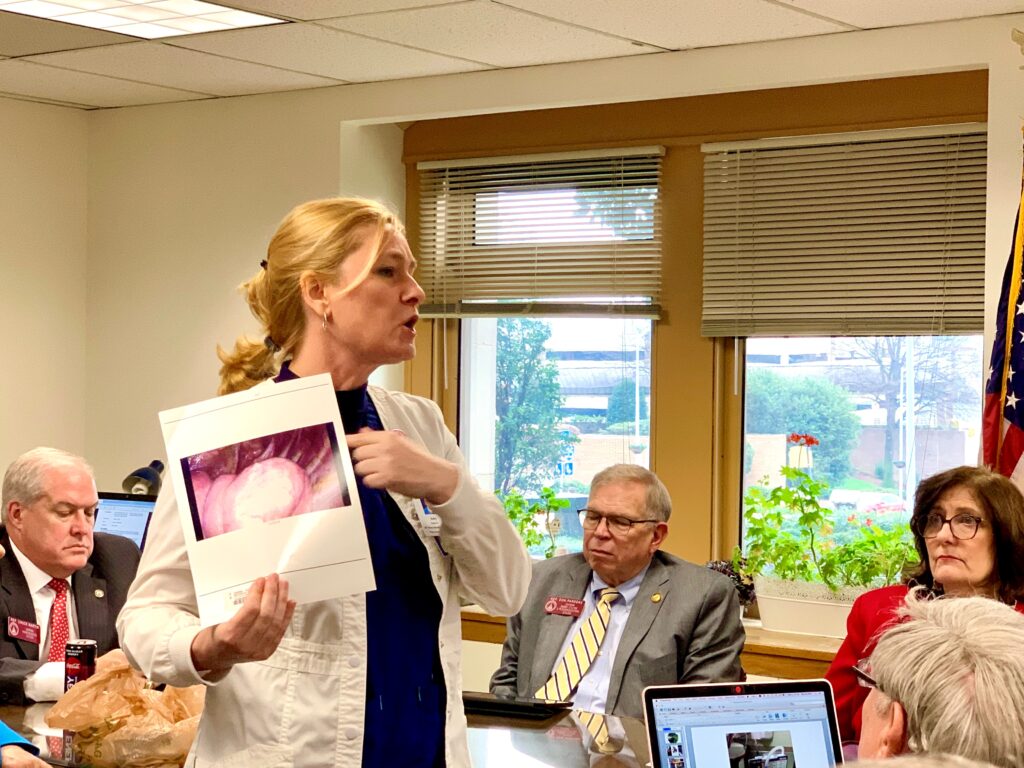
Northside Hospital nurse Amy Sedgwick shows a photo of her son’s lung to state lawmakers at a Feb. 19, 2020 hearing on vaping. (Photo by Beau Evans)
ATLANTA – Vaping could face a new tax in Georgia under a House bill state lawmakers began considering Wednesday.
Several legislators have targeted vaping amid studies showing a growing number of teenagers becoming addicted to nicotine and reports of dozens of vaping-related lung illnesses seen in Georgia by the state Department of Public Health.
But vaping proponents have long stressed
the activity provides a safer alternative to smoking tobacco that can help
addicted smokers kick the habit. Nearly
500,000 people die each year in the U.S. from tobacco-caused diseases,
according to the Centers for Disease Control and Prevention.
House Bill 864 would levy a 7% excise tax
on sales in Georgia of vaping products like e-cigarettes, refillable
cartridges, vape pens and electronic hookahs.
It would also require businesses that make, market or sell vaping products to procure special annual licenses from the state Department of Revenue.
The combined tax revenues and licensing
fees would raise an estimated $11.4 million to $17.1 million in the first year
the legislation takes effect, according to a fiscal note.
The bill’s sponsor, Rep. Bonnie Rich,
said the purpose is to curb vaping use among children. She said she does not
want to penalize adults who may use vaping products to curtail tobacco
addiction.
“I believe this is the best way to slow
down the flow to children,” said Rich, R-Suwanee.
Several supporters who spoke Wednesday
urged passage of the legislation to deter health harms traced to vaping and the
growing number of teenagers who try vaping products.
Students from the youth council in Sugar
Hill told lawmakers they have friends who have become addicted to nicotine
through vaping and go through intense withdrawal when trying to quit.
“Some of my friends have tried to stop, but they can’t,” said Avery Tam, a 17-year-old student at North Gwinnett High School. “Once passionate about school or sports or fashion, today they can only think about getting their fix.”
Amy Sedgwick, a nurse at Northside
Hospital in Forsyth County, recounted graphic details of her teenaged son’s
surgery after his left lung collapsed from heavy vaping use last year. Sedgwick
said he had only used vaping products from convenience stores, not any
off-market items laced with marijuana.
“No mother should have to watch their
17-year-old being wheeled off to surgery” due to vaping-induced injuries, Sedgwick
said.
Meanwhile, several vaping business owners
who spoke Wednesday highlighted the economic and health impacts of price
increases for vaping products caused by a new tax.
They warned higher costs for vaping could
drive longtime smokers back to cigarettes after they’ve made headway weening
themselves off tobacco via vaping.
“When you raise the price of this
product, people will go back to smoking,” said Keith Gossett, owner of Bucky’s
Vape Shop in Columbus.
Others focused on a provision in the bill
limiting vaping products to “face-to-face” sales only, which they worry could
eliminate online vaping sales that many retailers rely on in Georgia. Cutting
out online markets could benefit out-of-state companies not bound by the rules,
said David Higginbotham, president
of the nonprofit advocacy group Georgia Smoke Free Association.
“What we’re missing here is that while
vaping is not safe, per se, it is safer than cigarettes,” Higginbotham said.
A House Ways and Means subcommittee that
heard testimony on the bill Wednesday did not vote on whether to send it to the
full committee.
Rich’s bill will likely see tweaks to the
licensing arrangement and taxing specifics as it moves through the session.
It also figures in handful of other bills
that have been filed this session that take aim at colorful advertising
techniques and branding for vaping products believed to cater to children.
House Health and Human Services Committee
Chairwoman Sharon Cooper, R-Marietta, said last fall that she expects to see
legislation this year that would ban flavored vaping liquids in Georgia. That
kind of measure has yet to be filed.
Sen. Tonya Anderson (far left) talks with Sen. Randy Robertson (far right) about back-seat safety belt legislation on Feb. 19, 2020. (Photo by Beau Evans)
ATLANTA – Legislation aimed at requiring back-seat passengers to wear safety belts in Georgia hit speed bumps Wednesday as key Senate lawmakers disagreed over penalties and court implications for violators.
Georgia has required front-seat passengers
to wear belts in most vehicles since 1988. It remains one of 20 states that
lack similar rules for the back seat.
But under Senate Bill 226, every person
in a vehicle would need to buckle up – not just those in the front seat. Currently,
state law exempts back-seat passengers from needing to wear a safety belt.
The bill’s sponsor, Sen. Randy Robertson,
said the point is to make Georgia’s roads safer and reduce hospital and
investigation costs associated with auto crashes.
The measure poses an “opportunity to save
some lives in Georgia and I think save a lot of money,” Robertson, R-Cataula,
said during a Senate Public Safety Committee hearing Wednesday.
It would not end an exemption for certain
vehicles like tractors, mail carriers and school buses.
The Senate committee did not vote on the bill Wednesday.
Fines for violations would increase greatly under an amended version of the bill brought Wednesday from $15 to $75 for drivers and passengers, and from $25 to $125 for drivers who do let children ride without seat belts.
Some lawmakers balked at the steep fine
increases, worried they could hit low-income drivers and passengers hardest.
Senate Majority Leader Mike Dugan,
skeptical that raising fines would produce the desired effect, urged more talks
before the bill advances.
“I would like to have a conversation
about modifying those numbers a little bit,” said Dugan, R-Carrollton.
Also concerned about the fines was Sen.
Tonya Anderson, D-Lithonia, who filed identical legislation on back-seat belt
use days before Robertson did during last year’s legislative session.
At Wednesday’s hearing, Anderson
questioned the logic of setting fines so much higher, noting her own
legislation – Senate Bill 160 – would leave the fine amounts untouched.
“That bill did not have the over-policing
and the overbearing of fines,” Anderson said of her measure.
Robertson said he’s open to revising the
fine amounts but believes they need to be tough enough to encourage belt use.
Likewise at issue in Robertson’s bill is
whether to add a provision allowing civil courts in Georgia to admit evidence
that a person was not wearing a seat belt during a crash. State law currently
bars such evidence.
Supporters say allowing seat-belt
evidence in court would bring more fairness to court proceedings when lawsuits
are filed seeking big damage awards from insurance companies. But critics warn
shifting the burden of proof to crash victims could dissuade legitimate claims
from being filed, thus protecting insurers.
A Senate study committee formed last year
recommended changing the law to permit seat-belt evidence in court.
That committee was created through a
resolution sponsored by Anderson, who speculated Wednesday that her bill may
have been skipped over in favor of Robertson’s because she does not support
allowing seat-belt evidence.
Robertson, however, said he wants his
bill to pass without any amendments on evidence admissibility.
“I’m hoping by keeping this clean we totally
get away from the evidentiary issue,” Robertson said.
That approach is not favored by Sen.
Tyler Harper, R-Ocilla, the public safety committee’s vice chairman.
Harper wondered why more Georgia
passengers should be required to wear safety belts despite court evidence
protections – and even questioned the virtue of mandated belt use overall.
“I would be OK if we struck the entire
seat belt code from Georgia law,” Harper said. “I believe wholeheartedly in
personal responsibility.”
Former Tift County Sheriff Gary Vowell will temporarily head up Georgia’s public safety agency. (Credit: Office of Gov. Brian Kemp)
Former Tift County Sheriff Gary Vowell
has been tapped to head up the Georgia Department of Public Safety on an
interim basis following the resignation last week of former Commissioner Mark
McDonough.
McDonough tendered his resignation last Thursday at the behest of Gov. Brian Kemp in the wake of a cheating scandal in the agency’s cadet training program.
Vowell, a career law enforcement
official, was approved unanimously Wednesday by the state Board of Public
Safety to assume the interim commissioner role. He starts on the job March 1.
“My entire career has been devoted to
keeping Georgia families safe and upholding the highest ideals of integrity in
our law enforcement community, and I look forward to working in the Kemp
administration,” Vowell said in a statement.
The public safety department houses the
Georgia State Patrol, the Motor Carrier Compliance Division and the Capitol
Police Division.
Vowell was a field training officer and
peace officer instructor with the state patrol for two decades before being
elected sheriff of Tift County in 1996. He kept that office until 2012 when he
decided not to seek re-election.
Kemp touted Vowell’s qualifications
Wednesday, calling the former sheriff “a respected and trusted leader within
Georgia’s law enforcement community.”
“Given his background, I know that Gary will
be able to easily transition in this important role,” Kemp said in a statement.
McDonough’s resignation followed the firing last month of an entire cadet class caught cheating on an online exam required to use the agency’s radar speed detectors.
It also came in the wake of a cyberattack
in July that downed the agency’s main computer server for months and a break-in
at the state Capitol that left light fixtures and paintings damaged.
A U.S. Marine veteran, McDonough was a
state trooper in Blue Ridge before being tapped as the commanding officer of
the state patrol. He was picked for the commissioner post by then-Gov. Nathan
Deal in 2011.
ATLANTA – The race to fill former U.S. Sen. Johnny Isakson’s seat permanently looks to remain a free-for-all “jungle” primary involving candidates from all parties at once after legislative changes to that format were shelved Tuesday.
Under House Bill 757, special elections
in Georgia for suddenly vacated offices would require a party primary to be
held prior to a general election in the fall.
Currently, special elections do not
include party primaries, instead pitting all candidates who qualify against
each other simultaneously in the general election.
Changes to the bill introduced Tuesday
would apply the party-primary format to special elections starting in 2021.
That timing would keep this year’s U.S. Senate contest to permanently replace
Isakson as a free-for-all special election with no party primary.
The party-primary bill became a political hot potato last month when U.S. Rep. Doug Collins, R-Gainesville, announced his bid to unseat appointed U.S. Sen. Kelly Loeffler. Gov. Brian Kemp tapped Loeffler late last year to fill Isakson’s seat until the Nov. 3 election.
The bill was initially amended to require a party primary for the Senate race. Several of Collins’ supporters including Georgia House Speaker David Ralston, R-Blue Ridge, favored the change.
Many lawmakers and observers at the state
Capitol speculated restoring the election format to a traditional primary could
boost Collins’ chances to beat Loeffler before competing against the Democratic
candidate.
Without the changes, the November
free-for-all election will likely result in a January runoff. Special elections
require the leading candidate to secure more than 50% of votes to avoid a
runoff.
The revised bill would also apply the
party-primary format for special elections to state House and Senate seats.
Some state lawmakers worried Tuesday that adding more primaries for local
elections could be too expensive for many counties.
Originally sponsored by Rep. Barry
Fleming, R-Harlem, the bill’s changes in recent weeks have been brought by Rep.
Shaw Blackmon, R-Bonaire.
At a House Governmental Affairs Committee
meeting Tuesday, Blackmon said the latest changes aimed at pushing back the
start date were “requested by members of our body” and took into account how
the race “is playing out in the Senate.”
Georgia Secretary of State Brad Raffensperger, who favored holding off on the changes until next year, said the slower approach to tweaking elections in Georgia is prudent. He also called for creating a commission to keep studying the issue after the 2020 legislative session ends.
“It’s a very broad issue that deals with
several different races,” Raffensperger said. “It’s not just a one-off for a
congressional seat.”
Critics, meanwhile, wondered why the
changes could not take effect in time for this year’s elections.
“If the policy is good for Jan. 1, 2021,
then it should be good for now,” said House Minority Leader Bob Trammell,
D-Luthersville.
The race between Loeffler and Collins has
heated up amid rounds of political advertising. Collins has lampooned
Loeffler’s touting her upbringing on a farm in Illinois, despite now being a
wealthy CEO from Atlanta. Loeffler’s allies have cast Collins as too enmeshed
in the politics of Washington, D.C.
Aside from Republicans Loeffler and
Collins, and Democrat Raphael Warnock, the U.S. Senate race has drawn two other
Democratic challengers so far: Matt Lieberman, the son of former U.S. Sen. Joe
Lieberman of Connecticut, and Ed Tarver, a former U.S. attorney and state
senator from Augusta.