ATLANTA — The economic boom continued in Georgia last year, with a second record-topping year of business investment and job growth.
Gov. Brian Kemp and the state Department of Economic Development announced $35.2 billion in project investments for the fiscal year that ended June 30. That is up from $26.3 billion the prior fiscal year, which had also broken records.
The figures are for companies newly locating in Georgia and for expansions by existing companies. Expansions accounted for 79% of projects and for 15,370 of the estimated 25,300 new private-sector jobs, the joint statement Thursday said.
Sometimes familiarity breeds contempt, but that adage does not seem to apply to Georgia and business.
“The greatest vote of confidence is a company choosing to expand their existing operations in our state,” Kemp said.
Three out of four of the new projects and expansions were outside the 10-county metro Atlanta region, spreading economic opportunity to rural Georgia.
A chunk of that investment came from overseas. Foreign companies invested $7.8 billion and creating 9,350 jobs, according to the state. The top investors were South Korea, Italy, Belgium, Canada, and France.
Last month, German industrial giant Siemens announced plans to develop a 550,000-square-foot manufacturing plant near Pendergrass. The $185 million investment was expected to produce 1,400 jobs.
Kemp said the investments last year showed how his administration was delivering on its promise “to bring good-paying jobs to hardworking Georgians in every zip code.”
Kemp often refers to that magazine’s ranking when touting his administration’s record. On Thursday, he said that with the latest economic development figures, “we’re proving why we remain the No. 1 state for business.”
Rick Jackson, the Republican nominee for Georgia governor, has portrayed his priorities as a continuation of Kemp’s policies.
Jackson has said he would cut taxes while continuing to recruit companies to the state.
“I’m going to try to beat his record on putting together the most jobs, what he’s done in the rural areas,” Jackson said in August, when Kemp appeared alongside him at a Georgia Chamber of Commerce event in Athens.
Kemp said Georgia had “the most people working ever in the history of the state,” and he said he believed Jackson could “keep this going, and that’s why I’m supporting him.”
Jackson’s Democratic opponent, former Atlanta Mayor Keisha Lance Bottoms, has targeted the cost of living as a top campaign issue, saying she has a plan to help Georgians afford their grocery bills.
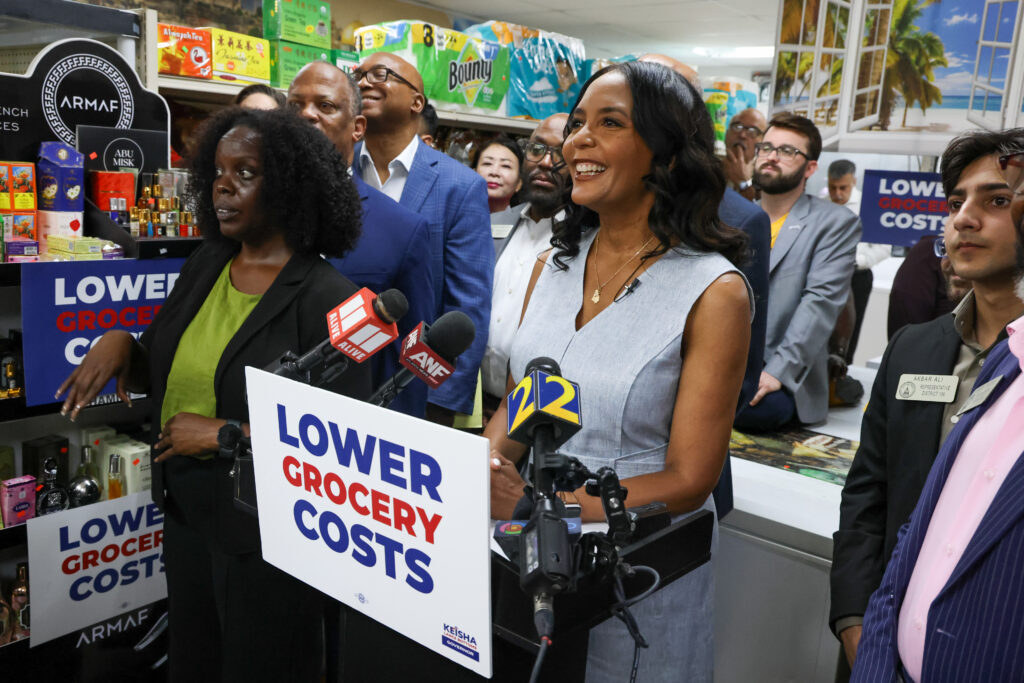
During a campaign stop at a Gwinnett County grocery store Wednesday, Bottoms unveiled her plan to encourage cities and counties to waive sales taxes on groceries.
The Democratic state senator for the area opened the event by saying that Kemp — and by extension Jackson — had their priorities backward.
“Things are tough for everyone,” Sen. Sheikh Rahman, D-Lawrenceville, said, asserting that Bottoms, not Jackson, would be best at attacking high costs.
She will do “everything to make sure the state of Georgia is not the No. 1 state for business,” he said, “but the No. 1 state for family.”
ATLANTA — With voters upset about the cost of living, both candidates for governor are rolling out affordability plans to woo them.
After Republican Rick Jackson pitched cuts to income and energy taxes last month, Democrat Keisha Lance Bottoms unveiled her proposal Wednesday to lower grocery bills by cutting the sales tax.
The state already exempts groceries from its 4% sales tax. Her new plan would give cities and counties the option of waiving theirs, too.
The former Atlanta mayor said that if voters make her the first Democratic governor of Georgia in more than two decades — and the first Black woman ever — she will ask lawmakers to let cities and counties opt out, too.
Speaking at a campaign stop in a small grocery store in Lawrenceville, Bottoms framed rising costs as an existential crisis.
Whether she goes to the hair or nail salon, the grocery store or church, Bottoms said, “people are talking about how expensive it is just to exist.”
Democratic gubernatorial nominee Keisha Lance Bottoms discussed rising prices and her plan to reduce costs by cutting local grocery sales taxes at a press conference at Al Huda Grocery in Lawrenceville, Georgia, on Wednesday, Sept. 2, 2026. (Caroline Newbern/Capitol Beat)
President Donald Trump has endorsed Jackson, and Jackson has said he would be Trump’s favorite governor.
The Bottoms campaign hopes that alliance hurts Jackson more than it helps him.
“Donald Trump ran on lowering grocery costs, specifically the cost of eggs, immediately when he came into office,” Bottoms said. “Well, we are still waiting on him to deliver on that.”
Bottoms’ affordability plan offers local leaders two options: permanently eliminate their sales taxes on groceries and other eligible essentials, or temporarily suspend those taxes when prices rise sharply.
She would establish a one-year $250 million state fund to subsidize communities for revenue losses in excess of 5% of the prior-year grocery-tax collections.
Bottoms could not do this alone as governor. Her plan is predicated on a major assumption: that Democrats will win control of both the state House and Senate, long controlled by Republicans.
She would need the cooperation of the General Assembly to get enabling legislation approved.
Bottoms said she hopes Democrats seize control of the Legislature but said she was prepared to collaborate with Republicans if they remained in power.
The Jackson campaign dismissed Bottoms’ plan, asserting that Atlanta became unaffordable when she was mayor from 2018 through 2021.
“Rick Jackson has treated it as a crisis since day one, and his plan doesn’t need permission from 159 county commissions,” Jackson campaign spokesman Garrison Douglas said in an email.
Speaking at an Atlanta barbershop in mid-August, Jackson said he would address the cost of living by attacking other types of taxes.
He said he would gradually cut the state income tax in half, eliminate state taxes on the electricity and natural gas delivered to residences and suspend the motor fuels tax during gasoline price spikes.
Jackson also pledged to freeze the rising home valuations that are driving up property tax bills.
The Bottoms campaign has labeled her opponent “Slick Rick,” an insult she used at her Al Huda Grocery stop Wednesday.
When a reporter asked her why Lt. Gov. Burt Jones, the Republican who lost to Jackson in the GOP primary runoff, had not endorsed Jackson, Bottoms said she thought it was because Jones did not trust Jackson, in part due to the money Jackson’s healthcare staffing company has earned from the state.
“Slick Rick received a $700 million no-bid contract in the middle of COVID, and he stood before cameras like this and said if he were elected, he wouldn’t continue to do business with the state of Georgia,” Bottoms said. “And then he just extended that contract three weeks ago.”
Jackson addressed the issue last month.
During his campaign stop at Tommy’s Barbershop, Jackson said any contracts his company held with the state could and would be canceled if he were elected governor.
ATLANTA — A Stone Mountain rapper will spend six years in federal prison after pleading guilty to charges involving the theft of thousands of checks from the mail.
Shamarri Tache Brooks, 34, pleaded guilty in May to bank fraud and aggravated identity theft, according to his record in the U.S. District Court for the Northern District of Georgia.
The federal indictment filed against him in December accused him of altering purloined checks to name recruits with their own accounts as the payees.
One check from August 2024 was for more than $655,000. Another the same day was for more than $122,000. Another the next day was for more than $405,000.
In a brazen twist that displayed an instinct for business, Brooks traded on his knowledge by promoting and selling a collection of his financial fraud methods, the indictment said.
As part of his fraud-promotion business, the indictment said, Brooks sold the check images on their own or packaged with check-forgery tutorials in what he called the “Sauce Book,” accepting payment on various digital platforms.
He even sold apparel, registering Brooks Merchandise as a limited liability company with the Georgia Secretary of State and marketing balaclava-style masks with bank logos and clothing with the logo “No Free Sauce” or “NFS.”
Authorities alleged that he used his own product while working: the indictment said he wore “No Free Sauce” masks when depositing stolen, altered checks at ATMs.
It is unclear how much money Brooks made from the side hustles, but Hertzberg’s office said he went unrewarded by the underlying work of check theft.
Brooks and his associates stole checks with a combined face value of more than $6.5 million, but law enforcement recovered many of the checks from Brooks’s home, adding that there was no evidence Brooks succeeded in “negotiating” the remainder of the stolen checks.
Hertzberg said Brooks’ victims were spared from any known loss. “Thankfully, Brooks’s ineptitude matched his boldness,” he said.
After prison, Brooks, who also goes by Juney Knotzz, will serve five years of supervised release.
Authorities noted that Brooks already had a criminal history, including convictions for drug trafficking, weapon possession, obstruction of law enforcement and battery.
This case was investigated by the FBI, FDIC Office of Inspector General, the U.S. Secret Service and the U.S. Postal Service Office of Inspector General. The Dunwoody Police Department and the U.S. Treasury Inspector General for Tax Administration assisted.
Neither the indictment nor Hertzberg explained how Brooks and his associates were able to obtain so many stolen checks, but authorities warned the public against leaving checks or other mail in mailboxes overnight and to use the letter slot inside a Post Office when sending mail.
ATLANTA — In late July, a new website popped online carrying local news stories from Georgia.
There was an article about a disgraced former Atlanta City Council member, another about President Donald Trump’s visit to Cobb County and one about Georgia coach Kirby Smart.
The stories were copied and pasted from other journalism sites, including Capitol Beat, and carried the original authors’ bylines, with links to the original publications.
But two pieces with no bylines have appeared on the Peach State Post’s website.
Both attack Democratic U.S. Sen. Jon Ossoff for his votes against Republican tax initiatives.
Then, there is another new website with a shared interest in publishing local news but with a divergent take on partisan politics.
It carried articles about Flock Safety cameras and a data center proposed in Columbia County, both originally published by USA Today Network properties and shared via Reuters Connect.
The site, called Courier Georgia, launched in May with one correspondent and features her original articles. Her reporting covers topics that are priorities for Democratic politicians, such as Medicaid expansion and the social media posts by the son-in-law of U.S. Rep. Mike Collins, the Republican running to unseat Ossoff in November.
The Courier also runs unbylined videos, with one featuring Collins walking away from a news conference about his son-in-law as Collins’ guards block the videographer following him. Another shows Ossoff calling Trump a “draft-dodging crook president.”
Both news sites have something in common besides being new: they’re run by people with partisan ties.
The Peach State Post site discloses it is paid for by One Nation.
It is part of a “fake news network” and Republican dark money, according to an article on a Substack site called Popular Information.
The article, published in early August, reported that One Nation was a dark money group that had given more than $70 million to the Senate Leadership Fund, a super PAC aligned with Senate Republicans. And it said One Nation had started six news sites in states with key U.S. Senate races, including Georgia.
Judd Legum, the author, was a campaign researcher for Hillary Clinton who switched to independent publishing.
Legum said in an interview that in addition to tracking campaign contributions he linked One Nation to the GOP Senate fund through technical methods, such as the tracking pixels on their websites.
An article published in July by Axios quoted an anonymous source who said One Nation’s executive director had said in a conference call with GOP donors and Senate Majority Leader John Thune that the group would be spending about $100 million against Democratic Senate incumbents in Georgia and two other states.
The Peach State Post and One Nation websites do not list contact information. A request for comment left by Capitol Beat on One Nation’s web contact portal in mid-August yielded no response.
Georgia Republican Party Chairman Josh McKoon did not respond to text messages asking about Peach State Post.
“I personally doubt that they’re involved,” Legum said. “I think that this is an extension of the super PAC and One Nation spending.”
Courier Georgia is part of the Courier Newsroom, which is owned by Good Information, Inc.
The Courier sites list Tara McGowan as publisher of Courier Georgia and as publisher and CEO of Courier Newsroom. The Poynter Institute, a nonprofit journalism school and research organization, identifies McGowan as the founder of Good Information.
The news site Notus reported in 2024 that McGowan was a Democratic operative who had pitched the Courier in a 2019 memo as an answer to GOP and right-wing investment in digital media. Axios reported in 2021 that Good Information was launching with millions of dollars in seed money from wealthy left-leaning donors, including Reid Hoffman and George Soros.
The Georgia Democratic Party said it had no comment, but Courier Newsroom responded in writing to an email asking about the organization’s reported partisan links.
“Every day, our award-winning reporters, editors, and social teams tell the stories shaping people’s lives — from Medicaid cuts and ICE raids to education battles,” wrote Mariela Rosario, the Courier Newsroom state managing director.
The email touted Courier’s presence on TikTok and said the network had an audience of millions and planned to have 20 newsrooms by year’s end.
“As local news disappears in too many places, we’re proving independent, values-driven journalism can grow without sacrificing credibility,” Rosario wrote.
Courier Georgia and Peach State Post started publishing in Georgia ahead of an election that could help decide which party controls the U.S. Senate.
Both sandwich real news around what journalism expert Karin Assmann described as political advertorials.
“It’s political branded content hiding behind real news, so it’s just muddying the waters,” said Assmann, an associate professor at the University of Georgia’s journalism school.
Assmann and Burton Speakman, an associate professor at Kennesaw State University, collaborated on a research article published in June that examined websites posing as news outlets while promoting a partisan worldview.
The industry term, they wrote, is “pink slime,” a metaphor ripped from headlines over a decade ago about the food-industry term for ammonia-treated beef trimmings.
It applies to digital sites masquerading as news, they wrote, because both the meat and the sites are slippery and hard to digest.
Assmann said the two new news entrants in Georgia look more sophisticated.
“It is more subtle than obvious propaganda, like an advertorial with political messaging disguised as news to encourage people to believe it — and without disclosing whose money is behind the message,” she said. “It’s actually a political ad, and it should be marked as such.”
Speakman, when asked if he thought Peach State Post was propaganda, sighed.
“Well, yeah. Of course it is. I mean, it’s being funded by One Nation,” he said. “The Peach State Post is trying to use legitimate news sources’ articles to provide them some credibility for the other stuff that they’re trying to slide in.”
Speakman called it “an advancement of the technique” used by the 30 sites in Georgia that he and Assmann characterized as pink slime in their paper.
But Speakman said the Post and the Courier, which were too new to have made it into their paper, are also misleading readers.
“They’re trying to legitimize themselves by using mainstream sources to manipulate the public into having a worse understanding of what’s going on in politics in the world,” he said.
Both Speakman and Assmann said that mixing partisan messaging with republished reporting was a dangerous development for democracy.
But Speakman thought the new projects would be short-lived, particularly those operated by One Nation.
“Unless there’s some sort of unforeseen runoff in one of these six states, those six sites are going to disappear,” he said. “They only bought their web domains, each of the web domains, for one year.”
As for the Courier properties, Speakman said Democratic media projects have often struggled to attract sustained funding.
“The history of liberal and progressive media sticking around has not been good historically,” he said. “Air America fizzled out, most of the liberal talk radio fizzled out.”
ATLANTA — Georgia will execute Stacey Ian Humphreys on Sept. 16 after postponing a prior execution scheduled for late last year.
Humphreys was convicted of murder and other crimes in in the 2003 deaths of Cyndi Williams and Lori Brown in Cobb County.
Georgia Department. of Corrections Commissioner Tyrone Oliver selected the new execution date after a Cobb superior court judge ordered it between Sept. 16 and Sept. 23.
Humphreys exhausted his appeals in October when the U.S. Supreme Court decided against him after twice declining to hear his earlier appeals. The Georgia Supreme Court had twice issued decisions against him.
He was sentenced to death for the murders of two real estate agents during the lunch hour on Nov. 3, 2003. The women worked in a construction company’s model home at a new Cobb subdivision when Humphreys walked in and killed them.
In September 2007, a jury convicted him of murder, assault, armed robbery and kidnapping. He pleaded guilty to possession of a firearm by a felon and was sentenced to death.