ATLANTA — The federal government announced the delivery Thursday of the rest of a $218 million award to Georgia to support rural hospitals.
The $93.3 million completes the first fiscal year of a five-year, $50 billion national funding program approved by Republicans in Congress last year in President Donald Trump’s One Big Beautiful Bill Act.
The Centers for Medicare & Medicaid Services said the money will pay for technical innovations at rural hospitals, such as surgical robotics and telehealth, plus medical training and recruitment, maternal and behavioral services, and newborn screening.
It will also help 87 rural Georgia hospitals prepare to provide what the federal agency is calling “value-based” care.
Dr. Dean Burke, the physician who leads Georgia’s Department of Community Health, said in a statement Thursday that the program will “have decades of positive impact” on rural healthcare.
U.S. Rep. Mike Collins, R-Jackson, thanked the Trump administration for “prioritizing rural communities.”
Collins, who is running to unseat Democratic U.S. Sen. Jon Ossoff, also attacked his opponent for voting with all other Democrats against the funding, which was part of the One Big Beautiful Bill and its budget and tax cuts.
Democrats had instead wanted to preserve funding for Medicaid, which the bill slashed by hundreds of billions of dollars.
Democrats have been attacking Collins and the GOP for their approach to healthcare, blaming it for rural hospital funding shortfalls.
For instance, the state Democratic Party asserted in late-July that Collins’ vote to pass “massive Medicaid cuts” had “solidified” St. Mary’s Sacred Heart Hospital’s decision to close its labor and delivery unit.
The Democratic Party has portrayed healthcare in Georgia as a crisis caused by Republicans and their refusal to expand Medicaid in the state.
A recent survey conducted by the University of Georgia for the Georgia Health Initiative found rising healthcare costs to be a potent political issue, especially among Democrats.
Concerns about rising costs cross party lines, according to the UGA survey, with 54% of Democrats and 38% of Republicans saying they were very or somewhat worried about being able to afford their monthly premiums over the next year.
The federal Rural Health Transformation Program that emerged from the One Big Beautiful Bill is sending $10 billion a year to the states over five years in the form of grants.
The state Department of Community Health said less than 10% of the first year of funding will go toward administrative costs.
The state budgeted $15.6 million to help seven hospitals prepare for the new federal efficiency and accountability program, along with 80 other hospitals that were awarded money previously.
Another $6.2 million will support a “continuum of care,” such as medical transportation, school-based health services and newborn screening.
Eight hospitals will split a portion of nearly $10.4 million for a dozen “telepods” for telehealth and for pediatric “telepsychiatry” training. The money will also cover other initiatives to improve healthcare access.
The second largest amount, $23.6 million, will go toward medical workforce development efforts, including training and nurse faculty recruitment at Georgia’s public universities.
More than a third of the funding, $37.5 million is for technological innovations, such as surgical robots at 13 hospitals that will also get funding for surgeon recruitment and retention. The funding will also cover a grant to Equifax for “eligibility system enhancements” to expedite “eligibility determinations.”
ATLANTA — An agreement to resolve a federal lawsuit brought by Georgia and other states and U.S. jurisdictions would require Meta to impose new limits on teen accounts on its social media platforms while also giving parents the option for more control.
The operator of Facebook and Instagram also agreed to pay up to $17.1 billion to the plaintiffs as part of the settlement proposal filed Wednesday in federal district court in California.
The proceeds would be shared among 47 states, Washington, D.C. and several U.S. territories, with Georgia to receive between $100 million and $135 million, state Attorney General Chris Carr’s office said.
Carr called it a landmark agreement, suggesting in a statement that there could be future cases, “and while Meta is the first to come to the table, they shouldn’t be the last. It shouldn’t take lawsuits, legislation or investigations to do the right thing.”
The lawsuit grew from a bipartisan, nationwide investigation that alleged Meta had designed Instagram to addict children despite the resulting mental health harms the company documented but did not publicly disclose, Carr’s office said.
The settlement also would resolve claims against Meta for sharing nonpublic information about Facebook users with Cambridge Analytica and others ahead of the 2016 election.
The leader of Fairplay, a Boston-based organization that has pressured state and federal lawmakers to act, heralded the settlement as a “watershed moment” protecting children from “addictive and dangerously designed social media.”
Still, Fairplay Executive Director Josh Golin said the court agreement did not exact enough concessions from Meta.
“We are disappointed that the settlement does not turn off by default recommendation algorithms that connect kids to predators and send young people down dangerous rabbit holes,” Golin said in a statement. “In general, the settlement is too focused on offering parents tools rather than restricting harmful features.”
The agreement calls on Meta to limit teen access to its platforms to two hours per day with access restricted from midnight to 6 a.m. and to restrict notifications during school hours. It also would limit features linked to eroding mental health, such as plastic surgery filters and “like” counts.
Meta already bans accounts for those under 13. The settlement would require the company to implement better processes to identify users that young and delete their accounts.
The agreement also would require that Meta encourage parents of teens ages 13 to 17 to take supervisory control over their children’s accounts.
Parents who take that step would be notified if their child communicates with another adult on the platform or engages in repeated searches for terms related to suicide, self-harm or eating disorders.
Meta would also have to give teens a “reasonably accessible” option to turn off algorithmic feeds, something parents could also control if their child’s account was enrolled in parental supervision. The account would then be restricted to content from accounts the teen follows, in chronological order.
Child-protection advocates were disappointed that those features required parents to opt in.
“If it’s not a default, it doesn’t get picked up,” said Sharon Winkler. “That’s pretty weak.”
Winkler has testified before the Georgia General Assembly about the risks of unbridled child access to social media.
Her son, Alex Peiser, died by suicide at age 17 in 2014, and she blames the Instagram algorithm that she said sent him dark memes, such as images of corpses, after he broke up with his girlfriend.
“He didn’t want to see pro-suicide stuff,” she said. “He wanted breakup songs” and support.
Winkler was also disappointed that the protections against child-adult interactions were optional rather than automatic.
“Good start but much more work to go,” she said.
Under the terms of the agreement, the settlement funds could pay for a variety of services, including crisis intervention, after-school or summer programs, youth mental health programming, outdoor activities, and investigations and litigation to improve teen safety on social media.
A spokeswoman for Carr’s office said Georgia’s proceeds would go into the state treasury.
ATLANTA — Growing public concern about license plate reader systems has led a key state senator to consider legislation to limit abuses by police.
After nearly weekly news reports of law enforcement officers accused of misusing license plate reader data for personal purposes, such as spying on friends and family, Sen. John Albers, R-Roswell, said on Tuesday that he was joining a new task force to explore whether legislation is needed.
He said other lawmakers also were invited to join.
“Like every citizen in our state, we’re concerned about the abuses that have taken place,” said Albers, who, as chairman of the Senate Public Safety Committee, has influence over law enforcement legislation.
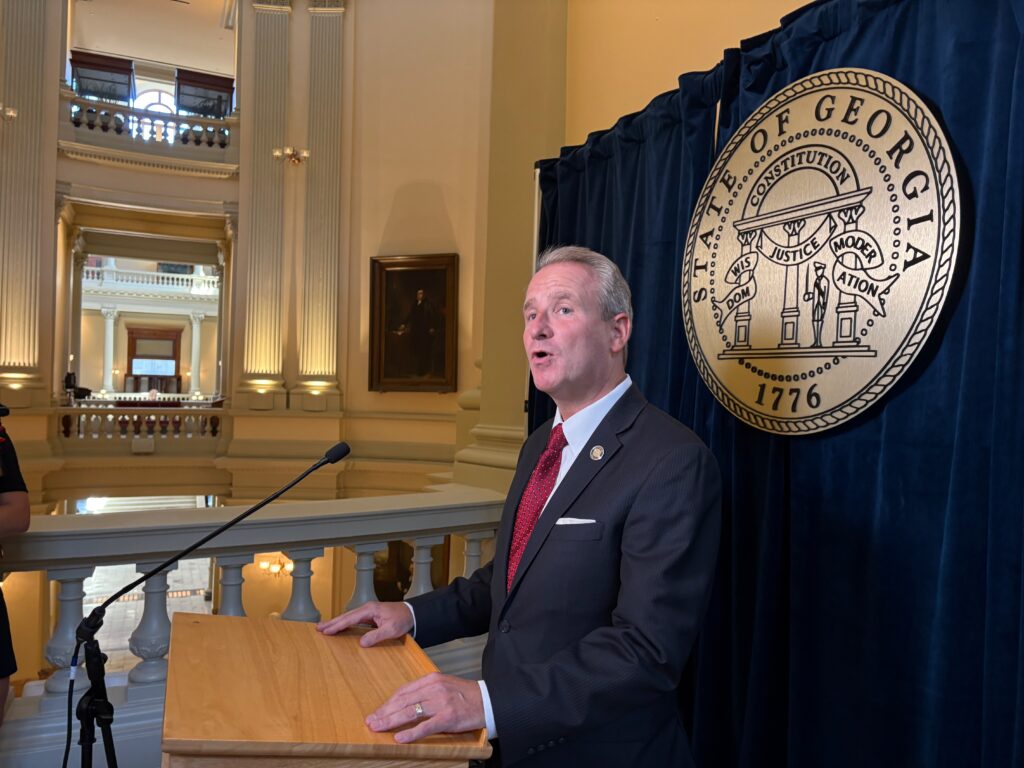
Sen. John Albers, R-Roswell, talks to reporters at the Georgia Capitol in Atlanta on Tuesday, Aug. 25, 2026 about a task force convened to address police misuse of the Flock Safety camera network. (Ty Tagami/Capitol Beat)
News reports about police misuse of the camera systems in Georgia increased this year, as more local departments started auditing use and reporting potential abuses to the Georgia Bureau of Investigation.
As recently as last week, three former officers in Savannah were charged with misuse of a license plate reader system and violation of oath of office, WSB-TV reported Monday, noting that a fourth employee also was charged with misuse of the system.
In separate Georgia cases, former law enforcement employees also have been charged with misuse, as well as stalking and computer invasion of privacy.
Atlanta-based Flock Safety is one of the leading companies in the license plate reader industry. The company told Atlanta News First in 2023 that its cameras were watching in at least 70% of Georgia’s cities.
The proliferation of its cameras has been accompanied by concerns about privacy.
At least 30 localities across the country had deactivated their Flock cameras or canceled their contracts with the company since the beginning of 2025, NPR reported in February. That report noted that Flock CEO Garrett Langley had criticized DeFlock, a crowdsourced mapping project.
As of Tuesday, DeFlock’s website reported that more than 130 cities had canceled Flock contracts, deactivated their cameras or otherwise rejected the systems. But the website said there were still at least 135,000 license plate readers in use.
In mid-August, Flock announced new accountability and privacy measures. The company said it was reducing its recommended default data retention period from 30 days to seven. It also said it was letting cities control the types of offenses that external law enforcement agencies could search their data for.
Flock’s network stitches together law enforcement across the country. Last week, the Utah News Dispatch reported that 10 Flock cameras in one county had been searched more than five million times between February 2022 and July, nearly 97% of the searches coming from law enforcement in 45 other states.
Flock has said its technology helped locate 10,000 missing persons in 2025, adding that the cameras contributed “significantly” to the recovery of stolen vehicles.
Police in Cobb County credited interagency access to the Flock network for the capture of the suspect in a deadly Midtown Atlanta shooting in 2023, according to Atlanta News First.
Albers said the new task force was formed by the Georgia Association of Sheriffs and the Georgia Association of Chiefs of Police.
Speaking to reporters at the Capitol, he said he was unsure whether any legislation would emerge from their discussions. He noted the distinction of legislating Flock cameras on public versus private property, and he emphasized their value to police work.
“People have concerns and public trust is paramount,” he said.
He also called the cameras “an invaluable crime-fighting tool.”
ATLANTA — Data centers are a financial boon to communities, according to the Georgia Chamber of Commerce, which is pushing back on concerns about their impact on the environment, on utility bills and on their neighbors.
The pro-business organization is launching a messaging campaign that extols the jobs and property tax revenue that data centers provide while asserting that their impacts through water and energy use are not as significant as many believe. The Chamber’s new Georgia Digital Infrastructure Alliance includes industry leaders, utility representatives, policymakers and community members.
Chris Clark, the Chamber president and CEO, said the group will begin briefing policymakers statewide in September. The goal, he said, is “to be transparent, to make sure that we have responsible development and that we show the benefits to communities because obviously there’s a lot of backlash and a lot of negative PR right now.”
Polling suggests the public is souring on data centers.
The Annenberg Public Policy Center at the University of Pennsylvania found 61% of Americans opposed the construction of new data centers in their area this summer, up 12 percentage points from the spring. The summer survey found opposition across party lines, with 69% of Democrats and 54% of Republicans opposing new local data centers.
The rising negative sentiment comes less than three months ahead of an election that will determine control over the state and Congress.
Former Atlanta Mayor Keisha Lance Bottoms, the Democratic nominee for Georgia governor, said at a Georgia Chamber event in early August that “we need a pause” on new data centers.
Rick Jackson, her Republican opponent, said at that same event that data centers produce so much property tax revenue that they can eliminate property tax bills for everyone else in at least 70 counties. Communities should get to choose whether to let one be built, he said.
In early April, Macon news station 13WMAZ reported that Jackson said he understands data centers because he invested in one in Texas.
Elsewhere, Republicans who once championed data centers are beginning to see them as a political liability.
Late last year, Texas Gov. Greg Abbott, a Republican, was touting data center investments. Then, in early August, he halted approvals for new data centers pending audits of their power and water use and their impact on neighbors.
His Democratic opponent had been rising in the polls while attacking him on the issue, The Wall Street Journal reported last week.
President Donald Trump has argued that more data centers are necessary to win an artificial intelligence race against China. But he also suggested recently that data centers need “a little public relations help,” according to multiple news reports.
Clark said the Georgia Chamber is pushing back with facts. Data centers use less water than a decade ago, he said, adding that in Georgia they are paying to build the energy infrastructure that will deliver power to them.
He challenged a central premise about the data center boom: that it is driven by AI.
“A lot of what we’re building out right now is to handle your Facebook posts, your medical records, your bank transactions,” he said.
Yet “AI” is in the name of the company behind the largest data center announced for Georgia so far. Project Camellia near Savannah, which is expected to need 3.2 gigawatts from Georgia Power, is for OpenAI.
The tech industry has been responding to concerns about water use.
OpenAI says its new data center will use a closed-loop cooling system, which reduces water consumption by reducing or eliminating discharge and evaporation. Other companies have announced similar systems.
However, closed-loop systems require more energy, and energy generation involves water.
Chris Manganiello, the water policy director for the Chattahoochee Riverkeeper, said state records show significant water lost to evaporation at power plants.
In 2023, for instance, Plant McDonough, a 2.5 gigawatt facility in Cobb County fueled primarily by natural gas, withdrew an average of 10 million gallons of water a day from the Chattahoochee River, he said. It returned a quarter of that water.
Research indicates data centers are consuming a lot of water.
“The exponential growth of artificial intelligence (AI) has driven the rapid global expansion of data centers, raising serious concerns about their environmental impact — particularly water use,” said an academic article published earlier this year.
Trade-secret protections and security concerns restrict what the public can know about data center water consumption, said the paper in AGU Advances, a peer-reviewed journal of the American Geophysical Union. But the paper added that available information suggests data centers rank among the top 10 water-consuming industrial or commercial sectors in the country.
Many Georgians are concerned about more than water.
Amy Sharma has been traveling around the state to attend town halls about proposed data centers.
The executive director of Science for Georgia said she and others are concerned the AI boom will turn into a bust, leaving communities on the hook for half-built or abandoned data centers.
Local leaders should require developers to post a surety bond to pay for redevelopment should a project go bankrupt, she said.
She disagreed with Clark’s sanguine outlook on protections for residential electricity ratepayers, pointing to a lack of legislation.
Last year, the state Public Service Commission, which regulates Georgia Power, did agree to the utility’s plan for a rate freeze, but the plan excludes “reasonable and prudent” costs related to storm damage and will be in effect for only three years. Then, during Georgia’s legislative session earlier this year, Georgia Power opposed a bill that would have made it illegal for the company to pass on costs for expanding the power grid to serve data centers for the long term. The bill was then weakened by amendments and did not pass.
And Sharma noted that a lawyer with the Southern Environmental Law Center told the Columbus Ledger-Enquirer in May that data centers are paying nothing toward the cost of new natural gas pipelines. Much of the additional generating capacity that Georgia Power is building to meet data center demand will be fueled by natural gas.
Public opinion will likely influence how big a welcome mat Georgia lays out for data centers, especially this November when voters head to the polls.
Sharma said she has witnessed growing opposition across ideological lines.
At one town hall, she listened as a man complained that the government first wanted to force everyone to take a COVID-19 vaccine and now was pushing data centers. She said she also heard someone wearing Bernie Sanders apparel complain about data centers.
Clark said many people are simply misinformed. When communities have questions, they should get transparent and responsible responses, he said. “I think a lot of what we’re seeing right now is both misinformation, disinformation, old information, and just the fear of the unknown.”
Manganiello said the industry and local leaders have brought this on themselves.
“Some data center developers and local leaders have not been entirely transparent about proposed projects,” he said. “When residents can’t get their basic questions answered, they go out looking to fill the holes.”
Manganiello welcomed an initiative by the Chamber to share more information before a project is approved.
“The question will be whether or not that is actually what happens,” he said.
Sharma predicted that Clark’s initiative would ignite more opposition.
“We’re advocating for a community’s right to choose the best path forward for themselves,” she said, sounding like Clark.
“But the best path forward must provide transparency, an open and democratic decision-making process, sufficient power and water, and a surety bond,” she said. “So I guess we’re also advocating against data center misinformation.”
ATLANTA — Facing renewed pressure over his business dealings as he runs for Georgia governor, Republican Rick Jackson pledged to end his healthcare contracting with the state by Dec. 31 if he wins the election against Democrat Keisha Lance Bottoms.
Appearing at an Atlanta barbershop with a handful of supporters Thursday, Jackson also pledged to cut taxes and the state budget during an event billed as a partial reveal of his affordability agenda.
If elected, he said he would eliminate state taxes on the electricity and natural gas delivered to residences. He said he would gradually cut the state income tax in half and also eliminate the state income tax on tips, building on the limited exemption passed into law by the General Assembly this year. He said he would sign onto a federal tax credit program that reimburses taxpayers for donations toward private school scholarships as Gov. Brian Kemp did earlier this year. And he said that sudden spikes in gasoline prices caused by international conflicts, natural disasters or other emergencies would trigger eliminations of the state motor fuel tax for at least 60 days.
“Government should not collect a windfall when families are being hit [by an] emergency,” said Jackson, speaking at a lectern at Tommy’s Barbershop in Atlanta.
“Earn More. Pay Less,” said a sign affixed to the lectern.
Jackson said he knew about economic distress, having been raised by an alcoholic mother who waited tables for a living. He said he had never met his father and had been on welfare at one point, according to a live video of the event provided through a partnership with C-SPAN.
Jackson pledged to freeze the rising home valuations that are driving up property tax bills.
Property taxes fund local governments and schools rather than the state, but Jackson also said he would cut billions from the state budget, as well.
“There’s not a business in the world that I can’t cut 10% out of,” he said. “You can find waste everywhere.”
He said he would balance the cuts with increased revenue from economic growth and by updating software at state agencies to reduce waste.
“If I can’t do it, it can’t be done, but I’m going to get it done,” said Jackson, who founded and runs Jackson Healthcare, a staffing and workforce company based in Alpharetta.
Jackson has grown his business into a financial juggernaut that allowed him to pour more than $100 million of his own money into his campaign.
Some of that wealth came from doing business with the state.
The Bottoms campaign pointed to reporting Tuesday by 11Alive that said a subsidiary of Jackson’s company had renewed a multimillion-dollar contract to provide health services to a state agency. The contract signed by Jackson expires next summer, 11Alive reported, six months into the term of the next governor.
“Rick Jackson promised to unwind his state contracts at the same time he was cutting a secret new deal to make millions of dollars off of taxpayers into 2027,” the Bottoms campaign said in a statement the next day.
On Thursday, Jackson said that legally there was nothing stopping him from holding a contract with a state agency as long as he did not work for that agency. But he said any outstanding contracts could and would be canceled should he win the election. He said he wanted to avoid the appearance of a conflict of interest.