ATLANTA — Communities across Georgia that were hit hard by Hurricane Helene will begin learning in November whether they will get a share of federal relief funding earmarked for water projects.
The U.S. Environmental Protection Agency awarded the state nearly $500 million to help improve water infrastructure after the hurricane. The bulk of the money, nearly $360 million, is for drinking water systems. The next largest portion, nearly $125 million, is for wastewater.
“As communities across Georgia continue to recover from the most destructive storm in state history, these funds will help accelerate that ongoing work,” Gov. Brian Kemp said in a statement.
The funding is from the federal 2025 American Relief Act. The Georgia Environmental Finance Authority is responsible for distributing the money.
Kemp’s office said the agency will present the first group of project awards to its board of directors in November, after calling for applications last fall.
The goal is to harden water systems against flood damage. Projects that are eligible for Helene Resilience Funding are supposed to either reduce the risk of flood damage or vulnerability to it or enhance resilience.
Examples of eligible projects include relocating or replacing equipment and facilities, decentralizing wastewater systems, installing backup power and planning.
ATLANTA — Georgia collected nearly $2.5 billion in net tax revenue in August, a 3.5% increase from August 2025, extending the overall year-over-year gains recorded in July.
The August increase was driven by receipts from individual income taxes and sales taxes, according to figures released by Gov. Brian Kemp’s office this week.
Individual income tax collections rose 3.5% from a year earlier. The nearly $1.2 billion in monthly revenue from the individual income tax was up $40 million from August 2025.
The rise in individual income tax collections reversed declines in June and July.
Net sales and use tax collections of more than $866 million were up $44.6 million, or 5.4%, from August 2025.
That increase built on a year-over-year rise in sales tax receipts in July.
Likewise, the adjusted sales tax distribution to local governments continued upward, totaling $911.9 million in August. It was an increase of $81.9 million over August of last year, or 9.9%.
Revenue from some categories fell.
Corporate income tax collections declined $21.4 million year-over-year, a 53.8% fall from August 2025. The total August collection in that category was $18.4 million.
Receipts from the motor fuel tax fell $6.6 million, or 3.3%, from August 2025, while tag and title fee collections for August increased $8.3 million, or 27.4%.
The decline in motor fuel tax receipts was slightly lower than the year-over-year fall of more than $10 million in July.
ATLANTA — The Georgia Constitution gives the state broad authority to exercise police power, but the state Supreme Court clarified the extent of that authority when it comes to private property rights.
In an opinion Wednesday, the state’s high court overturned lower courts that said the state had no obligation to compensate a farming company for crop loss caused by law enforcement activity.
The case stems from a drug-interdiction operation by the Governor’s Drug Suppression Task Force in the summer of 2021.
Three police helicopters and an airplane flew so close to legal hemp crops in Dahlonega that they destroyed two rows of plants.
The owner, Blue 42 Organics, is licensed to grow hemp in Georgia. As required, the company had logged the coordinates of its operations.
But that didn’t stop the police from flying near enough to the company’s crops for the aircraft’s rotor wash and prop wash to cause an estimated $37,000 in damage.
The company sued, and the state Department of Public Safety convinced a trial court that it had no obligation to pay for the damage. The state argued that its use of police power made it “categorically exempt” from the state constitutional prohibition on the taking of private property without “just and adequate” compensation.
The trial court dismissed the case, so the company appealed. Then, the Georgia Court of Appeals affirmed the dismissal.
When the state high court agreed to hear the case, the National Hemp Association filed a brief in support of Blue 42 Organics.
Hemp crops became legal after Congress passed the Agriculture Improvement Act of 2018. The Georgia Legislature followed with its own regulatory law.
The association said in its brief that the federal and state laws would be worthless if the Supreme Court allowed the state to inadvertently destroy hemp crops during what the brief described as “a routine aerial survey for marijuana” in the absence of an emergency.
“If state law enforcement agencies can destroy licensed hemp crops — without checking readily available licensing databases, without coordinating with the regulatory agency that issued the license, and without any obligation to compensate the farmer — then the federal-state regulatory framework that Congress and the Georgia General Assembly built is rendered meaningless,” the association’s brief said.
The outcome turned on the interplay between sovereign immunity, which shields the state from lawsuits; eminent domain, which allows the government to take land when compensating the owner; and on the extent of state police power.
The Georgia Attorney General’s office argued that the crop destruction was caused by police action rather than eminent domain, so the state did not have to compensate the owner.
That argument did not convince the high court.
The opinion, written by Chief Justice Nels S.D. Peterson, said case law allowed police to destroy private property without compensating the owner while either abating a nuisance or acting during “urgent necessity.”
But the Department of Public Safety’s motion to dismiss the case had failed to argue that either condition applied in the crop destruction, the opinion said.
Instead, the agency had argued that it was immune from being required to pay compensation through a “categorical police power exemption.”
That argument did not persuade the high court.
With all justices concurring except one who was disqualified, the Supreme Court reversed the Court of Appeals decision, ruling that the Department of Public Safety had failed to identify a categorical exemption that would apply to such a “routine” police action.
“The Constitution’s promise to protect private property rights would be an empty one if the State is permitted to avoid paying just compensation for taking or damaging private property merely by invoking the police power,” the opinion said.
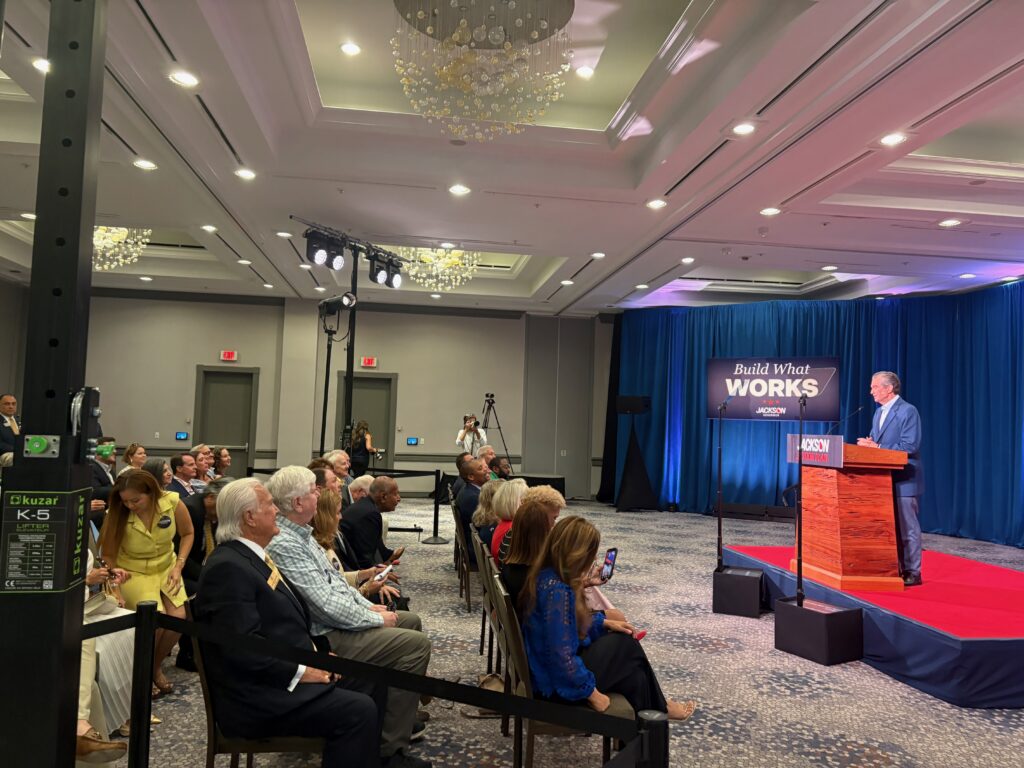
ATLANTA — Republican Rick Jackson unveiled an expansive pitch to voters Tuesday as he campaigns against Democrat Keisha Lance Bottoms to win the governor’s office.
Speaking before a small invitation-only group at the Westin Atlanta Perimeter, Jackson made five campaign promises that were broad in scope but narrow in detail.
His appearance came after Bottoms held an event at a Lawrenceville grocery store last week to unveil a plan to target the rising cost of living by encouraging local officials to waive their taxes on groceries.
The “Jackson action plan,” as he called it, goes far beyond one problem and one solution.
He reiterated the state tax-cutting plan he unveiled at an Atlanta barbershop last month: reduce income taxes by half, eliminate the tax on tips, suspend the gasoline tax during price spikes and eliminate taxes on energy for residential and small-business customers.
Jackson said at that campaign stop last month that he would pay for those tax cuts by increasing government efficiency, for instance with new computer systems, and by cutting the budget.
His new tax plan builds on something he announced last month: taking a bite out of rising local property taxes by freezing property values. On Tuesday, Jackson said he would require local governments to hold a public hearing and take a recorded vote before raising property taxes.
Rick Jackson, Republican candidate for governor of Georgia, unveiled his five-point “Jackson action plan” at the Westin Atlanta Perimeter on Tuesday, Sept. 8, 2026. (Ty Tagami/Capitol Beat)
Georgia law already requires local governments to advertise extensively and to hold three public hearings before voting to set a property tax rate that does not fall enough to offset any increase in tax proceeds caused by rising property values.
Jackson said he would attack housing costs by expediting permitting and inspections, which are largely functions of local government. He said he would ensure no data centers are approved unless they would not increase local utility costs. For the college-bound, he said he would freeze tuition, room and board at Georgia’s public colleges and technical schools.
And he said he would build on Gov. Brian Kemp’s template for Medicaid with “intelligent” expansion.
Kemp’s Pathways to Coverage program limits access by requiring participants to work, attend college, care for others or volunteer their time.
Jackson said he would expand coverage for those who earn too much to qualify for traditional Medicaid but too little to afford other coverage.
Unemployed able-bodied adults would be trained and linked to employment, he said. Meanwhile, he would discourage people from swapping private insurance for Medicaid.
“I believe every Georgian should have access to healthcare coverage or insurance,” said Jackson, who founded and operates a healthcare staffing company. “So on day one, I will close the coverage gap with intelligent Medicaid expansion. We will cover those who need it the most and keep work requirements in place for those who are able. And we will not force the 500,000 people who have subsidized private plans onto a government plan.”
Jackson said he would reduce overall medical costs by requiring “meaningful price transparency” so patients can price shop. He did not say how he would accomplish this.
He said he would pursue fraud, waste and abuse in state healthcare programs by using “modern technology.”
And he said he would use the state’s bulk-purchasing power to drive down drug and healthcare-related costs.
“Nothing is more important than making Georgia more affordable,” Jackson said. “Many Georgia families are working harder than ever and still feel like they’re falling behind. Affordability is a crisis and government needs to treat it like one.”
But Jackson also said public safety was the most important part of his plan. “Nothing else in this plan works if a family does not feel safe in its home, a child does not feel safe in walking to school, or a small-business owner is afraid to open the door,” Jackson said.
Jackson said he would end child sex trafficking and set high standards for law enforcement while providing the “right” resources. He took a dig at his opponent for her handling of public unrest when she was mayor of Atlanta.
“Keisha Lance Bottoms’ record in Atlanta offers a warning about what happens when police morale and staffing are not treated as priorities,” Jackson said. “As governor, I will make public safety a daily responsibility, not a talking point after a crisis.”
ATLANTA — Amie Anderson’s first instinct was rage.
Her daughter, a nurse, had just told her how a young mother had walked into the hospital and surrendered her infant.
Under Georgia law, hospitals are among the safe places where a mother can leave her newborn.
“I was just like, ‘Who in the world does this and why?’,” the elder Anderson recalled recently.
“And I’m just raging. I mean all-Christianity-out-the-window raging,” she said. “And my daughter was like, ‘Mama no, no, no: she was so brave.'”
Amie Anderson then felt a sense of guilt so profound that it spurred her to spend three years prodding Georgia lawmakers to amend the law.
She searched online and found news about babies abandoned in dumpsters and trash cans.
She also saw heartening stories, such as one about a firefighter in Ocala, Florida, who adopted an infant left in the “baby box” at his fire station.
Then, she had an epiphany: some scared mothers needed anonymity.
“My assumption is that having to look a person in the face and hand that baby over is scary,” she said. “And when people panic, they do stupid things.”
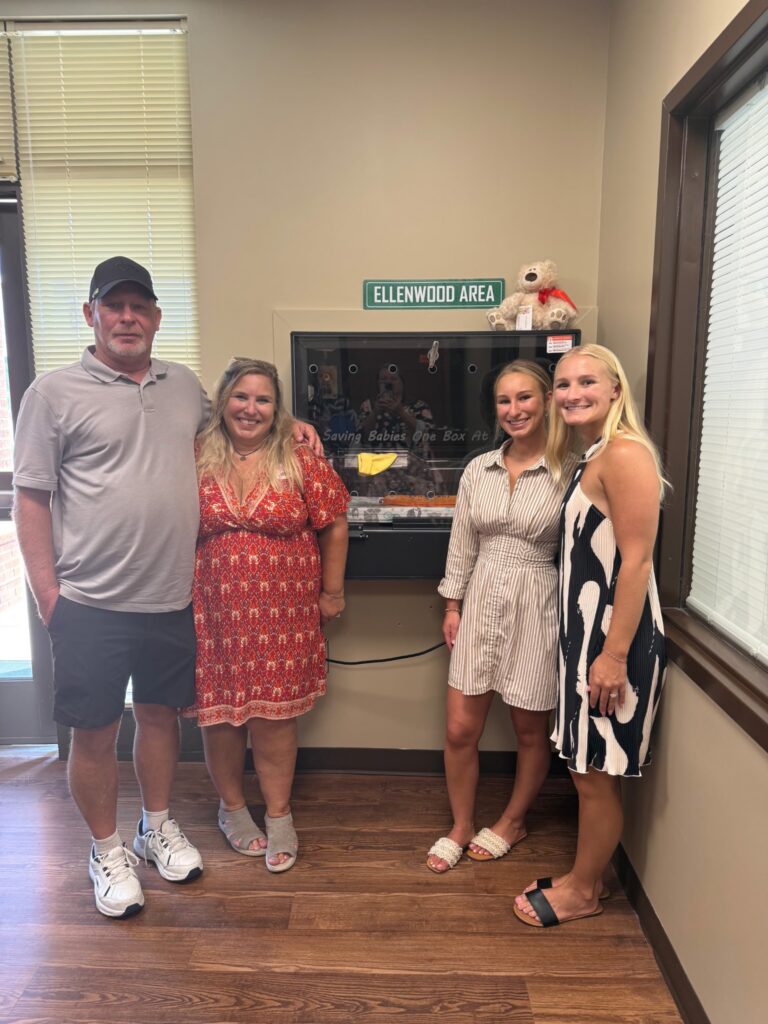
The Anderson family — from left to right, Jay, Amie, Kerri and Kadi — inside a Henry County fire station with Georgia’s first Safe Haven Baby Box. Kerri Anderson is the nurse who set her mother, Amie Anderson, on a three-year journey to make the boxes legal in Georgia. CONTRIBUTED
The Indiana nonprofit Safe Haven Baby Boxes made the box that delivered a baby girl to the Florida firefighter and his wife.
Each unit is built into an exterior wall at a fire station, hospital or other approved site. The temperature-controlled compartment contains a plastic bassinet. The external door locks after it is closed, and two alarms alert building personnel. The box also alerts 911 if no one opens the Plexiglass door on the inside and retrieves the baby.
Anderson called Safe Haven to ask about installing boxes in Georgia.
She said the organization told her she would have to get the law changed first. At the time, babies in Georgia could only be surrendered to warm hands at a designated safe place.
Anderson gathered allies, including her local state representative, who wrote legislation and then handed it to Rep. Mike Cameron, R-Rossville.
Finally, this year, they got the box law passed, but it almost didn’t happen.
House Bill 350 got a final vote during the last minutes of this year’s legislative session.
The 164-4 House vote was nearly derailed by a Senate amendment. It required that a camera be aimed at each box, in case someone put something harmful inside.
A Democratic representative asked a salient question: Wouldn’t the loss of anonymity undermine the whole point of the boxes?
“No. Maybe not,” Cameron said, refusing to take more questions and calling for the vote.
He was worried about where that debate might go, and how long it might take, he recalled. “It was a nail-biter.”
Cameron, who lives in northwest Georgia, read accounts of these boxes being installed in nearby Tennessee. He said he thought Georgia should do the same.
Georgia is now among 27 states where they are legal, according to Safe Haven.
“There’ll be babies saved,” Cameron said.
During hearings in the Senate, some lawmakers expressed unease about the boxes and wondered about the need.
“It looks like a book depository or something,” one of them said.
Another, Sen. Brian Strickland, R-McDonough, said the concept gave him “kind of a weird feeling, because who would leave a baby in a box, right?”
But he said he felt obliged to vote for the bill because the GOP-led General Assembly had banned abortion once a fetal heartbeat is detected.
“If we’re going to be a state that is pro-life, this is also notice to parents, to moms, that we’re all in, and we’re willing to help you even if you think you have no options,” Strickland said. “So I support this.”
Anderson, who testified at that March hearing, said she feared the committee would table the bill. Even if it didn’t, she worried about the addition of a camera mandate. She said that would have violated Safe Haven’s rules about the anonymity of parents.
Then, Sen. Matt Brass, R-Newnan, mentioned an account of a young woman in his part of the state who had given birth to an infant, then placed her in a cooler and left her by the side of a road. The body of the infant was found days later.
Brass worried about a failure with the baby box safety features, for instance if the alarm that calls 911 rolled over to voicemail. Still, he said, “I do think this is a way better option than a trash can or a cooler.”
A week later, the senators heard from a woman who was forever scarred by the incident Brass referenced.
Anderson had called a friend who knew her and asked her to speak at the hearing.
Jill Patterson told the lawmakers about how a detective had come to her door in March 2020. The officer told her a dead infant had been found in Troup County more than a year before, swaddled in sweatpants and zipped into a rolling cooler decorated with a pattern of watermelon slices.
Genetic evidence had linked the baby to Patterson’s family.
“Within three minutes, I learned that I had a granddaughter and she was dead,” Patterson said.
She said her 19-year-old son did not know about his high school girlfriend’s pregnancy and that the news devastated him.
The infant’s mother later pleaded guilty in the child’s death and was sent to prison.
Patterson said her family struggled every Dec. 28, the anniversary of the 2018 death, and each March 17, the date they learned of the infant they would name Eliza Jane.
“There are no simple answers for my family. Just the cold, harsh reality of what happened,” Patterson said. “But there is a simple answer before you, ladies and gentlemen.”
That was all the bill needed, Cameron said. “We all broke up. It was just a horrific story.”
One of the reluctant senators was so moved that he asked to change the name of the underlying law.
The Safe Place for Newborns Act of 2002, which gave mothers immunity from prosecution when they left their infants in a designated safe place, would become the Eliza Jane Warner Act.
The committee added that amendment and others, including the camera mandate and a ban on using state funds for the baby boxes.
The next week, on the final scheduled day of the legislative session, the Senate voted 49-1 to pass HB 350. That was about half an hour before midnight. More than an hour later, the House approved the Senate’s changes.
In late August, a fire station in Henry County celebrated the installation of the first baby box in Georgia.
Anderson said her group wants to raise $100,000 to $125,000 to install several more in the county, at a cost of $20,000 to $25,000 apiece for the installation, training and ongoing maintenance.
And what about those cameras that undermine the case for anonymity, the reason a scared mother might be drawn to such a box in the first place?
“We were all very angry about the whole camera thing,” Anderson said, but she said Safe Haven was fine with the final language in the law.
The wording requires a camera capable of recording anyone who accesses a box. It was “not real specific,” Anderson said, so they put the camera inside the box.
“That camera goes directly to 911, and you can see the baby, and you can probably see mama’s arms,” she said, “but you cannot see mama’s face.”