ATLANTA — Georgia voters turned so sharply in a new direction Tuesday that the results surprised even some winners and set several historical firsts.
Keisha Lance Bottoms is the first Black woman elected governor in U.S. history, but Georgia could also see a Black woman leading the state House.
Voters put a Democrat in every statewide elected office, from attorney general to agriculture commissioner, ousting four Republican incumbents in the process.
They also appeared to have handed the state House to Democrats while putting a Democrat in the presiding seat of the Senate — and second in line of succession to the governor.
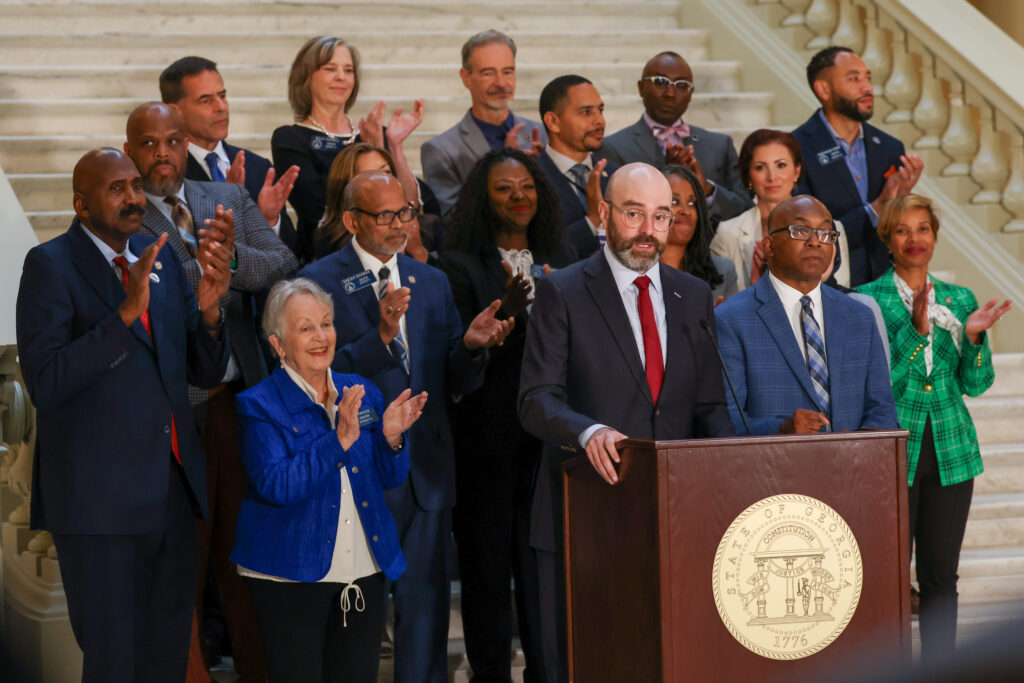
State Sen. Josh McLaurin, D-Sandy Springs, defeated state Sen. Greg Dolezal, R-Cumming, for the open lieutenant governor’s seat by more than 10 percentage points, according to the unofficial tally by the Georgia secretary of state’s office.
“What we saw was not just a blue wave. It was not just a blue tsunami. It was the complete and utter collapse of Donald Trump’s MAGA coalition,” McLaurin said at the state Capitol Wednesday. “What it means is that voters are tired of the culture war. They’re tired of the distractions. I think the one word I heard the most for 18 months on the campaign trail was ‘exhausted.'”
During legislative sessions, Dolezal focused on immigration, transgender athletes and other issues on the Trump agenda. In his campaign for lieutenant governor, Dolezal shifted to Islam, echoing fears voiced in Texas, where some Republicans had contended that parts of the state were at risk of falling under Islamic legal influence.
“I’m fighting to ban Sharia law,” Dolezal said during his campaign.
Voters did not buy what he was selling.
“Last night, we saw what happens when you traffic in division,” said Bentley Hudgins, the first openly transgender person elected to the Georgia General Assembly.
The incoming House member from DeKalb County defeated a Republican challenger, an outcome that was no surprise in that Democratic stronghold. But Hudgins won by more than 80 percentage points, according to the unofficial tally, taking nearly 28,000 votes to the Republican nominee’s more than 2,000.
Hudgins first came to the state Capitol a few years ago to advocate against legislation of the kind that Dolezal and his allies were promoting.
Hudgins would like to see legislation for LGBTQ+ people, such as protections for same-sex couples who want to adopt a child. But the incoming lawmaker has other priorities.
“We have kitchen tables too. And we want to eat groceries that we know won’t make us sick, that we can afford,” Hudgins said Wednesday. “We want to sit at a kitchen table in a house that we’re not sweating whether we can pay the rent or the mortgage.”
Democrats in the General Assembly have concluded that voters gave them a mandate on affordability, and said they intend to deliver, in part by working with like-minded Republicans.
Democratic leaders of the House expect to take control when new members are sworn in, in January, but Republicans appear to have kept control of the Senate by the slimmest of margins.
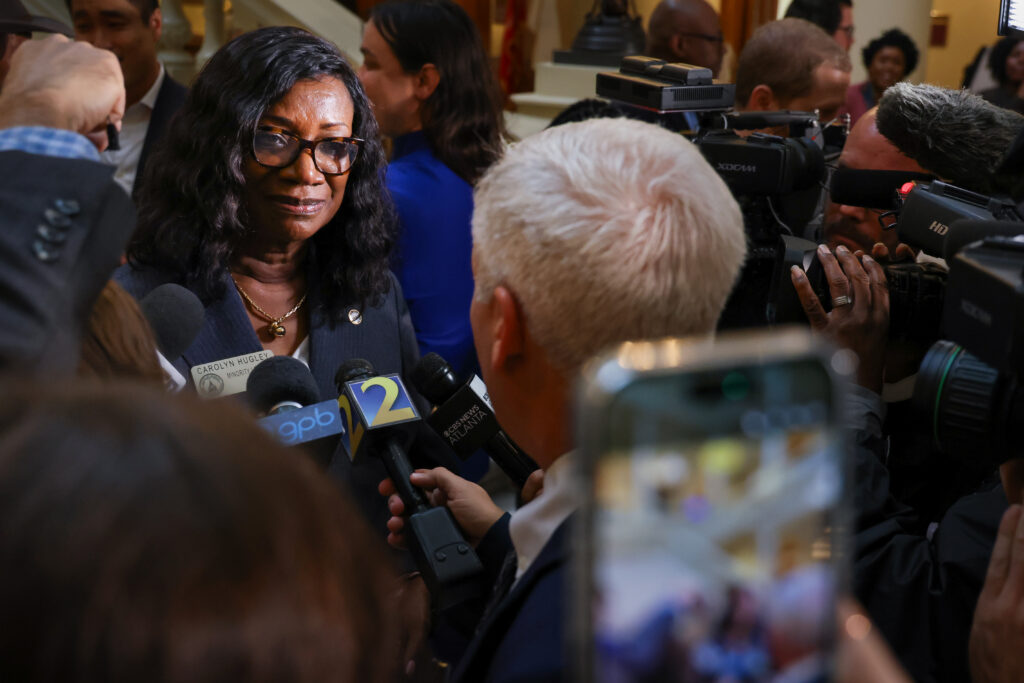
The performance by Democratic House candidates had Rep. Carolyn Hugley, D-Columbus, the minority leader, considering a bid to replace House Speaker Jon Burns, R-Newington.
If her prospective Democratic majority chooses her, she would become the first Black woman to lead the House, after serving 34 years in that chamber.
“So, it will be a historical moment,” she said Wednesday. “I only wish my parents were still alive.”
Hugley said she did not quite believe what was happening Tuesday night.
“I’ve been at these elections a lot of times when we went home crying, and so it was hard for me to believe when the results came in as early as they did. I’m like, ‘okay, is that really real?’ And then they kept coming, kept coming, kept coming.”
Like other leading Democrats, Hugley said she would focus her chamber on the cost of living.
“What Georgia citizens have told us is affordability is the No. 1 issue. And so you can expect the issues that we put forth in this first legislative session are going to be focused on meeting that challenge of affordability,” she said.
Bottoms campaigned on expanding access to Medicaid as most other states have done. It is a top goal for McLaurin.
Democrats will need help from Republicans to pass legislation, though.
McLaurin said Republicans appeared to have kept 29 Senate seats, which is a majority of the 56-member chamber with no wiggle room. A majority is needed to pass legislation.
Gov. Brian Kemp has opposed Medicaid expansion, and so have Republican leaders in the General Assembly. Few Republican lawmakers have publicly supported Medicaid expansion, but McLaurin said he knows several who have privately told him they would vote for it.
Rural Republicans have watched as hospitals in their areas have closed because of budget cuts, he said.
McLaurin could end up as a figurehead.
Twice since Republicans took control of the Senate in 2003, they have stripped power from the lieutenant governor, the first time when the occupant was a Democrat and the second time when he was a Republican.
“There’s quite a bit of precedent for that,” said Charles Bullock, a longtime political science professor at the University of Georgia.
Bullock said he would not be surprised if they did it again with McLaurin.
Republicans took control of the governor’s office and the Senate from Democrats in 2003, but they did not take the House until 2005.
Aside from that two-year period, control of the two chambers has not been split between the parties since at least the 1870s, according to Bullock.
But he said bipartisanship is possible under Georgia’s Gold Dome, where heels aren’t dug in quite so deeply as in Congress. He chalks it up to something as mundane as it is profound: seating charts.
In Congress, the two parties sit on opposite sides of a center aisle.
In Georgia, lawmakers are all jumbled together regardless of party. Relationships bloom across political divides.
“You get to talk to the person beside you about whatever the latest sporting event was or congratulate them because they have a new child or grandchild or whatever else,” Bullock said. “So you get to know them as individuals and therefore you can disagree without being disagreeable. So, this makes it easier, I think, to get things done.”
Kemp signaled a possible new direction for his party in a statement Wednesday.
He had been rumored to be considering calling lawmakers back to the Capitol for another special session this year, while Republicans were still in control, after GOP leaders declined to redraw maps in a June special session. The rumored goal was legislative redistricting.
But Kemp said in his statement that he would not call a special session for redistricting or “to curtail executive branch powers.”
The term-limited governor also posted a message on X for his fellow partisans.
“Republicans now have the opportunity, and responsibility, to heed the will of voters and learn from last night’s results,” Kemp’s post said. “I firmly believe the conservative principles of our party lead to greater freedom, security, and prosperity for all Americans — and it’s time we get back to those principles in the months and years to come.”