ATLANTA – Electric
scooters started showing up on city streets and college campuses in Georgia a
year and a half ago, but the General Assembly has yet to figure out how to
regulate them.
A state
Senate study committee has released a report recently on how to approach the
issue that is expected to become the starting point for a bill lawmakers will
consider during the 2020 session that kicks off Jan. 13.
The panel’s
recommendations seek to balance concerns for public safety driven by an
explosion of e-scooters in Atlanta and its suburbs with a desire to encourage
an industry with potential to help alleviate the metro region’s chronic traffic
woes.
“I’m not
against some common-sense regulations,” said Sen. Steve Gooch, R-Dahlonega, the
study committee’s chairman. “But we need to create innovation. … There’s an
opportunity here for Georgia to offer a private-sector solution to a problem
that’s been around for years.”
Georgia
cities’ reactions to the sudden proliferation of e-scooters reflects the
uncertainty surrounding the technology. While Atlanta, Brookhaven and Decatur allow
scooters, 12 cities have either banned them outright or imposed a temporary
moratorium on scooters while elected officials consider how to regulate them.
Even the
cities that allow scooters have imposed restrictions on their use. In Atlanta,
Mayor Keisha Lance Bottoms issued an executive order last year prohibiting
nighttime use of scooters, while the Atlanta City Council passed an ordinance
repealing the city planning department’s authority to issue new permits to
scooter companies.
The
crackdown followed several deaths involving e-scooters and complaints from
pedestrians about the number of scooters parked illegally on sidewalks.
The study
committee’s recommendations caution against overregulating scooters, suggesting
local governments refrain from either banning them or capping the number of
scooters allowed on local roadways.
Gooch said a
scooter bill that failed to make it through the Georgia House of Representatives
last year included so many restrictions it would have discouraged scooter
companies from setting up shop.
“The last
thing you want to do with an industry like this is overregulation,” he said.
But Michael
McPherson, a governmental relations associate with the Georgia Municipal
Association, said cities need time to weigh lingering uncertainties about the
safety of e-scooters.
“If we can’t
do a moratorium, how can we address safety concerns everybody agrees are
there?” he asked.
McPherson
said he has other questions about the study committee’s report, including its
recommendation that the state model rules of the road for e-scooters after
existing rules for bicycles whenever possible.
“Bikes are
allowed to go out on any highway that does not have limited access,” he said.
“That means roads with speed limits of 65 miles an hour.”
Gooch said
lawmakers and representatives of local governments and the scooter companies
will work to reach a consensus on such concerns during the upcoming legislative
session.
Although a
scooter bill Gooch introduced into the Senate last year is still pending, he
said he expects to start over with a new measure.
“There
should be common-sense guidelines for scooters, just like with automobiles,
bicycles and motorcycles,” Gooch said. “[But] the technology is continuing to
evolve. We don’t want to box them in too much.”
AT A GLANCE
Here are
some of the recommendations of the Georgia Senate study committee on electric
scooters:
The state should set the rules of the
road for scooters and match them with existing rules for bicycles whenever
possible.
The state should clearly define
scooters in statute broadly enough to anticipate future technology.
State and local governments should be
careful not to overregulate scooters.
State and local governments should
embrace safer roads with dedicated infrastructure for bicycles and scooters and
lower automobile speed limits in corridors with high scooter and bicycle
traffic.
Local governments should not restrict
access to scooters either by banning them or capping the number of scooters
allowed on local roadways.
State and local governments should
encourage the scooter industry to provide charging stations at fixed locations to
help reduce clutter.
ATLANTA – The
supermarket chain Lidl will build a regional distribution center in Covington,
a $100 million investment expected to create 270 full-time jobs, Gov. Brian
Kemp announced Friday.
The German
company cited Georgia’s excellent logistics infrastructure in its decision to
build the 925,000-square-foot center close to Interstate 20 in Newton County.
“Our
logistics infrastructure puts domestic and international markets within arm’s
reach, and leading brands from around the world are taking notice,” Kemp said.
“As the No.-1 state for business seven years running, Georgia’s ability to
support international companies looking to expand their U.S. footprint is
unmatched.”
Lidl has
opened four stores in Georgia and hired more than 150 employees in Augusta,
Marietta, Mableton and Snellville. The company operates more than 70 stores
across nine East Coast states.
“We look
forward to breaking ground on Lidl’s fourth regional distribution center in the
U.S. and hiring hundreds of new team members in Georgia,” Lidl US Chairman
Roman Heini said. “This centrally located facility will allow us to efficiently
deliver outstanding quality products to our customers at the lowest possible
prices and expand our network of stores across the region.”
The state
Department of Economic Development’s Global Commerce Division partnered with
Georgia Power Co. and Select Newton to land the project.
ATLANTA – Georgia
Rep. Richard Smith, R-Columbus, will succeed the late Rep. Jay Powell as
chairman of the powerful House Rules Committee, Speaker David Ralston announced
Tuesday.
“Richard
Smith has earned the trust and respect of every member of our House of Representatives,”
said Ralston, R-Blue Ridge. “He is a wise and thoughtful leader who always puts
the interests of this state and its citizens first. We are fortunate to have
Chairman Smith in this new role, and I congratulate him on his appointment.”
Powell, R-Camilla,
died unexpectedly in November at age 67. He had chaired the Rules Committee,
the “traffic cop” of the House because it decides which bills reach the House
floor, for just one year following the death of then-Rules Chairman John
Meadows.
Smith has served
since 2011 as chairman of the House Insurance Committee. He was elected to the
General Assembly in 2004 after serving on the Columbus City Council and, for
several months, as interim city manager of Columbus.
Smith’s House District 134 includes portions of Muscogee and Harris counties.
Ralston also named Rep. Eddie Lumsden, R-Armuchee, to succeed Smith as chairman of the Insurance Committee.
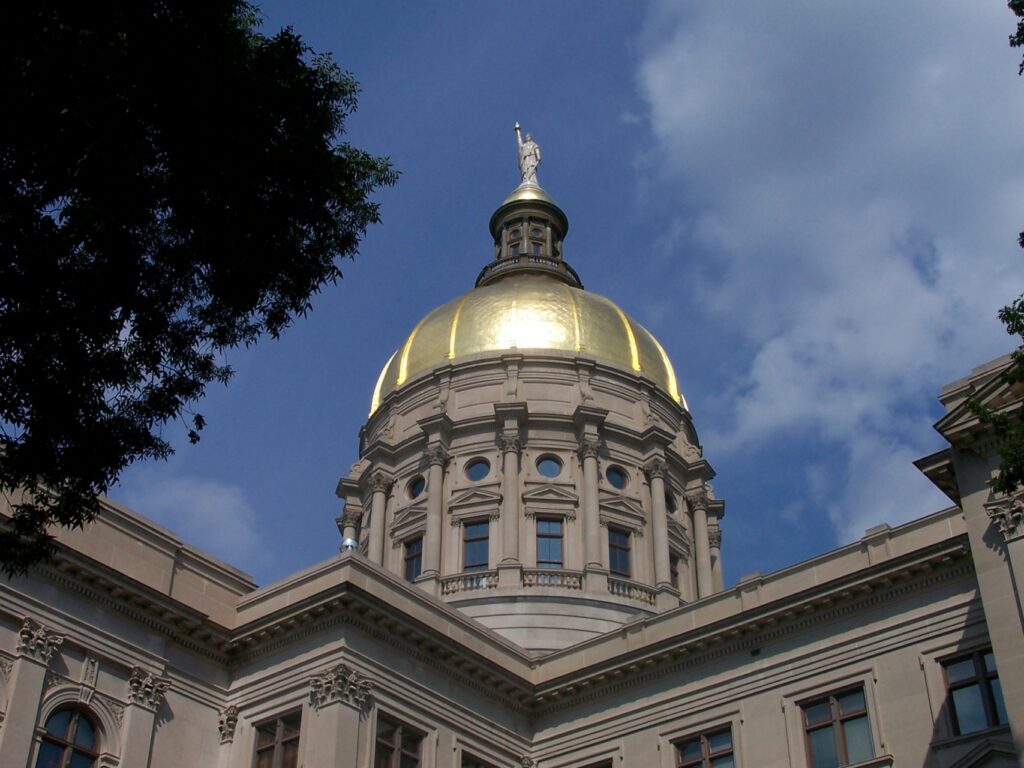
The steps of the Georgia Capitol will be renovated after this winter’s legislative session.
ATLANTA – The
historic limestone and granite steps at the north and south entrances of the
Georgia Capitol will get a makeover next year.
The Georgia
State Financing and Investment Commission has released a request for
qualifications seeking a contractor for the $1.5 million project.
Besides removing,
repairing and reinstalling the steps, the work will involve installing concrete
support walls, a waterproofing system, bronze handrails and floodlights.
Workers also will repair the crosswalk at the base of the south stairs.
The Georgia
Capitol has been designated as a National Historic Landmark.
Bids on the
project are due Jan. 15. The work will begin at the end of the 2020 General
Assembly session, likely in early April, with completion expected within 210
days.
ATLANTA – Georgia
Lottery ticket sales increased by $178.2 million during fiscal 2019, driven by
a huge jump in Mega Millions ticket sales.
Mega
Millions sales rose by $73.5 million, or 58.6%, to $199.1 million during the
fiscal year, which ended June 30, according to an annual independent audit the
Georgia Lottery Corp. released last Friday.
The report
attributed the popularity of the Mega Millions game to the size of the
jackpots.
“The Mega
Millions jackpot exceeded $400 million on three occasions during the year,
reaching a high value of $1.537 billion in October 2018, $522 million in June
2019 and $437 million in January 2019,” the audit stated.
Mega
Millions is a multi-state lottery game operated with 10 other states: California,
Illinois, Maryland, Massachusetts, Michigan, New Jersey, New York, Ohio,
Virginia and Washington.
Overall, the
lottery accounted for $4.776 billion in ticket sales during fiscal 2019, up
from $4.598 billion the previous fiscal year, representing an increase of
$178.2 million, or 3.9%.
Of that
amount, a record $1.207 billion was returned to education, including the HOPE
Scholarships program, up $63.9 million compared to fiscal 2018.
Scratcher
games accounted for the most lottery ticket sales. Scratcher game sales
increased by $77.6 million to $3.219 billion, according to the report.
The audit
attributed the growth of scratcher game sales primarily to the popularity of
the $10 and $20 games.