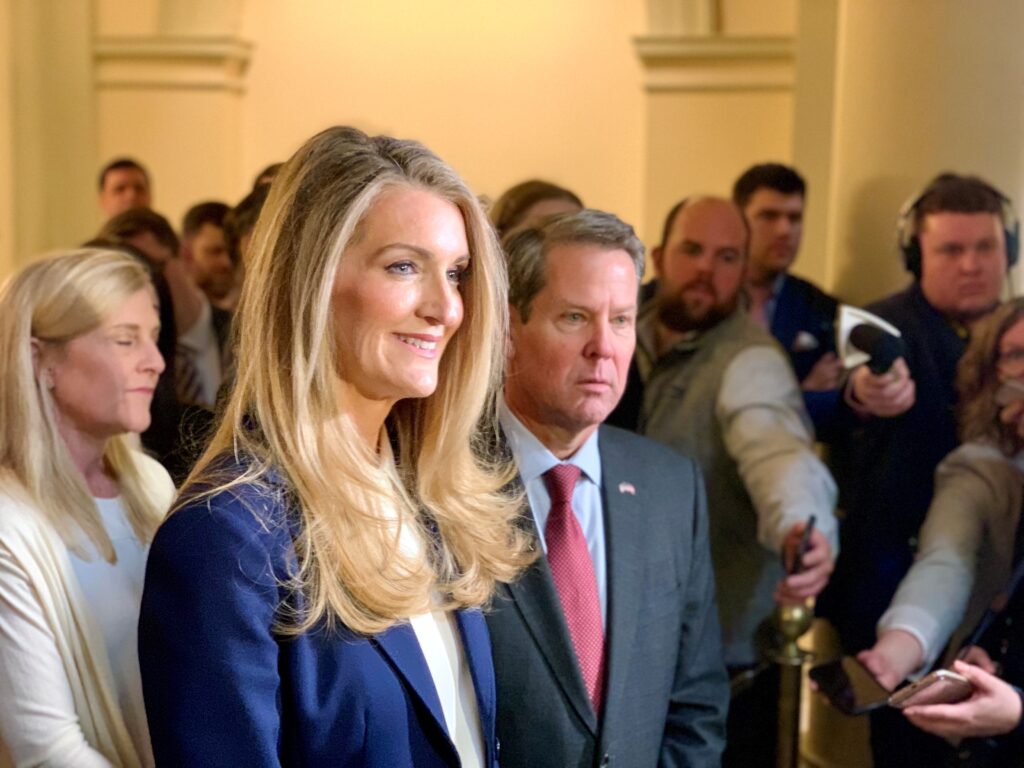
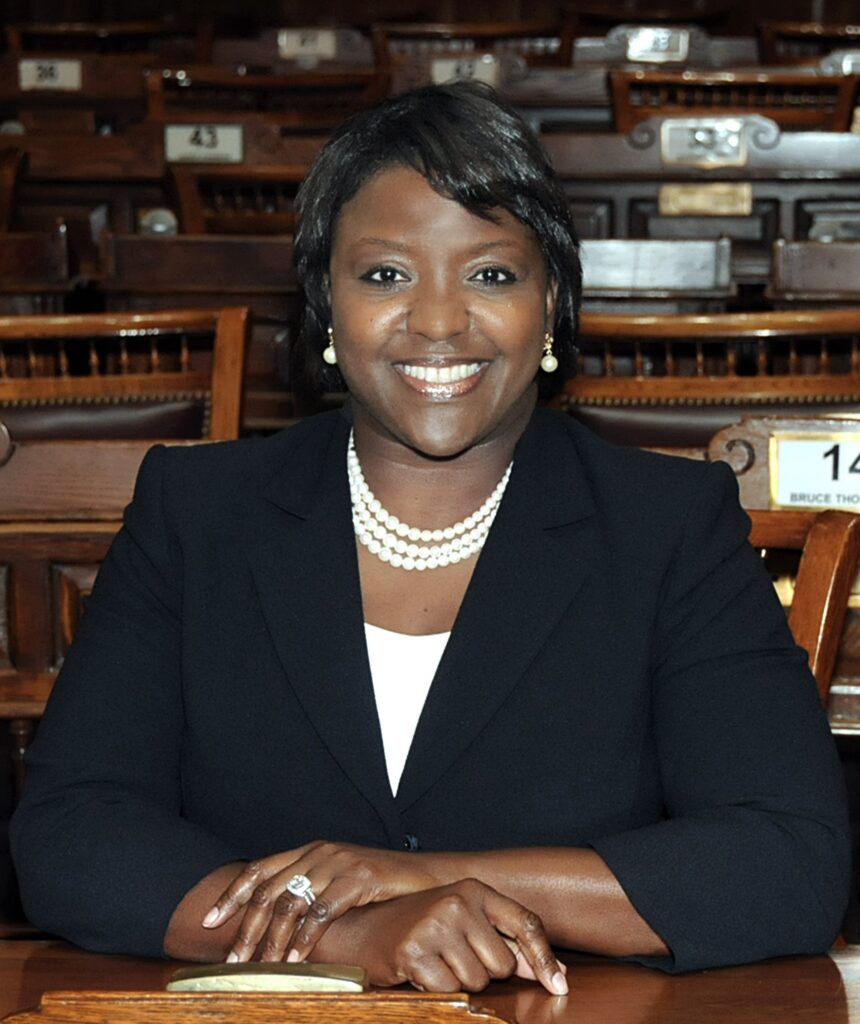
U.S. Sen. Kelly Loeffler speaks at the State Capitol after qualifying for the 2020 election on March 2, 2020. (Photo by Beau Evans)
ATLANTA – Georgia lawmakers began qualifying Monday for a spate of races in the 2020 elections, both for state and federal offices.
The 2020 elections see every seat in the
Georgia House of Representative and Senate up for grabs as well as all 14 U.S.
House seats and the state’s two U.S. Senate seats.
Candidates and incumbents for dozens of
state and federal seats had signed up within hours of the qualifying period’s
commencement.
Notably, all three Republican candidates
for Georgia’s two U.S. Senate seats made appearances at the Georgia Capitol
building shortly after qualifying, which kicked off at 9 a.m. The qualifying
period runs until Friday at noon.
Each angled for recognition as an
“outsider” candidate or incumbent with a strong affinity for President Donald
Trump’s policies.
Back-to-back showings at the Capitol of U.S. Rep. Doug Collins and U.S. Sen. Kelly Loeffler, who are competing with each other to fill the remainder of retired U.S. Sen. Johnny Isakson’s term, underscored the tense party in-fighting in Georgia this election season.
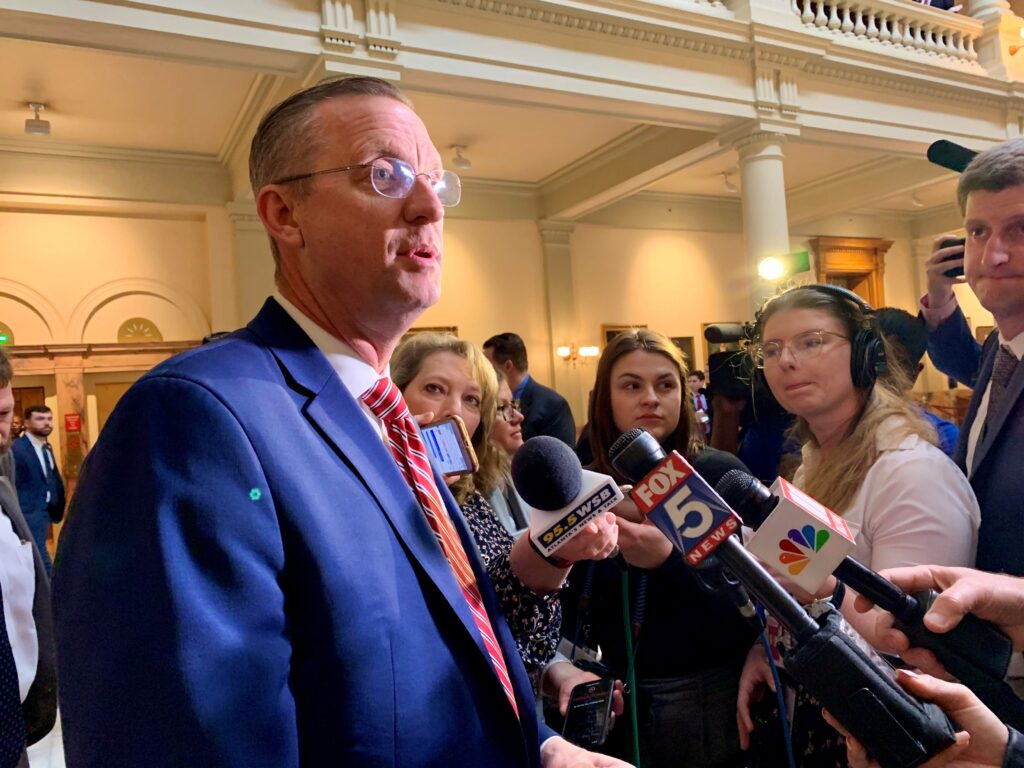
U.S. Rep. Doug Collins speaks at the State Capitol after qualifying for the 2020 election on March 2, 2020. (Photo by Beau Evans)
Standing feet from where Loeffler was
scheduled to speak, Collins railed against the attack ads by his opponents’
allies depicting him as an entrenched Washington politician.
He slammed the billionaire Atlantan who
has amassed $10.5 million for her campaign so far as out of touch with Georgia
voters, particularly the state’s farmers. Loeffler is seeking to woo voters
with her background growing up on an Illinois farm.
“Today begins a new day,” Collins said. “I
say bring it on. You can spend your money, but we’re going to have a debate.”
Loeffler then stepped out from a side
room of the Capitol’s North Wing alongside several high-profile supporters
including Gov. Brian Kemp, who appointed her in December to hold Isakson’s seat
until the November election.
Despite the recent campaign ads, Loeffler
pledged to run a Georgia-centric campaign aimed at uniting the state’s
Republican party against Democratic challengers.
“The state should not be at risk,”
Loeffler said. “I will not let it be at risk.”
Georgia Democrats eying an opening in the
race for Isakson’s old seat highlighted the intra-party conflict on Monday.
Alex Floyd, a spokesman for the Democratic
Party of Georgia, called the jousting between Loeffler and Collins “a no-win
scenario” for state Republicans that has resulted “in a multimillion-dollar slugfest.”
“While Republicans fight over who can appeal most to a narrow
base, Georgia Democrats are ready to focus on the issues that matter to Georgia
families,” Floyd said.
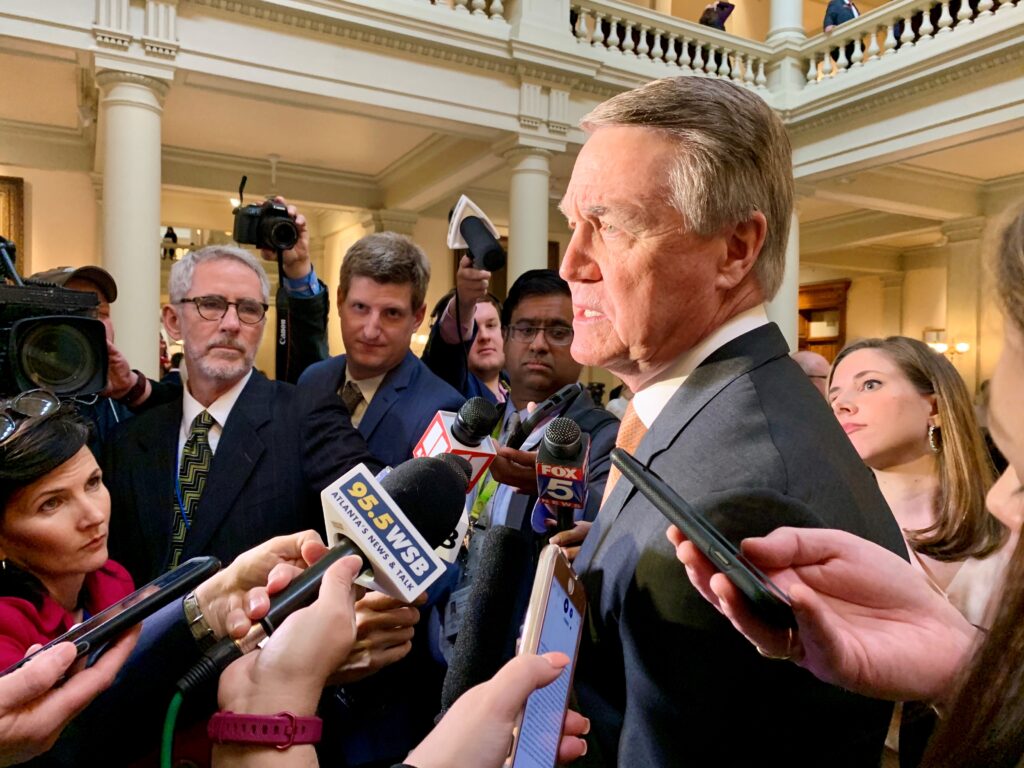
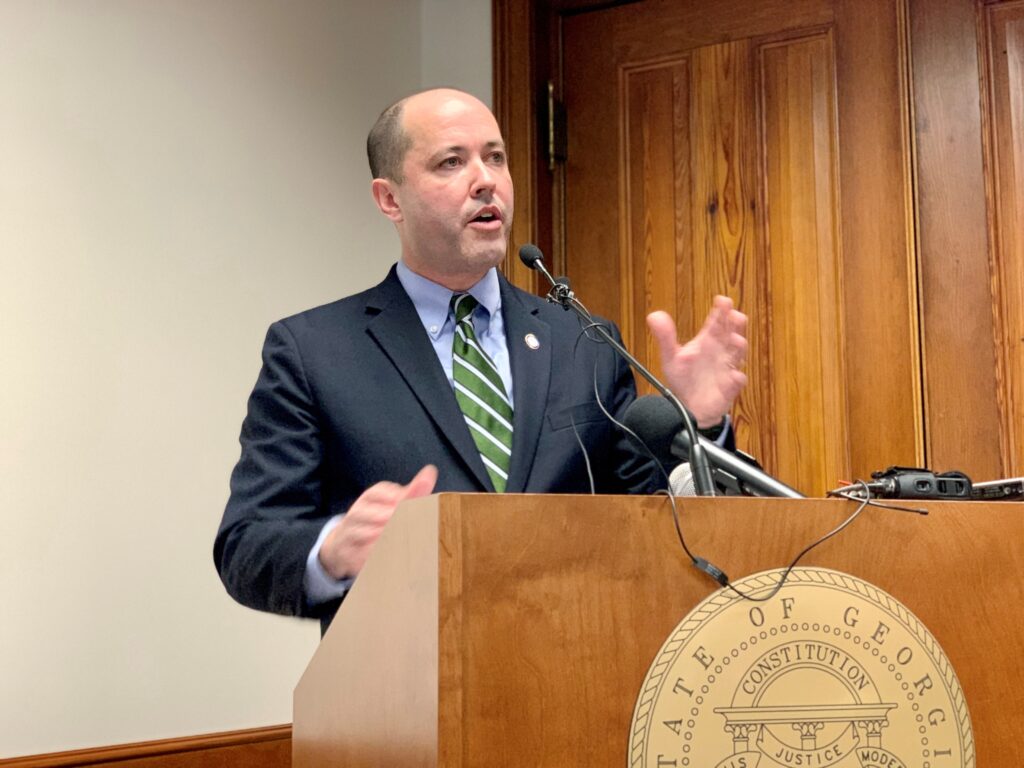
U.S. Sen. David Perdue speaks at the State Capitol after qualifying for the 2020 election on March 2, 2020. (Photo by Beau Evans)
Democratic contenders, especially
presidential candidate U.S. Sen. Bernie Sanders, loomed large in the speech
from U.S. Sen. David Perdue, who is seeking re-election to Georgia’s other U.S.
Senate seat. The GOP incumbent called for beating back support for policies
splitting the national Democratic party like Sanders’ Medicaid-For-All plan.
“What we have to do is to make sure once
and for all in the state of Georgia that the road to socialism will never run
through Georgia,” Perdue said.
The two U.S. Senate seats have each drawn a trio of Democratic challengers, including pastor Raphael Warnock. Warnock, Loeffler, Collins and others will compete for Isakson’s old seat in a free-for-all special election scheduled the same day as the Nov. 3 general election.
Two Democrats challenging Perdue qualified on Monday: former Columbus Mayor Teresa Tomlinson and James Knox of Evans, a U.S. Air Force retiree.
U.S. Rep. John Lewis, D-Atlanta, who was recently diagnosed with stage 4 pancreatic cancer, was also on hand at the Capitol for qualifying after rallying in Selma, Ala., on Sunday. As a young civil rights leader, Lewis was severely beaten during a 1965 march across the Edmund Pettus Bridge at Selma.
Besides Lewis, other incumbent Georgia
congressmen who signed up Monday to seek re-election included U.S. Reps. Buddy
Carter, R-Savannah; Sanford Bishop, D-Albany; Hank Johnson, D-Stone
Mountain; Lucy McBath, D-Roswell; Jody Hice, R-Greensboro; Barry Loudermilk,
R-Cassville and David Scott, D-Atlanta.
Several vacant House seats drew a good
deal of attention on the first day of qualifying.
Republican state Sen. Renee Unterman,
R-Buford, and Republican businessman Mark Gonsalves signed up for the GOP
primary for the 7th Congressional District seat being vacated by
Rep. Mark Woodall, R-Lawrenceville. Democrat Carolyn Bourdeaux, who came close
to beating Woodall in 2018, also qualified on Monday.
In the 9th District, which
Collins is vacating to run for the Senate, Republican state Reps. Mark Gurtler,
R-Tiger, and Kevin Tanner, R-Dawsonville, tossed their hats into the Republican
primary race. Three other GOP candidates – retiree Maria Strickland, crane
operator Michael Boggus and attorney Ethan Underwood – also entered the GOP
primary contest in the heavily Republican district.
And in the 14th Congressional District, where Rep. Tom Graves, R-Ranger, is not running for re-election, four Republicans qualified on Monday. The list of hopefuls includes businessman Kevin Cooke, neurosurgeon John Cowan, attorney Clayton Fuller and businesswoman Marjorie Taylor Greene.
Bureau Chief Dave Williams contributed to this story.
ATLANTA – Criminal justice advocates are pushing for Georgia to pass legislation this year aimed at restricting public access to certain criminal convictions when seeking jobs or housing.
More than 4.4 million people have a criminal record of at least an arrest in Georgia, totaling nearly half the state’s population, according to the Georgia Bureau of Investigation.
Several bills before the General Assembly would let a large portion of those people shield their criminal records from public viewing if they are not currently allowed under state law to do so. Law enforcement agencies would still have access to the records.
Supporters say passing second-chance
legislation would turn around the lives of people who have been denied good
jobs and housing due to a criminal background.
Those people would include Marietta
defense attorney Kim Frye’s father, who she said still cannot purchase a gun
after he was arrested 40 years ago for buying a weapon at a pawn shop. Frye
said her father’s case has sat on the court “dead docket” for decades,
languishing without a final judicial ruling while continuing to pop up in
background searches.
“This is truly your permanent record,”
Frye said about minor offenses like her father’s.
State law currently requires people with certain downgraded charges, vacated convictions and dead-docket cases to petition a court for restricting records. Only certain misdemeanor convictions can be shielded such as for alcohol-related charges, first-time drug possession and crimes committed before age 21.
So far, none of the roughly half-dozen
bills on records restriction still alive this legislative session has moved
past the committee stage for a full House or Senate vote.
The most recently filed measure, Senate Bill 288, would automatically restrict public access to most kinds of criminal convictions and arrest histories, except for several major offenses like sex crimes, drunk driving and child molestation.
The bill would shield records of felony
charges if 10 years have passed since the sentence was completed. That would
also apply for overturned convictions and any charges that never led to a
conviction.
Sen. Tonya Anderson (D-Lithonia)
Its sponsor, Sen. Tonya Anderson, said
expanding records-restriction rights could dramatically turn around the lives
of millions of Georgians whose minor offenses have kept them at a perpetual
economic and social disadvantage.
“This bill would bring about a great
economic change to Georgia,” said Anderson, D-Lithonia, at a hearing of her
bill in the Senate Judiciary Committee.
“Communities will be safer,” she
continued, “and the economy will improve so that those who have been
rehabilitated can have a second chance to take care of their families and be
reunited in society after having served their sentences.”
Other bills, filed by both Democratic and
Republican lawmakers in both chambers, propose different thresholds for having
records restricted. They include ranges of wait times after sentences have been
completed, from zero to five or more years for felonies.
Concerns remain over specifics about the
time needed to elapse before records could be hidden, said Houston County
Solicitor General Amy Smith, president of the Georgia Association of Solicitors
General.
She said some crimes like family violence
and stalking should not be shielded, but that her organization overall supports
the concept of broadening records restrictions in Georgia.
“We are not opposed and never have been to
records restrictions in certain circumstances and under certain conditions,”
Smith said. “[But] we have concerns about particulars in all of the bills that
we’ve seen.”
Transparency issues could also crop up if second-chance legislation results in hiding instance of repeated crimes that indicate patterns of behavior like drug abuse, said Richard Griffiths, president of the Georgia First Amendment Foundation.
Relaxing restriction rules too much might also increase chances for abuses of power by persons or organizations able to sweep misbehavior under the rug, he said.
“I am very sensitive to concerns about people wanting to rebuild their lives,” Griffiths said. “We can’t do that without building in protections for the public to understand what’s happening in the courts and what’s happening in society.”
State lawmakers passed second-chance
legislation in 2012 that expanded restriction rights for people whose charges
did not result in convictions. But Georgia has fallen behind in recent years
compared to other states, said Brenda Smeeton, legal director for the nonprofit
Georgia Justice Project.
She cited a recent study from the nonprofit Collateral Consequences Resource Center that found Georgia is one of three states that have not passed any second-chance legislation in recent years.
“The reality is that the vast majority of
the people that come to our office … can’t be helped under the current law
because it is so limited,” Smeeton said.
Limited job and housing opportunities also hurt programs that help people transition back into society once they are released from prison, said Brendan Spaar, a board member of the Greater Gwinnett Reentry Alliance.
Shielding records of people who have paid their dues would help erase the biases of employers and landlords inclined to deny life-changing opportunities over a long-gone criminal offense.
“If they can’t see it and it’s not really relevant to the job, then does it really matter?” Spaar said.
Anderson said she does not know if her
second-chance bill will be scheduled for a vote in the judiciary committee.
ATLANTA – Legislation has been filed in the Georgia House to clean up issues with the state’s lucrative film tax credit following a pair of scathing audits released last month.
House Bill 1037, sponsored by state Rep. Matt Dollar, would require all film productions located in Georgia to undergo mandatory audits by the Department of Revenue. The revenue agency could set up a credentialing program and contract auditing tasks out to third parties under the bill.
It would also tighten rules for how film
companies could transfer or sell unused tax credits to other businesses, a
common practice for production groups that conduct part of their movie-making
work outside Georgia.
Dollar, R-Marietta, said his measure
would improve watchdog rules for the popular film tax credit program that have
not been updated in more than a decade.
“In my opinion, this is something that is
very needed and very healthy,” Dollar said.
But he faced criticism Thursday over a
provision in the bill that would expand the tax credit to media coverage and
broadcasts of large special sporting events that happen infrequently, like the
Super Bowl.
Some members of a House working group
looking at film credits questioned the need for adding those sports broadcasts
to the credit list, noting state lawmakers are keen to tidy up deficiencies
with the existing program rather than expand it further.
“Pay the people that cover it? They’re
going to cover it anyway,” said Rep. Winfred Dukes, D-Albany.
Dollar said the state was potentially
leaving money on the table by not incentivizing more marquee sporting events
with the tax incentive.
The House Working Group on Creative Arts
and Entertainment did not vote on the measure Thursday.
Dollar’s bill follows back-to-back reports from the state Department of Audits and Accounts that found Georgia’s film tax credit has been poorly managed while being touted as having more economic impact on the state than it actually does.
Some local economists have pushed back on the findings of those two audits, noting they ignored the huge impacts the state’s film industry has even if the tax credit’s metrics and rules may be looser than they should be.
Even so, the film-credit audits spurred
calls from state lawmaker to keep closer watch over tax breaks and credits in
Georgia.
ATLANTA – A Georgia Senate committee Thursday tacked a fee favored by ride-share companies like Uber and Lyft onto a measure aimed at relieving income taxes for farmers hit hard by Hurricane Michael.
A proposed 50-cent excise tax for
ride-share bookings cleared the Senate Finance Committee after some lawmakers
questioned whether it should be added to legislation before the Georgia House
of Representatives meant for such a different purpose.
The original meat of House Bill 105,
sponsored by Rep. Sam Watson, involves an income-tax exemption for farmers
receiving federal disaster aid payments to recover from the destruction the
Category 5 storm brought to the heart of Georgia’s agriculture industry in late
2018.
The excise tax, which acts like a flat fee, stems from separate legislation to collect sales taxes from third-party retailers like Amazon and Google that facilitate online transactions for other businesses.
That legislation stumbled last year amid
opposition from Uber, which argued paying sales taxes would drive costs up too
high for its riders and drivers. The San Francisco-based company supports
paying the fee instead of a sales tax.
An amendment brought to Watson’s bill on
Thursday proposes such an exemption, while separately charging Uber and Lyft a
new 50-cent fee per ride for single-person bookings and a 25-cent fee for
shared rides. The fee would also apply to other transportation companies like
taxis and limousines.
Revenues would be dedicated to funding
transportation infrastructure repairs and public transit upgrades. Sen. Steve
Gooch, who pushed for the amendment to be added onto Watson’s bill, framed the
fee as a way to raise as much as $40 million a year for transportation
projects, particularly in more isolated rural areas.
“This is an attempt to protect
transportation,” Gooch, R-Dahlonega, said Thursday. “We know we need more
money. This is a way to do it without having to dip into the general fund.”
Barring a quick passage of the fee into
law, Uber and Lyft will be subject to the same sales tax collections that other
big marketplace facilitators face starting on April 1.
“If
action is not taken by April 1, Georgians will end up paying one of the highest
taxes in the county on ridesharing – making trips more expensive for students,
seniors, and commuters alike,” said Uber spokeswoman Evangeline Georgia.
The combined Hurricane Michael-Uber fee
bill by Watson passed out of the committee by a 9-1 vote. It heads next for the
Senate floor.
A similar 50-cent fee on Uber and Lyft rides had previously been slated for inclusion in a measure sponsored by Rep. Kevin Tanner, R-Dawsonville, that seeks to drum up more funding for rural transit services.
On Wednesday, state officials announced farmers in in the southern part of the state could start applying next month to receive Hurricane Michael recovery funds as part of a $347 million federal aid package.
Georgia Attorney General Chris Carr talks at the State Capitol on Jan. 27, 2020. (Photo by Beau Evans)
ATLANTA – A new investigative unit tasked with cracking down on human trafficking in Georgia has started paying dividends after its creation last year, according to state law enforcement officials and Gov. Brian Kemp.
Attorney General Chris Carr announced
Thursday indictments were handed down recently for four people charged with
human trafficking in Gwinnett, Chatham, Greene and Cobb counties.
Carr said more arrests and indictments
are expected to come from his office’s Human Trafficking Prosecution Unit,
which was launched last spring after.
“This is just the beginning,” Carr said
at a news conference Thursday. “We will stop at nothing to seek justice on
behalf of these victims.”
Kemp made going after human traffickers a high priority when he took office last year, citing Georgia’s unenviable status as a state with one of the highest rates of human trafficking in the nation. He formed a state commission to tackle the issue and installed his wife, first lady Marty Kemp, as one of three co-chairs.
On Thursday, the governor also
highlighted a new training program required for all state employees focused on
identifying signs of human trafficking and victimization.
“We won’t stop until we put an end to
this modern-day slavery in our state,” Kemp said.
Last year, state lawmakers budgeted about
$171,000 for four staff members in the new human trafficking unit. House
lawmakers have recommended reducing that budget this fiscal year by about
$87,000 due to hiring delays. Kemp’s fiscal year 2021 budget proposes an
additional roughly $194,000 for the unit.
Meanwhile, state lawmakers have targeted
human trafficking with bills in the 2020 legislative session.
Legislation aimed at helping victims of
human trafficking clean up any criminal records they may have cleared the
Senate Judiciary Committee on Wednesday.
Senate Bill 158, sponsored by Sen. Brian
Strickland, would let victims petition the court to vacate convictions for
crimes committed while they were being trafficked. Strickland, R-McDonough, who
is one of Kemp’s floor leaders, said the measure would reduce a major barrier
that keeps many formerly trafficked persons from finding stable employment.
“These are people that are trying to find
their way away from something that’s all they know,” Strickland said Wednesday.
Another measure, House Bill 823 sponsored
by Rep. Houston Gaines, R-Athens, would impose a lifetime ban on driving a
commercial vehicle for persons convicted of human trafficking-related offenses.
The ban would only apply for people who used commercial vehicles to traffic
victims.
Other legislation includes a measure
closing a loophole in state law aimed at punishing foster parents who sexually
abuse children in their care. House Bill 911, introduced by Rep. Ed Setzler,
R-Acworth, passed out of a House Judiciary Non-Civil subcommittee on Wednesday.
ATLANTA – Halloween signs and legal hurdles tripped up legislation aimed at requiring repeat sexual offenders to wear electronic ankle monitors for life in Georgia that a state House panel examined Wednesday.
Lawmakers are hustling to continue
monitoring sex offenders classified as “sexually dangerous predators” following
a Georgia Supreme Court ruling last year that upended the practice of automatic
lifetime ankle monitoring absent a judge’s sentence.
As a result, more than 400 sex offenders
deemed at risk for committing future crimes had been freed from their lifetime
monitoring punishments as of last October, totaling nearly half of the state’s roughly
1,000 sexually dangerous predators.
House Bill 720 would automatically impose
lifetime electronic tracking on sexual predators with multiple sex-offense
felony convictions. That should keep the state’s most dangerous sexual
predators from flying under the radar while Georgia’s rules on electronic
monitoring are in flux, said the bill’s sponsor, Rep. Steven Sainz.
“This looks at trying to identify the
population that has committed an offense and are most likely to be needing that
additional monitoring,” said Sainz, R-Woodbine.
But the measure does not tackle the
overarching issue of giving judges in Georgia full discretion to include
lifetime ankle monitoring as a form of probation included in an offender’s
original sentence, regardless of whether the crime was a repeat offense, Sainz
said.
He noted that proposal on judicial
discretion may come in a separate bill not yet introduced in the 2020
legislative session.
Currently, Georgia law gives the state
Sexual Offender Registration Review Board sole authority to classify sex
offenders in a way that forces them to wear ankle monitors for life.
That was the arrangement until last
March, when the state’s high court said lifetime monitoring would be
unconstitutional if not part of a judge’s original sentence.
A Georgia Senate study committee recently
recommended changing state law to give judges authority to incorporate lifetime
ankle monitoring into a sentence, which would factor in information provided by
the review board.
Members of a House Judiciary Non-Civil
subcommittee did not vote on Sainz’s bill’s Wednesday amid concerns from some
lawmakers and criminal defense attorneys who objected to the measure’s broad
scope – as well as a last-minute change requiring repeat sex offenders to post warning
signs outside their houses for Halloween.
Rep. Josh McLaurin, D-Sandy Springs, said
he opposed an amendment to the bill brought Wednesday concerning the Halloween
sign, which would legally have to say: “No candy, treats, or treat-or-treating
at this residence.”
The sign, which McLaurin called a
violation of free-speech protections, would have to be displayed every year on
Oct. 30 and Oct. 31.
“It’s just downright humiliating to have
to post that at your house,” McLaurin said. “And I understand that sexual
offenses are extremely serious. My concern would be that the dignity of a
person – and particularly with regard to their First Amendment interests – is
seriously implicated by this type of statutorily mandated language.”
Sainz said after Wednesday’s hearing that
he plans to keep the Halloween sign requirement but might modify what it says.
The bill could also cast too wide a net
over who might be subject to a lifetime-tracking sentence, McLaurin said. He
noted state law already sets lifetime imprisonment as the maximum punishment
for several violent crimes like murder and rape. Adding separate lifetime
penalties for various sexual offenses could cause legal murkiness, he said.
“My concern is this bill won’t do the
thing it’s supposed to do,” McLaurin said.
Officials on the state review board have
said they’re well-positioned to decide who should merit lifetime monitoring
because the board has comprehensive access to key information like an
offender’s criminal records, psychological profile and behavior history while
incarcerated.
But critics argue the review board has
too much leeway to set the stiff punishment, often doing so long after a judge
hands down a sentence or an offender is released from prison. They have also
claimed the review board’s methods for classifying offenders as sexually
dangerous predators are not transparent.
Broadening the kinds of sexual offenses that
could prompt lifetime monitoring could complicate the issue more than
clarifying it, said Jill Travis, executive director of the Georgia Association
of Criminal Defense Lawyers.
“We would continue to recommend that the
need for this lifetime monitoring should be tied to individuals’ sexual
dangerous and not a specific crime,” Travis said.
The subcommittee’s chairman, Rep. Ed
Setzler, R-Acworth, said he wants to see some tweaks to the bill but expects it
to eventually head to the full committee.