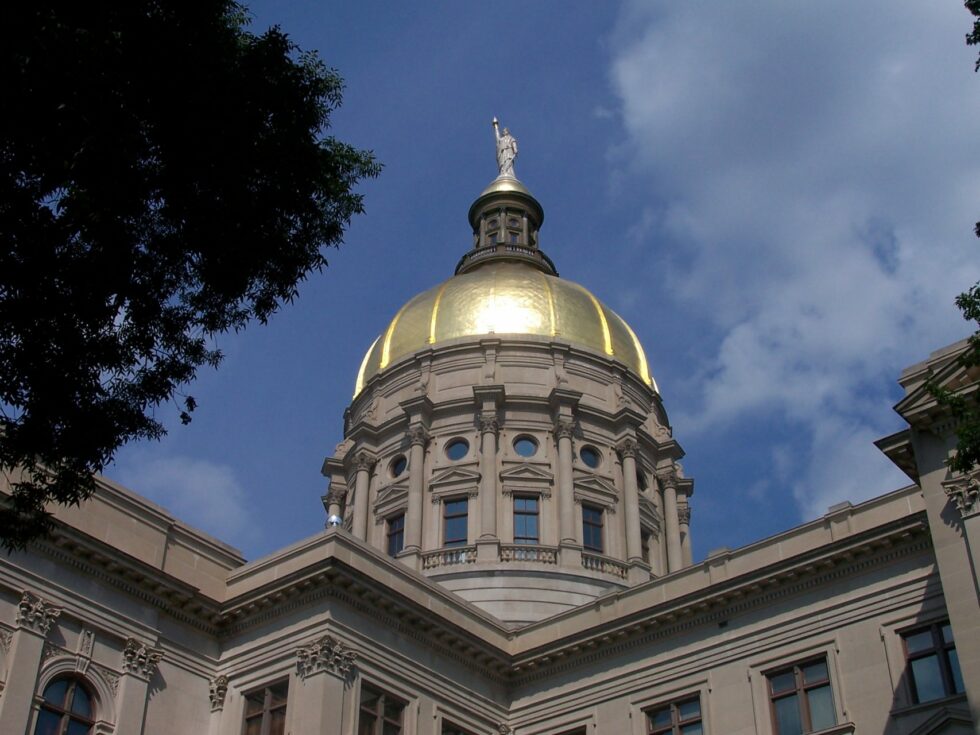
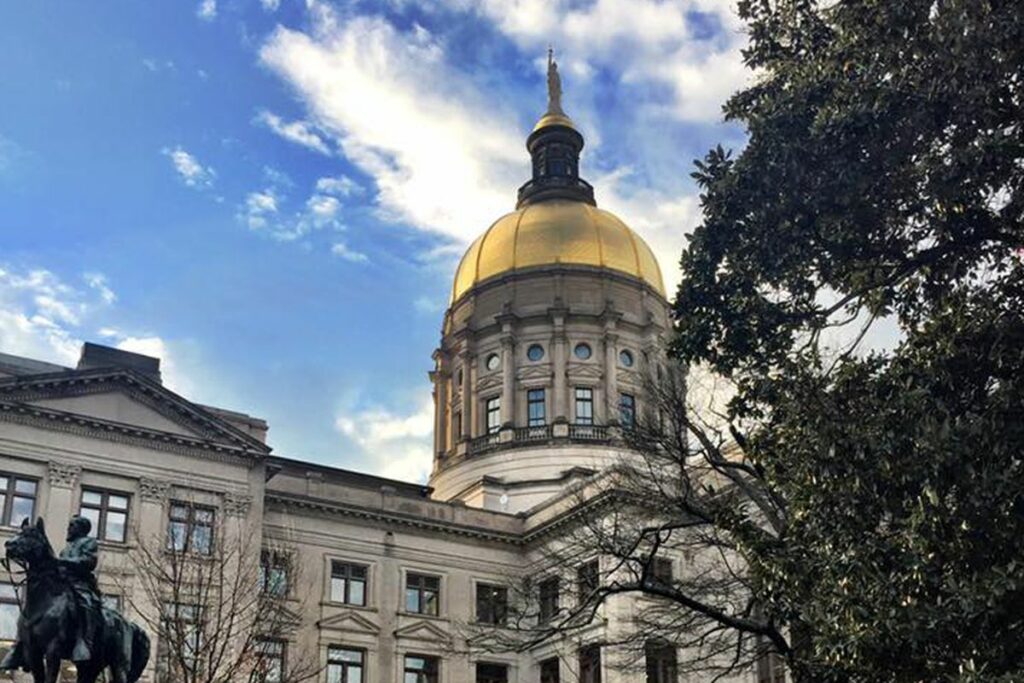
ATLANTA – Georgia Republicans and Democrats put positive spins on their 2022 election prospects Friday as the weeklong candidate qualifying period concluded at the state Capitol.
Both parties fielded candidates for every federal and statewide elective office.
A record-breaking 310 Democrats signed up to run up and down the congressional and legislative ballot, as the party looks to build upon its successes in 2020, when Democrats captured both of Georgia’s U.S. Senate seats.
“When I became chair of the Democratic Party of Georgia in 2019, we made it a priority to ensure Democrats were competitive in more seats all across Georgia – and this year’s qualifying numbers are a testament to those efforts,” U.S. Rep. Nikema Williams, D-Atlanta, said Friday.
But Republicans, too, were encouraged by the results of Qualifying Week.
“We qualified nearly twice as many canidates as the Democrats,” Georgia Republican Chairman David Shafer said Friday. “We have Republicans running for every statewide office and in every congressional district. Our Republican ticket this fall will be strong, wide and deep.”
Republicans will have to overcome divisions in the party over the response to President Donald Trump’s loss to President Joe Biden in Georgia in 2020.
At the top of the ballot, a slate of Republican candidates endorsed by Trump is running in the May 24 GOP primary against fellow Republicans, some of whom refused to join Trump’s bid to reverse the outcome of the election.
University of Georgia football icon Herschel Walker and former U.S. Sen. David Perdue top the Trump ticket. Walker is seeking the GOP nomination to oppose Democratic Sen. Raphael Warnock in November.
Perdue has Trump’s endorsement in his challenge to incumbent Republican Gov. Brian Kemp, whom Trump supported in 2018 but who would not go along with the then-president’s attempts to change the 2020 election results in Georgia.
Another race the former president is weighing in on is for secretary of state. Incumbent Republican Brad Raffensperger, who famously declined to try to “find” enough votes in Georgia to elect Trump, is being challenged in the primary by U.S. Rep. Jody Hice, R-Greensboro, with Trump’s blessing.
The Republican race for lieutentant governor also features a Trump-endorsed candidate. With incumbent Republican Lt. Gov. Geoff Duncan – who also crossed Trump over the election – not seeking a second term, the former president has endorsed state Sen. Burt Jones against Georgia Senate President Pro Tempore Butch Miller.
Some statewide races are more crowded than others. Nine Democrats qualified this week to run for lieutenant governor. Five more Democrats are vying for commissioner of labor, a post being vacated by Republican Mark Butler.
On the GOP side, the top-ballot races for Senate and governor each feature five candidates.
Some candidates are unopposed for their party’s nomination, including Democratic candidate for governor Stacey Abrams and Republican state Sen. Tyler Harper, who is looking to succeed Republican Gary Black as agriculture commissioner.
Black is leaving that post to run for U.S. Senate.
Here is the list of candidates who qualified for statewide offices this week:
U.S. Senate
Democrat
Tamara Johnson-Shealey
Sen. Raphael Warnock*
Republican
Georgia Agriculture Commissioner Gary Black
Josh Clark
Jon McColumn
Latham Saddler
Herschel Walker
Governor
Democrat
Stacey Abrams
Republican
Catherine Davis
Brian Kemp*
Former U.S. Sen. David Perdue
Kandiss Taylor
Tom Williams
Lieutenant Governor
Democrat
Georgia Rep. Erick Allen
Charlie Bailey
Tyrone Brooks Jr.
Tony Brown
Former Atlanta City Councilman Kwanza Hall
Jason Hayes
Georgia Rep. Derrick Jackson
R. Malik
Georgia Rep. Renitta Shannon
Republican
Georgia Sen. Burt Jones
Mack McGregor
Georgia Senate President Pro Tempore Butch Miller
Jeanne Seaver
Secretary of State
Democrat
Dee Dawkins-Haigler
John Eaves
Georgia Rep. Bee Nguyen
Michael Owens
Republican
David Belle Isle
U.S. Rep. Jody Hice
T.J. Hudson
Brad Raffensperger*
Attorney General
Democrat
Georgia Sen. Jen Jordan
Christian Wise Smith
Republican
Chris Carr*
John Gordon
Commissioner of Agriculture
Democrat
Georgia Rep. Winfred Dukes
Nakita Hemingway
Fred Swann
Republican
Georgia Sen. Tyler Harper
Insurance Commissioner
Democrat
Raphael Baker
Janice Laws Robinson
Georgia Rep. Matthew Wilson
Republican
Ben Cowart
John King*
Patrick Witt
State School Superintendent
Democrat
Currey Hitchens
Jaha Howard
James Morrow Jr.
Alisha Thomas Searcy
Republican
John Barge
Richard Woods*
Commissioner of Labor
Democrat
Georgia Rep. William Boddie
Thomas Dean
Nicole Horn
Georgia Sen. Lester Jackson
Nadia Surrency
Republican
Kartik Bhatt
Mike Coan
Georgia Sen. Bruce Thompson
Public Service Commission – District 3 (Metro Atlanta)
Democrat
Sheila Edwards
Chandra Farley
Missy Moore
Republican
Fitz Johnson*
Public Service Commission District 2 (East)
Democrat
Patty Durand
Russell Edwards
Republican
Tim Echols*
*denotes incumbent
This story is available through a news partnership with Capitol Beat News Service, a project of the Georgia Press Educational Foundation.
ATLANTA – The General Assembly came one step closer Friday to temporarily suspending Georgia’s sales tax on gasoline and other motor fuels to reduce pump prices that have soared in recent weeks.
The state House of Representatives voted unanimously to suspend collection of the tax through May 31.
Gasoline prices have skyrocketed since the Russian invasion of Ukraine more than two weeks ago and the subsequent ban on U.S. imports of Russian oil President Joe Biden imposed earlier this week.
The average price of a gallon of gas in Georgia stood at $4.29 on Friday, highest in the state’s history, said Rep. Jodi Lott, R-Evans, one of Gov. Brian Kemp’s floor leaders in the House.
The state has suspended the gasoline tax in the past when fuel supplies were disrupted. While the governor is legally permitted to suspend the tax by executive order when the General Assembly is not in session, this suspension must go through the legislature.
The bill will head next to the state Senate, which likely will pass it during the next legislative day on Tuesday. The suspension would take effect as soon as Kemp signs the bill.
This story is available through a news partnership with Capitol Beat News Service, a project of the Georgia Press Educational Foundation.
ATLANTA – The Georgia House of Representatives overwhelmingly adopted a $30.2 billion fiscal 2023 budget Friday that would increase state spending by 10.8% over the budget lawmakers passed last year.
A year ago, Georgia was struggling with a global pandemic that prompted businesses to close and lay off employees. The shaky economy left Gov. Brian Kemp and lawmakers uncertain of the impact COVID-19 would have on tax collections.
But tax revenues have been unexpectedly strong, allowing the governor and legislator to tee up election-year raises for state workers, teachers and university system employees.
“What a difference a year makes,” said House Appropriations Committee Chairman Terry England, R-Auburn.
The fiscal 2023 budget, which takes effect July 1, would pour a record $11.8 billion into K-12 education, including more than $300 million to pay for $2,000 raises for K-12 and pre-kindergarten teachers.
The spending plan also would fully fund Georgia’s K-12 student funding formula, which was cut during the early months of the pandemic.
Additional raises would go to correctional officers in Georgia’s adult and juvenile prison systems, and to nurses and aides at state mental hospitals. Those agencies have been hit particularly hard by turnover.
The Department of Behavioral Health and Developmental Disabilities would receive a nearly $100 million influx of funding to help implement an overhaul of the state’s mental health system. The mental health bill, which the House passed this week, is a top priority of House Speaker David Ralston, R-Blue Ridge.
The budget also includes a $900 billion bond package. However, the House didn’t add as many building projects as usual because lawmakers decided to accelerate many projects by funding them with cash in the fiscal 2022 mid-year budget rather than with bonds.
Bond projects House lawmakers did add to the fiscal 2023 budget include $13 million for a planned expansion of the University of North Georgia’s Blue Ridge campus – located in Ralston’s House district – and $5 million for the Lake Lanier Islands Conference Center.
Rep. Donna McLeod, D-Lawrenceville, who voted against the budget, objected to a $12.7 million allocation for raises for correctional officers in four private prisons. Democratic lawmakers have opposed private prisons in the past as encouraging the warehousing of low-income African Americans incarcerated for non-violent crimes.
“This ensures we have a thriving school-to-prison pipeline with nice warm bodies,” McLeod said.
The fiscal 2023 budget now moves to the Georgia Senate, which gave the mid-year budget final passage Friday in a unanimous vote.
The mid-year plan includes a $1.6 billion tax refund for all Georgia taxpayers and $5,000 raises for most state workers and university system employees. Non-teaching school employees, including cafeteria and custodial workers and school bus drivers, will receive $2,000 bonuses.
This story is available through a news partnership with Capitol Beat News Service, a project of the Georgia Press Educational Foundation.
ATLANTA – The Republican-controlled Georgia Senate passed controversial legislation Friday prohibiting the teaching of a series of “divisive concepts” on race in the state’s public schools over the objections of Democrats.
The bill, which passed 34-20 along party lines, lists nine concepts teachers could not teach, including that the United States and Georgia are systematically racist and that no race is inherently superior or inferior to any other.
The measure requires local school boards to adopt a process allowing parents to file a complaint to their child’s school if they believe the law has been violated. Parents not satisfied with the response could appeal to the school district’s superintendent, the local school board and – if still not satisfied – to the state Board of Education.
Nothing in the bill would prohibit the teaching of slavery, racial segregation or the Holocaust, said Sen. Bo Hatchett, R-Cornelia, the legislation’s chief sponsor.
“What this bill says is a teacher should not tell a child that because of their race, ethnicity or skin color, they should feel guilty, that it’s their fault,” he said.
Senate Democrats argued the bill is unnecessary because racist concepts are not being taught in Georgia schools.
“What is it we’re trying to stop?” asked Sen. Nan Orrock, D-Atlanta. “Do we have a problem we’re not solving?”
Hatchett responded that the divisive concepts listed in the bill would not be taught by “99.9%” of Georgia teachers.
“But 0.1% of the population believes these divisive concepts are true and need to be taught,” he said.
Other opponents said the bill would discourage teachers from addressing racism in their teaching of history for fear of drawing complaints from parents.
“We should not be sending a message that we don’t trust teachers when we are already facing a massive shortage of teachers,” said Sen. Freddie Powell Sims, D-Sasser.
“Let’s not pit parents against teachers,” added Senate Minority Leader Gloria Butler, D-Stone Mountain. “Whoever heard of reprimanding teachers for teaching our children?”
Senators approved an amendment proposed by Sen. Sonya Halpern, D-Atlanta, removing the attorney general and local district attorneys from considering appeals from parents not satisfied with the way school officials handled their complaint.
“How we teach our kids is not a criminal justice issue,” she said.
The Senate also removed a provision from the original bill that would have extended its provisions to University System of Georgia students and professors.
The bill now moves to the state House of Representatives, which passed similar legislation last week.
This story isavailable through a news partnership with Capitol Beat News Service, a project of the Georgia Press Educational Foundation.
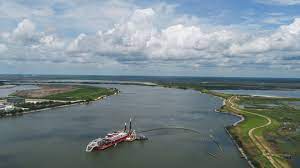
ATLANTA – The deepening of Savannah Harbor has been completed seven years after the $1 billion project began, the U.S. Army Corps of Engineers announced Wednesday.
The harbor has been deepened from 42 feet to 47 feet to accommodate the giant containerized cargo ships now calling at the Port of Savannah regularly with fewer weight and tidal restrictions.
“A deeper channel means more than just efficient passage for the largest vessels calling the U.S. East Coast,” Griff Lynch, executive director of the Georgia Ports Authority, said Thursday. “It means continued opportunity, job growth and prosperity for the state of Georgia.”
Savannah is the nation’s third busiest port and has been the fastest growing during the last decade. It handled 9.3% of total U.S. containerized cargo volume and 10.5% of all U.S. containerized exports in fiscal 2020.
The dredging project is expected to net more than $291 million in annual benefits to the nation.
The work took longer to plan -15 years – than it did to build. Extensive environmental mitigation was involved, including the construction of a fish bypass around the New Savannah Bluff Lock & Dam up the Savannah River near Augusta, a freshwater impoundment for the city of Savannah’s water treatment plant and recovery of the Civil War ironclad CSS Georgia from the bottom of the river.
This story isavailable through a news partnership with Capitol Beat News Service, a project of the Georgia Press Educational Foundation.