The U.S. Department of Education on Thursday signaled it will deny Georgia’s request to waive year-end standardized tests for the 2020-21 school year amid the COVID-19 pandemic, sparking a bold backlash from the state’s top school official.
In a letter Thursday, U.S. Education Secretary Betsy DeVos told Georgia school officials they “should not anticipate” receiving approval to scrap the annual assessments this year, citing the need to maintain performance standards and data-tracking for student achievement.
“If we fail to assess students, it will have a lasting effect for years to come,” DeVos wrote. “Not only will vulnerable students fall behind, but we will be abandoning the important, bipartisan reforms of the past two decades at a critical moment.”
“It is disappointing, shows a complete disconnect with the realities of the classroom and will be a detriment to public education,” he wrote in a statement.
Woods then advised Georgia school districts not to sweat the tests despite any waiver denial because he will likely move to strip the tests of their scores and results value.
“Don’t worry about the tests,” Woods said Thursday.
He added: “If the spring gets here and we are still federally required to administer a summative assessment, we will abide by federal law, but we are also going to take the high-stakes power of the tests away.”
“No test prepping or cramming. No punishing students, teachers or schools for scores. No giving up weeks to administer, remediate and administer tests.”
“I repeat: do not worry about the tests.”
Georgia officials submitted a testing waiver request in June to abstain from year-end tests as the state’s roughly 2,800 public schools continue grappling with resuming classes online and in-person amid the virus. The federal government must approve the waiver before tests can be paused.
The waiver request drew broad support from students, parents, teachers and other Georgians who were surveyed recently on whether they back scrapping tests again this year, after tests were shelved with federal approval in the spring during the opening months of the pandemic.
School officials sought the waiver as not only a breather for students and teachers already grappling with profound learning environment changes prompted by the virus, but also as a means to save on millions of dollars needed to administer the tests while school budgets are being slashed statewide.
The Georgia Association of Educators praised Woods’ condemnation of DeVos’ letter Thursday, calling a federal mandate to move forward with year-end tests during the pandemic out of touch with the realities of challenges local schools face.
“We expected these actions by Secretary DeVos since her public statements have indicated as such,” said Lisa Morgan, the association’s president. “We are disappointed that the USDOE continues to value test scores as valid and reliable indicators of the teaching and learning that occurs in our classrooms each day.”
State officials have already eliminated four year-end tests in high school and one in the third grade from the trove of annual assessments this year due to legislation the General Assembly passed in June and Gov. Brian Kemp signed a short time later.
As of Thursday afternoon, more than 277,000 people had tested positive in Georgia for COVID-19, the disease caused by the novel strain of coronavirus that sparked a global pandemic. It had killed 5,868 Georgians.
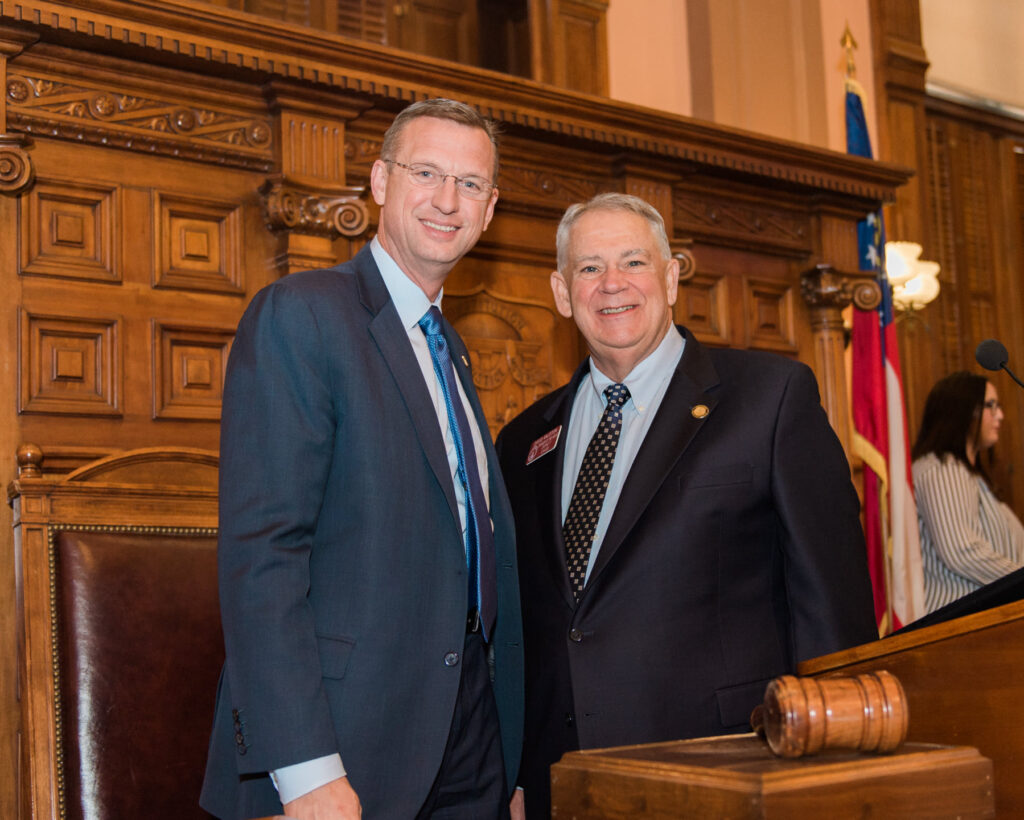
U.S. Rep. Doug Collins (left) has been endorsed by Georgia House Speaker David Ralston (right) in the U.S. Senate race. (Photo from David Ralston Facebook page)
Georgia House Speaker David Ralston, among the state’s most powerful political leaders, has endorsed U.S. Rep. Doug Collins in his run for the U.S. Senate seat formerly held by retired U.S. Sen. Johnny Isakson.
Ralston, R-Blue Ridge, handed Collins his endorsement Thursday in an announcement that characterized the four-term congressman from Gainesville’s conservative values as “like a tree planted by the water.”
“[Collins] and his family live those values every single day: a strong Christian faith, a tireless work ethic and a public servant who serves with honor and integrity,” Ralston said in a statement.
Collins has been battling for months with U.S. Sen. Kelly Loeffler, R-Ga., over which of the two Republican candidates represents the most conservative pick in the upcoming special election on Nov. 3.
Loeffler, an Atlanta businesswoman appointed by Gov. Brian Kemp to fill Isakson’s seat until the election, has long pushed staunchly conservative stances while attacking Collins’ background as a criminal defense attorney and voting record with Democratic favorite Stacey Abrams in the state legislature.
A Loeffler campaign spokesman dismissed Ralston’s endorsement late Thursday and highlighted controversy swarming the House speaker over reports he has frequently used his legislative role as a means to delay court cases while working as a defense attorney.
“Like Doug Collins, Ralston is a career politician and criminal defense lawyer who abused his power to protect violent criminals, domestic abusers and child molesters,” said Stephen Lawson, a spokesman for Loeffler. “Both are political insiders who care more about their taxpayer funded paycheck and politics than public safety and service.”
Collins has punched back at Loeffler, particularly by criticizing her ownership of the Atlanta Dream women’s basketball team and highlighting connections between the team and past events involving Abrams and the pro-abortion rights nonprofit Planned Parenthood.
Thursday’s endorsement did not come as a surprise. Ralston has long touted his friendship with Collins and publicly praised the Gainesville congressman earlier this year during the 2020 legislative session.
But the endorsement does emphasize intra-party schisms between many of the state’s most powerful Republican officeholders like Kemp and Ralston, who each hold large political sway at the state Capitol.
Likewise, Collins held a rally in Gainesville last week that drew attendance from former Gov. Nathan Deal, who has not yet endorsed the congressman but whose presence nonetheless created the appearance of a former Georgia governor lined up against Kemp.
Meanwhile, Loeffler has held a spate of campaign events since last week featuring Kemp, Lt. Gov. Geoff Duncan, Georgia Attorney General Chris Carr, and big-name Washington, D.C., backers including U.S. Sen. Tim Scott, R-S.C., and U.S. Sen. Tom Cotton, R-Ark.
On the Democratic side, frontrunner Rev. Raphael Warnock, the senior pastor at Atlanta’s Ebenezer Baptist Church, has pulled support from a stream of prominent state and national Democratic leaders including Abrams and Jon Ossoff, the investigative journalist who is competing in Georgia’s other U.S. Senate race as the Democratic nominee.
The hotly contest race for the Senate seat held by Loeffler has drawn 20 other candidates vying to unseat her. All candidates will be on the Nov. 3 ballot in the free-for-all-special election. A runoff will be held in January if no candidate gains more than 50% of votes.
This story has been updated to include a response from Sen. Loeffler’s campaign.
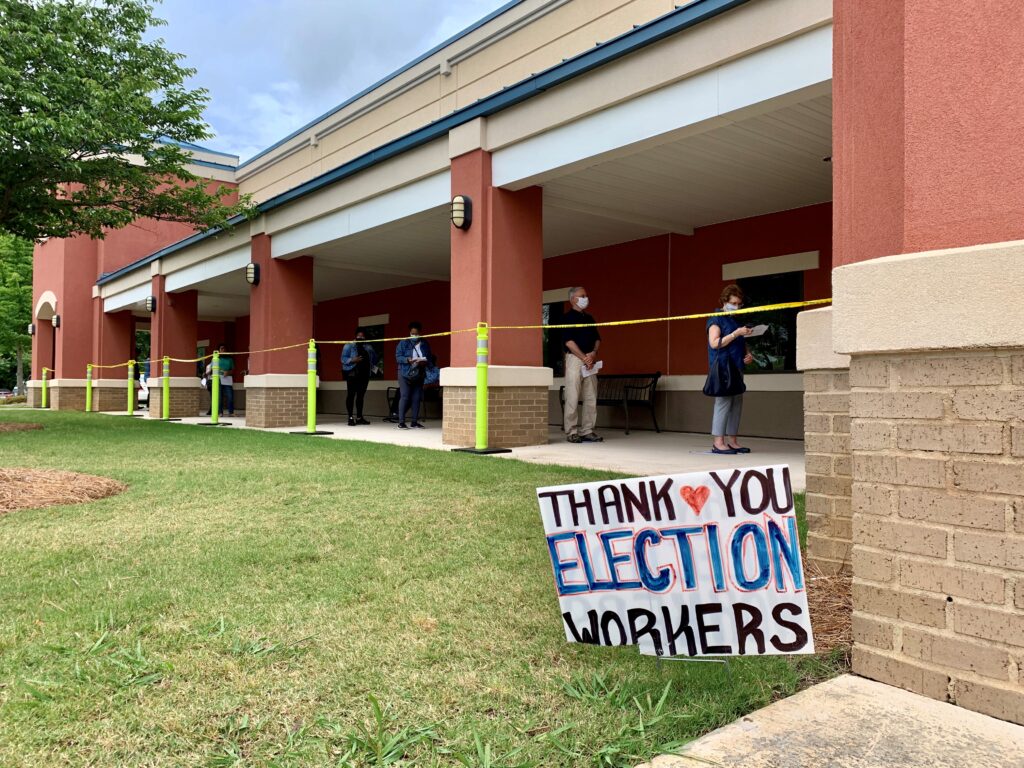
Voters wait in line at a precinct in Cobb County on May 18, 2020. (Photo by Beau Evans)
More than 10,000 poll workers have been recruited to help staff local precincts in Georgia ahead of an expected surge of voters in the Nov. 3 general election, Secretary of State Brad Raffensperger’s office announced this week.
The 10,000 new poll workers account for about half of the 20,000-worker recruitment goal the state has set in recent months to bolster polling places, Raffensperger’s office said Thursday. The new recruits span the state but especially represent population centers like the Atlanta and Savannah metro areas.
More than 50 groups have partnered with Raffensperger’s office to recruit workers including local Rotary clubs, county chapters of the NAACP, some state agencies, the Metro Atlanta Chamber, the Savannah Regional Film Commission and the nonprofit TeenPact.
Raffensperger’s office said it has not surveyed counties to get a total of how many poll workers may be needed overall for the election. His office also said it does not have a list of how many poll workers have been hired statewide overall since it is the counties that hire the workers and they have not submitted lists of local staffing numbers to the state.
Raffensperger’s office has sent spreadsheets to county election officials so they can track inventory and training needs to smooth over any future hiccups more quickly than has happened in a few recent elections in which Georgia’s new voting machines have been used.
Safety concerns over the ongoing COVID-19 pandemic prompted many poll workers to abstain from the state’s June 9 primary election, which saw long lines and technical know-how issues with the new voting equipment in some polling places, particularly Fulton County.
Raffensperger and local election officials have put a premium on recruiting more poll workers to curb chances for similar problems in the upcoming general election, in which voter turnout could top 5 million Georgia registered voters.
“After we saw how the pandemic-related shortage of poll workers contributed to long lines in June, we set out to mobilize an all-hands-on-deck effort to make sure county elections officials had the staff they need in November,” Raffensperger said in a statement. “Thanks to the great work of our partners and the dedication of Georgia voters, elections in Georgia will move more smoothly and efficiently in the future.”
State and local election officials are also anticipating a flood of absentee ballots from voters who opt to stay home on Election Day due to coronavirus concerns. Raffensperger’s office has launched an online portal to request absentee-ballot applications.
ATLANTA – First-time unemployment claims in Georgia declined last week for the sixth week in a row, the state Department of Labor reported Thursday.
For the week ending Aug. 29, initial claims totaled 51,283, down 5,485 from the previous week.
During the 24 weeks since the coronavirus pandemic forced Georgia businesses to shut down, the labor department has paid out more than $3 billion in regular state unemployment benefits, more than the last seven years combined.
“I don’t believe anyone would have imaged that we would disperse more than $3 billion,” Georgia Commissioner of Labor Mark Butler said Thursday. “It is a testament to my staff here at the [labor department], who have processed more than 3.5 million claims.”
Meanwhile, the labor agency is in the testing phase prior to rolling out federal unemployment checks of $300 per week under an initiative President Donald Trump announced last month. The president acted after an earlier federal program that had been providing unemployed Americans $600 a week expired and Congress failed to renew it.
The $300 checks authorized under the new Lost Wages Assistance (LWA) Program should begin going out by the middle of this month.
The program is limited to an initial five weeks, and Georgia has qualified for all five. After that, states will be required to request the money every week through Dec. 27 or the termination of the program, whichever comes first.
From March 21 through the end of last week, the accommodation and food services job sector accounted for the most initial unemployment claims in Georgia with 858,572 claims. The health care and social assistance sector was next with 422,810 claims, followed by retail trade with 387,184.
More than 148,000 jobs are listed online at EmployGeorgia.com for Georgians to access. The labor department offers online resources for finding a job, building a resume and assisting with other reemployment needs.
ATLANTA – Democratic U.S. Senate candidate Jon Ossoff raised more than $4.7 million last month, a total his campaign said marked the highest single-month fund-raising total of any Georgia candidate in Senate history.
“Georgians from all walks of life are united behind Jon’s message of rebuilding an economy that supports flourishing small businesses and working families, attacking the rampant corruption in Washington and ensuring every Georgian has affordable and accessible health care,” Ellen Foster, Ossoff’s campaign manager, said Thursday.
With a series of polls calling the race between Ossoff and incumbent Republican Sen. David Perdue a tossup, Perdue’s GOP backers have been pouring money into his campaign as well.
The National Republican Senatorial Committee, the Senate GOP’s fund-raising arm, has given Perdue nearly $5 million since mid-July, The Wall Street Journal reported.
Another $6.1 million has come from the Senate Leadership Fund, Senate Majority Leader Mitch McConnell’s political action committee, with $13.5 million more to come by Election Day, Politico reported.
Ossoff, an investigative journalist, won the Democratic nomination to challenge Perdue in a crowded primary in June. Perdue captured the Republican nomination unopposed.
While this is Ossoff’s first statewide bid for elective office, he ran for a congressional seat in a special election in 2017, losing to Republican Karen Handel in a race that became the most expensive in the history of the House of Representatives.
Businessman Perdue, who served asCEO of several companies including Dollar General before being elected to the Senate, is seeking his second six-year term.