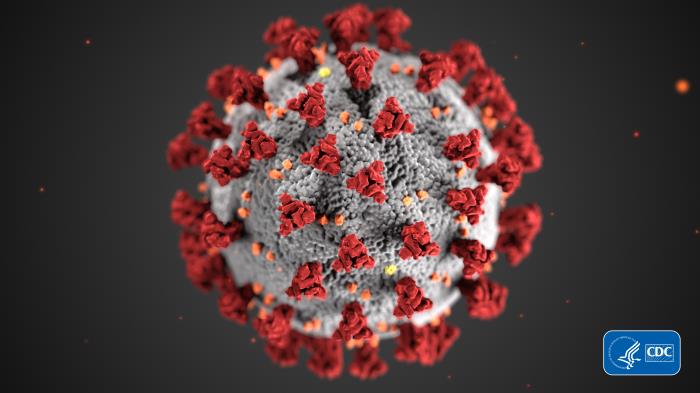
Coronavirus has sickened hundreds of thousands people and killed thousands more in Georgia. (Image: Centers for Disease Control and Prevention)
State public health officials highlighted promising downward trends in the COVID-19 pandemic following Labor Day weekend in Georgia as researchers race to evaluate potential vaccines.
Since early last week, Georgia’s overall virus transmission rate has fallen by more than double digits through Tuesday, according to data from the state Department of Public Health.
The seven-day average positivity rate – a key marker for assessing the virus’ spread – has dropped from 10.1% to 8.9% over the past roughly two weeks, according to the state agency.
Hospitalizations from coronavirus have also decreased since the start of September, though health experts have warned data on mortality and intensive-care visits typically lag by days or even weeks after outbreaks.
State officials and health experts pressed Georgians not to throw caution to the wind for the Labor Day holiday weekend, particularly in light of evidence that past holiday get-togethers in May and July likely sparked COVID-19 flare ups.
“We’ve come too far in our fight with COVID-19 to turn back now,” Gov. Brian Kemp said this week. “I’m asking Georgians to wear a mask, wash their hands, practice social distancing and follow public health guidance to stop the spread.”
As of Tuesday afternoon, more than 285,000 people in Georgia had tested positive for COVID-19, the disease caused by the novel strain of coronavirus that sparked a global pandemic. It had killed 6,070 Georgians.
Dr. Carlos Del Rio, a leading Emory University epidemiologist who has focused on the virus since its onset in March, noted Georgia’s virus positivity rate has mimicked a decline across the country over the past few days.
He urged Georgians to continue wearing masks, washing hands and keeping distance from each other.
“We need to not drop our guard because we are in a good trajectory and we need to keep moving forward,” Del Rio said in a news conference Wednesday morning.
Clinical trials entered a new phase last month for a potential vaccine to prevent COVID-19, marking one of a few trials from researchers and lab companies pushing to have a vaccine ready for release in the coming months.
Atlanta-based Emory is one of several institutions participating in clinical trials for a vaccine candidate manufactured by the company Moderna. Researchers in mid-August began recruiting more subjects for expanded testing of the potential vaccine.
Del Rio said Wednesday that while trials are going well, researchers still need more participants from local Black and Latino communities who represent populations that have been hardest hit by the virus and health-care disparities.
“You want to be sure that the most affected populations are represented,” Del Rio said.
Vaccine trials have shown promising results so far at Emory and across the country for a so-called mRNA vaccine using genetic sequencing to create proteins that mimic coronavirus, triggering a response from a patient’s immune system to erect safeguards.
Anyone interested in participating in the trials at Emory can sign up by filling out forms or emailing the following:
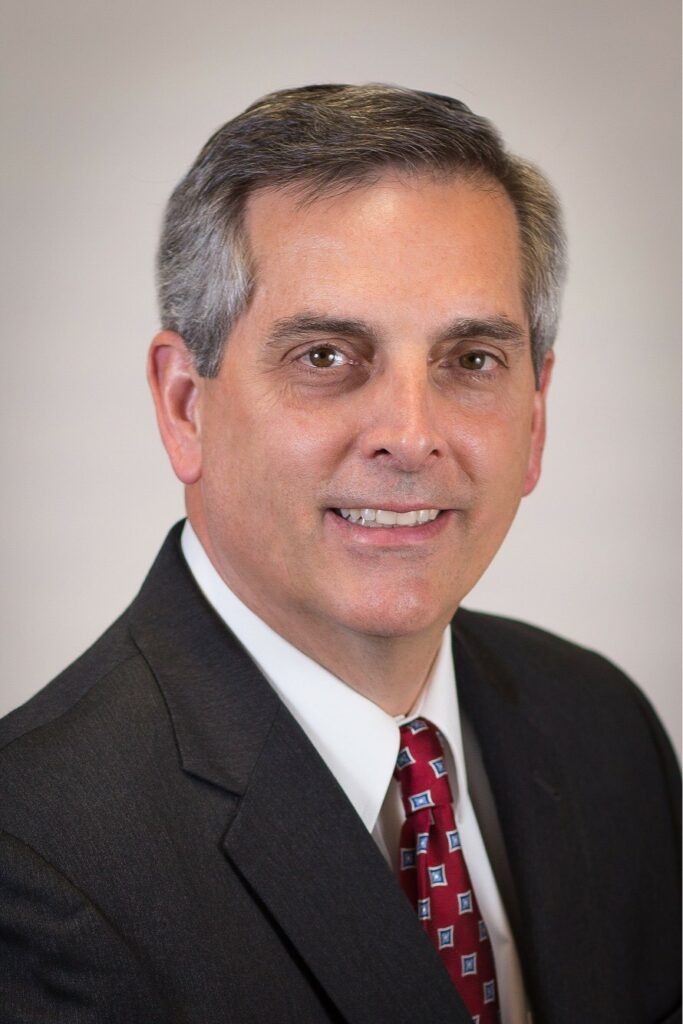
Georgia Secretary of State Brad Raffensperger announced Tuesday his office is investigating alleged instances of double voting in the state’s June 9 primary elections.
At a news conference, Raffensperger claimed investigators have identified 1,000 alleged instances in which Georgia voters intentionally cast ballots twice: once via absentee and once in person.
He did not provide evidence Tuesday as to how his office might know for certain that 1,000 people intentionally voted twice, other than to state that “we know one person was bragging about it down in Long County.”
Reports emerged last week of alleged voting irregularities including double voting in a local Long County election for judge.
“They knew what they were doing,” Raffensperger said of voters who allegedly voted twice.
Results from an investigation into the alleged double voting should be ready “in the next couple of weeks,” he added. Findings will be sent to local, state and federal authorities for further prosecution.
Raffensperger, a Republican, drew swift criticism Tuesday from state Democratic leaders who argued his announcement has the potential to undermine confidence in the Nov. 3 general election while noting that instances of voter fraud in Georgia are rare.
“It is clear that rather than do his job of promoting the safety and security of our voting process, the Secretary of State is instead pushing the GOP’s voting conspiracy theories and disinformation, as he fights in court to make voting by mail less accessible to voters,” said Scott Hogan, executive director of the Democratic Party of Georgia.
This election season has seen vote-by-mail skyrocket in Georgia amid health concerns brought by the ongoing COVID-19 pandemic. The primary elections in June drew historic numbers of absentee ballots. The upcoming general election is also poised for huge mail-in voting turnout.
Voters in Georgia who apply for absentee ballots can still vote in-person on Election Day so long as they formally cancel their absentee ballots or applications at a polling place.
Raffensperger said around 150,000 voters applied for absentee ballots for the June primaries, then showed up to vote in person. Of those, he claimed 1,000 voters intentionally cast an absentee ballot before voting in person without first canceling their absentee ballots on Election Day.
“We’ll be investigating all 1,000 (double-voting allegations) and we’ll get to the bottom of it,” Raffensperger said.
None of the alleged double-voting instances had any impact on the final outcomes of the primary contests, he added.
Knowingly voting twice in the same election is a felony crime in Georgia that carries a one to 10-year prison sentence and a fine up to $100,000 upon conviction, Raffensperger noted.
Georgia’s election system has been under intense scrutiny in recent years following a close gubernatorial race in 2018 and the rollout earlier this year of new voting machines that Raffensperger has touted as secure from vote tampering and cybersecurity breaches.
While some technical issues involving the new machines have cropped up in recent elections, state election officials have attributed those issues to a lack of experience on the part of some local poll workers and county officials.
On Tuesday, Raffensperger said the state’s voting system caught the alleged double voting but that some local election officials missed them. He said training on identifying voter fraud will be boosted ahead of the elections in November.
“The system worked fine,” Raffensperger said. “It’s not the system. It’s really voters.”
Raffensperger’s announcement follows controversial remarks President Donald Trump made last week in which the president appeared to encourage North Carolina voters to vote twice in order to see “if their system is as good as they say it is.” Trump has frequently criticized large-scale vote-by-mail in recent weeks as he campaigns for a second term in office.
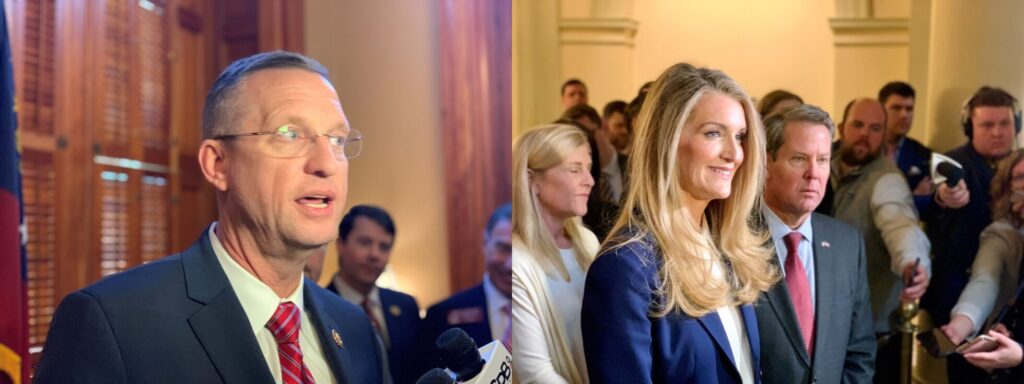
U.S. Rep. Doug Collins (left) and U.S. Sen. Kelly Loeffler (right, with Gov. Brian Kemp) are battling on the Republican side in a heated Senate race. (Photos by Beau Evans)
U.S. Sen. Kelly Loeffler, R-Ga., nabbed the endorsement of Georgia Labor Commissioner Mark Butler Tuesday morning in the race to hold her U.S. Senate seat ahead of the Nov. 3 special election.
The endorsement by Butler, a Republican, marked the latest development in the hustle for high-profile supporters between Loeffler and U.S. Rep. Doug Collins, R-Gainesville, a well-known Republican in the state who is also vying for the senate seat.
In a statement, Butler called Loeffler a “proven conservative champion” and highlighted her conservative stances on gun ownership, immigration and her background as an Atlanta businesswoman.
Butler’s endorsement builds on her base of prominent state Republican backers including Gov. Brian Kemp, Lt. Gov. Geoff Duncan and Georgia Attorney General Chris Carr. She has also drawn support from many national Republicans including U.S. Sen. Tim Scott, R-S.C., and U.S. Sen. Tom Cotton, R-Ark.
Collins, whose entrance in the race earlier this year jolted the state’s Republican establishment, has battled with Loeffler from the start over which of the two candidates is the most conservative.
Last week, Collins gained the endorsement of Georgia House Speaker David Ralston, R-Blue Ridge, a longtime friend who described the four-term congressman from Gainesville’s conservative values as “like a tree planted by water.”
That endorsement drew into sharp focus the intra-party schisms between many of the state’s most powerful Republican officeholders like Ralston and Kemp, who appointed Loeffler to hold retired U.S. Sen. Johnny Isakson’s senate seat until the November election.
Collins, a preacher and former criminal defense attorney, has also been endorsed by Georgia Agriculture Commissioner Gary Black and recently held a rally attended by former Gov. Nathan Deal – though Deal has not yet officially endorsed Collins.
Collins also recently touted endorsements from 41 Georgia sheriffs as he and Loeffler fight for the title of most pro-law enforcement candidate.
Collins also on Tuesday announced endorsements from about four dozen sitting and incoming state lawmakers on the heels of Ralston’s backing.
Loffler countered shortly after with her own set of 16 state lawmaker endorsements, roughly doubling the amount she had already gained.
On the Democratic side, frontrunner Rev. Raphael Warnock, the senior pastor at Atlanta’s Ebenezer Baptist Church, has pulled support from a stream of prominent state and national Democratic leaders including Abrams and Jon Ossoff, the investigative journalist who is competing in Georgia’s other U.S. Senate race as the Democratic nominee.
The hotly contest race for the Senate seat held by Loeffler has drawn 20 other candidates vying to unseat her. All candidates will be on the Nov. 3 ballot in the free-for-all-special election. A runoff will be held in January if no candidate gains more than 50% of votes.
This story has been updated to include additional endorsements for Loeffler and Collins.
There were several times over the past few months that Robin Hines, who oversees rule-setting for high school sports in Georgia, had doubts the football season could happen this fall in the Peach State while the coronavirus pandemic raged on.
His worries spiked after July Fourth as positive cases of the highly infectious virus soared in the state, just as Georgia’s roughly 2,800 public schools were set to reopen their doors and student athletes chomped at the bit to resume playing sports.
Two months later, most of the more than 400 schools that play football in Georgia have kicked off the fall season with unceremonious socially-distanced coin tosses and a steady optimism that one of the state’s most beloved traditions will make it through the playoffs without having to shut down.
“We’ve already taken a season away from the spring and it’s devastating for some people,” Hines said in an interview this week. “We feel like we’re obligated to get back to athletic activity as quickly as we can and as safely as we can.”
As of this week, roughly 370 football-playing schools in Georgia have elected to hold games, Hines said. About 60 schools have opted out for either a few weeks or the entire season.
The first week of football games in Georgia also coincided with the normally bustling Labor Day holiday weekend that has prompted state health officials and Gov. Brian Kemp to warn Georgians not to abandon caution with the virus and to wear masks, wash hands and keep distanced.
Spring seasons for baseball, track, soccer and more were scrapped along with in-person classes in March as the COVID-19 pandemic swept over Georgia. Since then, many students have returned for the fall semester and state officials have gradually eased up on virus-curbing distancing and activity restrictions.
The Georgia High School Association (GHSA), which Hines heads up as executive director, has pitched a laundry list of sanitizing and distance-keeping rules for football teams to follow with common-sense ideas like not sharing water bottles to proper soaping methods for washing composite leather balls.
But local schools largely are being left to their own devices when it comes to deciding whether fans will be allowed in the stands at games and what the threshold is for canceling games in the event players start turning up sick.
Some public-health experts in Georgia have eyed the return of football and other fall sports with wariness while the pandemic continues without a vaccine or cure.
Richard Rothenberg, an infectious-disease and epidemiology professor at Georgia State University who worked for 25 years at the federal Centers for Disease Control and Prevention (CDC), said football games being held in areas where the virus has created local outbreaks would likely speed up infections from person to person.
Especially in rural areas where hospitals have closed in recent years, schools need detailed data on testing and contact tracing in their surrounding communities to know whether the virus has gone quiet in their area – or whether an outbreak has sparked.
“If you can’t really answer those questions, you probably shouldn’t start the season,” Rothenberg said in an interview this week. “But that’s a difficult admonition. I understand that.”
Initially, the GHSA collected reports on positive COVID-19 test results from schools at the start of summer, when locker rooms were also banned and practicing teams limited to groups of 20 players with no scrimmages.
Since June, around 1,370 positive test results of players in all sports were reported from local school districts. Hines estimated Georgia has roughly 400,000 eligible high-school student athletes.
Now, Hines said the GHSA is not requiring schools to submit test results, noting the data was only used to assess how to move forward with summer training and whether to relax practice sizes and activity restrictions, Hines said.
The state Department of Education has not issued any COVID-19 safety guidelines for high school sports other than what the GHSA has advised, according to an agency spokesperson.
Hines said it’s a good bet the GHSA will know about any potential outbreaks if schools start quarantining their students and football games get canceled. The GHSA is waiving fines and other penalties for skipped games this season and allowing teams to make them up or declare a no-contest, Hines said.
With uncertainties hovering over all facets of life heading into fall, Hines said he does not anticipate so many teams will have to cancel games that the GHSA would be forced to halt the season.
“I expect that’s not going to be the case,” Hines said. “I expect there will be some bumps in the road.”
Echoing the advice of other health experts, GSU’s Rothenberg said student athletes and their parents need to decide whether the risks of potentially transmitting the virus outweigh the developmental benefits of participating in youth sports.
“It is a very difficult issue,” Rothenberg said. “There’s no single answer to this.”
Hines said much the same, stressing his belief that local communities and families should know better than the GHSA how to guard their own well-being and make sound decisions on when to pull the plug on football if necessary.
“At the end of the day, every student athlete as well as the parents and the school and the district have a decision to make,” Hines said. “Everybody has to make a determination and weigh the risks with the benefits.”
ATLANTA – U.S. Sen. David Perdue, R-Ga., picked up endorsements Friday from three former Georgia Republican senators, including the lawmaker he succeeded in Congress.
Supporting Perdue are former Sens. Johnny Isakson, who retired from Congress at the end of last year; Saxby Chambliss, who left Washington in 2014 to be succeeded by Perdue; and Mack Mattingly, elected in 1980 as Georgia’s first Republican U.S. senator since Reconstruction.
“For the better part of five years, I had the honor of working directly with David to represent Georgia in the United States Senate,” Isakson said. “I’ve seen firsthand how dedicated he is to improving our health care system, taking care of our veterans and expanding opportunities for our young people. We need David Perdue to keep fighting for us in the Senate.”
The show of unity behind Perdue is in sharp contrast to Georgia’s other U.S. Senate race, which has divided Republicans.
Gov. Brian Kemp appointed Sen. Kelly Loeffler, R-Ga., late last year to succeed Isakson on an interim basis, and the governor continues to back her, as does Lt. Gov. Geoff Duncan and Attorney General Chris Carr.
Other GOP leaders, including Georgia House Speaker David Ralston, are supporting U.S. Rep. Doug Collins, R-Gainesville, a former member of the General Assembly who is leaving the House to run for the Senate. Ralston, R-Blue Ridge, endorsed Collins on Thursday.
Former Gov. Nathan Deal hasn’t endorsed either Loeffler or Collins but attended a Collins rally last week in Gainesville.
Unlike Perdue’s reelection bid against Democratic challenger Jon Ossoff, which is limited to two major-party candidates, Loeffler and Collins are locked in a free-for-all contest that includes multiple Republicans and Democrats.
Some Republicans pushed during this year’s General Assembly session to set up a June primary for Loeffler’s seat to avoid pitting two or more GOP candidates against each other on the general election ballot in November but were unsuccessful.
Perdue also landed an endorsement Friday from Nancy Coverdell, the widow of former Republican U.S. Sen. Paul Coverdell, who served from 1993 until his death in 2000.