ATLANTA — Rick Jackson, the Republican running to be Georgia’s next governor, raised more money in the past two months than his Democratic opponent, former Atlanta Mayor Keisha Lance Bottoms, has collected since starting her campaign more than a year ago.
The latest reporting period ended July 31, with filings due by the end of last week.
Bottoms, who missed the deadline and filed over the weekend, a day late, raised $3.1 million from the beginning of May through July.
Jackson raised nearly twice as much — $6.1 million — over a shorter period. His latest report goes back to June 11, a few days before he won his primary runoff.
The wealthy healthcare entrepreneur spent more than $100 million of his own money to win the GOP nomination. He subsequently created what’s known under Georgia law as a “leadership committee,” a special entity that certain candidates can use to raise limitless amounts of money.
His campaign reported a contribution of $5 million from For All Georgians Inc., his new leadership committee.
Jackson gave his campaign no money in the latest reporting cycle, though he did provide tens of thousands of dollars from his own pocket in in-kind contributions, such as legal fees, rent and travel.
Altogether, Jackson has raised or given his campaign more than $118 million, spending nearly all of it. His campaign had $4.3 million left as of the end of July.
Bottoms has raised $5.7 million since May 6, 2025. She won her primary outright in May and did not have to spend on a runoff. She had just over $770,000 on hand at the end of July.
Their money came mostly from individuals, with corporations giving a little over $360,000 to Bottoms’ campaign since the start and over $240,000 to Jackson’s. Nearly $200,000 of his donations were from outside Georgia while $2.3 million of Bottoms’ collections came from out of state.
ATLANTA — Georgia tax revenue continued rising in July, bolstered by strong receipts from the sales and use tax, which sent more money to local governments.
Net tax collections were $2.57 billion, up $78.1 million from July 2025.
That 3.1% increase came despite a 2.1% year-over-year drop in collections from the individual income tax.
That $27.1 million decline from July of last year was counterbalanced by soaring receipts from the corporate income tax, which rose 34.3%, up $18.4 million.
The decline in individual income tax revenue continues a slide from June, when individual income tax collections fell 6.7%, or nearly $100 million, driven significantly by rising tax refunds.
The recent increase in corporate income tax revenue builds on a 7% year-over-year increase in June.
The July numbers, released by Gov. Brian Kemp’s office, indicated that shoppers were helping to prop up tax revenues.
Net proceeds from the sales and use tax rose 10% year over year, up $79.2 million, for a total of $875.3 million. Gross receipts totaled $1.78 billion, up $162.8 million from July of last year.
Adjusted sales tax distributions to local governments rose $85.9 million, totaling $894.5 million.
The overall increase occurred despite another decline in motor fuel tax collections. The $10.6 million year-over-year drop in July came despite the end in early June of a gas tax suspension that Kemp and lawmakers had approved to counter rising prices during the Iran conflict.
The motor fuel tax fell had fallen nearly $197 million in June compared to the prior year, nearly the same amount as in May when the suspension first went into effect.
ATLANTA — Residents in and around Jackson County in northeast Georgia will have access to more than 1,400 new jobs if Siemens Corp. can follow through on a new manufacturing plant expected there.
State development officials announced the 550,000-square-foot manufacturing near Pendergrass Friday, with buildout expected to begin in November pending final approvals.
The plant, which would take three years to complete, would produce low-voltage electrical components.
Barry Powell, North America president of the Siemens Electrical Products business unit, explained the minimum $185 million investment decision in a statement, saying Georgia offers a highly skilled workforce and close proximity to the company’s Southeast supply chain network.
“Building this facility strengthens our ability to serve customers more efficiently while expanding advanced manufacturing capacity in a region that is already home to many of the technicians, suppliers, and industry expertise that support our business,” Powell said.
Siemens Corp. is a U.S. subsidiary of Siemens AG, a tech and manufacturing company involved in everything from infrastructure and transportation to healthcare and industrial artificial intelligence.
For the fiscal year that ended Sept. 30, Siemens Group USA had more than $24.4 billion in revenue, with 25 manufacturing sites and more than 50,000 employees serving customers in every state and in Puerto Rico.
Gov. Brian Kemp visited the company’s headquarters in Munich last year during a trade trip to Germany and Poland.
“German companies excel in industries like life sciences and automotive manufacturing, and Georgia serves as a strategic gateway for them and other European businesses entering the U.S. market,” Pat Wilson, commissioner of the Georgia Department of Economic Development, said at the time.
Siemens has had a presence in Georgia for 140 years and already employs more than 1,700 at two manufacturing plants and six offices in the state, Kemp said in a statement Friday. He welcomed the expansion as “another testament to the strong economic partnership between our state and Germany.”
ATLANTA— Statewide scores on the Georgia Milestones tests continued to rise in math as teachers adapted to standards that were updated several years ago.
The 2025-26 results for every subject but English were released Thursday.
The Georgia Department of Education said it needs until November to assess the English Language Arts scores before a public release because the teaching standards for that subject were recently updated, with students taking their first tests on them this past school year.
Georgia began rewriting its math standards in 2019, with the first testing after implementation coming during the 2023-24 school year.
Scores in that subject have been climbing ever since, reaching record highs in grades four through six and in high school Algebra.
State School Superintendent Richard Woods attributed the gains to hard work.
Experts pointed to other positive trends, such as the use of data from other types of testing throughout the school year to tailor instruction to each student’s evolving needs.
“Since the pandemic, districts have been paying a lot more attention to individualized learning plans — how we use data throughout the year to assess where students are and how we can bring them forward,” said Mary-Kate Starkel, chief of staff for redefinED Atlanta, an education advocacy group that promotes data analysis in education.
Matt Smith, policy and research director for the Georgia Partnership for Excellence in Education, pointed to Georgia’s ongoing success at reducing chronic absenteeism.
The chronic rate, defined as missing at least 10% of the school year, fell in Georgia to 17.7% in 2025-26, down from a peak of 23.9% in 2021-22.
Unlike many other states, Georgia’s chronic absenteeism rate has continuously declined since then, but it remains above the pre-pandemic rate of 12%.
Despite the record gains in math, about half of Georgia students were performing at levels that are considered not proficient.
The state divides students into four categories based on their scores. From highest to lowest score, the categories are distinguished, proficient, developing and beginning.
The highest rate of students who scored proficient or distinguished was in fourth grade, at 50%. Third and sixth grades had the largest increases, with the rate of students scoring proficient or better rising 4 percentage points in each from 2024-25 — to 48% and 41% respectively.
In high school Algebra, the increase was 3 points, to 48%.
Gains in other subjects also were accompanied by large groups of underperforming students.
For instance, the proportion of students scoring proficient or better in high school physical science rose 4 points to 61%, meaning 39% were not proficient. High school biology rose 3 points to 47%, and U.S. history was flat, at 39% proficient or better.
Many students may be scoring above pre-pandemic levels, but that is not a high bar, Starkel said. “We still have a long way to go for many kids in the metro area and the state.”
Smith warned that the reporting of average statewide scores can mask poor performances in some school districts and also within school districts.
Like they did with the math scores during the 2023-24 school year, state education officials will assess the recent results in English Language Arts to determine where to set the scoring thresholds for placing students in one of those four performance categories.
English has not been a highlight for Georgia, with scores falling in all but two of the seven grade levels that were given a Milestones exam on the subject under the old standards in 2024-25.
Smith attributed that at least in part to the “swirl” of rapid changes, after the Georgia General Assembly began mandating new teaching methods for English. After many years of unsatisfactory literacy scores, lawmakers decided it was time to shift to more phonics-based instruction, especially in the lower grades.
Teachers in kindergarten through third grade were trained in the new methods. The release of the exam results in November will be the first to put that training to the test.
ATHENS — Georgia’s two candidates for governor showcased their competing plans for healthcare, jobs and other top issues at a business-focused gathering Wednesday.
Gov. Brian Kemp also gave his full-throated support to fellow Republican Rick Jackson, saying Jackson was the most likely candidate to continue his business-friendly policies.
The Democrat in the race, former Atlanta Mayor Keisha Lance Bottoms, spoke of government solutions for problems such as the shortage of affordable housing and healthcare.
The two candidates did not confront each other directly, outlining their platforms instead from a ballroom stage and in a hallway with reporters.
But the event, hosted by the Georgia Chamber of Commerce at The Classic Center in Athens, offered a rare opportunity to see them at the same venue, talking about many of the same issues.
Bottoms touted developer agreements for affordable housing reached during her tenure as mayor. And she said she would push for Medicaid expansion to confront rural hospital closures and the growing number of Georgians without health insurance.
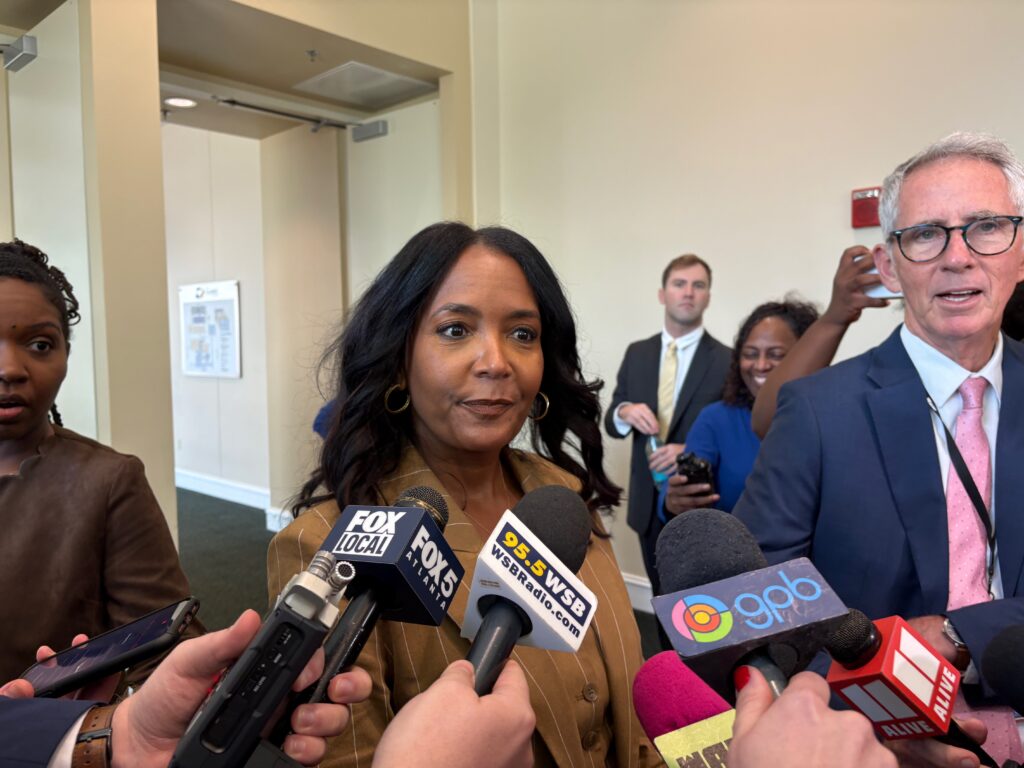
Former Atlanta Mayor Keisha Lance Bottoms, the Democratic candidate for Georgia governor, talks to reporters at The Classic Center in Athens on Wednesday, Aug. 5, 2026. (Ty Tagami/Capitol Beat)
Kemp, meeting with reporters with Jackson by his side, said he had decided to back the wealthy healthcare staffing entrepreneur because Jackson had succeeded despite a tough childhood in foster homes, a story that Jackson has repeatedly shared while campaigning.
Kemp also said he believed Jackson would build on his business-friendly legacy as governor, which Jackson quickly confirmed.
Jackson said he would seek to cut taxes while continuing to recruit companies to locate in the state, adding that he would steer economic development and jobs to rural Georgia as Kemp has done.
He said he would help small businesses and farmers.
Georgia Gov. Brian Kemp tells reporters he is backing Rick Jackson, the Republican candidate for governor, as Jackson watches, at The Classic Center in Athens on Wednesday, Aug. 5, 2026. (Ty Tagami/Capitol Beat)
From the stage, before an audience of hundreds in suits, Jackson said he planned on “increasing a huge amount of investment dollars for venture capital, early-stage development and PE just for Georgia companies. Atlanta is too big not to have more capital.”
Bottoms also said she would cater to small business, but her approach included government money. She said she would establish a state agency for small business and change contracts for services.
“I’d like to break up some of these mega-contracts in our state … to give small businesses an opportunity to compete for those contracts,” she said.
Bottoms also said she wanted to end Georgia’s Pathways to Coverage program, Kemp’s approach to Medicaid, which she called wasteful.
A federal review last year found that most of the money went to administrative overhead rather than to medical assistance. The program was set to expire last September, but the administration of President Donald Trump granted a one-year extension.
Jackson told reporters that he believed in “intelligent” Medicaid expansion. By that, he meant a federal block grant with few strings attached, for a program designed to transition recipients into jobs and onto private insurance.
Pathways already has a work requirement.
Bottoms and Jackson also had divergent views on data centers.
Bottoms reiterated an earlier call to “pause” data center approvals, while Jackson said he would leave it up to communities whether to allow them to build, noting the potential local tax benefits.