ATLANTA — Republican Clayton Fuller was cruising to victory in the special election runoff Tuesday night to select a successor for former U.S. Rep. Marjorie Taylor Greene, according to unofficial results.
Fuller, a former district attorney endorsed by President Donald Trump, held more than a 10 percentage point margin over Democrat Shawn Harris, a retired Army brigadier general, with most of the 10 counties in Congressional District 14 fully reporting.
“Tonight showed that GA-14 is committed to supporting President Trump and sending an America First fighter to Washington,” Fuller said in a statement. “This victory couldn’t have happened without President Trump’s endorsement and the amazing patriots of Northwest Georgia.”
A month ago, Fuller and Harris emerged as the leaders among a field of 17 candidates seeking to replace Greene, who left office a year early after falling out with Trump, mainly over the release of files related to deceased sex trafficker Jeffrey Epstein.
Democrats had hoped to make headway in the conservative northwest Georgia district after Harris led the field in the March 10 special election.
But there were only three Democrats vying for votes that night while Fuller had to split votes with 11 other Republicans.
Josh McKoon, chairman of the Georgia Republican Party, described Tuesday’s outcome as a Trump victory.
“Trump’s coattails are long, his movement is alive and well, and no amount of Hollywood cash or coastal elite endorsements could stop it,” McKoon said on social media, an apparent reference to the endorsement of Harris by actor Samuel L. Jackson.
Fuller said he would be “a strong vote for the President’s MAGA agenda in Washington and giving GA-14 a conservative voice again.”
Fuller will be back on the campaign trail soon: had Greene remained in office, she would have had to run for re-election, starting with the May 19 primary.
On that date, Fuller will face a rematch with nine of the 16 Republicans he vanquished last month.
Should he win against them, he will face a rematch with Harris on Nov. 3.
Harris was the only Democrat to qualify for the upcoming primary. It will be his third attempt to win the Congressional seat, having lost to Greene in 2024 when he secured 36% of the vote.
Among those Fuller defeated in March and will be facing again next month is former state Sen. Colton Moore, R-Trenton, a Trump devotee who resigned early this year to contest the Congressional race.
Voters on Tuesday put another Republican in Moore’s former seat: Lanny Thomas defeated Democrat John Bentley “Jack” Zibluk in the race to represent the 53rd state Senate district, which spans the northwest corner of Georgia, including Catoosa, Chattooga, Dade, Floyd and Walker counties.
In DeKalb and Gwinnett counties, Venola Mason defeated Kelly Kautz in the runoff to replace former state Rep. Karen Bennett, D-Stone Mountain, who resigned in January and pleaded guilty to charges that she fraudulently obtained $13,940 in unemployment supplements during the COVID-19 pandemic.
In a Richmond County state House runoff, Democrat Sheila Clark Nelson defeated Republican Thomas McAdams to take the seat previously held by state Rep. Lynn Heffner, D-Augusta, who resigned after moving out of the district because of damage to her house caused by Hurricane Helene.
ATLANTA — Homeowners will get relief from their fast-rising property tax bills and may even see tax cuts if Gov. Brian Kemp signs Senate Bill 33 into law.
But many other constituencies stand to lose, including one that cannot vote: children in public schools.
Local governments and schools collect the money they need to pay for operations using a simple formula: property values established by county assessors multiplied by tax rates set by each city council, county commission or school board.
SB 33 would arrest half of that formula by limiting increases in taxable home values to the rate of inflation.
Cities, counties and schools could simply bump the other variable in the formula, bringing in more revenue by raising the tax rate, also known as the millage rate.
That might not be politically popular, but it would keep the lights on.
There is a catch for schools, though: nearly all of Georgia’s 180 school districts are limited to a maximum rate of 20 mills under the state constitution.
So, the most that they can collect is $20 per $1,000 of assessed value.
Some districts would begin to see cost increases outpacing revenue increases in just a few years, said Justin Pauly, spokesman for the Georgia School Boards Association.
“It’s definitely going to squeeze things,” he said.
School districts are powerless to contain two big drivers of rising costs, he said. Teachers get two benefits that the locals must pay into at rates set by the state: a pension and health insurance.
Health insurance costs have risen 20% to 30% in the past half decade, said John Zauner, executive director of the Georgia School Superintendents Association.
If Kemp signs SB 33 into law, Zauner expects pockets of school districts around the state to begin laying off teachers in a few years.
Personnel costs account for 90% of a typical school budget, Zauner said. “How do you save money when 90% of your budget is personnel cost? You go to the personnel to reduce your costs.”
That, in turn, would mean more students per teacher, affecting teaching quality, he said.
SB 33 arrests costs for owner-occupied homes, so rural and primarily residential areas that lack industry would get hit first.
Also, most school systems are already near the maximum tax rate, with the state average at 15 mills.
At least five school districts already had tax rates set between 19 and 20 mills by 2024, including Clayton, Fayette and Gwinnett counties in metro Atlanta, according to Zauner’s count. Two others were Dublin City and Wilkinson County, both near Macon.
A handful of others had already reached or exceeded the 20-mill cap, but they are exempt owing to peculiarities in the constitution, Zauner said. Many of those are also in metro Atlanta, including the systems for DeKalb and Rockdale counties and for the cities of Atlanta and Decatur. Muscogee County, where Columbus is the county seat, is in that group, as well.
Many constituencies besides students would lose if SB 33 were to become law. The taxable value of properties that are not owner-occupied would be allowed to continue outpacing inflation, so apartments, factories, restaurants, stores and offices would see no benefit.
Also, SB 33 would allow a new penny sales tax to further offset the property tax burden for homeowners in counties that approve such a tax by referendum.
So, the burden of paying for parks, police, roads — and schools — could shift further from homeowners, while the overall economy carried the cost.
ATLANTA — Georgia House and Senate Republicans with competing agendas managed to push through income and property tax cuts as the curtain closed on the 2026 Georgia legislative session after midnight Friday.
The Senate did not get its elimination of income taxes. The House did not get its elimination of property taxes.
But both taxes would become smaller if Gov. Brian Kemp signs the two bills into law.
Owing to the late hour, Senate Republicans had to repurpose a hemp farming bill to send a property tax cut to the House.
The measure would basically shift money from homeowners’ right pocket to their left: the property taxes on their homes could be reduced by the income from a new penny sales tax.
It also would suppress the increase in valuations of owner-occupied homes, limiting the rise of those “homesteaded” properties for tax purposes to the rate of inflation.
Commercial properties — and renters — would not benefit from either provision.
The state House had had a similar idea, but it ran afoul of the state Constitution. A two-thirds vote was required for adoption, and Democrats opposed it, denying passage of House Bill 1116 in early March.
So the Senate came up with a legal workaround that would allow local legislative delegations to call for such changes, making it politically easier to get the necessary two-thirds vote for each of Georgia’s 159 counties. The new sales tax would then go to voters in a referendum.
The income from that sales tax revenue would bypass government and go straight to homeowners.
“We think there are about 110 counties and all the cities within those 110 counties that could pretty much eliminate their homestead property taxes for county and city with that one-time sales tax,” said Clint Mueller, deputy director of ACCG, the association for Georgia’s county commissioners.
Local governments would see revenue growth constrained by the inflation cap on home values. But when a property changes hands, or when there is new construction, the value would reset to the current market.
So fast-growing jurisdictions and those with a higher proportion of their tax base comprising properties that are not occupied by homeowners would be less affected.
Cities and counties could also raise their property tax rates. So could school districts, although, unlike cities and counties, nearly all of them are limited by law to a maximum rate of 20 mills, Mueller said. (A mill equals a dollar for every thousand dollars of assessed value.)
Sen. Blake Tillery, R-Vidalia, presented Senate Bill 33, formerly the hemp bill and now containing a mutation of HB 1116, on the Senate floor less than half an hour before midnight Thursday.
It passed despite firm opposition from Democrats, the minority party.
In the House, as the clock ticked toward 1 a.m., Rep. Shaw Blackmon, R-Bonaire, who’d been leading the charge on the House’s primary agenda of property tax reduction, acknowledged that the cut would pass by hitchhiking, allowing senators to take the credit.
He recounted a line from a favorite Marvel movie, involving the character Dr. Strange: “it’s not about you,” Blackmon said. “And we’re going to do what’s best for the taxpayer.”
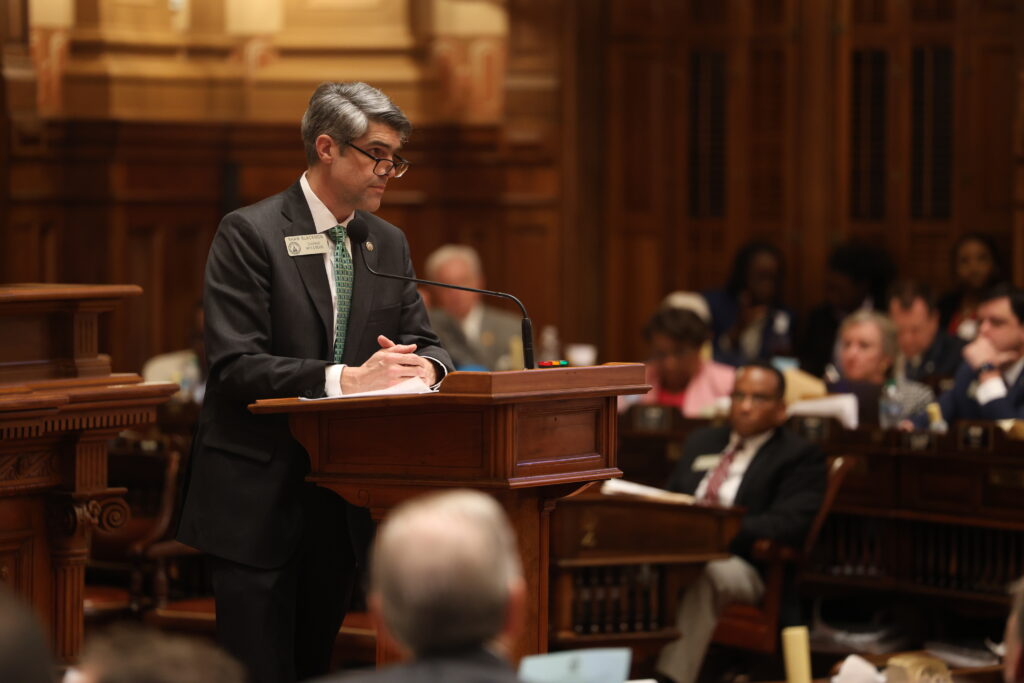
Rep. Shaw Blackmon, R-Bonaire, presented an amended version of House Bill 1116 on crossover day on Friday, March 6, 2026, at the Georgia State Capitol Building. The bill at that point was a pared back version of the one that had sought to eliminate homeowner property taxes in Georgia. The Senate chose to send back its own proposal for property tax cuts in Senate Bill 33 on Thursday, and the House approved it early Friday, as the legislative session ticked to an end. (Ashtin Barker/Capitol Beat)
House Republicans sent the bill to Kemp, overriding opposition from Democrats, also in the minority in that chamber.
Later, House Speaker Jon Burns, R-Newington, expressed mixed emotions about the outcome.
“The bill that came back to us was not strong enough,” he said. “There were several different initiatives we had in our property tax bill that would have been more meaningful for our property taxpayers.” But it was still a “robust” tax cut, he said, vowing to push further next year.
If Kemp signs House Bill 463 into law, Georgians will also pay less for income taxes.
The measure approved by lawmakers would drop the rate to 4.99% from the current 5.19%. It would continue falling over eight years to 3.99% if state revenues remain strong. Income tax deductions would rise, as well, over eight years, from the current $12,000 for single filers, to $18,000. The amounts would double for married couples. Dependent deductions also would rise by $1,000 over eight years from the current $4,000.
And the state income tax on overtime pay and cash tips would be waived on the first $1,750.
HB 463 would offset the cuts by eliminating a handful of tax breaks for items like electrical vehicle chargers and the manufacture of cigarettes for export.
Democrats complained that Georgia’s top earners would get the most back, and Blackmon responded that they put the most in.
He called it “real, meaningful tax relief.”
But Sen. Josh McLaurin, D-Sandy Springs, said the tax credits being eliminated to pay for the income tax cut would not come close to making up for the lost revenue.
“It’s a completely fiscally irresponsible bill,” he said, adding that the tax exemption for overtime pay and tips was “a handful of peanuts that we’re throwing back” at Georgians.
Sen. Harold Jones, II, D-Augusta, the Senate minority leader, called the income tax legislation, which passed the Senate around 10 p.m., a “cynical attempt at electoral politics,” in a year when affordability had become a central talking point.
Tillery, who, like McLaurin, is a candidate for lieutenant governor, admitted the income tax cut was not as big as what Senate Republicans had wanted. They had previously pushed a measure to eliminate state income taxes altogether.
ATLANTA — The youngest and oldest people in Georgia to whom the state owes a financial responsibility got something extra in the 2027 fiscal year budget that lawmakers sent to Gov. Brian Kemp Thursday night.
State retirees could get a bump in their pensions after the state House and Senate agreed to add at least $65 million in state money to their pension fund.
And children in grades kindergarten through third grade could learn how to read with the help of literacy experts hired with $70 million in state funds.
That is more money than the House had initially budgeted as a downpayment on hiring more than 1,300 literacy coaches.
The compromise budget also puts the money into a recurring fund whereas the Senate had proposed a one-time grant.
Grants must be renewed annually, so the House wanted the money engraved in the school funding formula.
The compromise puts the money into the Quality Basic Education funding formula, so it will be there year after year.
“I think QBE is usually a more consistent formula for our schools,” said Sen. Blake Tillery, R-Vidalia, chairman of the Senate Appropriations Committee. That should give schools more confidence in hiring employees, an ongoing expense, he said.
“I think there’s a lot more acceptance by the local school systems that it will be consistent whereas our non-QBE grants sometimes are one of the first to go in recessionary times,” he said.
Rep. Matt Hatchett, R-Dublin, chairman of the House Appropriations Committee, called it “a conservative and fiscally sound budget.” And he said it would help state pensioners who “put in years of hard work only to see inflation decimate” their income, with the first cost of living increase in recent history of over 2%.
The approvals by the House and Senate to House Bill 974 sends the $38.5 billion budget to Kemp who has line-item veto authority.
ATLANTA — People in Georgia who get injured badly enough to need an ambulance ride could worry less about the shock to their pocketbook if they have insurance and if Gov. Brian Kemp signs House Bill 506 into law.
The Georgia General Assembly sent Kemp the “Surprise Billing Consumer Protection Act” on Thursday, the final day of this year’s legislative session.
It would cap insurance costs for any ambulance ride requested by a first responder, with the amount indexed to a multiple of Medicare.
The same copayment, coinsurance or deductible charge would apply to ambulance rides whether or not they are in the insurer’s network. And the ambulance company would directly bill the insurance company.
“If someone has private insurance, that will be billed rather than self-pay on an ambulance ride,” said Sen. Shawn Still, R-Suwanee, who was responsible for overlaying HB 506 with the ambulance language.
The injured are not in a position to negotiate the cost of an ambulance ride, he said, so regulation is needed.
The underlying bill started out last year as a tobacco cessation measure. It passed the House in that form a year ago, then the Senate retrofitted it as a vehicle for the ambulance billing language.
The Senate passed the new measure unanimously Tuesday, and the House agreed to the changes Thursday, after passing a similar measure, House Bill 961, early last month.
“If I have a heart attack, I’m not going to negotiate,” said Rep. Alan Powell, R-Hartwell, the chief sponsor of HB 961, before it passed with just one vote in opposition. “Get me to the hospital quick!”
After HB 961 sped through the House, it stalled in the Senate.
HB 506 moved more slowly but made it to the finish first. It will go into effect Jan. 1 if Kemp allows it to become law.