ATLANTA — New state laws take effect Wednesday, bringing new mandates that will change life for Georgians in both obvious and unseen ways.
The laws that were passed this year and signed by Gov. Brian Kemp will affect everything from health and housing to safety and schooling.
There are new laws concerning religion, relationships and a child named Rio. Some were controversial and some were unifying.
Here are highlights of laws that take effect on July 1, 2026.
Consumers
Pennies are only for thoughts, after the U.S. Mint decided copper was too valuable to forge into coins destined for the bottom of fountains. House Bill 1112, which passed the state Senate unanimously and the House nearly so, requires merchants to round cash transactions at the register to the nearest nickel when customers lack exact change.
Senate Bill 439 regulates referral agencies for senior services, requiring them to disclose potential conflicts of interest by revealing relationships they have with the assisted living communities or personal care homes that they are recommending. Covered relationships include payments, ownership shares and other arrangements that could bias referrals. Enforcement falls to the state attorney general.
Development
Senate Bill 447 seeks to reduce development costs by expediting local building inspections. It gives local governments two days to notify applicants of deficiencies in their permit applications and requires more clarity around reasons for denial. The law also sets a January 2028 deadline for certain localities to establish websites with real-time permit tracking.
Drugs
Patients who have a prescription for medical marijuana can now get stronger and faster-acting doses. Senate Bill 220 lifts the state’s limit on THC content in medical marijuana and lets patients vape for faster relief. Georgia had a low adoption rate among the 42 states with medical marijuana programs, with about 34,500 registered patients and 2,200 registered caregivers when the Legislature was in session in the spring.
Education
Senate Bill 556 establishes a state-funded college scholarship for Georgia students from low-income households. The DREAMS Scholarship will begin disbursing aid in the fall from $325 million in state seed money. The program ends Georgia’s distinction as one of only two states in the nation without a need-based college scholarship.
Lawmakers also expanded a nearly two-decade-old program that funnels taxpayer dollars to primary and secondary students attending a private school. House Bill 328 increases the annual total cap on tax credits for contributions to Georgia’s student scholarship organizations to $150 million. The organizations allocate a portion of their proceeds to students in payments that the state calls scholarships but that critics call vouchers.
The new law also relaxes eligibility for some, exempting military families and students with intellectual or developmental disabilities from the requirement that they first enroll in a low-performing public school. That is the general eligibility requirement for students entering the program after first grade.
Donors who give money for scholarships can get all of it back as a credit off their state taxes. The statewide cap was $120 million, up from $50 million when lawmakers created the scholarships in 2008.
Senate Bill 150 extends a program that helps public schools fill teacher shortages by paying retired teachers in high-demand areas to return to the classroom while collecting their pensions. The program was to expire Wednesday but will now continue another four years.
Senate Bill 552, the True Patriotism and Universal Student Access Act, honors slain conservative activist Charlie Kirk by using the same acronym as the organization he founded, Turning Point USA. It requires equal access to public school facilities for student meetings, prohibiting denial of access for political or ideological reasons.
Homeownership
Residents in neighborhoods governed by condominium and homeowner associations are getting new rights from Senate Bill 406. Most of the mandates for accountability and transparency in the levy of fees and fines — and for limitations on foreclosures — will take effect in January. But a section regulating the associations’ authority to extract attorney’s fees from homeowners in payment disputes is now in effect, requiring review by judges in bench trials.
Religion
Imams, ministers, priests, rabbis and other clergy members now risk prison if they have sex with someone with whom they have a “pastoral counseling or spiritual authority relationship.” Senate Bill 542 establishes penalties, from a misdemeanor to a felony punishable by up to 25 years in prison and a $100,000 fine, with exceptions for married couples.
The concept is similar to existing laws that prohibit sexual relationships involving an authority figure when there is a power imbalance. For instance, sexual encounters between school employees and students are forbidden, as are such relationships between parole officers and their charges, hospital employees and patients, psychotherapists and their clients, police and those they arrest, and correctional officers and inmates with a disability.
Safety
Mason Sells was 20 when his heart stopped during an intramural soccer match at Mercer University two years ago. His death, which was caused by a soccer ball kicked to his chest, led to Senate Bill 399. The Mason Sells AED Coordination Act requires everyone with an automated external defibrillator to notify 911 of its location. It also gives 911 operators until the end of next year to get trained in how to coach callers to use the devices and to administer cardiopulmonary resuscitation.
Senate Bill 433 establishes a specialty license plate for people with autism or a developmental disability. Rio’s Law, named after a boy with autism, also requires training for police to avoid escalations during encounters with people who have those conditions.
Senate Bill 443 increases the financial exposure for protesters who block streets by enhancing the charge for the offense from a misdemeanor to a high and aggravated misdemeanor. Those convicted could still get up to a year in jail, but now they may also be fined up to $5,000 and could be sued by motorists and others for damages, such as for lost wages or medical costs.
House Bill 1230 makes it a felony to fly a drone over a jail or prison for criminal purposes, authorizing law enforcement agencies and officers to jam, hack and seize the aircraft. The measure is a reaction to the increasing use of unmanned aircraft to deliver drugs, weapons and other contraband to inmates.
ATLANTA — The Georgia Senate is back to full capacity after Adrienne White Carden was sworn in to represent the 7th District in Gwinnett County, the state Senate announced Monday.
The Democrat won the special election to succeed Nabilah Parkes, also a Democrat, on June 16. Parkes resigned during the legislative session to run for lieutenant governor, but lost the June 16 runoff to her former colleague, Sen. Josh McLaurin, D-Sandy Springs.
McLaurin had criticized Parkes for quitting ahead of the special session that ended last week, saying Democrats would need all the votes they could muster to counter any redistricting efforts by Republicans and that that she risked a Republican succeeding her.
Parkes pushed back, saying she had endorsed Carden, identified as Adrienne White on the ballot, and was confident she would win the special election to complete Parkes’ term.
Carden did win, but barely, taking just over 51% of the vote against Republican Aizaz Shahbaz Shaikh.
Shaikh remains the Republican nominee for the Nov. 3 general election, when voters will choose the person to occupy the District 7 seat for a full two years starting in January.
Shaikh will face Rep. Ruwa Romman, D-Duluth, who won the Democratic nomination in the June 16 runoff.
Although, as Parkes had predicted, Carden won the special election, she did not swear her oath of office until Friday, three days after the special session ended.
It turns out that the timing did not matter for redistricting. Just before the session began two weeks ago, Republicans announced they would not seek to change election boundaries during the special session.
Redistricting had been one reason Gov. Brian Kemp called lawmakers back to the Capitol, but the issue proved too controversial.
Sen. Carden, D-Duluth, will represent District 7 for the next six months.
Carden, an executive at SouthState Bank who is married to Gwinnett County Commissioner Kirkland Carden, said she was ready to work with the Legislature “to support progressive policies and achieve affordability for all Georgians.” She said she looks “forward to continuing to collaborate throughout the legislative interim.”
Her swearing-in restores the state Senate to a full complement of 56 members.
ATLANTA — As Ebola rages in the Democratic Republic of Congo, that country’s national team will play a World Cup match in Georgia Saturday.
The odds of the disease reaching Atlanta are remote given international travel restrictions, but if it did, few other places could match this city’s preparedness — a city that successfully treated two health care workers with Ebola in 2014.
On Wednesday, France confirmed its first case of a new strain of Ebola imported from Congo after a humanitarian doctor fell ill with symptoms midway through a commercial flight from the country’s capital, Kinshasa.
The outbreak, which has infected more than 1,100 people and killed more than 300 in Congo and Uganda, is driven by a rare strain for which there is no vaccine or treatment.
Also on Wednesday, Congo imposed a 21-day quarantine requirement for anyone seeking to travel abroad after returning from an Ebola-affected area.
But the United States had already imposed travel restrictions weeks ahead of the World Cup.
“I think the overall risk to the public is not as high as many may think,” Dr. Gavin Harris, a critical care and serious communicable diseases specialist, said in an interview before Ebola reached France.
Harris, who is with Emory Healthcare, said Atlanta is unusually qualified to handle such a dangerous disease.
Emory has a biocontainment unit and has been collaborating for years with specialists at Grady Memorial Hospital, the Georgia Department of Public Health and the Centers for Disease Control and Prevention, down the street from the Emory School of Medicine, where Harris is an assistant professor.
In 2014, two American health care workers who were infected while treating Ebola patients in Liberia were isolated and treated at Emory University Hospital. Kent Brantly and Nancy Writebol were cured.
Emory’s Serious Communicable Disease Unit had been established a dozen years before with help from the CDC, which wanted such a service available for any of its employees who fell ill during overseas assignments.
“We are probably more prepared than a lot of other places are and especially in the metropolitan area of Atlanta,” Harris said.
He said fans attending Saturday’s game between Congo and Uzbekistan or any other FIFA World Cup match at Mercedes-Benz Stadium should be more concerned about domestic diseases.
Ebola and other viral hemorrhagic fevers require close bodily contact to spread, traveling through bodily fluids.
But diseases such as measles, chicken pox and flu can fly quickly through a crowd because, as respiratory viruses, they are airborne.
Harris advised precautions. Those who are immunocompromised should consider wearing a mask, and everyone should practice hand hygiene, using hand sanitizer or soap and water when possible.
Those who arrive home feeling respiratory distress, nausea or feverishness, or who develop a rash, should call for help, Harris said, noting that 911 call takers have been trained to recognize symptoms for serious communicable diseases.
Anyone who thinks they might have the measles should quarantine at home, he said, adding that the disease has been on the rise, in part due to waning rates of immunization.
ATLANTA — Gov. Brian Kemp signed legislation into law Thursday that delays the July 1 ban on the use of QR codes in Georgia’s voting machines.
His signature postpones the prohibition until Jan. 1, 2028, giving lawmakers more time to adopt new election procedures.
Senate Bill 3EX, which passed Tuesday, the last day of the special session, removes Secretary of State Brad Raffensperger from the planning, instead putting lawmakers in charge of recommending a new voting system.
Raffensperger, a Republican who stood firm against President Donald Trump’s claims that the 2020 election was stolen, had become a target of GOP lawmakers. They blamed him for sticking with QR codes, and he blamed them for failing to select and pay for an alternative system.
The new law also mandates hand recounts of the top two statewide races on the ballot when the results are within a 0.5% margin.
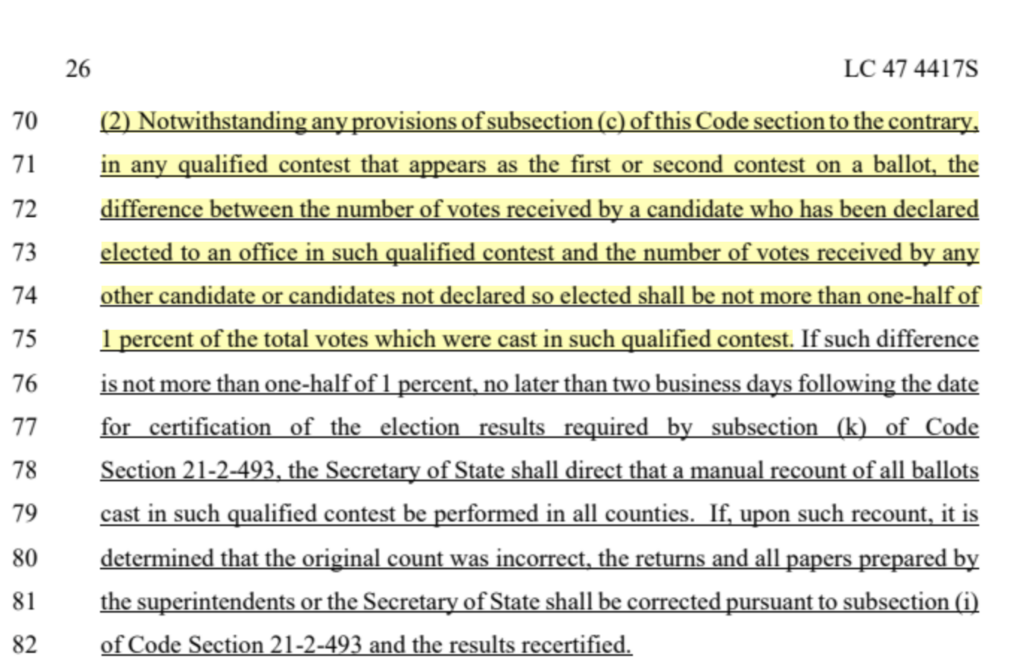
That requirement entered the bill through a late amendment. Critics contend the wording was rushed and flawed. The amendment, in describing the necessary margin for a recount, declares that the number of votes for the winner of one of those top two races “shall be not more than one-half of 1 percent of the total votes which were cast in such qualified contest.”
The Coalition for Good Governance, an organization that has long pressured the state to stop using QR codes in elections, wrote in a summary of SB 3EX that it literally “outlawed” race results with margins greater than 0.5%.
“While the drafting error will almost certainly be corrected in a future legislative session,” the group wrote, “it serves as a cautionary example of what happens when complicated election legislation is drafted, negotiated, generally behind closed doors, and passed at breakneck speed, with the public and Democrats not permitted to see bill drafts until moments before votes were taken.”
The disputed language from Senate Bill 3EX, signed into law by Gov. Brian Kemp on Thursday, June 25, two days after the Georgia General Assembly passed it during a special session.
Although Democrats largely opposed the measure, Sen. Josh McLaurin, D-Sandy Springs, voted for it, saying he trusted the Georgia Supreme Court to discern the intent of that language should a losing candidate sue.
McLaurin is the Democratic nominee for lieutenant governor. Three Senate Democrats, including Senate Minority Leader Harold Jones, II, D-Augusta, voted with him in favor of the bill.
Another 16 Democrats opposed it, including Sen. RaShaun Kemp, D-Atlanta, who said he doubted the courts would rule in favor of a Democrat, such as the party’s nominee for governor.
“What happens if Keisha Lance Bottoms comes up on top and it’s by 0.2%?” Kemp said. “I cannot support a bill that we already know has incorrect language in it.”
McLaurin alleged that his opponent for lieutenant governor, Sen. Greg Dolezal, R-Cumming, had secretly worked to sabotage the legislation on behalf of QR code opponents who believe the 2020 election was stolen from Trump. McLaurin said the final version of the bill was “a little clunky” but that it needed to pass to avoid pandemonium during the November midterms.
McLaurin said there were “election deniers in the hallway who are all saying the same thing: don’t fix the problem. … But dear God, we have to fix this problem.”
Dolezal did not stand to rebut McLaurin’s allegation about sabotage, but Senate President Pro Tem Larry Walker, III, R-Perry, did.
He said Dolezal had been an “honest broker” in support of the bill and that McLaurin’s allegation that Dolezal had tried to whip up votes against it were “patently false.”
ATLANTA — They were allegedly flying to help prisoners get high and to maybe escape, but now nine people, all but one from Macon, are behind bars themselves after federal agents arrested them in connection with delivering drugs, phones and weapons into prisons from above.
The bust, announced Wednesday, involved a “vast alleged conspiracy using drones to smuggle contraband,” according to the U.S. Department of Justice.
The nine suspects and three inmates are accused of coordinating deliveries of methamphetamine, marijuana and other controlled substances, as well as cell phones, tobacco and objects such as saw blades to be used as weapons for escape.
The eight of the accused who are from Macon are Leviticus Blash, 42; Chrystal Dunn, 37; Ira Christopher Jackson, 42; Xavier Maxwell, 30; Kenna Middleton, 45; Glenn Middleton, 70; Jeff Richardson, 23, and Tysean Richardson, 23.
The accusations were in an indictment unsealed Wednesday that described drone deliveries to 10 prisons in eight states, including two in Georgia, in Atlanta and in Jessup.
The joint announcement by the federal government included U.S. Attorney William R. “Will” Keyes for the Middle District of Georgia and William K. Marshall III, director of the Federal Bureau of Prisons.
Drones have been an ongoing problem for Georgia prisons.
During a legislative hearing at the Atlanta Capitol in December, Matthew Wolfe from the Georgia Department of Corrections said that for the year through June 2025 there were 120 inmates charged and 362 civilians arrested in connection with contraband deliveries.
The schemes sometimes involved simple methods, such as wrapping contraband with duct tape into the shape of a football and tossing it over a prison fence. But they often involved drones, said Wolfe, who displayed a photo of a confiscated unmanned aircraft that could carry hundreds of pounds.
“Civilian involvement remains the most common threat vector, with throwovers and drone drops continuing to be the primary method used to infiltrate our institutions,” Wolfe said.
Corrections Commissioner Tyrone Oliver said technology existed to stop such drones.
“We just don’t have the authority, the legal authority, to be able to do it,” Oliver told lawmakers.
The General Assembly responded by passing House Bill 1230, which takes effect Wednesday.
The new law will make it illegal to fly a drone over a prison. It will also authorize law enforcement agencies and officers who suspect drone use for criminal intent to detect, track and identify the aircraft and then intercept and disable them with jamming, hacking or other methods.
That law is for state and local authorities.
The indictment unsealed Wednesday involved a takedown by the federal government using sophisticated tracking technology.
The federal Bureau of Prisons used a drone detection system that provided alerts when drones were nearby and that reported an aircraft’s make, model and identification number, along with the launch location, flight path and altitude.