ATLANTA — Democratic U.S. Sen. Jon Ossoff raised about 10 times as much in campaign contributions over the past three months than U.S. Rep. Mike Collins, his Republican challenger in the November general election, according to numbers from the two campaigns.
Ossoff’s campaign said it raised $20 million from April through June, ending the period with $42 million on hand.
Collins’ campaign said it raised a little over $2 million in the second quarter and had about $2 million on hand.
Ossoff’s campaign suggested his financial advantage could change after a U.S. Supreme Court decision two weeks ago that struck down a federal law limiting how much political parties can spend in coordination with candidates.
Ossoff’s campaign manager, Ellen Foster, said Ossoff is building momentum “to push back against Republican dark money, power our massive and winning coalition over the next four months, and resoundingly defeat Trump loyalist Mike Collins at the ballot box come November.”
Both candidates characterized their campaigns as “grassroots.”
The Ossoff campaign said it averaged $42 from more than 474,000 donors, adding that nearly 340,000 gave less than $200.
The donations came from all 159 Georgia counties, Ossoff’s campaign said.
Collins’ campaign said it averaged $19.05 from about 16,000 donations but did not characterize the maximum amount of most donations. The Collins campaign also did not say where its donors were located but said it had an operation spanning all 159 counties.
Collins’ camp asserted its opponent took in significant amounts from donors in other states.
Ossoff’s “California and New York donors know exactly what they’re funding: a senator who will push their socialist agenda in Washington,” Collins’ campaign manager Josh Siegel said in a statement. “Mike Collins’ support comes from everyday Georgians because they know he will always put Georgia first,” he added.
ATLANTA — Brady Lum liked to play music, but he did not like to pay for his hobby.
Instead, he used the Southeast’s leading visual arts museum as a piggy bank, according to federal court documents.
Lum, 59, of Atlanta, pleaded guilty to stealing from the High Museum of Art during his nearly seven years as its chief operating officer, using creative accounting to disguise purchases of music lessons, luxury guitars and other musical equipment, and woodworking equipment.
The High receives money from the federal government, so the FBI got involved, leading to a charge of theft from a federally funded institution.
Lum pleaded guilty Monday in the Atlanta federal courtroom of Judge Michael L. Brown, accepting a deal that could put him behind bars for up to a decade and that will require restitution.
Lum, who was the High COO until December, was charged on April 14, according to his docket sheet filed in the U.S. District Court for the Northern District of Georgia.
The charging document said Lum used various schemes to cover his tracks, including altered invoices and accounting adjustments.
For instance, in November 2024, he used the High’s online expense platform to alter a $9,147.87 invoice for a guitar and accessories to appear as a purchase of a speaker array, subwoofers and equipment cases, the document said.
The office of U.S. Attorney Theodore S. Hertzberg prosecuted the case and said in a statement that Lum had engineered more than 700 reimbursements totaling more than $600,000.
“Over several years, Lum deceptively plundered the southeast’s premier museum of visual art,” Hertzberg said in the statement.
The FBI seized Lum’s ill-gotten goods, and now he has to repay the victims — with interest, according to the plea agreement he signed.
Lum remains free on bond pending his Nov. 2 sentencing.
The plea deal said Lum could be ordered to serve anywhere from zero to 10 years in prison, with prosecutors recommending a sentence at the low end. Lum also faces supervised release of zero to three years.
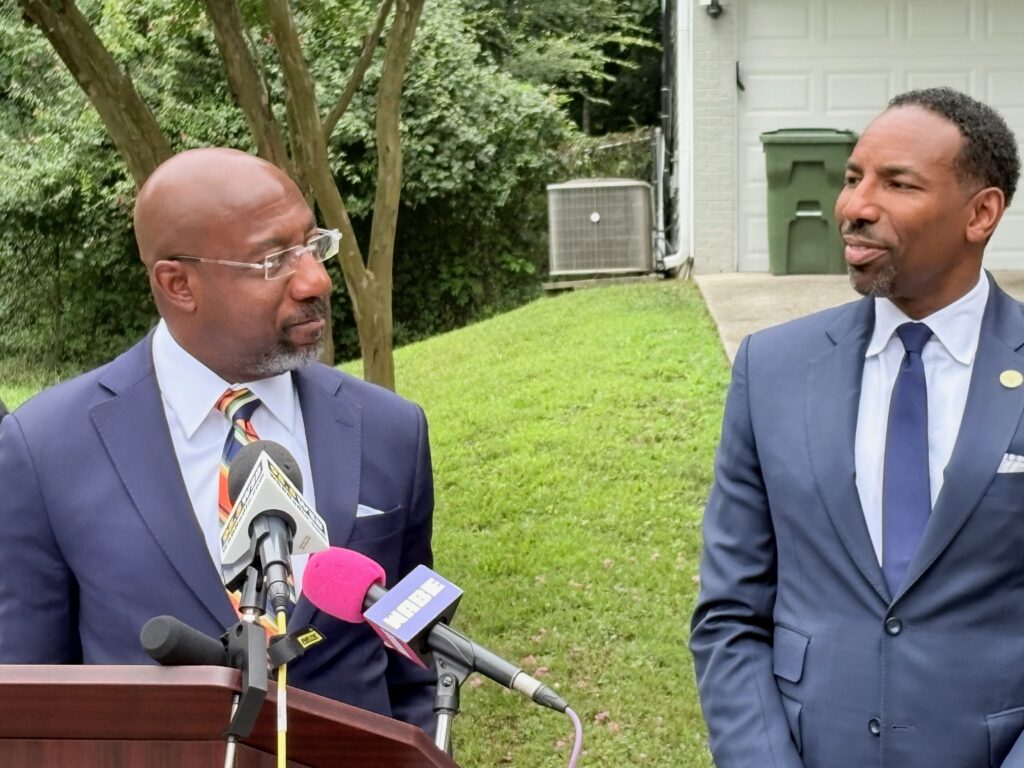
ATLANTA — U.S. Sen. Raphael Warnock met with other Democratic officials, including Atlanta Mayor Andre Dickens, in front of a corporate-owned house in southwest Atlanta Monday to celebrate a new federal law that seeks to give renters more hope in their quest to own a home.
The 21st Century ROAD to Housing Act became law at midnight Friday without the signature of President Donald Trump, who was protesting the lack of action on an unrelated bill.
The new law offers incentives to local communities to encourage more construction, and it caps corporate ownership of rental housing, which became an issue after the Great Recession.
Workers cannot compete with Wall Street when buying a home, Warnock said, speaking in the middle of a temporarily closed Adamsville Drive in front of a corporate-owned house.
“They will outbid you every time. So, this is about fairness,” Warnock said, adding that Atlanta is “ground zero for private equity’s domination of the housing market.”
U.S. Sen. Raphael Warnock and Atlanta Mayor Andre Dickens, both Democrats, describe the impact of the bipartisan federal 21st Century ROAD to Housing Act while standing in Adamsville Drive in Southwest Atlanta on July 13, 2026. (Ty Tagami/Capitol Beat)
The house behind Warnock, which he said should be owned by a person rather than a corporation, is listed in Fulton County property records as belonging to a company in Scottsdale, Ariz. DeKalb County property records have that same company sharing a mailing address with Invitation Homes.
Invitation Homes was the subject of criticism last summer by another Democrat, U.S. Sen. Jon Ossoff, who staged an event at his Atlanta headquarters so renters could complain about conditions at the company’s properties.
One renter described dangerous debris in his backyard that injured one of his dogs. Another complained about gas leaks at her home.
“We’re not humans to them. We’re dollar signs,” she said. “I felt completely worthless and small.”
An Invitation Homes spokesperson told Capitol Beat at the time that it had over 200 associates in the state to address such problems. The spokesperson did not address the specific complaints of the two renters.
Warnock said such large private equity investors own a quarter of the single-family rental homes in Atlanta.
That figure is confirmed by other reports. While Atlanta is an epicenter of the phenomenon, corporations own a far less significant share of all houses. Corporate rental stock comprises 3% of all Atlanta single-family houses, according to The Pew Charitable Trusts, which has produced numerous reports about the housing crisis.
Pew has concluded that the most significant solution is to build a lot more houses.
Warnock noted that home construction is encouraged by the new law, which he helped to shape with amendments.
The law changes federal housing grant formulas in a way that incentivizes communities to allow denser development, with faster permitting.
Dickens said it will encourage developers to build more starter homes while encouraging zoning that allows for more duplexes, townhouses and multifamily housing.
“This is just enabling us to get more out of the land,” he said, speaking with City Councilmember Andrea Boone, who represents the area.
Warnock called the new law a necessary first step. He praised the bipartisan collaboration that led to it, saying that is the only way to make lasting change.
He also noted the enormity of the challenge ahead, with analysts estimating a shortage of 4 million to 5 million houses in America.
“This is an important step today in the right direction,” Warnock said. “But this is not the end. There’s more legislation that we need to do. We have a real housing affordability crisis in this country.”
ATLANTA — The battle over voter confidence in Georgia’s election machines flared up after the Legislature decided last month to keep them until 2028.
Weeks after lawmakers voted to postpone their prior ban on the machines’ use of QR codes to tally results, the U.S. Department of Justice planned to surge into Atlanta with 260 FBI analysts. They were coming to help investigate the 2020 election, after the agency’s January raid of the Fulton County election warehouse to seize more than half a million ballots.
And the Federal Emergency Management Agency threatened to withhold anti-terrorism funds from states that do not start moving toward hand-marked paper ballots.
But the Trump administration also suffered a serious setback in its efforts to expand the 2020 election probe of Fulton, the most populous county in Georgia and a Democratic bastion.
A federal judge in Atlanta denied the administration’s demand for the personal information of thousands of Fulton election workers and volunteers.
The statute of limitations on any crimes in 2020 had long since expired, U.S. District Judge William M. Ray II ruled on July 7, denying the Justice Department’s grand jury subpoena.
Disclosing addresses, phone numbers and other sensitive information “threatens to chill participation in future elections, which will surely impact Fulton County,” the judge’s order said.
The FBI executed a search warrant for ballots from the 2020 presidential election at the Fulton County elections warehouse on Wednesday, Jan. 28, 2026. (Mark Niesse/Capitol Beat)
Ray decided the administration’s subpoena was unreasonable, calling it an “arbitrary fishing expedition.”
Fulton Commissioner Dana Barrett said the ruling by a judge who was appointed by President Donald Trump should put the 2020 election to rest.
“The conspiracy theory that the election was stolen and there was wrongdoing, that needs to now recede to the corners of the internet where conspiracy theories live,” Barrett said. “Go into the corner where the Jewish space lasers are and Area 51 and the JFK assassination.”
Barrett, who ran unsuccessfully in the recent Democratic runoff for secretary of state, said the Justice Department, the State Election Board and the “election deniers of the world” were using fictions about 2020 to sow doubts about Fulton and its ability to run clean elections.
She said it was a pretext for intervention in the county elections operations in 2026 and 2028: “It’s about trying to continue the narrative that Fulton County doesn’t know how to run elections and therefore either take that ability completely away from the county and put it in the hands of the MAGA-controlled state election board or put monitors in.”
The election board establishes the rules by which elections operate. Four of its five members are Republicans, and several are critical of Georgia’s electronic voting machines and of Secretary of State Brad Raffensperger, who selected the system.
This week, the board adopted two rules, one banning the use of optical character recognition to tally votes even though the state’s election machines do not use that technology. The other rule would require that Raffensperger allow board members into his election center when county-level vote counts are aggregated on election night.
That rule passed even though Georgia Attorney General Chris Carr told the board it lacked legal authority to implement it, since Raffensperger was elected by voters.
The board also initiated a public comment process on a rule that would disqualify the current voting machines over privacy issues.
Salleigh Grubbs, the author, cited several concerns, including the “huge” displays on the machines.
Sara Tindall Ghazal, the lone Democrat, called it a ruse to force election officials to use the paper ballots they keep for power outages and other emergencies.
Board Chairman John Fervier, a Republican, expressed a similar suspicion.
“This isn’t just about ballot secrecy,” said Fervier, who was appointed by Gov. Brian Kemp. “It’s all part of a larger agenda to get to hand-marked paper ballots.”
Fervier said that if the current machines were disqualified over secrecy concerns, it would cause “massive” problems for election officials, who are already busy recruiting and training poll workers on the current system. Local election leaders have repeatedly said they lack the time to switch systems before the general elections in November.
The measure passed, setting it on course for adoption.
Democrats have been dubious about the ongoing assault on Georgia’s voting machines.
Two years ago, Republican lawmakers pushed through a ban on the use of QR codes to tally votes, which would have made Georgia’s current system illegal effective July 1.
But they failed to approve and pay for an alternative system, so Kemp called them back to the Capitol last month to address the looming deadline.
They postponed the ban until 2028.
Just before the special session, Democratic lawmakers from across the South gathered in Atlanta to strategize ahead of the special session. With them was Rep. Carolyn Hugley, D-Columbus, the minority leader of the state House.
“The QR code is a manufactured issue to begin with because a certain person could not accept the fact that he did not win Georgia,” Hugley said at that event, referring to Trump.
Raffensperger has consistently pushed back against his GOP critics, asserting that his machines are all but flawless.
This week, his office announced the results of a review of all 91 contests in last month’s runoffs. The audit of all 1,111,856 ballot images found 23 discrepancies with hand-marked ballots and none with the digital voting machines.
“We run elections with nearly perfect accuracy, and we will never stop reminding the public their machines are accurate, their counts are accurate, and that elections in Georgia are accurate,” Raffensperger said in a statement.
His office calculated that the hand-marked error rate would create about 3,500 discrepancies in a presidential election year with 5 million ballots cast.
The state Republican Party and many GOP lawmakers, dismiss such audits as window dressing, saying flaws in the system make errors difficult or impossible to detect.
The national fight over elections has taken a toll on voter confidence.
A PBS News/NPR/Marist poll in March found that two-thirds of Americans are confident in fair and accurate elections, down from 76% in late 2024.
Georgia GOP voters had a different take.
A survey in late April of likely Republican primary voters by the firm Cygnal had more than 78% expressing confidence that their votes would be counted fairly in 2026, with 28% “very” confident and more than 50% “somewhat” confident.
The poll was commissioned by the bipartisan Democracy Defense Project, which is trying to counter “false narratives about ‘stolen elections'” that it blames on a “proliferation of politicians” who are trying to bolster their own campaigns.
The project’s Georgia board members include former Democratic Gov. Roy Barnes and former Atlanta Mayor Shirley Franklin. On the Republican side are former U.S. Sen. Saxby Chambliss and former U.S. Rep. Drew Ferguson.
Ferguson and Franklin appeared at the DeKalb County elections center during the runoff last month to push back against doubters.
They pointed to record turnout in recent years.
“What we have found is 80% of voters on a bipartisan level feel very strongly that the elections are being run fairly and safely here in the state of Georgia,” Ferguson said.
But the Democracy Defense Project’s own polling indicates lingering suspicion.
That April survey by Cygnal found that nearly 76% of likely GOP primary voters approved of the FBI raid on the Fulton elections warehouse, more than 61% strongly approving.
ATLANTA — Georgia tax revenues fell in June, driven by a gas tax suspension and helped along by increased income tax refunds.
Net tax revenues for the month fell 6.8% compared with June 2025, according to the Georgia Department of Revenue.
The bulk of it was driven by a nearly $197 million decline in motor fuel excise tax collections, which Gov. Brian Kemp’s office attributed to his executive order extending the suspension of that tax from May 20 through June 3.
The General Assembly had previously suspended it starting March 20, as the war in Iran drove up prices at the pump.
As the expiration date approached ahead of Memorial Day, Kemp called a state of emergency to extend it. He then called lawmakers back to the Capitol for a special session, in part to retroactively approve his decision.
Last month, the state revenue department reported that motor fuel tax collections for May fell nearly $200 million compared with May 2025.
Even without the fuel tax suspension, state revenues lagged in June. Net tax revenues fell just over $215 million from June 2025. Excluding motor fuel tax changes, net tax revenues were down 0.6% for the month.
Another big driver was an increase in individual income tax refunds, up nearly $67 million, or about 71%. That contributed to a nearly $100 million decline in individual income tax collections compared to June last year.
Most eligible taxpayers also benefited from House Bill 1000 this year, which passed the General Assembly unanimously, with an estimated price tag of nearly $1.2 billion. Taxpayers who filed timely state returns for 2024 and 2025 were set to receive one-time rebates of $250 for individuals, $375 for heads of household and $500 for married couples filing jointly.