ATLANTA – More than 266,000 Georgians filed initial unemployment claims last week, up about 19,000 from the previous week, the state Department of Labor reported Thursday.
That brings to nearly 1.4 million the number of claims the labor agency has processed during the six weeks since schools and businesses began shutting down prompted by the coronavirus pandemic.
The industry sector in Georgia by far the hardest hit by job losses is accommodations and food services, with 396,209 initial unemployment claims during the past six weeks. Health care and social assistance is next with 157,496 claims, followed closely by retail trade with 156,123.
Workers in administrative and support services have filed 109,483 unemployment claims during the past six weeks, while 105,122 claims have come from those in manufacturing.
“The accommodation and food service sector has truly suffered during this pandemic,” Georgia Commissioner of Labor Mark Butler said Thursday. “We hope that employers and employees can work together to find a return-to-work plan that can work for both parties allowing for continued financial support from state and federal programs as we gradually reopen Georgia for business.”
Employers and their employees have worked together closely when it comes to filing claims. About 75% of the initial unemployment claims during the past six weeks have been filed by employers on behalf of their workers.
The labor department paid out more than $155 million in unemployment benefits last week, bringing the total for the past six weeks to $388 million. That’s more than the annual total for each of the past four years.
“Our employees are managing unprecedented numbers of claims and are getting people paid,” Butler said.
Many of the remaining unpaid claims are awaiting eligibility determination. Delays have occurred in cases where duplicate claims have been filed, identification has been requested, excessive weekly earnings have been reported or child support stops have been issued.
Butler said Georgians whose claims are ruled invalid still might be eligible for federal unemployment assistance. Groups eligible for the federal program include the self-employed, gig workers, 1099 independent contractors, employees of churches or other nonprofits or those with limited work history.
The Georgia Department of Labor has issued more than $700 million in federal funds during the past six weeks, including more than $336 million last week alone.
Meanwhile, the agency is continuing to post job opportunities. More than 106,000 jobs are listed online at www.EmployGeorgia.com
ATLANTA – A new study by Georgia State University economists shows a strong correlation between Americans unemployed due to coronavirus and those likely to be displaced by automation after the pandemic is over.
About 75% of industries at risk from COVID-19 closely match those with high potential for automation due to artificial intelligence (AI) and advanced computer technologies (ACT), according to a report released Wednesday by researchers and faculty at Georgia State’s Fiscal Research Center and Andrew Young School of Policy Studies.
The study also found about 50% of jobs in Georgia are at risk from AI and ACT. The vast majority of those jobs are among relatively low-paid occupations characterized by routine tasks that don’t require complex decision-making.
“The COVID-19 public health crisis is exacerbating AI’s structural changes to employment and occupation by increasing the speed of the transition to automation as a result of social distancing measures and concerns regarding the virus’ spread,” said Peter Bluestone, a senior research associate with the school’s Center for State and Local Finance, which published the study. “Education, business, medicine and other industries are finding creative ways to use digital technologies.”
The most vulnerable industries from coronavirus and the onward march of advanced technologies are accommodation and food services, arts and entertainment, wholesale and retail trade and construction, according to the study. Dominated by occupations paying relatively low wages and requiring low levels of education, many of these industries already put vulnerable workers at higher risk for economic instability.
On the other hand, the short-term threat of COVID-19 and long-term automation post vastly different threat levels for farmworkers. While fewer than 10% of agricultural jobs are at risk due to coronavirus, 58% are threatened by automation.
“This difference is understandable in that the virus lockdown cannot stop consumption,” Bluestone said. “Farmers are not likely to stop their production, although problems in logistics and transportation have already begun to impact production.”
The COVID-19 outbreak is expected to accelerate the transformation toward digital technology in businesses experiencing high numbers of layoffs prompted by the virus, according to the study. While the trend will increase productivity in the long run, it could make it difficult for workers lacking sufficient skills to compete in the changed labor market when the pandemic is over.
“Governments, nonprofits and the private sector have an opportunity to support these doubly displaced workers for the long term,” the report concludes. “This is the time for higher education – colleges, universities, vocational and technical schools – to be harnessed quickly to teach people digital and other tools that will be increasingly in demand as the COVID-19 cloud lifts.”
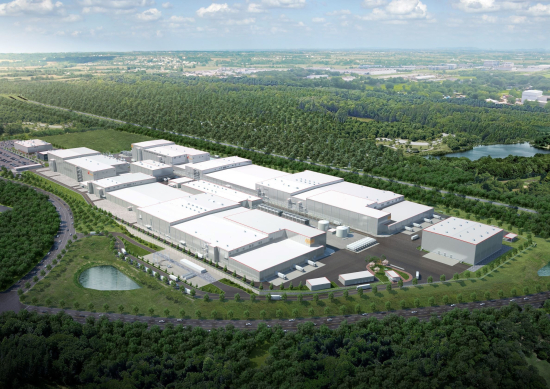
SK Innovation will build a second EV battery plant near Commerce. (rendering)
ATLANTA – A South Korean battery manufacturer is planning to build a second electric vehicle (EV) battery plant in Jackson County, Reuters reported Tuesday.
SK Innovation broke ground in March of last year on its first U.S. EV battery plant near Commerce, with Gov. Brian Kemp and U.S. Commerce Secretary Wilbur Ross in attendance.
Construction on the second plant will start this summer, representing an investment of $727 million.
Together, investment on the two plants will total more than $1.5 billion. The plants aim to start production in 2002 and 2023, creating about 2,000 jobs when they reach full capacity by 2025.
Between them, the two plants represent a capacity of 21.5 gigawatt-hours of EV battery power.
SK Innovation, South Korea’s largest oil refiner, has expanded in recent years into EV batteries, with factories in South Korea, China and Hungary. The Georgia plants will supply the Volkswagen plant in Chattanooga, Tenn., the Ford plant in Kentucky and possibly the BMW plant near Greenville, S.C.
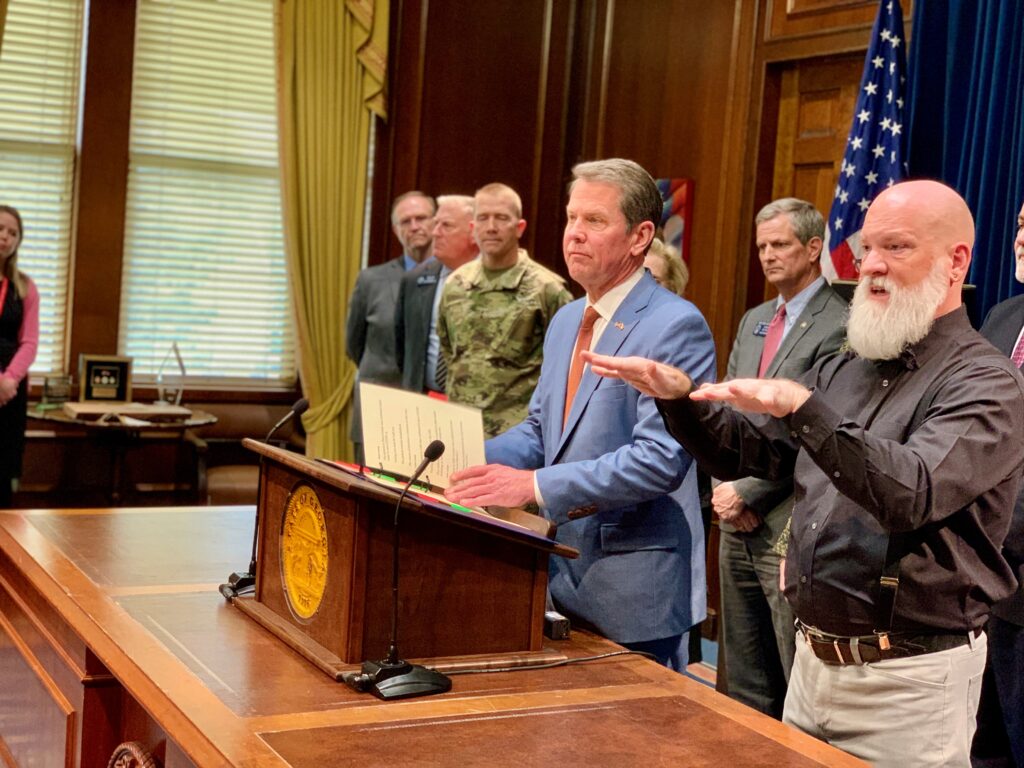
Gov. Brian Kemp gives an update on coronavirus in Georgia on March 9, 2020. (Photo by Beau Evans)
ATLANTA – The state’s effort to increase testing for COVID-19 is starting to pay off.
Nearly 13,000 new tests were reported to the Georgia Department of Public Health’s website Tuesday, the most in a single day since the coronavirus pandemic began.
Initially, the state was testing only elderly Georgians and those with chronic illnesses, considered the most vulnerable to contracting COVID-19, as well as health-care workers and first responders likely to be exposed to the virus.
On Monday, Gov. Brian Kemp said testing has been ramped up to the point that all Georgians showing symptoms can and should be tested. There’s also enough testing capacity to test Georgians without symptoms but who are health-care workers, first responders, law enforcement personnel or residents or staff of a long-term care facility, he said.
“We are making significant progress,” Kemp said Tuesday after reporting the record-high daily tests. “We are pushing our testing capacity to the max. … We have the sites, the physicians and the tests. We just need more Georgians to participate.
Kemp has made making tests more readily available a key component in his goal of reopening businesses he shut down early this month when he issued a shelter-in-place order.
Gyms and fitness centers, bowling alleys and close-contact businesses including barbershops and hair salons were allowed to reopen last Friday. Dine-in portions of restaurants and movie theaters got the go-ahead to reopen starting Monday.
The shelter-in-place order is due to expire this Thursday, unless Kemp extends it, except for the elderly and medically fragile, who must remain at home at least through May 13.
Georgia now has 49 COVID-19 testing sites, set up through the combined efforts of the state public health department, the University System of Georgia, local public health agencies and the private sector. The Georgia National Guard has opened another nine testing sites.
State Sen. Nikema Williams, chairwoman, Democratic Party of Georgia
ATLANTA – The Democratic Party of Georgia is adjusting its schedule for selecting delegates to the party’s national convention this summer in light of the coronavirus pandemic.
Reflecting the postponement of the Democratic presidential primary until June 9, the deadline for congressional district-level delegate hopefuls to file for candidacy is April 30. District-level elections will take place May 23.
Party leaders, elected officials and Democrats wishing to serve as at-large delegates must file for candidacy by May 28, with elections set for June 20.
Also, all voting is being converted from in person to online, so Georgians can elect delegates from home.
“Our team has worked around the clock to adjust to our new normal and make sure that we can protect the health and safety of Georgians while making our delegate selection process open to all,” said state Sen. Nikema Williams, D-Atlanta, the party’s state chairwoman. “Our new virtual delegate selection model will help us make participation more accessible to all Georgians and build the most diverse delegation in Georgia history.”
All meetings of the Georgia delegation also will take place online, as will all district-level delegate elections.
After the June 9 primary, delegates will be allocated based on the percentage of the vote each presidential candidate receives.
The Democratic National Convention is set to take place Aug. 17-20 in Milwaukee.