ATLANTA – Georgia’s coronavirus-prompted judicial emergency is about to be extended for another month.
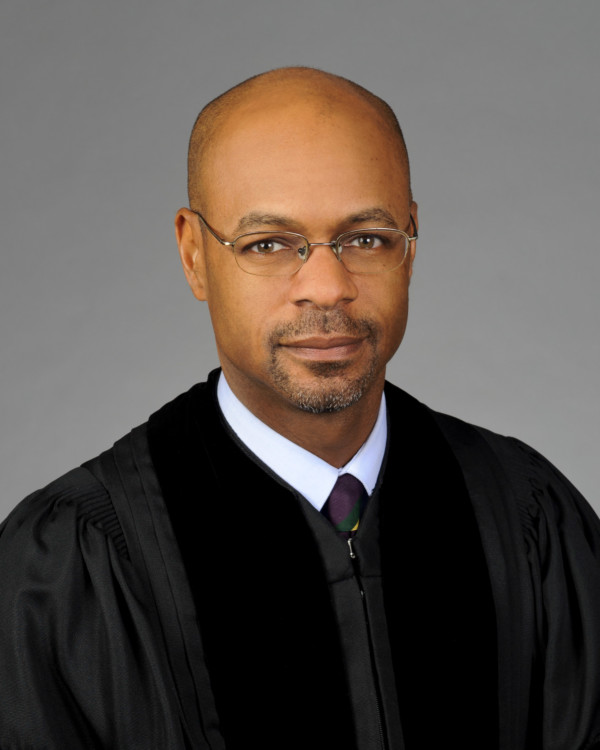
Chief Justice Harold Melton announced Monday that he will sign an order this week extending the emergency from May 13, the current expiration date, until June 12.
All criminal and civil jury trials will continue to be suspended, and courts will be barred from summoning and impaneling new trial and grand juries.
While Georgia businesses are gradually reopening following Gov. Brian Kemp’s lifting of his shelter-in-place order late last week, Melton said the courts are different from most private establishments and public places.
“We compel people to attend court proceedings, and that requires us to be extra cautious,” he said.
Since Melton issued the first judicial emergency order in mid-March, courts have remained open to handle critical and essential court services.
Under the new extension order, courts will be urged to develop plans for restoring non-critical operations that can be conducted remotely by videoconferencing or by maintaining adherence to public health guidelines. Increasing the use of remote judicial proceedings where legally permitted is aimed at limiting the backlog once the emergency order is ended.
The state Supreme Court has set an example by starting to hold hearings via remote videoconferencing.
Melton has created a special task force to help courts conduct remote proceedings and develop plans for the safe resumption of more extensive in-court proceedings, including jury trials and grand jury proceedings.
The task force will include judges from every category of courts, civil trial lawyers, court clerks and sheriffs.
ATLANTA – Two Democrats running for the Georgia Public Service Commission focused their fire Monday on the current PSC and Georgia Power Co. rather than each other.
Daniel Blackman, a longtime environmental advocate, and John Noel, owner of an energy-efficiency contracting company, are seeking the Democratic nomination to oppose Republican Commissioner Lauren “Bubba” McDonald in PSC District 4, which includes northern Georgia and the state’s eastern border south through Augusta.
In a debate live streamed by Georgia Public Television, both accused the PSC of dragging its feet when it comes to developing renewable energy and deploying broadband service to rural Georgia.
“We’ve got a lot of coal power still hanging around and a lot of natural gas that comes from fracking sources,” Noel said. “We do not have enough solar.”
Blackman said the commission is not doing enough to work with the state’s electric membership corporations (EMCs) to promote broadband in rural Georgia. Inadequate internet service in rural areas has become even more of a problem as the coronavirus pandemic keeps people at home, he said.
“We need to help educate communities … and give communities input into a lot of this process,” he said.
Both candidates have run unsuccessfully for the PSC in recent years. Noel, who represented an Atlanta district in the Georgia House of Representatives in the early 2000s, has moved to Augusta so he can seek the District 4 seat. Under a unique provision in state law, PSC candidates are elected statewide but must live in the district they wish to represent.
“It’s important for the city of Augusta to have a statewide elected official. They haven’t had one in decades,” Noel said. “It’s an antique and dumb system, but I’m living by the rules.”
Noel is taking a different approach toward by running for the PSC in combination with fellow Democrat Robert Bryant of Savannah, who is seeking the District 1 seat covering all of South Georgia. Currently, all five seats on the commission are held by Republicans.
“We believe that running as a tandem is stronger,” Noel said. “When we win, we’ll have two seats of the five.”
With a background in the environmental justice movement, Blackman said the rate increases the PSC approved for Georgia Power and Atlanta Gas Light last December are being disproportionately felt by low-income customers.
“Seniors on fixed incomes are struggling to pay bills,” he said.
Blackman said the commission also needs to do more to help low-income families and renters invest in clean energy.
“They can’t afford to install rooftop solar,” he said.
Both candidates also complained about the basic service fees the PSC lets the utilities charge regardless of how much electricity or gas a customer consumes.
Blackman and Noel will face off for the Democratic nomination to challenge McDonald in a June 9 primary.
ATLANTA – U.S. Sen. David Perdue, R-Ga., took some hits Sunday evening from six Democrats vying for their party’s nomination to challenge the GOP incumbent’s bid for a second term in the June 9 primary.
But much of the debate aired statewide on public television was taken up by candidates attacking each other’s records and whether their experience makes them qualified to sit in Congress.
Investigative journalist and documentary filmmaker Jon Ossoff, who lost a bid for the U.S. House to Republican former U.S. Rep. Karen Handel in a special election in 2017, came under fire for lacking government experience.
But Ossoff said the kind of work he does uncovering political corruption is well suited for the Senate.
“At a moment when political corruption is destroying our democracy, when drug prices are through the roof because of the power of the drug industry, when the environment is being destroyed because of the power of polluting industries … an anti-corruption fighter is exactly what we need in the U.S. Senate,” he said.
Teresa Tomlinson, a former two-term mayor of Columbus, was questioned about aspects of her record in office, including overseeing a prison work camp that paid inmates just $3 a day.
She said she inherited a state-run prison labor program when she took office and acted to overhaul it.
“We completely reformed our budget … to remove our reliance on the work camp,” Tomlinson said. “It became more of a job training/rehabilitation center.”
Marietta businesswoman Sarah Riggs Amico, the Democratic nominee for lieutenant governor in 2018, defended her car-hauling company’s decision to file for bankruptcy protection last year as a job-saving measure.
“We were caught in the middle of a pension crisis that the U.S. Senate has failed to address,” she said. “In restructuring, we gave up our family’s equity … to save 3,000 jobs without a single person taking a pay cut or a wage cut.”
The Democrats agreed on a number of issues, including the need for reforming America’s gun laws in a way that still protects the constitutional right to bear arms.
“I’m a firm supporter of the Second Amendment,” said James Knox, a retired U.S. Air Force veteran. “But I don’t believe you need to have a 50-round magazine. If you need 100 rounds, you need to get better at your sport.”
“We’re not, as Democrats, trying to take away guns,” added Marckeith DeJesus, a health-care professional. “We’re trying to keep guns out of the hands of those who are mentally unstable.”
The candidates also criticized the coronavirus relief packages huge bipartisan majorities in Congress have passed in recent weeks for steering too much of the aid to large businesses and not enough to workers.
“Democrats allowed it to go through without care or concern for the people at the bottom … working-class people,” said Maya Dillard Smith, a civil and human rights lawyer and former Georgia director of the American Civil Liberties Union.
The Democratic candidates also were unified in criticizing as premature the reopening of Georgia’s economy while the COVID-19 pandemic continues raging.
“We went back against CDC guidelines,” Tomlinson said. “It would be so much better if we had a plan to first get public safety straight. … That allows us to have economic prosperity.”
Most of the candidates endorsed the Green New Deal, a legislative package that aims to address climate change with job-creating clean energy investments. Amico called the issue a top-five priority of her campaign.
Much of the criticism of Perdue from the Democrats focused on his close ties to President Donald Trump. The incumbent also was accused of being overly dependent on campaign contributions from corporate political action committees.
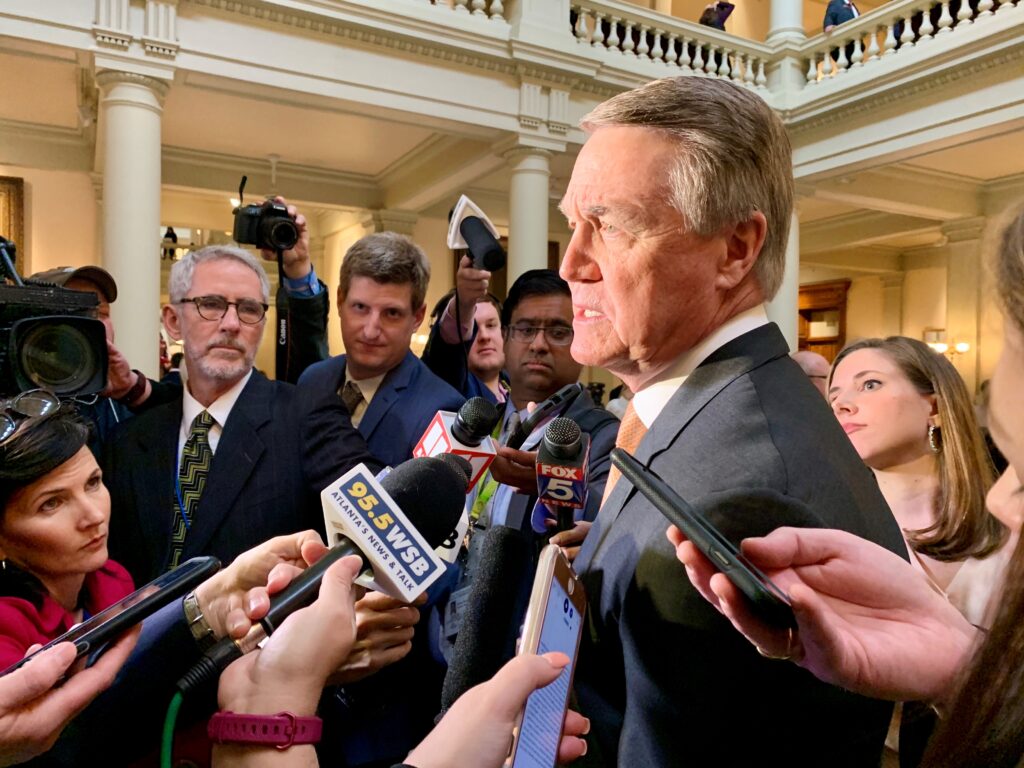
U.S. Sen. David Perdue speaks at the State Capitol after qualifying for the 2020 election on March 2, 2020. (Photo by Beau Evans)
ATLANTA – U.S. Sen. David Perdue, R-Ga., is planning to introduce bipartisan legislation aimed at relieving the nation’s shortage of doctors and nurses critically needed to respond to the coronavirus pandemic.
The bill would recapture and reallocate 25,000 unused immigrant visas for nurses and 15,000 for doctors and instruct the State Department and Department of Homeland Security to expedite processing them.
“The growing shortage of doctors and nurses over the past decade has been exacerbated by the COVID-19 crisis,” Perdue said. “Fortunately, there are thousands of trained health professionals who want to practice in the United States. This proposal would simply reallocate a limited number of unused visas from prior years for doctors and nurses who are qualified to help in our fight against COVID-19.”
One-sixth of the U.S. health-care workforce is foreign-born, said Senate Minority Whip Dick Durbin, D-Ill., one of the bill’s cosponsors.
“It is unacceptable that thousands of doctors currently working in the U.S. on temporary visas are stuck in the green-card backlog, putting their futures in jeopardy and limiting their ability to contribute to the fight against COVID-19,” Durbin said.
While the legislation is aimed at increasing the supply of doctors and nurses, if does contain some caveats. Employers would be required to attest that immigrants from overseas who get these visas would not displace an American worker.
Also, the filing period for recaptured visas would be within 90 days of the termination of President Donald Trump’s COVID-19 emergency declaration.
Joining Perdue and Durbin on the bill are Sens. Todd Young, R-Ind., and Chris Coons, D-Del.
The bill will be introduced when the Senate reconvenes.
ATLANTA – The Georgia House of Representatives is gearing up to resume a 2020 legislative session interrupted in mid-March by the coronavirus pandemic.
In a letter to House members and staff dated Thursday, Speaker David Ralston notified committee chairmen they may begin holding online meetings on Monday, May 4.
If all goes as planned, the House staff would report back to work in the state Capitol on May 18, and in-person committee meetings would resume on May 19.
“We remain mindful that the coronavirus still poses a risk, and we will alter our policies and procedures accordingly,” the speaker wrote. “Guidelines for employees will be provided in advance of a final decision on the staff report date. … [In-person committee] meetings will be subject to the provisions of any applicable public health directives.”
Ralston, R-Blue Ridge, indicated he is working with Lt. Gov. Geoff Duncan, the Senate’s presiding officer, to set a date to resume the legislative session. Duncan has expressed a preference for returning to the Gold Dome next month, but Ralston states in the letter he is anticipating lawmakers will reconvene on June 11.
Whenever lawmakers gavel in, it will be Day 30 of the 40-day legislative session. The most pressing business will be adopting a state budget for the fiscal year that starts July 1.
The House approved a $28.1 billion spending plan on March 10, three days before the session was suspended indefinitely. But all bets are off because of the financial impacts of the coronavirus pandemic, from the need for additional health-care services to the massive losses of state tax revenue resulting from thousands of businesses shutting their doors and laying off workers.
An Atlanta-based think tank released a report last week suggesting the state is facing a fiscal 2021 budget shortfall of up to $4 billion.