ATLANTA – Local school boards will have to develop policies to screen and potentially remove books from school libraries deemed harmful to minors under legislation that gained final passage in the Georgia Senate Wednesday.
Senate Bill 226 passed the Republican-controlled chamber 29-21 along party lines. It already had passed the state House of Representatives last week 97-61, also on a party-line vote.
Under the bill, school principals would have seven business days to review complaints from parents that a given book is obscene and “lacking in serious literary, artistic, political or scientific value for minors.” Principals would have three additional days to determine whether a book should be removed from that school’s library and inform the parent of the decision.
Local school boards would have 30 calendar days to handle appeals of principals’ rulings.
The bill also requires school boards to post titles of books removed from the shelves on the system’s website within 15 business days of a determination.
School boards would have until Jan. 1 to develop policies for handling complaints. They would get help from the state Department of Education, which would have until Sept. 1 to develop and publish a model policy.
Opponents argued there are already local policies in place for handling complaints from a parent that a school library is displaying obscene material on its shelves inappropriate for minors.
Similar arguments of existing policies have come from educator groups and legislative Democrats about other bills majority Republicans have been considering this year. Opponents also have accused Republicans of pushing a conservative education agenda to win votes in an election year.
Senate Bill 226 is the first to gain final passage and go to GOP Gov. Brian Kemp, who is expected to sign it.
Other Republican-backed legislation specifying how Georgia schools should teach about racism and a Parents’ Bill of Rights aimed at guaranteeing parental involvement in their children’s education are still pending, as is legislation prohibiting transgender students born male from competing in most girls’ sports.
This story is available through a news partnership with Capitol Beat News Service, a project of the Georgia Press Educational Foundation.
Georgia House Speaker David Ralston (Photo by Beau Evans)
ATLANTA – The General Assembly gave final passage Wednesday to an overhaul of the state’s mental health-care delivery system praised as “transformative” by one legislative supporter.
The Georgia Senate passed House Bill 1013 unanimously. The House of Representatives followed a short time later, also voting unanimously to agree with changes to the legislation made on the Senate side.
Georgia ranks among the lowest states in the nation for access to mental-health services.
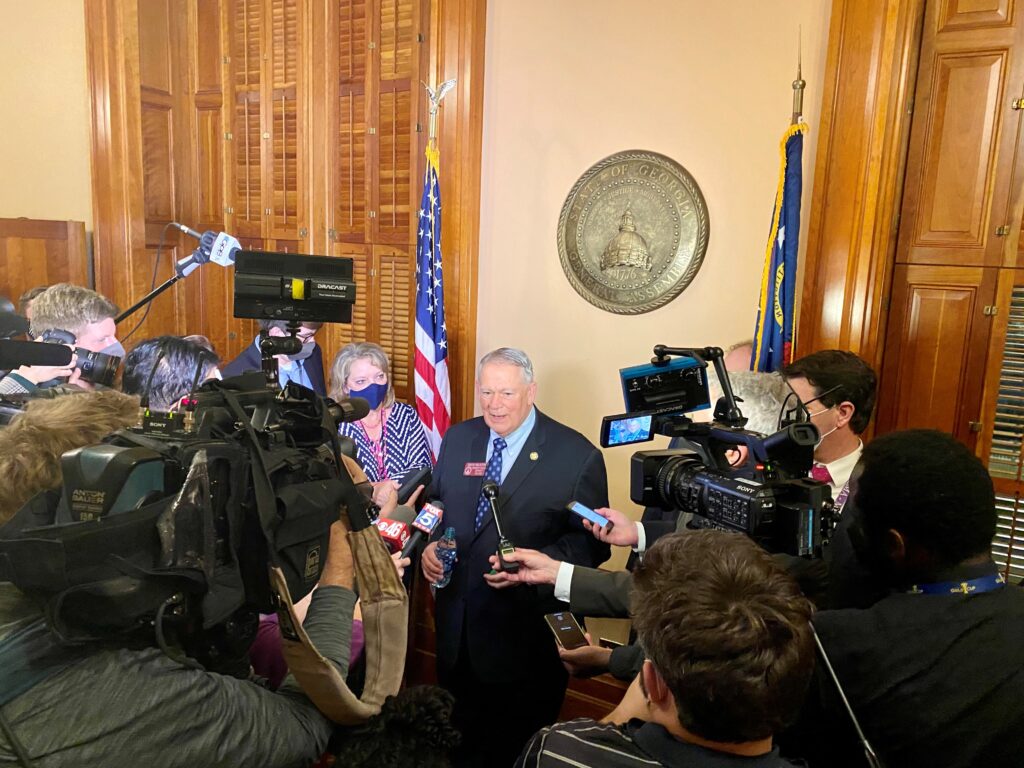
But that dismal status should end as a result of Wednesday’s vote, an emotional House Speaker David Ralston – who made the bill his top priority for this year’s session – told House members after the vote.
“Today, hope won,” said Ralston, R-Blue Ridge, to a standing ovation from the lawmakers. “Countless Georgians will know we’ve heard their despair and frustration.”
The legislation, which now heads to Gov. Brian Kemp for his signature, requires health insurance companies to cover mental illness the same way they cover physical illness. The parity provision also would apply to Georgia Medicaid and the State Health Benefit Plan.
Care management organizations (CMOs) participating in Georgia Medicaid will have to dedicate at least 85% of their revenues to patient care.
The bill also creates a service-cancelable loan program to address a workforce shortage by offering loan forgiveness to several types of mental-health specialists as well as primary-care physicians.
The Senate left intact in the measure the current law requiring that a mentally disturbed person pose an “imminent” threat to themselves or others before they can be involuntarily committed for an evaluation at a mental-health care facility. The original House version of the bill had removed “imminent” from that provision.
“An officer may take an individual to be evaluated without having to charge them with a crime,” said Sen. Brian Strickland, R-McDonough, who carried the bill in the Senate.
The bill also includes legislation originally introduced into the House by Rep. Yasmin Neal, D-Jonesboro, authorizing the Georgia Public Safety Training Center in Forsyth to provide mental health training to police officers.
Legislative leaders have been working on mental health reform for several years. Some of the recommendations from a task force of industry experts formed in 2019 are included in the bill that passed Wednesday.
Strickland said the work the Behavioral Health Reform and Innovation Commission isn’t done. The bill authorizes the panel to keep working on mental-health reforms, setting a new deadline of June 30. 2025.
“Many parts of this bill are long-term investments,” he said. “But we’ll start the process to make Georgia not just the No.-1 state in which to do business, but the No.-1 state for mental-health services.”
Also Wednesday, the House unanimously passed a related Senate bill allowing local law enforcement agencies to develop procedures for mental-health workers to join police in responding to 911 calls.
“If [police] find a mental-health crisis, they can call in a trained mental-health worker,” said Rep. Sharon Cooper, R-Marietta, who carried Senate Bill 403 in the House. “This is the way we should be dealing with our mental-health people.”
Because of changes the House made to the bill, it must return to the Senate to gain final passage.
This story is available through a news partnership with Capitol Beat News Service, a project of the Georgia Press Educational Foundation.
ATLANTA – The Georgia Senate gave final passage Wednesday to several bills offering tax breaks to various types of businesses.
House Bill 1041, which passed unanimously, would increase the annual cap on the state’s rural hospital tax credit program from the current $60 million a year to $75 million. The original version had called for raising the annual limit to $100 million.
Eight rural hospitals in Georgia have closed during the last decade for lack of operating funds, said Sen. Billy Hickman, R-Statesboro, who carried the House bill in the Senate.
“Without a rural hospital, a community is not viable,” he said. “And without being viable, a community dies.”
The rural hospital tax credit offers dollar-for-dollar credits to taxpayers who donate to a rural hospital in their community.
Hickman said the $60 million cap on the tax credit last year was reached in August. This year, donations to rural hospitals are running 75% ahead of last year, he said.
Lt. Gov. Geoff Duncan, who was instrumental in creating the tax credit in 2016 as a member of the state House of Representatives, said the key to its success has been its flexibility.
“We don’t try to sit in this building and tell [rural hospitals] how to spend those dollars,” said Duncan, who presides over the Senate
The Senate also voted 48-6 to exempt from state sales taxes the purchase of tickets to nonrecurring major sporting events held in Georgia.
Sponsors of events including the Super Bowl, college basketball’s Final Four, the college football playoffs and soccer’s World Cup demand tax breaks on ticket sales from host states, said Sen. John Albers, R-Roswell, who carried House Bill 1034 in the Senate.
The Final Four generated more than $100 million in economic impact in 2013, the last time it was held in Atlanta, Albers said.
“We know the economic results of getting one of these,” he said.
Senators also voted 50-1 to offer Georgia’s timber industry the same exemption from property taxes on equipment used in timber harvesting that already goes to the purchasers of farm equipment.
“This bill is long overdue to bring equity and relief for our forestry community,” said Sen. Larry Walker III, R-Perry, who carried House Bill 997 in the Senate.
The tax break will be subject to a statewide referendum before it can take effect.
All three bills now head to Gov. Brian Kemp for his signature.
This story is available through a news partnership with Capitol Beat News Service, a project of the Georgia Press Educational Foundation.
ATLANTA – Georgia is challenging a mask mandate the Biden administration has imposed on public transportation and at transit hubs.
A lawsuit filed by Attorney General Chris Carr and Gov. Brian Kemp charges the mandate is an unconstitutional overreach of federal power.
The suit comes even as the federal Centers for Disease Control and Prevention (CDC) has walked back similar masking guidance, the White House itself has ended its mask mandate for federal buildings, and states with some of the most restrictive COVID-19 policies have lifted their mask mandates.
“This mask mandate was unlawful from the very beginning,” Carr said. “Yet, the Biden administration has once again inexplicably extended its policy despite recent science-based developments that would indicate otherwise.
“The CDC does not have the authority to force everyone, including children, to wear a mask on public transportation, and to continue to do so is unnecessarily burdensome to both travelers and the industry alike.”
The mandate applies to airplanes, trains, buses, ships and other modes of transportation. Specifically, the rule requires that masks be worn by all personnel and passengers two years of age and older.
“Though it is just one of many egregious federal mandates imposed by their heavy government hand, this mandate in particular has caused a rise in tensions and incidents between personnel and customers and unnecessarily divided people,” Kemp said. “At this point where cases are dropping and more and more people are taking advantage of the vaccine, travelers should be able to make the choice for themselves about whether or not they want to wear a mask.”
Kemp also has fought mask mandates at the state level. Legislation introduced into the General Assembly on the governor’s behalf prohibiting school districts in Georgia from imposing mask requirements gained final passage last week, and Kemp signed the bill on Tuesday.
With the new federal lawsuit, Kemp and Carr have now filed five separate legal challenges to the Biden administration’s vaccine and mask mandates. In one of those cases, the U.S. Supreme Court overturned a vaccine mandate applying to businesses with 100 or more employees.
Twenty other Republican-led states have joined Georgia in the new federal suit, including Alabama, Florida, and South Carolina. The suit was filed in the U.S. District Court in Tampa.
This story is available through a news partnership with Capitol Beat News Service, a project of the Georgia Press Educational Foundation.
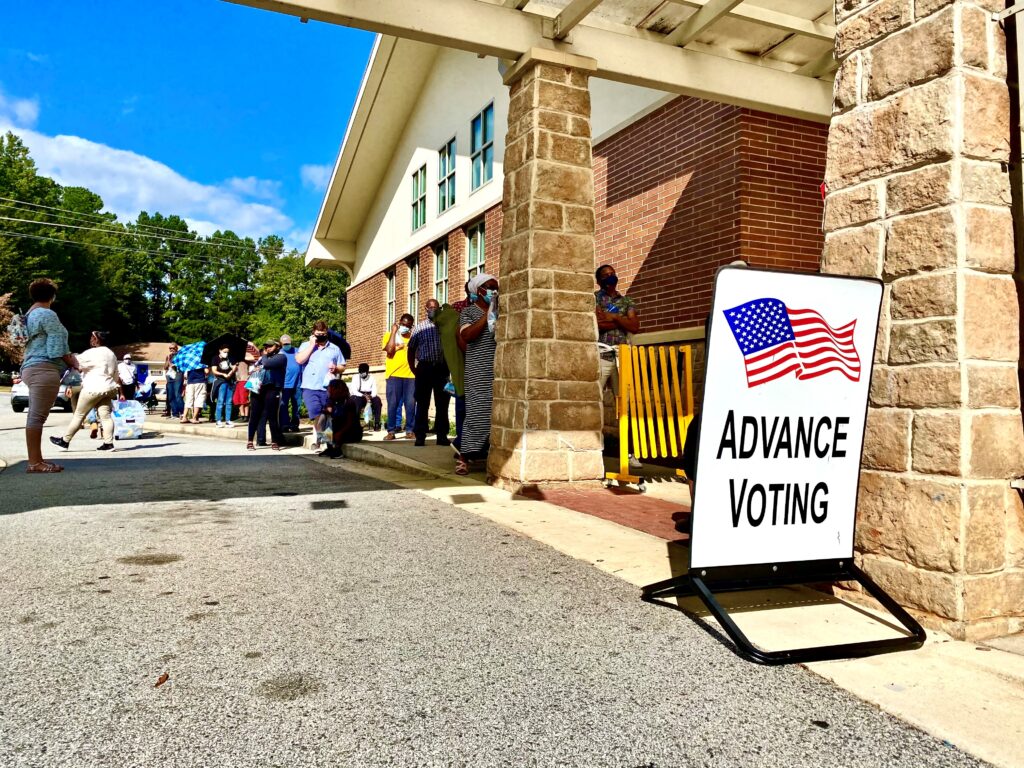
Workers would get time off for early voting under a bill a state Senate committee approved Tuesday.
ATLANTA – A state Senate Committee Tuesday scrapped every part of a controversial Republican-backed election bill, leaving only a provision that would expand Georgians’ ability to vote.
The version of House Bill 1464 the Senate Ethics Committee approved unanimously would require employers to give their workers up to two hours off to cast a ballot during the early voting period prior to an election. That would expand upon legislation the General Assembly enacted last year allowing employees time off from their jobs to vote on Election Day.
“This just broadens the ability to vote,” said state Rep. James Burchett, R-Waycross, the bill’s chief sponsor.
“It’s certainly good for the voter and good for the employer,” added Sen. Max Burns, R-Sylvania, the Ethics Committee’s chairman.
When the bill left the House two weeks ago after passing on a party-line vote, it contained provisions aimed at ensuring ballot security through tighter controls on the transfer and custody of ballots. It also would have authorized the Georgia Bureau of Investigation to investigate complaints of voter fraud without being asked by local authorities, derided by critics as the “election police” provision.
Voting rights groups and local elections officials packed committee rooms during hearings on the bill, reminding Republican lawmakers that GOP Gov. Brian Kemp had promised not to push for further election law changes this year after last year’s comprehensive overhaul of Georgia’s election laws.
Senate Republicans responded by backing away from the bill’s controversial provisions, at least for now.
“This is one of the most politicized issues across the country,” Burchett said. “We’ll just continue working on these issues that were in the bill and try to find some middle ground.”
This story is available through a news partnership with Capitol Beat News Service, a project of the Georgia Press Educational Foundation.