ATLANTA – Legislation supporters said would protect Georgia farmers from nuisance lawsuits cleared the Republican-controlled state Senate Friday.
Senators passed the Freedom to Farm Act 31-23 along party lines. Because the Senate made changes to the bill, which originated in the Georgia House of Representatives, it must return to the House to gain final passage.
The legislation would give neighbors bothered by bad smells, dust or noise emanating from a farm two years to file a nuisance suit. After that, any farm operating legally would be protected.
A law the General Assembly passed during the 1980s to protect existing farms from nuisances needs to be updated to protect farmers from increasing residential encroachment, Sen. Larry Walker III, R-Perry, chairman of the Senate Agriculture and Consumer Affairs Committee, told his Senate colleagues Friday.
“The state has changed,” he said. “We’ve had so much growth hardly any farmers don’t have neighbors around them.”
Senate Democrats argued the farmers who most need protecting are those who suffer when a large corporate farming operation moves in next to them. In those cases, two years isn’t long enough, said Sen. Freddie Powell Sims, D-Sasser.
“Nuisances can take many years to manifest themselves,” she said.
Sims said the 1980s law already protects existing farmers when new neighbors move in, whether they’re homeowners or other agricultural operations. On the other hand, existing farmers could only file suit under the new law if the nuisance occured within two years, she said.
But Walker said farming is such a capital-intensive undertaking that farmers must have protection from lawsuits to make their investments worthwhile.
“At some point, you’ve got to give them some certainty on their legal status to continue to operate,” he said. “Two years is a good balance.”
Besides the two-year statute of limitations, up from one year under the House version of the bill, the Senate also added a provision requiring any plaintiff filing a nuisance lawsuit to be the legal owner of the property affected by the nuisance. Another Senate change would allow local governments to bring suit for a “public nuisance” without being subject to a time limit.
This story isavailable through a news partnership with Capitol Beat News Service, a project of the Georgia Press Educational Foundation.
ATLANTA – Georgians would be allowed to carry concealed firearms without a permit under legislation that gained final passage in the state Senate Friday.
The Republican-controlled chamber passed Senate Bill 319 34-22 along party lines two days after the Georgia House of Representatives approved it 100-67.
As the bill has gone through the General Assembly in recent weeks, legislative Democrats have argued that allowing permit-less carry would lead to more violent crime by putting more guns on the streets.
Sen. Elena Parent, D-Atlanta, noted that some police chiefs across the state have come out in opposition to the bill.
“Everyone has guns,” Parent said. “It makes our streets dangerous.”
But Sen. Randy Robertson, R-Cataula, said violent crime has risen in Georgia because of a lack of aggressive law enforcement by some police agencies.
“Let’s stop blaming an inanimate object,” Robertson said.
“The Constitution of the United States says we have the right to bear arms and the right to protect ourselves and our families,” added Sen. Jeff Mullis, R-Chickamauga, the bill’s chief sponsor.
The bill now moves to the desk of Gov. Brian Kemp, who endorsed the measure in his annual State of the State address to lawmakers in January.
This story is available through a news partnership with Capitol Beat News Service, a project of the Georgia Press Educational Foundation.
ATLANTA – The General Assembly has decided it needs more time to prepare for the coming wave of electric vehicles.
The state House of Representatives voted unanimously this week to create a joint study committee to develop a plan for rolling out a network of electric vehicle charging stations across Georgia. The Georgia Senate passed the resolution two weeks ago, also in a unanimous vote.
“EVs are here. We see them all around us,” House Transportation Committee Chairman Rick Jasperse, R-Jasper, told House members shortly before Wednesday’s vote. “But one part that’s lacking is charging infrastructure in this state.”
The U.S. Department of Energy has allocated $160 million to build EV charging stations in Georgia during the next five years, primarily along interstate highways.
Several bills were introduced in the General Assembly this year setting regulations governing the construction of charging stations.
Another measure was introduced in the Senate that would allow auto manufacturers to bypass dealerships and sell their cars directly to consumers if they maintain one or more repair facilities in the state. The bill was aimed at EV startup Rivian, which announced in December a $5 billion investment to build a manufacturing plant off Interstate 20 east of Atlanta, creating 7,500 jobs.
But when none of the bills made it through either legislative chamber by the mid-March Crossover Day deadline, lawmakers decided to form a study committee to do a deep dive on the issue this summer and and potentially come up with legislation for consideration next year.
Rep. Alan Powell, R-Hartwell, said time is of the essence if Georgia is to keep up with the growing proliferation of electric vehicles.
“The future of this country in transportation is all-electric vehicles,” he said. “We need to get our ducks in a row so we’re not in the same situation we were in with broadband.”
Under Senate Resolution 463, the joint committee will include four House members, four senators, the Georgia commissioners of transportation and economic development, and the chair of the state Public Service Commission.
The committee will have until Dec. 1 to make recommendations.
This story is available through a news partnership with Capitol Beat News Service, a project of the Georgia Press Educational Foundation.
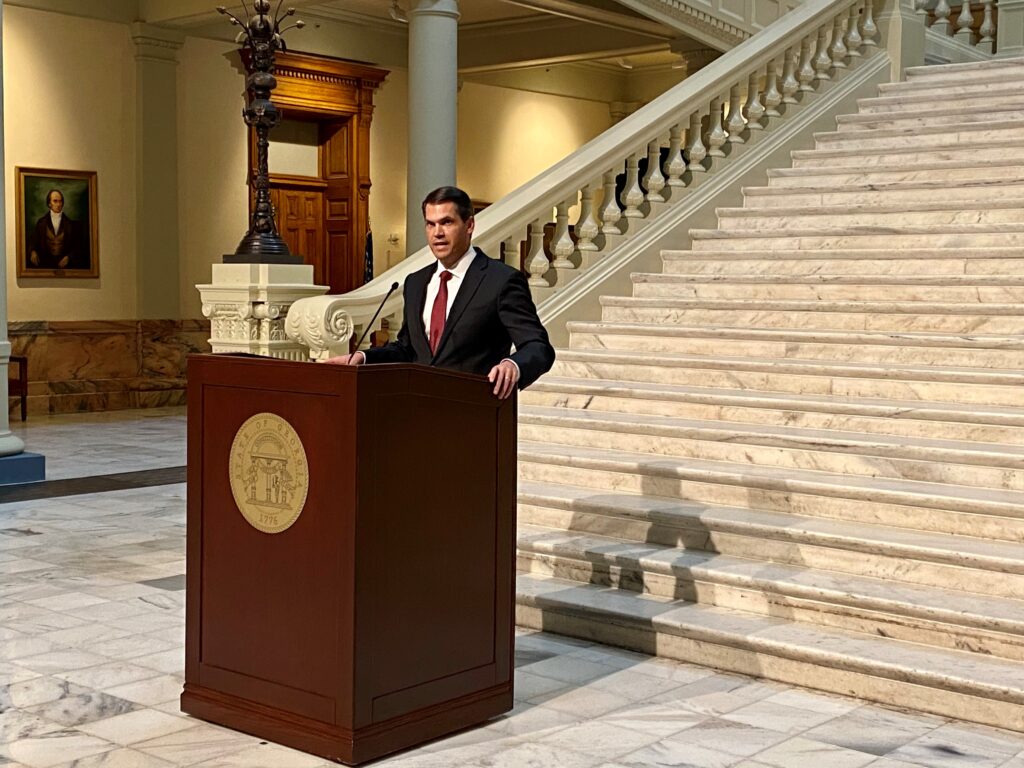
ATLANTA – The Georgia House of Representatives has passed legislation aimed at providing additional resources to local law enforcement agencies, a major priority of Lt. Gov. Geoff Duncan.
The “LESS” (Law Enforcement Strategic Support) Crime Act cleared the House 153-5 Wednesday after passing the state Senate in February.
The bill offers Georgia taxpayers a dollar-for-dollar income tax credit on contributions to public safety initiatives in their communities. It’s modeled after the highly successful rural hospital tax credit Duncan championed back in 2016 as a member of the House.
Under Senate Bill 361, law enforcement agencies could use the money for police officer salary supplements, to purchase or maintain department equipment and/or to establish or maintain a co-responder program so mental-health professionals could help police officers de-escalate behavioral health emergencies.
“The LESS Crime Act is symbolic of what can happen when leaders seek solutions beyond the scope of government and promote good policy,” Duncan said Wednesday. “Our legislation serves as a model for government entities around the country.”
“The resources generated through the LESS Crime Act will significantly aid Georgia’s 159 sheriffs in strengthening local public safety initiatives,” added Terry Norris, executive director of the Georgia Sheriffs’ Association.
The bill includes a statewide cap on the program of $75 million a year. Individual law enforcement agencies are limited to $3 million annually.
Single taxpayers could receive a tax credit of up to $5,000, with married couples filing jointly eligible for up to $10,000.
If signed by Gov. Brian Kemp, the legislation would take effect with the 2023 tax year.
Because of changes the House made in the bill, it must return to the Senate on Friday or Monday for final passage. The General Assembly is scheduled to adjourn for the year by midnight Monday.
This story is available through a news partnership with Capitol Beat News Service, a project of the Georgia Press Educational Foundation.
Gov. Brian Kemp (Gov. Kemp’s official Facebook page)
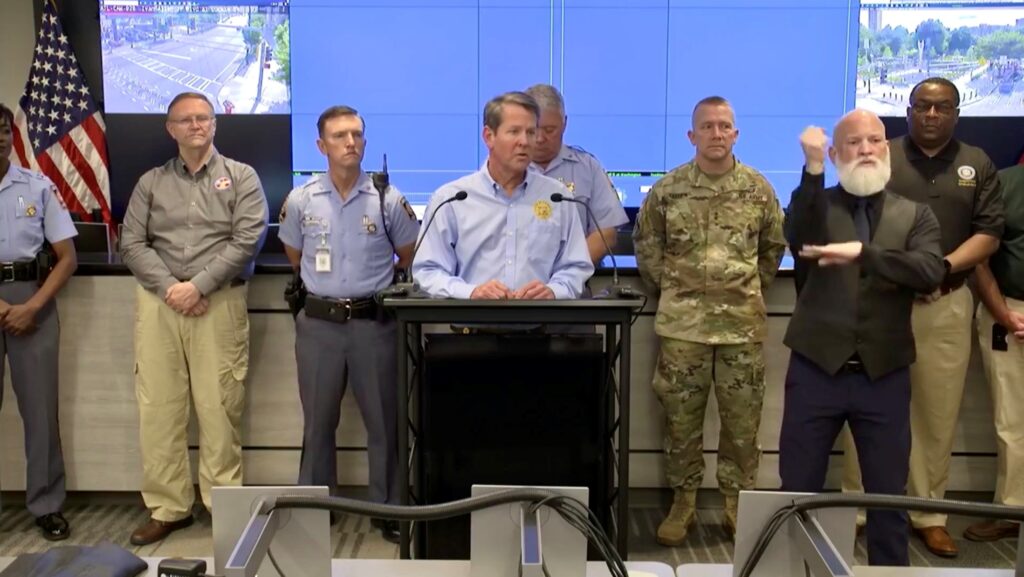
ATLANTA – The multi-agency Crime Suppression Unit Gov. Brian Kemp put together last April to fight a crime wave apprehended 26 murder suspects and made 214 drug arrests during its first year in operation.
Kemp gave a progress report on the unit on Wednesday. The state and metro-Atlanta law enforcement agencies that make up the unit also arrested 451 wanted persons, made more than 23,600 vehicle stops – including 588 for driving under the influence – and impounded about 1,300 vehicles, the governor reported.
“We’re going to keep chopping, keep up the good work and go even harder in taking the fight to the street gangs and criminals,” Kemp said.
Kemp put together the unit in response to a rise in violent crime that accompanied the coronavirus pandemic. Coordinated by the Georgia Department of Public Safety, the unit includes the Georgia Bureau of Investigation, the state Department of Natural Resources, the Georgia Department of Community Supervision, the Atlanta Police Department and the Fulton County Sheriff’s Office.
The Crime Suppression Unit also has been active in other Georgia cities including Columbus and Macon.
Col. Chris Wright, commissioner of the Department of Public Safety, said the unit also has arrested nine major street-racing organizers in the Atlanta metro region.
“Proactive policing and high visibility patrols result in crime reduction and improve the quality of life for our citizens,” he said. “We share the governor’s vision of reducing crime and making Georgia communities safer.”
This story is available through a news partnership with Capitol Beat News Service, a project of the Georgia Press Educational Foundation.