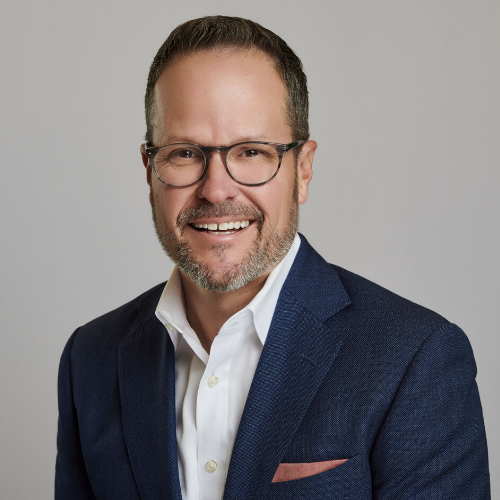
ATLANTA – Trucking executive Mike Collins is the leading fundraiser in a crowded 10th Congressional District Republican race that features Donald Trump-endorsed candidate Vernon Jones.
Collins had raised $1.1 million through the first quarter of this year in a bid to succeed U.S. Rep. Jody Hice, R-Greensboro, who is leaving Congress to run for Georgia secretary of state. While $531,000 of Collins’ money came in the form of a loan he made to his campaign, he also raised $562,535 from individual contributors.
Jones, a former DeKalb County CEO and Democratic state representative, lagged behind Collins and six other Republican candidates in the battle for bucks. A late entry after dropping out of the race for governor, Jones had raised $265,651 through March 31.
All of the Republican hopefuls have raised in the six figures for what promises to be a lengthy run at the GOP nomination in the 10th District, largely Republican terrain stretching from Butts and Henry counties northeast through Athens to the South Carolina border. With so many candidates in the field, the contest for the nomination is virtually certain to stretch beyond the May 24 primary to a June 21 runoff.
David Curry, Henry County’s tax commissioner, raised $690,265 through the first quarter, including a personal loan of $415,000, according to a report filed with the Federal Election Commission.
Businessman Marc McMain raised $596,153 through the end of last month, including a $330,000 personal loan.
Alan Sims, a Delta Air Lines pilot and retired Army colonel, raised $578,010, including a personal loan of $305,000.
State Rep. Timothy Barr of Lawrenceville raised $527,784 through the first quarter, all from contributions with no loans.
Former Congressman Paul Broun raised $456,029, also coming totally from contributors rather than loans.
Mitchell Swan, a retired Marine colonel, raised $290,488, including $61,600 in personal loans.
On the Democratic side, retail business owner Phyllis Hatcher has raised $31,038, compared to $18,124 raised by registered nurse and community activist Tabitha Johnson-Green and $8,999 brought in by Jessica Fore.
Collins has the most money left in his treasury by far heading into the final weeks of the primary campaign, reporting $743,953 cash on hand as of March 31. The only other candidates with more than $200,000 remaining in their campaigns at the end of last month were Curry with $298,602, McMain with $296,143, and Sims with $286,913.
This story is available through a news partnership with Capitol Beat News Service, a project of the Georgia Press Educational Foundation.
ATLANTA – The Georgia Chamber of Commerce is pulling together local chambers from cities across Georgia outside of metro Atlanta to focus on issues of interest to those communities.
The new Hub Chamber Council will advocate on behalf of chambers of commerce in Albany, Athens, Augusta, Brunswick, Columbus, Dalton, Macon, Rome, Savannah, Valdosta, and Warner Robins.
“This new council will help coordinate federal, state and local policy in these dynamic and growing economic centers,” said Chris Clark, president and CEO of the Georgia Chamber. “Our hope is that by galvanizing these communities together in one direction it will produce outcomes greater than if their efforts were individualized.”
The Hub Chamber Council is modeled after the Georgia Chamber Center for Rural Prosperity, which opened in Tifton five years ago to help raise the profiles of rural communities and improve coordination of efforts to boost their economies.
The new council will work to increase the influence of the member chambers at the Georgia Capitol and in Washington, D.C., and improve the economic prosperity of the larger cities and counties outside of metro Atlanta. Specifically, it will focus on workforce housing, recruiting talent and building the infrastructure needed to foster economic development in those areas.
David Bradley, president and CEO of the Athens Area Chamber of Commerce, will serve as the council’s inaugural chairman.
“I look forward to all this council will be able to achieve towards a better understanding of how these communities, like ours in Athens, can have their needs met through a coordinated statewide effort,” he said. “The Georgia Chamber is uniquely positioned to host this newly formed Hub Chamber Council, which will have lasting impact for our Georgia metro communities.”
This story is available through a news partnership with Capitol Beat News Service, a project of the Georgia Press Educational Foundation.
ATLANTA – Gov. Brian Kemp has named a former commissioner of the Georgia Department of Administrative Services to chair the board that oversees the state’s struggling medical marijuana program.
Sid Johnson, who now serves on the faculty at the University of Georgia’s Carl Vinson Institute of Government, took over as board chairman of the Georgia Access to Medical Cannabis Commission on Monday, succeeding Dr. Christopher Edwards.
“I’m looking forward to the insight that Sid Johnson will bring to the commission,” Kemp said. “He has a keen understanding of how local, state, and federal policies interact and impact citizens, and with his wealth of experience he will assuredly be successful in navigating the commission’s mission in the years to come.”
The commission was created in 2019 as part of a bill that legalized growing marijuana in Georgia and converting the leafy crop into low-THC cannabis oil for sale to patients suffering from a variety of diseases.
But the program has yet to get off the ground. After issuing a request for proposals, the commission tentatively awarded two “Class 1” licenses last summer authorizing the winning bidders to grow marijuana in up to 100,000 square feet of space and four “Class 2” licenses to grow the crop in a space of up to 50,000 square feet.
Sixteen other companies that applied for but did not receive licenses filed legal protests charging the licensing process was unfair and arbitrary, threatening to tie up the program in lengthy litigation.
The General Assembly tried to fix the problem during the recently concluded 2022 session. But legislation aimed at breaking the logjam tying up the licensing process was tabled in the session’s final hours.
Besides appointing Johnson to head the commission’s board, Kemp also directed $150,000 from the Governor’s Emergency Fund to the commission to expedite hearings of pending legal protests at the Office of State Administrative Hearings.
This story is available through a news partnership with Capitol Beat News Service, a project of the Georgia Press Educational Foundation.
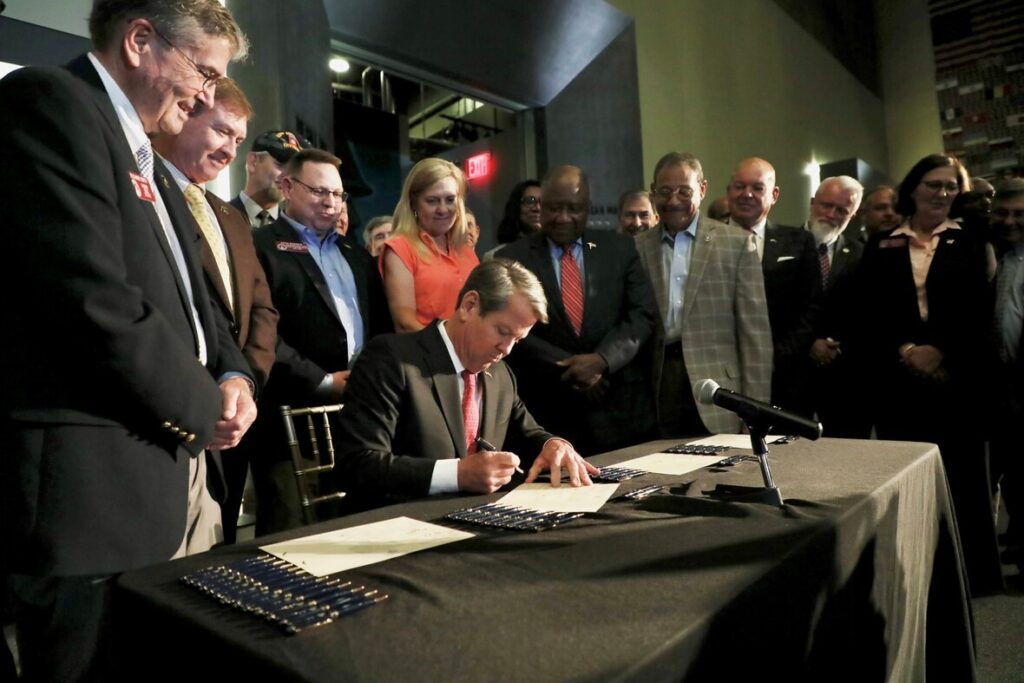
Gov. Brian Kemp signed four bills Monday benefiting members of the military and their families.
ATLANTA – Gov. Brian Kemp has signed a series of bills benefitting members of the military, their spouses and military retirees.
Monday’s signing ceremony took place at the National Infantry Museum in Columbus before an audience of active-duty service members and retirees.
“These men and women, and others like them around our state who proudly wear a uniform, have chosen careers of service above self,” Kemp said. “They make our nation stronger, they defend our freedom and way of life, and they make our communities better places to call home.
“So today, we are taking important steps forward in more fully recognizing and thanking them for those contributions.”
Kemp signed legislation providing the first military retirement income tax exemption in Georgia history. He also signed bills to expedite the issuance of professional and business licenses to military spouses and allow veterans to use their Veterans Health Identification Card when they seek the service of a public notary.
A fourth measure, named in honor of the late state Sen. Jack Hill, will allow taxpayers to donate all or part of their annual state income tax refund to scholarships for disabled veterans.
Georgia has the nation’s fifth largest military population, with almost 700,000 former service members and more than 101,000 military retirees calling the Peach State home.
This story is available through a news partnership with Capitol Beat News Service, a project of the Georgia Press Educational Foundation.
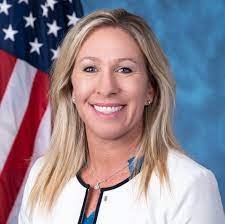
ATLANTA – Democrat Marcus Flowers, a U.S. Army veteran, outraised incumbent U.S. Rep. Marjorie Taylor Greene, R-Rome, in the first quarter in Northwest Georgia’s 14th Congressional District.
But Greene, a conservative lightning rod since winning the seat two years ago, has raised more money overall than Flowers in her bid for a second term and has more cash left in her campaign war chest heading into next month’s Republican primary.
Flowers raised more than $2.4 million in the heavily Republican district during January, February and March, according to a report filed with the Federal Election Commission. That brought his total for the election cycle to nearly $7.1 million.
Greene raised almost $1.1 million during the first quarter. However, her campaign has brought in more than $9.9 million overall.
The Greene campaign reported more than $3 million cash on hand as of March 31, compared to more than $1.9 million for Flowers.
Despite the national name recognition Greene has built, the 14th District race has drawn a lot of interest from both parties.
Joining Flowers on the Democratic side is small business owner Holly McCormack, who raised nearly $1.7 million through the first quarter of this year. Longtime Democratic Party activist Wendy Davis raised $451,202.
Several Republicans are challenging Greene in the May 24 GOP primary. However, only health-care consultant Jennifer Strahan has raised more than $100,000. Strahan’s campaign has brought in $322,625 and had $157,549 cash on hand as of March 31.
This story is available through a news partnership with Capitol Beat News Service, a project of the Georgia Press Educational Foundation.