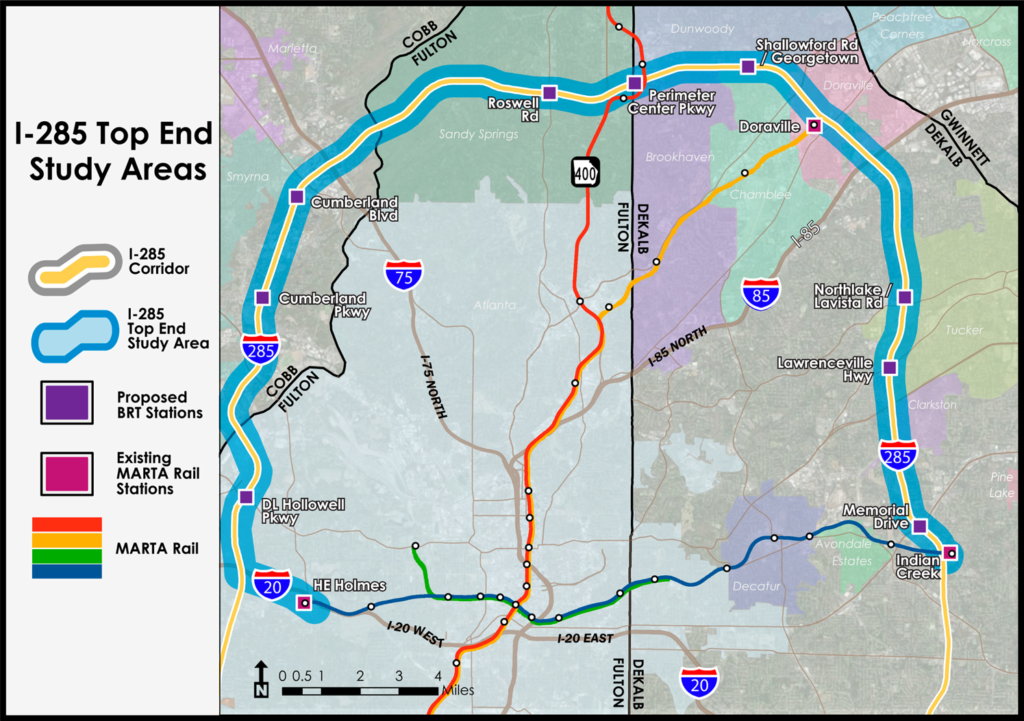
Plans call for nine bus-rapid transit stations along the Top End of Interstate 285.
ATLANTA – The elected heads of Fulton, Cobb, Gwinnett and DeKalb counties signed an agreement Wednesday aimed at piggybacking mass transit on toll lanes to be added to the Top End of Interstate 285.
The four counties will work with MARTA, the Atlanta-Region Transit Link Authority (ATL), the Georgia Department of Transportation and the Atlanta Regional Commission (ARC) on a $16.2 million study to incorporate bus-rapid transit (BRT) service on I-285 from its interchange with I-20 west of Atlanta all the way around to the I-285/I-20 interchange east of the city.
Plans call for up to nine BRT stations to line the route, some of which could be co-located with an existing MARTA station.
“This is an idea, a concept, for what transit can look like,” Chris Tomlinson, executive director of the ATL, said shortly before he, the county leaders and representatives of MARTA, the State Transportation Board and the ARC signed an agreement known as a memorandum of understanding.
The agreement calls for a consortium made up of the four counties, seven cities along I-285 and four self-taxing community improvement districts to develop plans for a multi-jurisdictional, multi-operator transit system along the Top End. The consortium will work with the state and regional transportation agencies to put together preliminary cost estimates.
Brookhaven Mayor John Ernst said the state DOT’s original plan for improving traffic flow along the heavily congested Top End didn’t include transit. It was limited to adding two barrier-separated toll lanes in each direction along the interstate.
It was the mayors of the cities who lobbied the state to include transit, a transportation option that is decades overdue, Ernst said.
“The best time to do transit was 50 years ago,” he said. “Now, the best time to do transit is today.”
Cobb County Commission Chairman Lisa Cupid said adding a transit option along I-285 will further connect the Cumberland business district with MARTA, making it easier for Cobb residents to get to jobs, schools and medical appointments.
“We’re not just speaking about transit,” she said. “This is economic development.”
While the Top End does not extend into Gwinnett County, improving traffic flow through the corridor is critical to Georgia’s second largest county, Gwinnett County Commission Chairman Nicole Hendrickson said.
“Congestion on the Perimeter directly affects congestion on I-85,” she said. “It has a significant impact on our residents and businesses.”
Tomlinson said BRT stations are being proposed at or near the I-285 interchanges with Donald E. Hollowell Parkway, Cumberland Parkway, Cumberland Boulevard, Roswell Road, Perimeter Center Parkway, Shallowford Road, LaVista Road, Lawrenceville Highway and Memorial Drive.
BRT stations could be co-located with the existing Hamilton E. Holmes, Doraville and Indian Creek MARTA stations.
This story is available through a news partnership with Capitol Beat News Service, a project of the Georgia Press Educational Foundation.
ATLANTA – Former state Sen. and 2018 gubernatorial candidate Hunter Hill was named executive director of the Georgia Environmental Finance Authority (GEFA) by the agency’s board Tuesday.
Hill, who currently serves as GEFA’s executive director, will succeed the retiring Kevin Clark on July 1. Hill was recommended for the promotion by Gov. Brian Kemp.
Hill was elected to the Senate in 2012 representing a suburban Atlanta district including parts of Cobb County and North Fulton.
He left office in 2017 to seek the Republican nomination for governor but finished third in the 2018 GOP primary.
A West Point graduate, Hill served three combat tours in Iraq and Afghanistan.
After leaving the military, he worked in the private sector in commercial real estate, executive leadership coaching and wealth management.
GEFA provides financing for a variety of energy, land, and water projects. Since 1985, the agency has approved financial commitments totaling more than $5 billion to local governments, businesses, and nonprofit organizations.
This story is available through a news partnership with Capitol Beat News Service, a project of the Georgia Press Educational Foundation.
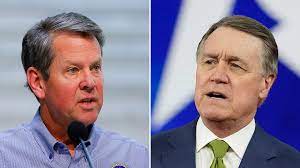
Gov. Brian Kemp (left) has opened a huge fundraising lead over former U.S. Sen. David Perdue
ATLANTA – Gov. Brian Kemp continues to dominate former U.S. Sen. David Perdue in fundraising heading into their Republican gubernatorial primary showdown.
Kemp’s campaign had raised $22.4 million through the end of last month toward his bid for a second term, according to a report filed Monday with the Georgia Government Transparency & Campaign Finance Commission.
Perdue, who is mounting a rare primary challenge against an incumbent governor, reported raising only $3.5 million as of April 30, including a $500,000 loan he made to his campaign.
Kemp also has a lot more to spend getting his message out to voters in the final weeks leading up to the May 24 GOP primary. The governor’s campaign had $10.7 million remaining in its treasury as of the end of last month, compared to just less than $900,000 left for Perdue.
Three other Republican candidates for governor lag far behind Kemp and Perdue in the battle for bucks.
Educator Kandiss Taylor had not filed a report with the state covering February, March, and April as of Tuesday. Her campaign had raised about $175,000 as of the end of January.
Conservative activist Catherine Davis had raised only $13,777 through April 30, while Tom Williams hadn’t raised or spent any money, according to his report to the state.
This story is available through a news partnership with Capitol Beat News Service, a project of the Georgia Press Educational Foundation.
ATLANTA – Georgia tax collections skyrocketed in April for the second month in a row, the result of last year’s late tax filing date of May 17, the state Department of Revenue reported Monday.
The agency brought in just more than $5 million last month, up 78.9% over April of last year.
Individual income tax receipts were up 158.7% due to a huge increase in tax payments.
Net sales tax collections rose by a much more modest 12.9%.
Corporate income tax revenues were up 56.9%, as tax payments increased by 75%.
Tax receipts on motor fuels including gasoline fell by 39.5% in April, reflecting Gov. Brian Kemp’s decision to temporarily suspend the tax to help offset rising pump prices. The governor’s executive order suspending the tax is due to expire May 31.
The revenue department said year-over-year tax comparisons will be comparable again after the end of this month.
Even when the temporary spike in tax revenue ends, the state is expected to be sitting on a huge budget surplus that has made spending decisions easier both for Kemp and the General Assembly.
The $30.2 billion fiscal 2023 budget due to take effect July 1 would increase spending by 10.8% over the spending plan lawmakers adopted a year ago. Kemp is expected to sign the budget later this week.
This story is available through a news partnership with Capitol Beat News Service, a project of the Georgia Press Educational Foundation.
ATLANTA – Gov. Brian Kemp signed two tax credit bills Monday along with legislation authorizing “co-responder” teams of law enforcement officers and mental health professionals to answer emergency calls.
The three bills were priorities of Lt. Gov. Geoff Duncan, who presides over the Georgia Senate. All three passed the General Assembly with bipartisan support.
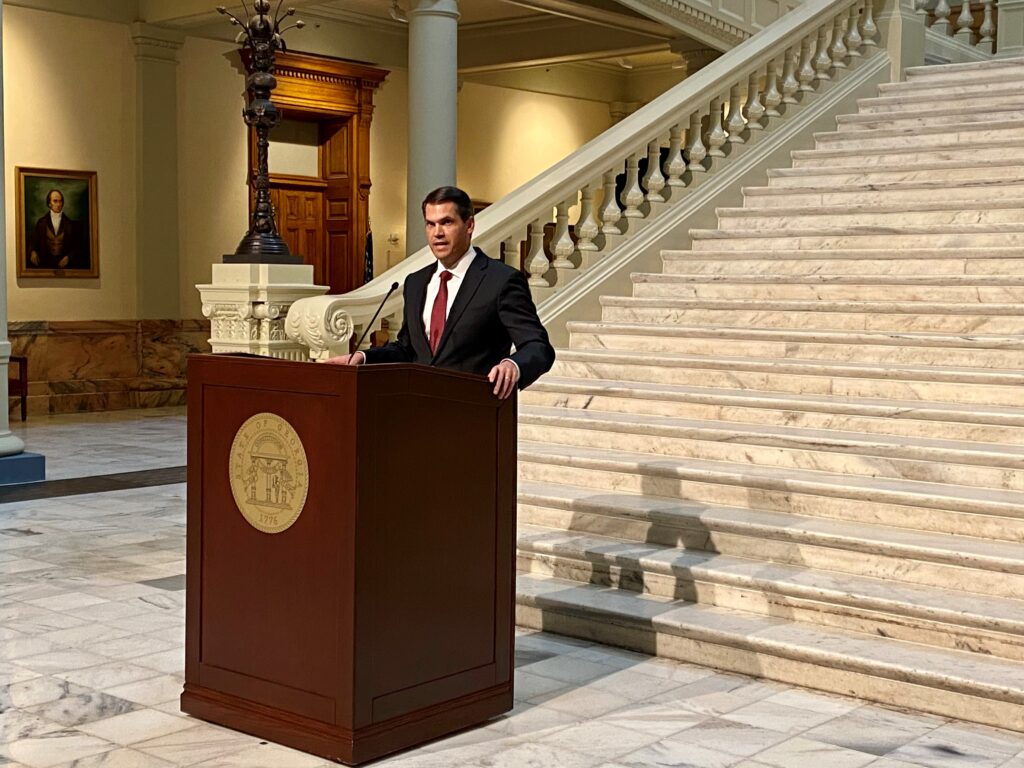
“We worked together across the party divide,” Duncan said during a news conference at the state Capitol before Gov. Brian Kemp signed the bills.
The “LESS” (Law Enforcement Strategic Support) Crime Act will provide Georgia taxpayers a dollar-for-dollar income tax credit on contributions to public safety initiatives in their communities.
Law enforcement agencies will be able to use the money for police officer salary supplements, to purchase or maintain department equipment and/or to establish or maintain a co-responder program.
“This gives much more resources to local law enforcement,” said Sen. Larry Walker III, R-Perry, the bill’s chief sponsor.
The bill includes a statewide cap on the program of $75 million a year. Individual law enforcement agencies are limited to $3 million annually.
Single taxpayers will receive a tax credit of up to $5,000, with married couples filing jointly eligible for up to $10,000.
The second tax credit bill Kemp signed Monday will provide up to $20 million a year to nonprofit organizations that help foster children about to age out of the foster care system. More than 700 young men and women age out of the system each year.
“They don’t have a huge constituency down here lobbying us … to give them the same chance I had,” Duncan said.
The money will pay for services such as housing, food and transportation to help foster children leaving the system pursue college or technical school as well as provide mentors to help influence them to make good decisions.
The third bill will for the first time set up a statewide co-responder program to let mental health workers respond with police to emergency calls involving people who appear to be in mental distress.
A comprehensive bill overhauling Georgia’s mental health system the General Assembly passed unanimously this year calls for funding five co-responder programs around the state, including a training component.
This story is available through a news partnership with Capitol Beat News Service, a project of the Georgia Press Educational Foundation.