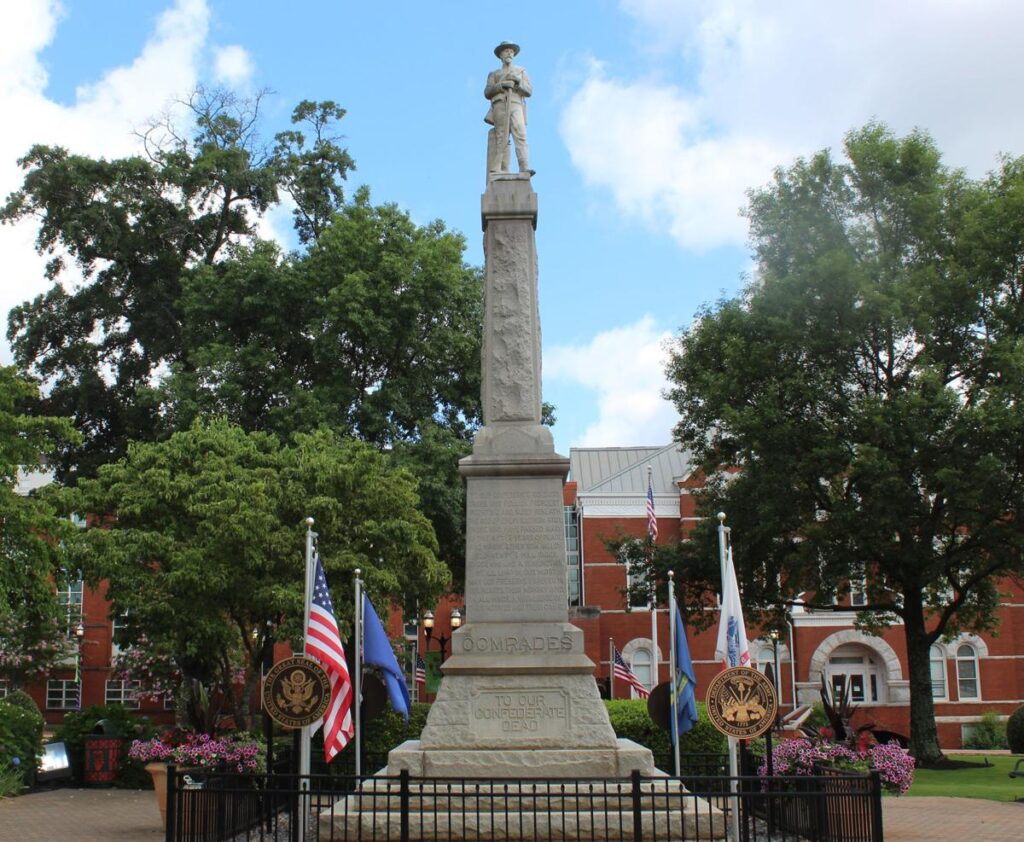
A Confederate monument in downtown McDonough was removed almost two years ago. (Credit: Henry Herald)
ATLANTA – A Civil War heritage preservation group has the right to sue Henry and Newton counties over the removal or planned removal of Confederate monuments, a lawyer for the Sons of Confederate Veterans (SCV) told the Georgia Supreme Court Thursday.
Legislation the General Assembly passed in 2019 authorized “any person, group or legal entity” to challenge any acts in violation of the law, which prohibited the desecration or removal of historic monuments from public property.
Kyle King, representing the SCV, also cited Georgia’s Open Meetings Law, which allows citizens to sue government entities over violations without having to prove they suffered any direct harm.
“That’s essentially what’s being done here,” King said.
But the Georgia Court of Appeals didn’t see it that way when it ruled last year that the SCV lacked legal standing to sue the two counties because its members could not show removing the monuments harmed them directly.
The SCV then appealed to the state Supreme Court.
Patrick Jaugstetter, a lawyer representing Newton County, argued the Open Meetings Law should not be used as a precedent in the SCV case because the lawsuit seeks to recover damages – the costs to repair and replace a removed monument.
In lawsuits involving the Open Meetings Law, plaintiffs seek a civil penalty to enforce a “public right,” he said.
“Damages exist only to address injury,” Jaugstetter said. “These plaintiffs have not established [an injury].”
The Confederate monument in downtown McDonough was removed in July 2020 following a vote by the Henry County Commission.
It was part of a nationwide trend to remove statues honoring the Confederacy and Confederate leaders during a summer of street protests following the murder of George Floyd, a Black man from Minnesota, by a white Minneapolis police officer.
The Newton County Commission voted at about the same time to remove the Confederate monument from historic Covington Square. But it remains standing pending the outcome of the court case.
This story is available through a news partnership with Capitol Beat News Service, a project of the Georgia Press Educational Foundation.
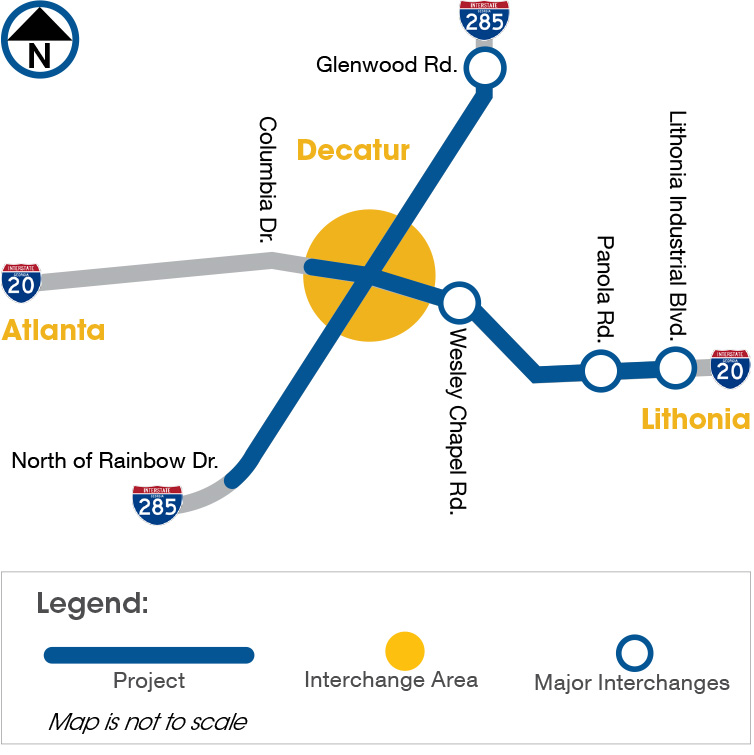
ATLANTA – A State Transportation Board committee voted Wednesday to approve an agreement with a roadbuilding consortium to redesign the interchange of interstates 285 and 20 east of Atlanta.
The $685.5 million project is aimed at smoothing traffic flow through an interchange rated as the nation’s 25th worst bottleneck last year.
The overhaul will include reconstructing ramps to create more direct alignments, adding new collector-distributor and auxiliary lanes, replacing several bridges and erecting new noise barriers.
The work will be done by East Interchange Builders, the consortium the board selected for the project last month. The lead partners are Archer Western Construction and E.R. Snell, two of Georgia’s leading highway contractors.
Representatives of the Georgia Department of Transportation (DOT) and East Interchange Builders have been negotiating the agreement during the last month.
It will be a design-build-finance contract, the same model that was used to build the Northwest Corridor toll lanes along I-75 and I-575 in Cobb and Cherokee counties and in the ongoing overhaul of the I-285/Georgia 400 interchange.
Under the terms of the contract, the consortium will design and construct the project, then turn it over to be managed by the DOT, Meg Pirkle, the agency’s chief engineer, told members of the board committee with jurisdiction over projects built through public-private partnerships.
“They are [also] solely responsible for the financing of the project,” she said.
Certain contingencies could drive up the cost of the work either for the consortium or the DOT.
Under the contract, the consortium could be assessed penalties for missing project deadlines or for unanticipated lane closures during construction. The DOT would pick up any additional costs of construction materials.
The full State Transportation Board is expected to approve the contract on Thursday.
Construction is scheduled to begin in the middle of next year, with completion in late 2026.
This story is available through a news partnership with Capitol Beat News Service, a project of the Georgia Press Educational Foundation.
ATLANTA – More than $170 million in federal investments in affordable housing are heading to Georgia, the Peach State’s two U.S. senators announced Tuesday.
The U.S. Department of Housing and Urban Development funding will come through five programs: formula-based Community Development Block Grants, HOME Investment Partnerships to help rehabilitate affordable housing units, Emergency Solutions Grants aimed at the homeless, Housing Opportunities for Persons with AIDS, and Housing Trust Fund Grants for affordable housing for low-income residents.
Most of the money – $96.8 million – will go to the state, with the remainder headed to 27 localities across Georgia.
“These robust federal investments in our state’s housing infrastructure will make it more affordable for hardworking Georgians at every income bracket to find better, more cost-effective housing,” said Sen. Raphael Warnock, D-Ga. “These investments will help elevate families into the working and middle class.”
The $170 million is in addition to $469,841 in federal pandemic relief funds Warnock and Sen. Jon Ossoff, D-Ga., secured last December to upgrade affordable housing for low-income Georgians in rural communities.
This story is available through a news partnership with Capitol Beat News Service, a project of the Georgia Press Educational Foundation.
ATLANTA – The Port of Savannah set a record for containerized cargo last month, while the Georgia Ports Authority reported its third busiest month ever.
Savannah’s Garden City Terminal handled 495,782 twenty-foot equivalent container units (TEUs) in April, a record for the month, the ports authority reported Tuesday. The terminal now handles nearly one out of every nine loaded containers crossing the nation’s docks.
Meanwhile, the ports authority’s containerized trade increased 6.2% last month compared to April of last year.
The growth is related in part to retailers replenishing depleted inventories and making early orders to ensure product availability. For the first 10 months of fiscal 2022, the ports authority has handled 4.75 million TEUs, up 8% year over year.
“Our long-running program of infrastructure expansion, coupled with the authority’s ability as an owner-operator to speed up the schedule of development, has allowed the Port of Savannah to adapt to heightened container volumes,” authority board Chairman Joel Wooten said Tuesday. “On-terminal and inland capacity improvements enable cargo to flow across our docks without congestion.”
Savannah was recently ranked the top U.S. container port by loaded export volume, handling 1.38 million TEUs in calendar year 2021.
This story is available through a news partnership with Capitol Beat News Service, a project of the Georgia Press Educational Foundation.
ATLANTA – Georgia’s hotel industry will receive by far the largest chunk of more than $415 million in federal pandemic relief grants announced by Gov. Brian Kemp Monday.
The Georgia Hotel & Lodging Association (GHLA) will get $150 million to help offset the losses hotels across the state have sustained during the pandemic.
The GHLA is among 33 Georgia recipients of federal assistance through the $1.9 trillion American Rescue Plan Act (ARPA) President Joe Biden signed into law in March of last year.
The recipients were approved by one of three committees Kemp formed last summer to determine how to distribute Georgia’s $4.8 billion share of ARPA aid among state and local governments, businesses and nonprofits applying for the money.
The Negative Impact Economic Committee included Pat Wilson, commissioner of the state Department of Economic Development; State Economist Jeffrey Dorfman; Georgia House Appropriations Committee Chairman Terry England, R-Auburn; and state Senate Appropriations Committee Chairman Blake Tillery, R-Vidalia.
“I’m proud of our state’s resilience,” Kemp said Monday. “We have worked hard and identified ways to further deliver assistance to hardworking Georgians, support businesses and speed up the recovery of impacted industries and rebuild crucial public services.”
While business and vacation travel is starting to bounce back, COVID-19 hit the hotel industry harder than most.
“This program will provide Georgia’s hospitality industry with the support it needs to create and sustain jobs for people throughout the state, helping the industry return to its pre-pandemic level of success,” GHLA Executive Director Jim Sprouse said Monday.
Other recipients of grants announced Monday include the Atlanta Community Food Bank, which will receive about $29.6 million, and Buckhead Christian Ministries, which will get $12.7 million to expand an emergency assistance program.
The Georgia Department of Economic Development will receive about $11.5 million to help performing arts venues around the state recover from the impacts of the pandemic.
“The arts and culture sector contributes $23.8 billion to Georgia’s economy, and getting it fully back on track after pandemic-caused economic harm is a priority,” said Tina Lilly, executive director of the Georgia Coucncil for the Arts. “Governor Kemp allowed our arts and entertainment venues to safely return to work earlier than many other states, and the funding he announced today will provide further assistance in restoring this sector.”
The GHLA will allocate its grant funding through a formula that will be tested through a pilot program. A deadline for applications will be determined in the coming weeks and apply to Georgia hotels that were in operation before the pandemic.
“We will make this a fair, data-driven application process that will get critical funds into the right hands efficiently,” Sprouse said. “We have the right partners in place to ensure this program succeeds.”
The state awarded more than $422 million in federal ARPA grants for water and sewer project across Georgia earlier this year as well as more than $400 million for broadband projects.
This story is available through a news partnership with Capitol Beat News Service, a project of the Georgia Press Educational Foundation.