State Sen. Burt Jones, R-Jackson, has won the Republican primary for lieutenant governor.
ATLANTA – Georgia Senate President Pro Tempore Butch Miller conceded defeat Friday in a tight race for the Republican nomination for lieutenant governor.
With 100% of the vote counted, state Sen. Burt Jones, R-Jackson, received 50.07% of the vote, narrowly avoiding a runoff with Miller, R-Gainesville, who finished second in a four-way race with 31.12% of the vote.
“I hoped for a different outcome in the election, but the people have spoken, and the votes have now been counted,” Miller said Friday. “Earlier today, I spoke with and congratulated the victor, Burt Jones, and wish him well. I look forward to supporting Burt in the upcoming general election.”
Jones doesn’t yet know who he will face in the general election in November. The Democratic nomination will be decided in a June 21 runoff between former Atlanta City Councilman Kwanza Hall and Charlie Bailey.
Hall won 31.3% of the vote in Tuesday’s primary, a contest that featured nine candidates. Bailey finished second to make the runoff with 17.6% of the vote.
Current Lt. Gov. Geoff Duncan, a Republican, is not seeking reelection.
This story is available through a news partnership with Capitol Beat News Service, a project of the Georgia Press Educational Foundation.
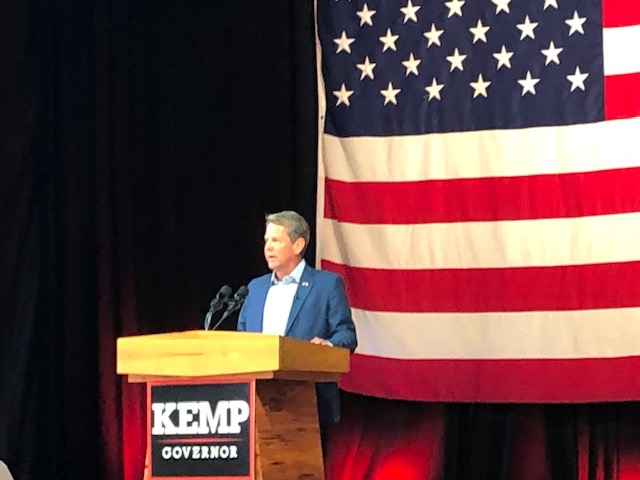
Gov. Brian Kemp addresses supporters after his primary win last Tuesday night. (Photo credit: Rebecca Grapevine)
ATLANTA – Going into last Tuesday’s Republican gubernatorial primary, former U.S. Sen. David Perdue’s challenge of incumbent Gov. Brian Kemp was threatening to tear the GOP apart, potentially easing Democrat Stacey Abrams’ path to victory.
But the huge margin of Kemp’s primary win – amassing nearly 74% of the vote to just 22% for Perdue – could help unite Republicans. Perdue took the first step Tuesday night when he urged supporters to get behind Kemp going forward.
“I don’t see the party being divided at this point,” said Chuck Clay, a partner with Atlanta law firm Hall Booth Smith and a former chairman of the state GOP.
Perdue carried the endorsement of former President Donald Trump into the race and made Trump’s claims of widespread fraud in Georgia’s 2020 elections – dismissed in multiple court rulings as baseless – the main theme of his campaign.
Perdue’s focus on an election a year and a half in the rear-view mirror played a key role in his defeat, said Kerwin Swint, a political science professor at Kennesaw State University.
“There was never really a rationale for Perdue’s challenge, other than the Trump controversy,” Swint said. “A lot of Georgia Republicans are ready to move on. … They are feeling you can be a Republican and a conservative and don’t have to do what Donald Trump tells you.”
Kemp, on the other hand, ran on his record of accomplishments in three and a half years as governor.
Just this year, he steered a conservative agenda through the General Assembly to let Georgians carry concealed firearms without a permit, give parents more say in their children’s education and require transgender students to compete in school sports based on their gender at birth.
Sitting on a huge budget surplus, Kemp gave teachers and state workers pay raises, refunded taxpayers $1.1 billion and launched a phased-in rollback of state income tax rates.
“Kemp had a lot to work with,” said Charles Bullock, a political science professor at the University of Georgia. “He had a good legislative session.”
Perdue’s defeat was part of a trend that saw a roster of other Trump-endorsed Republican candidates in Georgia come up short in their primary races.
U.S. Rep. Jody Hice, R-Greensboro, lost to incumbent Secretary of State Brad Raffensperger. Like Kemp, Raffensperger was targeted by Trump for refusing to help the then-president overturn Georgia’s 2020 presidential election results.
John Gordon, another Trump-endorsed challenger, lost to Attorney General Chris Carr. Patrick Witt was beaten by state Insurance Commissioner John King.
In statewide races, Herschel Walker and state Sen. Burt Jones, R-Jackson, were the only members of the Trump ticket to win their primaries. Walker won primarily because of his universal name recognition as a University of Georgia football great, while Jones was bidding for the vacant post of lieutenant governor.
Bullock said Trump’s down-ballot picks weren’t able to overcome their lack of name recognition because he didn’t put any money into their campaigns.
“The candidates didn’t have any way to get the word out,” Bullock said. “Endorsements don’t have any value if you don’t get the word out. … They don’t turn a nobody into a winner.”
Kemp’s one-sided victory over Perdue has given him a shot of momentum heading into the general election campaign against Abrams. How far that momentum carries the governor will depend in large part on whether he can convince Perdue voters to support him in November.
“So many Republicans are just not going to vote for Kemp,” Trump said during a “tele-rally” with Perdue the night before Tuesday’s primary.
Georgia Democrats are encouraged over Abrams’ chances to oust the governor, despite her narrow loss to Kemp in 2018 and two decades of Republican domination of statewide elections.
U.S. Rep. Nikema Williams, D-Atlanta, who doubles as state Democratic chairwoman, said Democrats are feeling positive coming off the 2020 election cycle, which saw Democratic presidential nominee Joe Biden carry Georgia and Democrats Jon Ossoff and Raphael Warnock flip the state’s two U.S. Senate seats.
“In 2018, nobody believed what was possible,” Williams said. “In 2020, we shocked the world. We showed them Georgia Democrats were competitive.”
But Swint said the size of Kemp’s primary win and the enthusiasm Republican voters are showing to bounce back from the 2020 losses bode well for the governor.
“Republicans are certainly pumped,” Swint said. “Kemp has the greater momentum now heading into the general election.”
This story is available through a news partnership with Capitol Beat News Service, a project of the Georgia Press Educational Foundation.
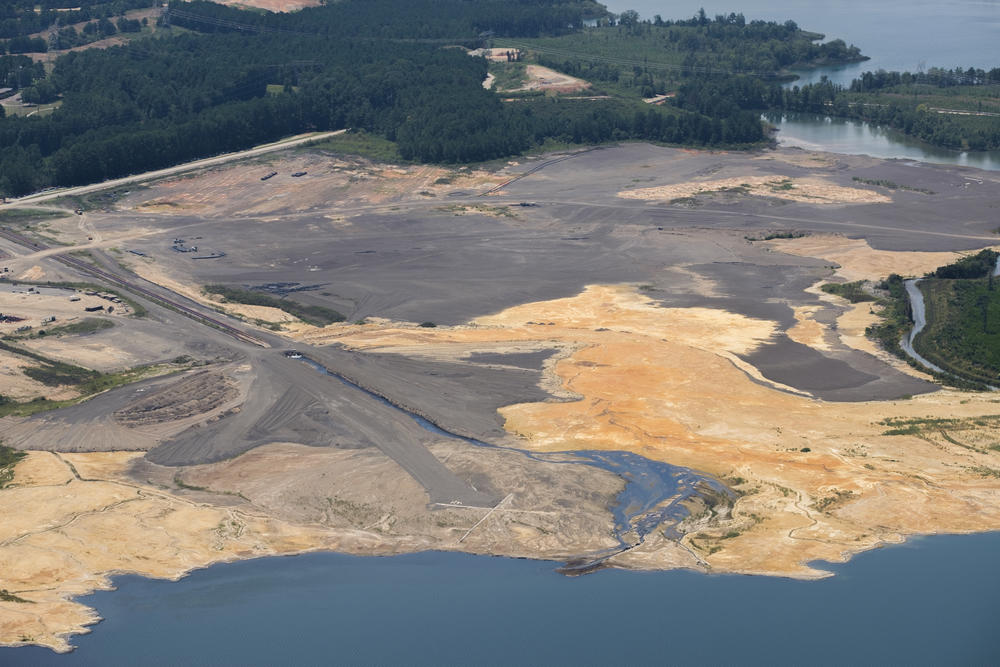
ATLANTA – Georgia Power’s plan to close in place some of its coal ash ponds violates a federal rule prohibiting ash to be in contact with groundwater, an environmental consultant said this week.
Mark Quarles, a senior consultant with Chicago-based BBJ Group, testified before the Georgia Public Commission (PSC) during three days of hearings on a plan the utility submitted in January outlining the mix of energy sources it intends to rely on for power generation during the next 20 years.
Georgia Power’s 2022 Integrated Resource Plan (IRP), which is updated every three years, calls for the company to continue phasing out its fleet of coal-burning plants and step up its investment in natural gas and renewable energy.
With the coal plants being retired, the utility plans to spend $9 billion to close all 29 of its ash ponds at 11 coal-burning power plants across Georgia. While ash is be excavated and removed from 19 of the ponds, the other 10 are scheduled to be closed in place.
Coal ash contains contaminants including mercury, cadmium and arsenic that can pollute groundwater and drinking water as well as air.
The U.S. Environmental Protection Agency (EPA) announced in January it intends to enforce a 2015 rule prohibiting utilities from dumping ash generated by coal-burning power plants into unlined ponds.
Any pond closures that allow coal ash to be in contact with groundwater violate the federal rule, Quarles testified Thursday.
“Groundwater contamination is common and widespread at [Georgia Power] disposal areas,” he said. “The company commonly built large unlined impoundments in streams.”
Specifically, Quarles cited a 343-acre pond at Plant Wansley in Heard County, which he said contains more than 16 million cubic yards of waste. Another 550-acre pond at Plant Scherer in Monroe County contains more than 15 million cubic yards of waste, he said.
“Improper closures by the company create significant risk to ratepayers and create unnecessary costs for the company,” he said.
Quarles said Georgia Power to its credit decided recently to excavate and remove ash from one of the ponds at Plant Wansley. He said that should serve as a model for other ash ponds.
Brandon Marzo, a lawyer representing Georgia Power at this week’s hearings, said the PSC approved the utility’s plan for closing ash ponds as part of its 2019 IRP.
Under both federal and state rules, closing ponds in place is considered equally protective as excavating and removing the ash, he said.
Marzo also cited a document prepared by the state Environmental Protection Division (EPD) asserting that closing ponds in place in unstable areas is permissible “if recognized and generally accepted engineering practices have been incorporated.”
The Georgia Power lawyer noted the EPD already has approved such a closure plan for an ash pond at Plant Bowen near Cartersville, where a foundation improvement plan was developed to prevent leakage.
But Quarles said the closure plan for Plant Bowen, site of the largest Georgia Power’s largest ash pond, is unique among the utility’s ponds.
Marzo also argued the description Quarles gave of the ash ponds at plants Wansley and Scherer does not represent the most recent information about those sites furnished by the EPD.
“It’s not what the ponds would look like after closure in place is completed,” he said.
The PSC will vote on Georgia Power’s 2022 IRP this summer.
This story is available through a news partnership with Capitol Beat News Service, a project of the Georgia Press Educational Foundation.
ATLANTA – Gov. Brian Kemp issued an executive order Thursday extending the suspension of the state gasoline sales tax through July 14.
The General Assembly passed legislation in March suspending the fuel tax until May 31 as inflation began raising pump prices above $4 a gallon. The price of gasoline dropped slightly earlier this month but has has gone back up to reach record highs.
Kemp blamed the Biden administration for the rise in fuel prices and inflation in general.
“While we continue to do what we can on the state level to ease the burden at the gas pump, in the grocery store and elsewhere, I will also continue to urge those on the federal level to change these failing policies, work toward greater energy independence for the country, and get our economy back to full operation,” the governor said.
In an effort to reduce pump prices, Biden has ordered releases of oil from the Strategic Petroleum Reserve, the nation’s emergency oil stockpile, and is reportedly considering limiting U.S. oil exports.
Kemp also issued a second executive order Thursday extending an executive order aimed at supply chain disruptions he issued April 14.
The order prohibits price gouging by gas station operators, waives federal rules that limit the number of hours commercial truck drivers may operate and allows commercial trucks to exceed normal weight, height and length restrictions subject to a permit from the Georgia Department of Public Safety.
The second executive order also is due to expire July 14.
This story is available through a news partnership with Capitol Beat News Service, a project of the Georgia Press Educational Foundation.
A commission has recommended renaming Fort Gordon for former President and World War II military commander Dwight Eisenhower.
ATLANTA – A commission created to rename military bases currently named for historical figures with ties to the Confederacy is recommending renaming Fort Gordon near Augusta for former President and World War II military leader Dwight Eisenhower.
The Naming Commission also suggested renaming Fort Benning near Columbus for Lt. Gen. Hal Moore and his wife Julia. Moore’s 32 years of service in the Army from 1945 until 1977 included commanding combat troops in Vietnam.
Forts Gordon and Benning are among seven Army bases the commission chose for renaming.
“Our goal was to inspire today’s soldiers and the local communities with names and values that have meaning,” retired Navy Admiral Michelle Howard, the chair of the Naming Commission, said Wednesday. “We wanted names and values that underpin the core responsibility of the military, to defend the Constitution of the United States.”
The commission visited the seven bases last year for listening sessions with military commanders and community leaders and to gain feedback including preferences for new names.
During the listening sessions and a public comment period, the panel received more than 34,000 submissions for renaming, including 3,670 unique names.
The push to rename military bases honoring Confederate military and political leaders has been part of an effort that has included removing statues from public places in cities across the South.
Other Army bases being renamed include Fort Bragg in North Carolina, Fort Rucker in Alabama; Fort Polk in Louisiana, and forts A.P. Hill, Lee and Pickett in Virginia.
The new names the commission is recommending will be in its report to Congress, which is due by Oct. 1.
This story is available through a news partnership with Capitol Beat News Service, a project of the Georgia Press Educational Foundation.