ATLANTA – Opponents of a proposed titanium mine near the Okefenokee Swamp used the monthly meeting of the Georgia Board of Natural Resources this week to raise concerns about the project.
“We’re talking about one of the greatest treasures of Georgia, one of the most ecologically valuable swamps in the world,” Rhett Jackson, a hydrology professor at the University of Georgia, said during a news conference outside the board meeting site at Stephen C. Foster State Park in Charlton County. “This is not the place to be doing mining.”
Alabama-based Twin Pines Minerals is seeking permits from the Georgia Environmental Protection Division (EPD) to mine titanium dioxide at a site three miles from the swamp.
Jackson said the mining operation would pull water out of the largely rain-fed, drought-sensitive swamp.
“Water levels in the swamp will drop,” he said. “Droughts will become more frequent and more severe.”
Bill Clark, board chairman of the nonprofit Okefenokee Swamp Park near Waycross, said the swamp is too valuable as a tourism resource to risk putting a mine nearby.
Clark said the Okefenokee National Wildlife Refuge is preparing a request to the U.S. Department of the Interior that could lead to the swamp’s selection as the 13th United Nations World Heritage Site in the U.S., a step that would draw tourists from around the world.
“It’s going to be an amazing economic development opportunity for us if this happens,” he said.
The project’s opponents are asking the state Board of Natural Resources to pass a resolution opposing the mine, an action the board took in 1997 that helped stop a titanium mine DuPont was seeking to build near the swamp.
Bipartisan legislation introduced in the General Assembly this year to ban mining near the swamp failed to make it through the Georgia House of Representatives, despite the backing of some of the chamber’s most powerful members.
“The Okefenokee Swamp is a natural gem, unlike any other place on the planet,” state Rep. Darlene Taylor, R-Thomasville, the House bill’s chief sponsor,” said in a statement released this week. “Its beauty is obvious, but it is the underground water flow, which supports the ecological integrity of the swamp, that is vital and must be protected from [Twin Pines Mineral’s] dangerous project.”
The EPD is still reviewing the company’s permit requests. A 60-day public comment period and one or more public hearings will follow once a draft land-use plan for the project is completed.
This story is available through a news partnership with Capitol Beat News Service, a project of the Georgia Press Educational Foundation.
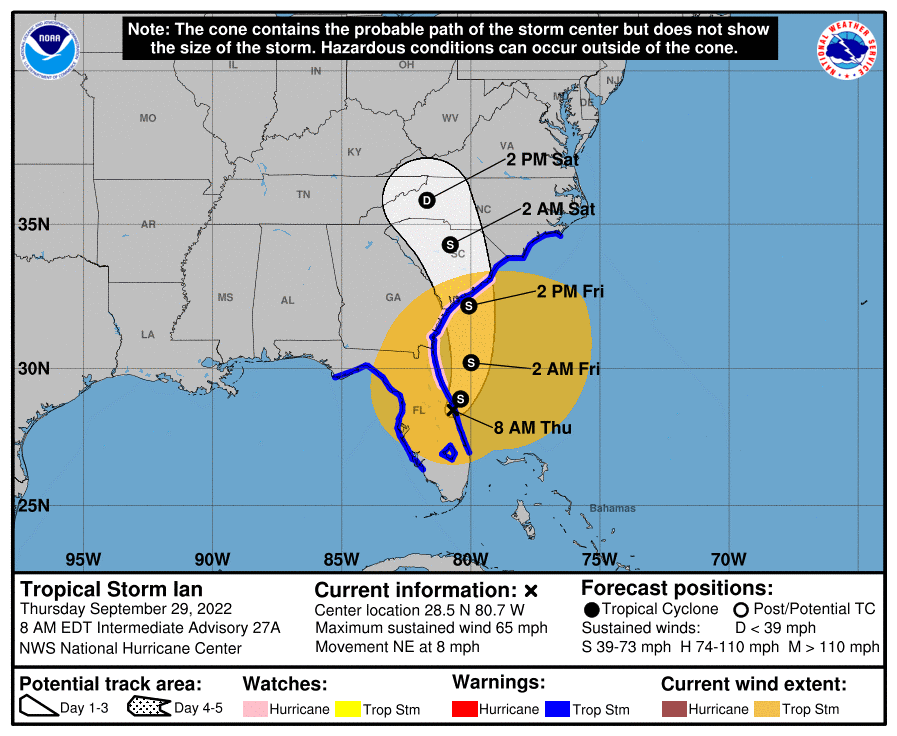
ATLANTA – Tropical Storm Ian has shifted to the east and is not expected to make a direct hit on the Georgia coast, Gov. Brian Kemp said Thursday.
Weakened from the Category 4 hurricane that slammed into Southwest Florida Wednesday, Ian is now expected to make a second landfall Friday in South Carolina, the governor said during a briefing in Savannah.
However, two to four inches of rain still are possible in East and Southeast Georgia Thursday and Friday, accompanied by three to five feet of storm surge and gusty winds of up to 40 miles an hour.
A tropical storm warning, storm surge warning, hurricane watch, and flood watch are in effect along Georgia’s entire 110-mile coast through Friday, while a wind advisory is in effect for much of North and Middle Georgia.
The order Kemp issued earlier this week declaring a state of emergency for all of Georgia’s 159 counties took effect Thursday morning.
The state Department of Transportation closed the Sidney Lanier Bridge in Brunswick Thursday morning, but the Houlihan Bridge over the Savannah River is closed only to boat traffic.
While Savannah/Hilton Head International Airport remains open, the Georgia Ports Authority has cleared the Port of Brunswick of all vessels until the storm passes. The Port of Savannah has cleared any waiting ships but will continue operating until 6 p.m. Thursday.
State emergency management officials said plenty of hotel rooms remain available in Georgia to house Floridians traveling north to get out of the worst effects of what was Hurricane Ian.
The Georgia Department of Economic Development has activated the Explore Georgia hurricane information webpage to help evacuees find rooms and other resources.
Kemp encouraged Georgians in low-lying areas or at-risk floodplains – particularly those who live in vulnerable housing – to consider moving temporarily to higher ground.
This story is available through a news partnership with Capitol Beat News Service, a project of the Georgia Press Educational Foundation.
ATLANTA – U.S. Sen. Jon Ossoff, D-Ga., introduced legislation Wednesday calling for greater oversight of the federal prison system.
The bill follows a 10-month investigation into conditions inside federal prisons – including the federal penitentiary in Atlanta – conducted by the Senate Permanent Subcommittee on Investigations, which Ossoff chairs.
The legislation would require the U.S. Department of Justice’s inspector general to perform comprehensive inspections of the federal prison system’s 122 correctional facilities, assign each a risk score and recommend how to fix problems. Higher-risk facilities would have to be inspected more often.
Recommendations from the inspector general would be forwarded to Congress. The U.S. Bureau of Prisons would be required to respond to reports within 60 days with a corrective action plan.
The bill also would establish an independent ombudsman in the Justice Department to investigate the health, safety, welfare, and rights of inmates and prison staff and create a secure hotline and online form for relatives and representatives of inmates to lodge complaints.
The bill is being cosponsored by Senate Majority Whip Dick Durbin, D-Ill., and Sen. Mike Braun, R-Ind.
“My 10-month bipartisan investigation of corruption, abuse, and misconduct in the federal prison system revealed an urgent need to overhaul federal prison oversight,” Ossoff said. “I am bringing Democrats and Republicans together to crack down on corruption, strengthen public safety, and protect civil rights.”
“More transparency and accountability will help create a safer environment for the correctional officers and staff who work in our federal prisons and will help crack down on violence … and contraband that endangers the health and safety of prison staff,” Braun added.
At a hearing Ossoff’s subcommittee held in July, two former administrators at the federal penitentiary in Atlanta told stories of inmates being severely abused amid inhumane conditions dating back at least to 2014.
A companion bill to Ossoff’s legislation was introduced into the U.S. House of Representatives Wednesday by Rep. Lucy McBath, D-Marietta.
“Incarcerated Americans should not fear death when they enter our federal prison system, and correctional officers should not fear for their safety at work,” McBath said. “Our federal prisons must serve as an institution that rehabilitates individuals and prepares them for reentry into society.”
This story is available through a news partnership with Capitol Beat News Service, a project of the Georgia Press Educational Foundation.
ATLANTA – The University System of Georgia awarded an all-time high 74,446 degrees during the last fiscal year, up 2.1% over fiscal 2021.
“By preparing students for good jobs and helping create the jobs of the future, Georgia’s public colleges and universities are a great value for students and a major contributor to our state’s economy,” system Chancellor Sonny Perdue said Tuesday.
“The record in degrees awarded only confirms that the hard work being done across the university system is having an impact on the success of both our students and Georgia.”
The number of degrees awarded since the university system joined the Complete College America program in 2011 has grown by 36%, far outpacing the 7.1% increase in enrollment during that period.
The university system has undertaken many initiatives during the last decade to boost graduation rates, including the Momentum Year program, which gets first-year students off to a fast start by ensuring they pursue an aggressive course schedule.
The system also has made a point of quickly alerting student advisors when their charges’ performance is lagging and provided “degree roadmaps” to prevent students wasting time and money on courses that don’t count toward their degree.
Last month, the system launched the website Georgia Degrees Pay to show the value of a degree.
Graduates from the class of 2021 will earn more than $1 million more during their lifetimes than they would have if they didn’t go to college and earn a bachelor’s degree, according to a recent analysis. Graduate and professional degrees lift those average earnings even higher.
The new website provides a variety of data on the university system’s 26 institutions to allow comparisons of costs to attend, majors and fields of study, and average career earnings.
This story is available through a news partnership with Capitol Beat News Service, a project of the Georgia Press Educational Foundation.
ATLANTA – For the fifth year in a row, Georgia public-school students outperformed their peers across the country on the SAT.
Georgia’s class of 2022 recorded a mean score of 1052, 24 points higher than the 1028 national score but lower compared to the previous year, when Georgia students posted a mean score of 1077.
The Georgia group also scored higher in the component portions of the test, with a mean score of 536 on the Evidence-Based Reading and Writing portion and 516 in math.
The high marks came despite the disruptions of the coronavirus pandemic, which caused many schools to close and switch to online instruction.
“That’s a testament to the hard work of students and teachers,” State School Superintendent Richard Woods said. “While students and school have faced significant challenges over the last several years, as a state we will continue to invest in academic recovery and the opportunities available to every graduate of every Georgia public school.”
Participation in the SAT among the Georgia class of 2022 increased sharply compared to 2021, when the impacts of the pandemic, the cancellation of some test registrations, and the closure of some test centers in 2020 caused fewer students in the graduating class to take the test.
Just more than half of the 2022 class took the SAT, up from 38% in 2021.
Georgia high school students haven’t been as incentivized to take the test as in past years. Citing the effects of the pandemic on learning, the University System of Georgia waived SAT and ACT test requirements at most of the system’s 26 institutions during the last school year and is doing so again this year.
This story is available through a news partnership with Capitol Beat News Service, a project of the Georgia Press Educational Foundation.