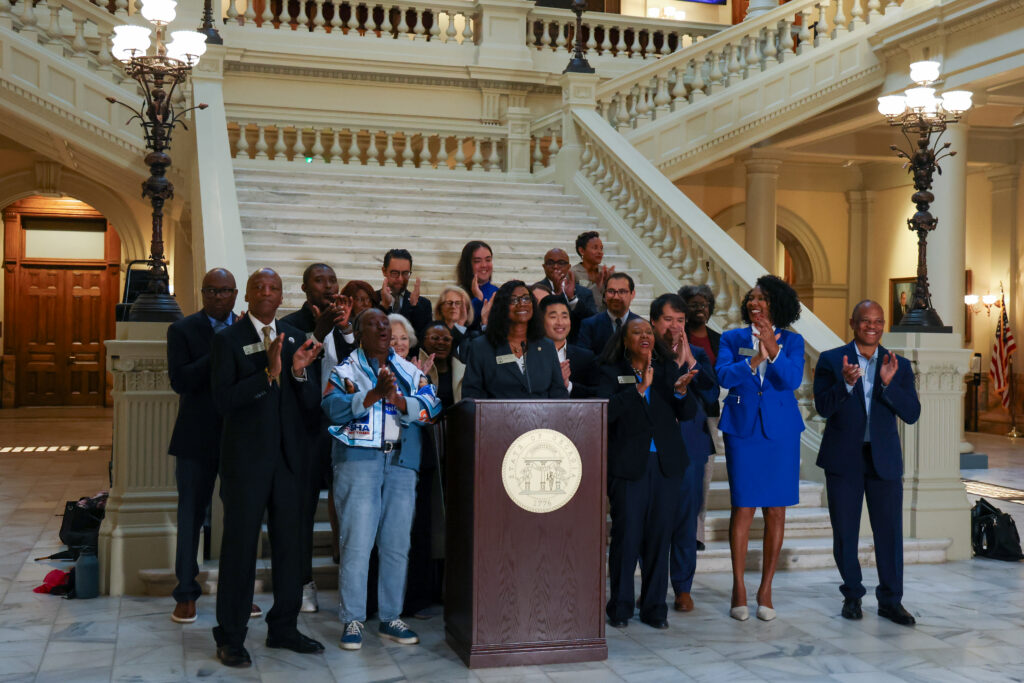
ATLANTA — Women won big in Georgia on Election Day.
Eight women, all of them Black Democrats, expect to be sworn in to statewide office in January after defeating Republicans on Tuesday.
The unofficial tally by the Georgia secretary of state’s office shows a Black Democratic woman taking over that agency, along with the offices for governor and attorney general.
The results also show Black Democratic women flipping the state school superintendent’s office, which oversees education, and the agriculture, insurance and labor commissioner posts, and putting one at the table in a new Democratic majority controlling the commission that regulates utilities.
Democrats nearly flipped the state Senate, according to the tally, which shows at least two Democratic women unseating Republican men, including one who authored the state’s abortion ban when he was in the state House of Representatives.
Results also show at least three Democratic women unseating Republican men in the state House, helping their party end more than two decades of GOP rule there.
Rep. Carolyn Hugley, D-Columbus, who is the House minority leader, is among those in line to become speaker when a new Democratic majority convenes to select leadership.
Like the women who won statewide, Hugley is Black. She would be the first Black woman to serve as House speaker.
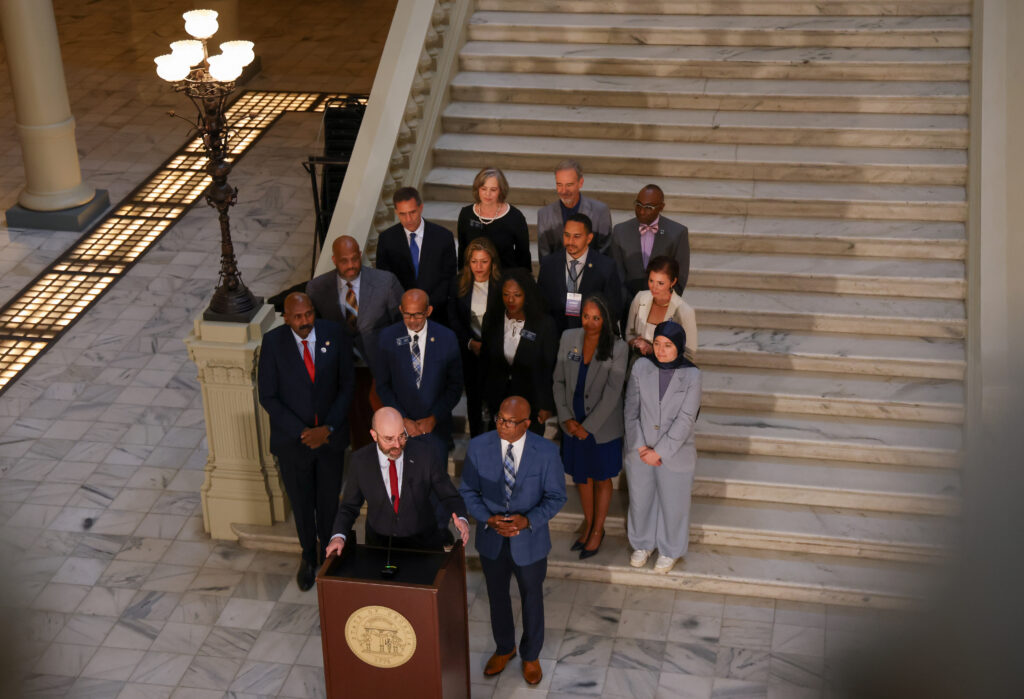
Rep. Mary Margaret Oliver, D-Decatur, has served in both the state House and Senate at different times since the late 1980s. She watched with disappointment as one woman after another lost bids for statewide office, including Cathy Cox and Stacey Abrams for governor.
“I think it’s exciting. I think it’s overdue — way overdue,” Oliver said.
Some of the women who won did so in contests for open seats against white Republican men, including former Atlanta Mayor Keisha Lance Bottoms for governor, state Rep. Tanya Miller, D-Atlanta, for attorney general, Penny Brown Reynolds for secretary of state and Shelia Edwards for the Public Service Commission.
Edwards’ lead in the unofficial election returns indicates that she would flip the five-member Public Service Commission to Democrats for the first time in three decades, consolidating Democratic gains from last year when the party dislodged two Republicans amid voter frustration over rising electricity bills.

Only three men won statewide on Tuesday, all of them Democrats who defeated male Republicans.
U.S. Sen. Jon Ossoff fended off a Republican challenger, as did Public Service Commissioner Peter Hubbard, who kept the seat he won in a special election last year.
State Sen. Josh McLaurin, D-Sandy Springs, appears to have defeated state Sen. Greg Dolezal, R-Cumming, in the open contest for lieutenant governor, the official who presides over the Senate and is next in line to the governorship.
Three women won congressional races in Democrat-learning territory, although several Democratic women failed to unseat Republican men in GOP-leaning districts.
Some voters said they backed Democrats because of frustration with rising prices and opposition to the policies of President Donald Trump.
“I went blue all the way because I believe in democracy,” said James Leggat, a former Republican who voted at Buford City Hall. “I’m not really crazy about fascism,” he said, explaining why he voted for every Democrat on his ballot.
He said he felt Republican messaging was “straight out of ‘Mein Kampf,'” citing Project 2025, a policy blueprint for a conservative administration drafted by the Heritage Foundation and former Trump administration officials.
The National Women’s Law Center describes the 900-plus-page handbook as “a hierarchal, gendered, patriarchal vision of society” that seeks to roll back gender equality and women’s rights.
Christine Ball said gender influenced some of her choices, though not in the governor’s race. Ball, who voted at Buford City Hall, said she picked Republican businessman Rick Jackson because she did not like how Bottoms had led Atlanta City Hall as mayor.
But unlike Leggat, Ball did not pick strictly along party lines. She said she voted to keep Ossoff in his U.S. Senate seat because she did not like his Republican challenger, U.S. Rep. Mike Collins. And she chose Miller for attorney general because, unlike her Republican opponent, Miller had experience as a criminal prosecutor.
Ball said she voted for down-ballot Republican incumbents but backed the Democrat in the open race for secretary of state.
Ball, a children’s mental health therapist, said she voted for Penny Brown Reynolds instead of state Rep. Tim Fleming, R-Covington, because she felt a woman would be more likely to feel urgency in approving licenses for professionals like her.
“I definitely wanted to see a female secretary of state,” Ball said.
This is who won down-ballot races, according to unofficial election results from the Georgia secretary of state’s office.
Four Black Democratic women appear to have defeated the Republican incumbents leading four state agencies:
- Katherine Juhan-Arnold against Agriculture Commissioner Tyler Harper,
- Keisha Sean Waites against Insurance Commissioner John King,
- Lydia Powell against state School Superintendent Richard Woods, who leads the Department of Education, and
- Nikki Porcher against Labor Commissioner Bárbara Rivera Holmes, who was appointed to the post last year and was the only female statewide incumbent on the ballot.
Three Black Democratic women appear to have won their congressional elections in Democratic-leaning territory:
- U.S. Rep. Nikema Williams appears to have defended her seat against a male Republican challenger in Clayton, DeKalb and Fulton counties,
- U.S. Rep. Lucy McBath appears to have kept her seat against a male Republican challenger in a district that spans Cobb, Douglas, Fayette and Fulton counties, and
- state Rep. Jasmine Clark, D-Lilburn, appears to have won an open U.S. House seat by defeating a male Republican in another Democratic-leaning district that spans six counties in east and south metro Atlanta.
At least three Democratic women appear to have unseated Republican men in the state House of Representatives, helping to flip the chamber to Democrats:
- Danielle Bell against Rep. Don Parsons, R-Marietta,
- Michelle Kang against Rep. Matt Reeves, R-Duluth, and
- Cynthia Starke-Jones against Rep. Joseph Gullett, R-Dallas.
At least two Democratic women appear to have helped bring the state Senate to within two seats of Democratic control by defeating male Republican incumbents:
- Laura Murvartian against Sen. Shawn Still, R-Suwanee, and
- Darcy Castro against Sen. Ed Setzler, R-Acworth, who was a member of the state House when he authored the law that bans most abortions after fetal cardiac activity can be detected, usually around six weeks of pregnancy.