ATLANTA — Democrat Keisha Lance Bottoms attacked her Republican opponent, Rick Jackson, on data centers, fuel costs and abortion when he skipped what would have been their final debate Monday night.
Bottoms used Jackson’s absence from the Atlanta Press Club event to claim her opponent believed that women who are victims of rape should have to prove it before they can qualify for an exemption from Georgia’s ban on abortion after fetal cardiac activity is detected, typically six weeks into pregnancy.
Bottoms used the portion of the debate when candidates are allowed to ask each other questions to say, “If he were here, I would ask, how do you prove that you have been raped in order to get an abortion?”
Bottoms alleged that the wealthy entrepreneur was flying on his private jet “rather than having to answer to the people of Georgia about this irresponsible position.”
Bottoms apparently was referring to a June news report about an audio recording of Jackson at a campaign stop.
An attendee reportedly asked Jackson, who supports Georgia’s anti-abortion law, about the law’s exception for rape, according to a report about the recording by The Atlanta Journal-Constitution.
Jackson reportedly responded, “You’ve still got life.”
Jackson had indicated weeks ago that he would not participate in this latest installment of the long-running debate series, which was intended to give Georgia Public Broadcasting viewers a chance to watch nearly every statewide candidate think on their feet.
The only other candidate to decline an invitation was Fitz Johnson, the Republican running to unseat Democrat Peter Hubbard from the Public Service Commission.
Bottoms pledged to look for willing Republicans to help Democrats overturn Georgia’s six-week abortion ban, though she said she hoped that “whole ballot energy” would result in her party taking control of the General Assembly.
Bottoms also attacked Jackson over his investments in the data center and oil refinery sectors.
ATLANTA — An executive vice president at Georgia Tech will step temporarily into the top job amid a search for a permanent president.
Chancellor Sonny Perdue on Tuesday named Timothy Charles Lieuwen as interim president effective Nov. 1.
That is when current President Ángel Cabrera leaves the role to lead the Aspen Institute, a move announced in June.
“As we conduct a nationwide search for the university’s next president, we’re fortunate to have Dr. Tim Lieuwen step into this leadership role,” Perdue said in a statement.
As executive vice president for research at Tech, Lieuwen oversees the Georgia Tech Research Institute, the Enterprise Innovation Institute and 11 interdisciplinary research institutes, according to the University System of Georgia.
A 14-member search committee chaired by Regent Harold Reynolds is still looking for a permanent successor to Cabrera.
Lieuwen earned a master’s degree and a Ph.D. in mechanical engineering from Tech after graduating from Calvin College.
When G. Wayne Clough was doing research for a book about the Georgia coast, he drove to St. Marys, boarded the ferry to Cumberland Island, then hopped onto an ATV piloted by a local legend.
Carol Ruckdeschel, the self-taught naturalist who had lived on the island for half a century, met him at a dock on the island’s south side, and whisked him to her museum by her home near the north end of the island.
As the hour approached to head back south for the last ferry, Ruckdeschel asked Clough if he wanted some raccoons. He said he declined her offer.
“You know, she collects dead animals,” Clough said.
The museum was filled with the remains of creatures Ruckdeschel had collected, including insects, snakes, whales and turtles.
Ruckdeschel, who turns 85 in December, led an unconventional lifestyle. Her residency on the island, her curiosity and her skill with a knife helped establish her reputation as an expert on sea turtles — and as a protector of them and of the island.
Her work helped document how sea turtles were trapped and drowned in shrimp trawler nets, leading to changes in their design. And hundreds of her specimens supported research at the Smithsonian Institution, which Clough led after leaving Tech. The scientists there told him about Ruckdeschel and showed him one of her early turtle specimens, which he featured in his new book, “The Ever-Changing Georgia Coast.”
“She was a significant part of the science community studying turtles and marine mammals,” Clough said.
She has also been a voice for the environment, and she is again speaking out against National Park Service plans for the island. NPS officials recently approved at least a doubling of daily visitation, which had been formally capped at 300 since the approval of a 1984 management plan.
Officials also are proposing property exchanges with longtime private owners. The owners would move to what NPS considers to be less environmentally sensitive areas. They would be allowed to build homes as large as 15,000 square feet in the new locations.
How Ruckdeschel helped solve a mystery
In her 2017 book, “A Natural History of Cumberland Island, Georgia,” Ruckdeschel cataloged the island’s flora, fauna, geology and ecology, using the field notes and drawings of the specimens she had collected over decades of living there.
She never graduated from college, but she learned to conduct necropsies of the creatures she found on the beaches and roads.
Clough, who was the 12th secretary of the Smithsonian from 2008 to 2014, said scientists there learned about Ruckdeschel’s research and raved about the quality of her notebooks. That led to an enduring relationship in which Clough said she gave about 700 of her specimens to the institution’s collections, where they were studied by scientists worldwide.
Ruckdeschel’s work also helped to answer a question that was crucial to turtle survival: why so many turned up dead on beaches.
Will Harlan served as a seasonal park ranger on Cumberland Island in 1997. He was expecting a summer beach getaway after graduating from college, but he encountered Ruckdeschel on his first day and it changed the direction of his life.
“She walked up to me, handed me a pile of sea turtle guts, and she was holding a rusty bloody knife,” Harlan said. She had opened the creature’s intestines, and shrimp had spilled onto the beach.
Ruckdeschel had found that many dead, beached turtles shared the same last meal, providing evidence that shrimp trawlers were killing them.
To prevent such deaths, many shrimp trawlers must now use nets equipped with turtle-excluder devices.
Concerns about a new direction
Ruckdeschel asserted in a recent interview that the Park Service lacked the expertise to gauge the impact of its planned and proposed changes.
“We’ve never had an ecologist on staff to help explain it to them,” she said in a phone interview while sitting at a picnic bench at Sea Camp Dock, in the shade of live oaks.
“This is really over the top,” she said of the plans. “It’s heartbreaking.”
The Park Service said in a statement that it had staff expertise “in resource protection, compliance, biological monitoring, and environmental analysis.” NPS said it was committed to protecting the island’s wilderness character and its natural and cultural resources.
NPS also said it followed development and approval procedures, making environmental assessments available for public comment.
The deadline for public comment on the land swaps is Friday, Oct. 16.
“These exchanges aim to consolidate public ownership, direct development potential toward areas with fewer resource concerns, and promote long-term conservation and natural resource management,” a Park Service environmental assessment of the proposal said.
NPS documents said the increase in visitation to as many as 700 people per day would reduce barriers to access. It would also benefit St. Marys and other gateway communities, an NPS finding published in August said. “Businesses within the community will continue to benefit from visitor spending on goods and services such as lodging, retail, dining, and transportation services.”
Lary Dilsaver, an emeritus professor at the University of South Alabama, wrote a history about the island and its management in his 2004 book, “Cumberland Island National Seashore: A History of Conservation Conflict.”
He said in an interview that the Park Service had long served conflicting constituencies and directives.
“There are three things going on there all the time,” he said. “There are the natural resources, which are compelling — the beach, the forest and the animals. Then there is the historic stuff — two colonial forts they can’t even find and all the estates from the Carnegies and the Rockefellers. … And then there is the recreation thing.”
Congress established Cumberland Island National Seashore in 1972, and initial Park Service plans envisioned as many as 10,000 visitors a day, with jitney tours running the length of the island and beach developments for 7,000 sunbathers, according to a 2005 article Dilsaver wrote for a science journal.
The Park Service’s mandate to conserve the environment, preserve historic buildings and offer recreation was further complicated on Cumberland Island by the legal rights of the private landowners there, he wrote.
‘Boots on the ground’
Ruckdeschel’s supporters fear the loss of her active presence on the island, more than half of which Congress designated as protected or potential wilderness in 1982.
“When she’s gone there will be no more boots on the ground,” said Charlotte Fries, a former Cumberland Island ranger. “Everyone should be worried.”
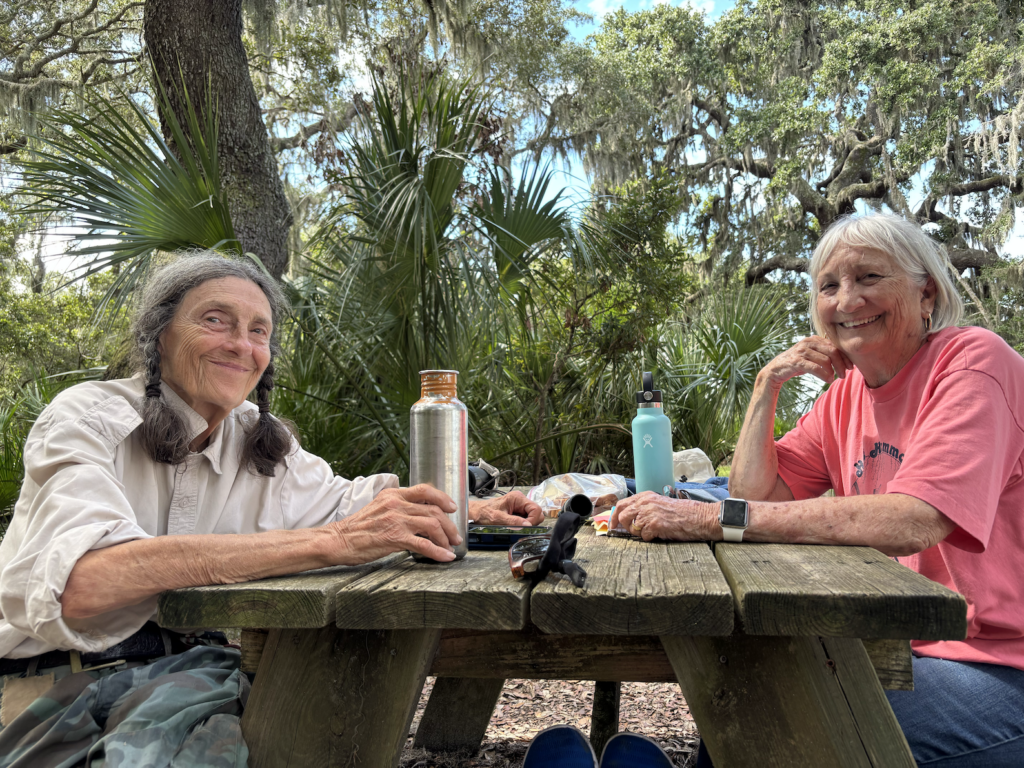
Carol Ruckdeschel (left) with Charlotte Fries at Sea Camp Dock on Cumberland Island on Friday, Sept. 18, 2026 (Contributed by Melissa Sellers)
Part of Ruckdeschel’s legacy is the legion of Cumberland Island devotees whom she helped inspire, said Harlan, who wrote a biography of her more than a decade ago (“Untamed: The Wildest Woman in America and the Fight for Cumberland Island”).
After that book, he left journalism to earn a master’s degree in biology. He is now a scientist with the Center for Biological Diversity and is an advocate for preserving the island.
“Carol changed my life and I’m just one of thousands that have been inspired by her example,” Harlan said. “No one gets their hands dirty the way Carol does. She literally has buckets of dead animals macerating in her front lawn as she analyzes their skulls and gut contents. She deals in death and studies death to better understand life.”
Ruckdeschel has been in the media limelight on and off for more than half a century.
A 1973 article in The New Yorker called “Travels in Georgia” portrayed her search with Coca-Cola heir Sam Candler for wildlands worth preserving. They were working for the Georgia Natural Areas Council, and the article documented Ruckdeschel’s canoe trip down a stretch of the Chattahoochee River with Gov. Jimmy Carter. She had camped as a child there, and the river corridor was under threat of development. Five years later, Carter, an avid outdoorsman who was by then the president, would sign the law that established Chattahoochee River National Recreation Area as a unit of the National Park Service.
It was Candler who gave Ruckdeschel a perch on the island, offering to hire her as a caretaker of the family vacation home, according to Harlan’s biography.
Carter, whose family had often visited the island with the Candler family, gave an interview to the National Park Service in 1995. He said they made a game of living off the land, gathering herbs and oysters, catching mullet, sea trout and sea bass.
They would watch a sea turtle lay her eggs and then return to the island later to watch her hatchlings scrabble to sea, the transcript said.
Carter said he hoped Cumberland Island would be allowed to grow wilder over time.
“I don’t really see any need to increase the number of visitors per day,” he said.
ATLANTA — The first debate between Democratic U.S. Sen. Jon Ossoff and U.S. Rep. Mike Collins, the Republican nominee challenging him, centered on President Donald Trump.
It was also an opportunity for the two opponents to paint each other as dangerous extremists.
The matchup, hosted by Atlanta News First on Thursday night, featured television journalists peppering the two with questions about the economy, healthcare, the Iran war, immigration and other issues.
Unlike Republican gubernatorial candidate Rick Jackson, who tacked more toward Gov. Brian Kemp than the president in a similar clash with Democrat Keisha Lance Bottoms on Tuesday, Collins hewed closely to Trump, defending the president’s policies.
Collins, who represents a district between Atlanta and Augusta, painted Ossoff as a liberal extremist who sides with U.S. Sen. Bernie Sanders and supports transgender athletes while opposing tax cuts.
“He wants to take control of this country with these weird and dangerous ideas with his radical friends,” Collins said.
Ossoff attacked Collins over Collins’ son-in-law, who lives on Collins’ property and has been posting social media content that promotes white supremacy and borrows from Nazi propaganda.
Ossoff also pointed to reports about former Collins congressional staffers’ links to white supremacists, saying Collins had “hired half the Third Reich” and had himself amplified neo-Nazi content online.
When moderator Rick Folbaum asked Collins what he had said to his son-in-law about his online posts and whether Collins would “once and for all denounce white supremacy,” Collins blamed Ossoff’s attacks for a recent death threat against Collins and his son-in-law that led to the arrest of a man in New York.
Then, Collins said he had “condemned racism, antisemitism, hate. I don’t care where the source is and I tell him that too. It’s wrong.”
Ossoff called Collins a “bigot” and said his proximity to white supremacists should disqualify him from office.
“Imagine running for the U.S. Senate while neo-Nazi propaganda is disseminated to an audience of millions from your home,” Ossoff said. “That’s Mike Collins.”
Ossoff started the debate by criticizing Collins for his ties to white nationalists and also for his “pathetic, childlike devotion” to Trump.
Collins tried to tie Ossoff to Abdul El-Sayed, the Democratic Senate nominee in Michigan who has been critical of Israel’s military campaign in Gaza and, as Collins put it, “hates Israel, loves Iran.”
When Folbaum asked Ossoff whether he believed Israel had committed genocide, Ossoff, who is Jewish and said he had family in Israel, deferred judgment to the International Criminal Court. But he said he believed Israeli forces in Gaza had “violated the law of armed conflict and international humanitarian law.”
Ossoff attacked Collins over the war in Iran, blaming rising fuel costs on Trump and on Collins’ support for the president’s policies. Collins said Trump had to stop Iran’s nuclear ambitions.
Ossoff also attacked Collins over tariffs and their effect on the cost of living.
Collins said he supported an “America first” policy and that the country had “bowed down” to other countries and their tariffs. American “tariffs now are making it fair,” he said.
Ossoff shot back: “You just heard Mike Collins say the tariffs are working. Go buy groceries.”
The debate also touched on the rising cost of fertilizer, a concern for farmers.
Ossoff blamed the war and tariffs. Collins blamed a reliance on imported fertilizer.
Collins pivoted to Democrats’ role last year in the government shutdown, blaming Ossoff for delaying Hurricane Helene relief funding to farmers. Ossoff said he had helped Georgia farmers by meeting repeatedly with India’s ambassador to get that country to reduce its tariff on pecans.
Collins criticized Ossoff and Democrats on immigration policy, saying his Laken Riley Act — the first bill signed by Trump in his second term — had secured the borders. Ossoff blamed the Trump administration’s aggressive deportation enforcement for the deaths of American citizens.
Collins blamed Democrats for rising healthcare costs. Ossoff blamed Republicans for cutting Medicaid and for allowing enhanced Affordable Care Act subsidies to expire, saying that a hospital in Collins’ district had closed its labor and delivery unit partly due to Medicaid cuts. Ossoff said the Congressional Budget Office had warned that service cuts at rural hospitals could result from passage of Trump’s One Big Beautiful Bill Act.
Collins blamed the subsidies. “The only people getting rich on these subsidies are our health insurance carriers out there,” he said.
In a rare instance of agreement, both suggested that more price transparency could help restrain rising healthcare costs.
ATLANTA — In what was likely to be their only debate before Election Day on Nov. 3, Democrat Keisha Lance Bottoms and Republican Rick Jackson attacked each other and sometimes agreed on policy during a live encounter hosted by Atlanta News First Tuesday night.
Billed as a “town hall,” the hourlong matchup (minus commercial breaks) between the gubernatorial candidates featured questions from more than a dozen voters.
A couple of them asked about privacy concerns and Flock cameras. Both candidates said there needs to be more accountability.
Several asked about healthcare, and both Bottoms and Jackson said they would expand Medicaid — Bottoms, fully, in the way that 40 states already have; and Jackson differently, in a way that he said would not lose $4.5 billion, without explaining what that meant or how he would do it.
He had only one minute. That was the format, although occasionally the candidates got extra time to rebut an attack by their opponent.
Jackson went after Bottoms for her handling of public safety when she was mayor of Atlanta and the city was roiled by unrest.
Bottoms targeted Jackson’s leadership of his multibillion-dollar healthcare company, claiming it had raided rural hospitals for their doctors.
Jackson did not rebut that. But he did deny her assertion that he had invested in at least four data center construction companies, although he told Macon news station 13WMAZ in April that his investment in one in Texas made him knowledgeable about the issue.
(He counterattacked, saying Bottoms had approved three data centers as mayor. She said she knew only of one, not hyperscale, at Georgia Tech.)
When a woman who had lost her job due to federal budget cuts asked about restoring funding, Bottoms attacked Jackson for saying during the Republican primary that he would govern like President Donald Trump but “with a Southern tone.” Jackson responded that he would stand up to anyone, “just like” Gov. Brian Kemp.
Jackson did not elaborate, but Kemp resisted Trump’s efforts to overturn Georgia’s 2020 election results.
Bottoms also challenged Jackson about his views on federal intervention in the upcoming election.
After a voter, who happened to be a poll manager, asked about “the divisiveness and concerns around the election process,” Bottoms said she was alarmed by Trump’s rhetoric while Jackson said he thought Kemp had the right approach.
Then, Atlanta News First anchor Rick Folbaum asked a follow-up question that gave an opening to Bottoms. Folbaum asked about a recent request by the Georgia State Election Board for the federal government to declare Georgia’s voting system illegal: “Would you be okay with the Justice Department overseeing and getting involved with Georgia elections?”
Jackson said no, unless Kemp felt it necessary.
Bottoms then asserted Jackson had said the National Guard would be called in during the election. (She also said the State Election Board, which sets the rules for voting, had “gone rogue” and was a “disaster.”)
Jackson denied he had ever suggested the National Guard should intervene, calling Bottoms’ claim “a complete falsehood.”
Folbaum gave Bottoms the last word on that.
“He said that the National Guard would be called in,” Bottoms said. “You all can pull the tape on that. Maybe he’s forgotten that he said it. But he said it.”
The Atlanta Journal-Constitution reported in August that it had obtained an audio recording from a rally in Columbus. The report said Jackson had talked with an attendee who wanted him to ask Trump for federal troops to monitor the election.
“Well, we’ll get National Guard — Gov. Kemp is going to watch it for us,” Jackson replied.
(The publication embedded the recording in its story and noted that Jackson’s campaign subsequently said Jackson never suggested deploying troops at polling places.)
Despite their differences, the two candidates aligned on several issues. Both would pay teachers more. Both would crack down on insurance companies that inappropriately deny care. Both would cut taxes — Jackson more than Bottoms. And both said retraining workers to give them technical skills was a path to higher pay as costs keep rising.
Jackson illustrated the value of those skills by saying that his plumber drives a Mercedes.
Perhaps owing to the limits on time, both candidates sometimes offered vague policy prescriptions.
To address low pay, Bottoms said she would “strongly encourage” companies to pay more.
To reduce the cost of living, Jackson said “there’s absolutely things that we can do to lower cost,” and then he pivoted to Bottoms’ tenure as mayor, blaming her for inflation.
An update to this story clarified both candidates’ data center claims.