When G. Wayne Clough was doing research for a book about the Georgia coast, he drove to St. Marys, boarded the ferry to Cumberland Island, then hopped onto an ATV piloted by a local legend.
Carol Ruckdeschel, the self-taught naturalist who had lived on the island for half a century, met him at a dock on the island’s south side, and whisked him to her museum by her home near the north end of the island.
As the hour approached to head back south for the last ferry, Ruckdeschel asked Clough if he wanted some raccoons. He said he declined her offer.
“You know, she collects dead animals,” Clough said.
The museum was filled with the remains of creatures Ruckdeschel had collected, including insects, snakes, whales and turtles.
Ruckdeschel, who turns 85 in December, led an unconventional lifestyle. Her residency on the island, her curiosity and her skill with a knife helped establish her reputation as an expert on sea turtles — and as a protector of them and of the island.
Her work helped document how sea turtles were trapped and drowned in shrimp trawler nets, leading to changes in their design. And hundreds of her specimens supported research at the Smithsonian Institution, which Clough led after leaving Tech. The scientists there told him about Ruckdeschel and showed him one of her early turtle specimens, which he featured in his new book, “The Ever-Changing Georgia Coast.”
“She was a significant part of the science community studying turtles and marine mammals,” Clough said.
She has also been a voice for the environment, and she is again speaking out against National Park Service plans for the island.
NPS officials recently approved at least a doubling of daily visitation, which had been formally capped at 300 since the approval of a 1984 management plan.
Officials also are proposing property exchanges with longtime private owners. The owners would move to what NPS considers to be less environmentally sensitive areas. They would be allowed to build homes as large as 15,000 square feet in the new locations.
How Ruckdeschel helped solve a mystery
In her 2017 book, “A Natural History of Cumberland Island, Georgia,” Ruckdeschel cataloged the island’s flora, fauna, geology and ecology, using the field notes and drawings of the specimens she had collected over decades of living there.
She never graduated from college, but she learned to conduct necropsies of the creatures she found on the beaches and roads.
Clough, who was the 12th secretary of the Smithsonian from 2008 to 2014, said scientists there learned about Ruckdeschel’s research and raved about the quality of her notebooks. That led to an enduring relationship in which Clough said she gave about 700 of her specimens to the institution’s collections, where they were studied by scientists worldwide.
Ruckdeschel’s work also helped to answer a question that was crucial to turtle survival: why so many turned up dead on beaches.
Will Harlan served as a seasonal park ranger on Cumberland Island in 1997. He was expecting a summer beach getaway after graduating from college, but he encountered Ruckdeschel on his first day and it changed the direction of his life.
“She walked up to me, handed me a pile of sea turtle guts, and she was holding a rusty bloody knife,” Harlan said. She had opened the creature’s intestines, and shrimp had spilled onto the beach.
Ruckdeschel had found that many dead, beached turtles shared the same last meal, providing evidence that shrimp trawlers were killing them.
To prevent such deaths, many shrimp trawlers must now use nets equipped with turtle-excluder devices.
Concerns about a new direction
Ruckdeschel asserted in a recent interview that the Park Service lacked the expertise to gauge the impact of its planned and proposed changes.
“We’ve never had an ecologist on staff to help explain it to them,” she said in a phone interview while sitting at a picnic bench at Sea Camp Dock, in the shade of live oaks.
“This is really over the top,” she said of the plans. “It’s heartbreaking.”
The Park Service said in a statement that it had staff expertise “in resource protection, compliance, biological monitoring, and environmental analysis.” NPS said it was committed to protecting the island’s wilderness character and its natural and cultural resources.
NPS also said it followed development and approval procedures, making environmental assessments available for public comment.
The deadline for public comment on the land swaps is Friday, Oct. 16.
“These exchanges aim to consolidate public ownership, direct development potential toward areas with fewer resource concerns, and promote long-term conservation and natural resource management,” a Park Service environmental assessment of the proposal said.
NPS documents said the increase in visitation to as many as 700 people per day would reduce barriers to access. It would also benefit St. Marys and other gateway communities, an NPS finding published in August said. “Businesses within the community will continue to benefit from visitor spending on goods and services such as lodging, retail, dining, and transportation services.”
Lary Dilsaver, an emeritus professor at the University of South Alabama, wrote a history about the island and its management in his 2004 book, “Cumberland Island National Seashore: A History of Conservation Conflict.”
He said in an interview that the Park Service had long served conflicting constituencies and directives.
“There are three things going on there all the time,” he said. “There are the natural resources, which are compelling — the beach, the forest and the animals. Then there is the historic stuff — two colonial forts they can’t even find and all the estates from the Carnegies and the Rockefellers. … And then there is the recreation thing.”
Congress established Cumberland Island National Seashore in 1972, and initial Park Service plans envisioned as many as 10,000 visitors a day, with jitney tours running the length of the island and beach developments for 7,000 sunbathers, according to a 2005 article Dilsaver wrote for a science journal.
The Park Service’s mandate to conserve the environment, preserve historic buildings and offer recreation was further complicated on Cumberland Island by the legal rights of the private landowners there, he wrote.
‘Boots on the ground’
Ruckdeschel’s supporters fear the loss of her active presence on the island, more than half of which Congress designated as protected or potential wilderness in 1982.
“When she’s gone there will be no more boots on the ground,” said Charlotte Fries, a former Cumberland Island ranger. “Everyone should be worried.”
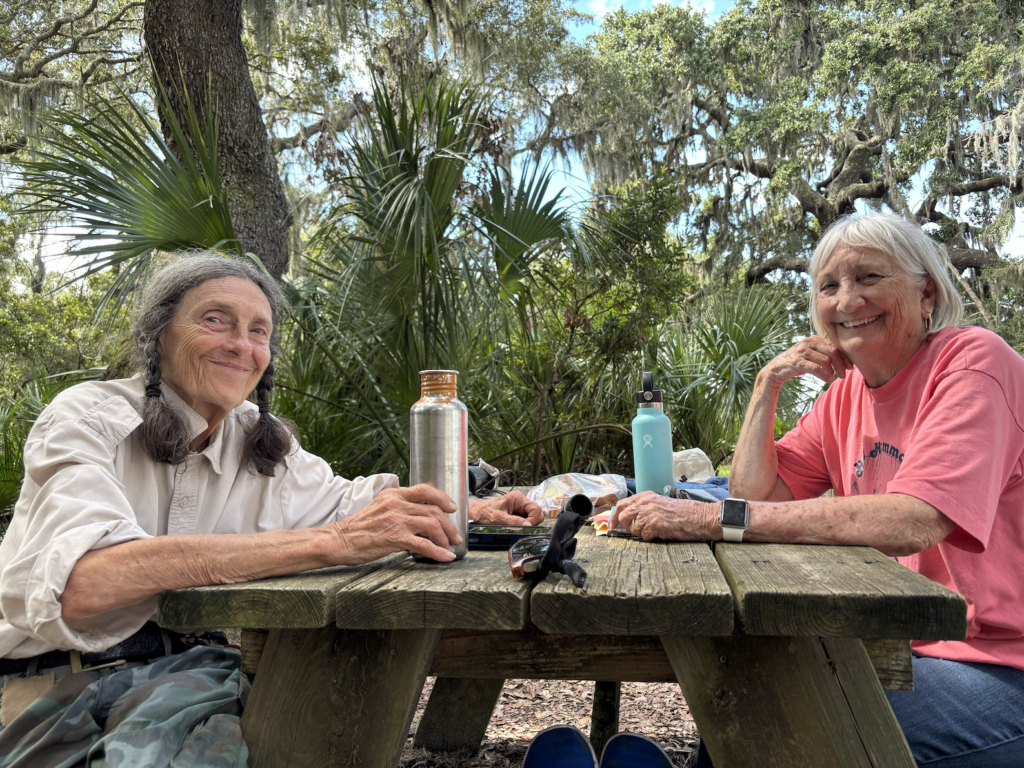
Part of Ruckdeschel’s legacy is the legion of Cumberland Island devotees whom she helped inspire, said Harlan, who wrote a biography of her more than a decade ago (“Untamed: The Wildest Woman in America and the Fight for Cumberland Island”).
After that book, he left journalism to earn a master’s degree in biology. He is now a scientist with the Center for Biological Diversity and is an advocate for preserving the island.
“Carol changed my life and I’m just one of thousands that have been inspired by her example,” Harlan said. “No one gets their hands dirty the way Carol does. She literally has buckets of dead animals macerating in her front lawn as she analyzes their skulls and gut contents. She deals in death and studies death to better understand life.”
Ruckdeschel has been in the media limelight on and off for more than half a century.
A 1973 article in The New Yorker called “Travels in Georgia” portrayed her search with Coca-Cola heir Sam Candler for wildlands worth preserving. They were working for the Georgia Natural Areas Council, and the article documented Ruckdeschel’s canoe trip down a stretch of the Chattahoochee River with Gov. Jimmy Carter. She had camped as a child there, and the river corridor was under threat of development. Five years later, Carter, an avid outdoorsman who was by then the president, would sign the law that established Chattahoochee River National Recreation Area as a unit of the National Park Service.
It was Candler who gave Ruckdeschel a perch on the island, offering to hire her as a caretaker of the family vacation home, according to Harlan’s biography.
Carter, whose family had often visited the island with the Candler family, gave an interview to the National Park Service in 1995. He said they made a game of living off the land, gathering herbs and oysters, catching mullet, sea trout and sea bass.
They would watch a sea turtle lay her eggs and then return to the island later to watch her hatchlings scrabble to sea, the transcript said.
Carter said he hoped Cumberland Island would be allowed to grow wilder over time.
“I don’t really see any need to increase the number of visitors per day,” he said.
The National Park Service has already decided to expand visitation, but the public comment period for the proposed land exchanges is ongoing. Anyone can submit comments on the proposals until Friday, Oct. 16, at https://parkplanning.nps.gov/document.cfm?parkID=371&projectID=124458&documentID=153378.