ATLANTA — Gov. Brian Kemp signed legislation into law Thursday that delays the July 1 ban on the use of QR codes in Georgia’s voting machines.
His signature postpones the prohibition until Jan. 1, 2028, giving lawmakers more time to adopt new election procedures.
Senate Bill 3EX, which passed Tuesday, the last day of the special session, removes Secretary of State Brad Raffensperger from the planning, instead putting lawmakers in charge of recommending a new voting system.
Raffensperger, a Republican who stood firm against President Donald Trump’s claims that the 2020 election was stolen, had become a target of GOP lawmakers. They blamed him for sticking with QR codes, and he blamed them for failing to select and pay for an alternative system.
The new law also mandates hand recounts of the top two statewide races on the ballot when the results are within a 0.5% margin.
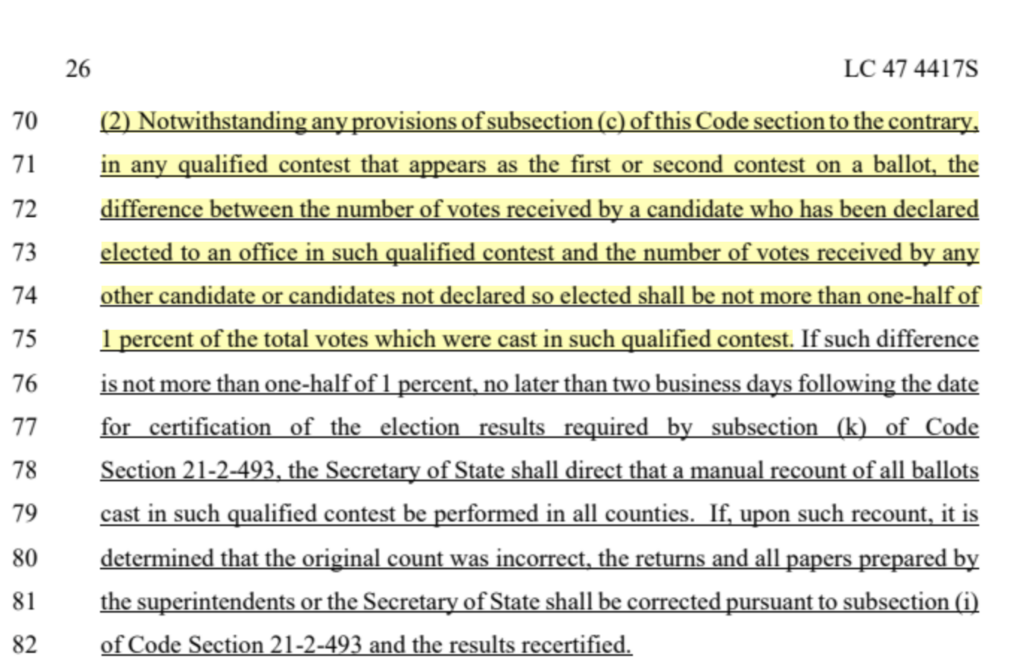
That requirement entered the bill through a late amendment. Critics contend the wording was rushed and flawed. The amendment, in describing the necessary margin for a recount, declares that the number of votes for the winner of one of those top two races “shall be not more than one-half of 1 percent of the total votes which were cast in such qualified contest.”
The Coalition for Good Governance, an organization that has long pressured the state to stop using QR codes in elections, wrote in a summary of SB 3EX that it literally “outlawed” race results with margins greater than 0.5%.
“While the drafting error will almost certainly be corrected in a future legislative session,” the group wrote, “it serves as a cautionary example of what happens when complicated election legislation is drafted, negotiated, generally behind closed doors, and passed at breakneck speed, with the public and Democrats not permitted to see bill drafts until moments before votes were taken.”
The disputed language from Senate Bill 3EX, signed into law by Gov. Brian Kemp on Thursday, June 25, two days after the Georgia General Assembly passed it during a special session.
Although Democrats largely opposed the measure, Sen. Josh McLaurin, D-Sandy Springs, voted for it, saying he trusted the Georgia Supreme Court to discern the intent of that language should a losing candidate sue.
McLaurin is the Democratic nominee for lieutenant governor. Three Senate Democrats, including Senate Minority Leader Harold Jones, II, D-Augusta, voted with him in favor of the bill.
Another 16 Democrats opposed it, including Sen. RaShaun Kemp, D-Atlanta, who said he doubted the courts would rule in favor of a Democrat, such as the party’s nominee for governor.
“What happens if Keisha Lance Bottoms comes up on top and it’s by 0.2%?” Kemp said. “I cannot support a bill that we already know has incorrect language in it.”
McLaurin alleged that his opponent for lieutenant governor, Sen. Greg Dolezal, R-Cumming, had secretly worked to sabotage the legislation on behalf of QR code opponents who believe the 2020 election was stolen from Trump. McLaurin said the final version of the bill was “a little clunky” but that it needed to pass to avoid pandemonium during the November midterms.
McLaurin said there were “election deniers in the hallway who are all saying the same thing: don’t fix the problem. … But dear God, we have to fix this problem.”
Dolezal did not stand to rebut McLaurin’s allegation about sabotage, but Senate President Pro Tem Larry Walker, III, R-Perry, did.
He said Dolezal had been an “honest broker” in support of the bill and that McLaurin’s allegation that Dolezal had tried to whip up votes against it were “patently false.”
ATLANTA — They were allegedly flying to help prisoners get high and to maybe escape, but now nine people, all but one from Macon, are behind bars themselves after federal agents arrested them in connection with delivering drugs, phones and weapons into prisons from above.
The bust, announced Wednesday, involved a “vast alleged conspiracy using drones to smuggle contraband,” according to the U.S. Department of Justice.
The nine suspects and three inmates are accused of coordinating deliveries of methamphetamine, marijuana and other controlled substances, as well as cell phones, tobacco and objects such as saw blades to be used as weapons for escape.
The eight of the accused who are from Macon are Leviticus Blash, 42; Chrystal Dunn, 37; Ira Christopher Jackson, 42; Xavier Maxwell, 30; Kenna Middleton, 45; Glenn Middleton, 70; Jeff Richardson, 23, and Tysean Richardson, 23.
The accusations were in an indictment unsealed Wednesday that described drone deliveries to 10 prisons in eight states, including two in Georgia, in Atlanta and in Jessup.
The joint announcement by the federal government included U.S. Attorney William R. “Will” Keyes for the Middle District of Georgia and William K. Marshall III, director of the Federal Bureau of Prisons.
Drones have been an ongoing problem for Georgia prisons.
During a legislative hearing at the Atlanta Capitol in December, Matthew Wolfe from the Georgia Department of Corrections said that for the year through June 2025 there were 120 inmates charged and 362 civilians arrested in connection with contraband deliveries.
The schemes sometimes involved simple methods, such as wrapping contraband with duct tape into the shape of a football and tossing it over a prison fence. But they often involved drones, said Wolfe, who displayed a photo of a confiscated unmanned aircraft that could carry hundreds of pounds.
“Civilian involvement remains the most common threat vector, with throwovers and drone drops continuing to be the primary method used to infiltrate our institutions,” Wolfe said.
Corrections Commissioner Tyrone Oliver said technology existed to stop such drones.
“We just don’t have the authority, the legal authority, to be able to do it,” Oliver told lawmakers.
The General Assembly responded by passing House Bill 1230, which takes effect Wednesday.
The new law will make it illegal to fly a drone over a prison. It will also authorize law enforcement agencies and officers who suspect drone use for criminal intent to detect, track and identify the aircraft and then intercept and disable them with jamming, hacking or other methods.
That law is for state and local authorities.
The indictment unsealed Wednesday involved a takedown by the federal government using sophisticated tracking technology.
The federal Bureau of Prisons used a drone detection system that provided alerts when drones were nearby and that reported an aircraft’s make, model and identification number, along with the launch location, flight path and altitude.
The 2026 special session of the Georgia General Assembly may be remembered more for what did not happen than for what did.
Gov. Brian Kemp called lawmakers back to the Capitol mainly to complete work they had left unfinished during their regular session last winter and spring.
They had failed to address a looming deadline of their own making: had they gone home Tuesday without addressing their own July 1 prohibition on the use of QR codes in the state’s voting machines, pandemonium would have reigned in the November midterm elections.
Georgia would have been left with no legal method for tallying votes, other than the paper ballots intended for sporadic emergencies, such as power outages.
On Tuesday, lawmakers, after creating that deadline two years ago, managed to push it back by nearly two more years.
They also checked another item off Kemp’s to-do list, retroactively approving his second gas tax suspension of the year. Kemp ordered the first one in March after lawmakers, still in session, authorized it.
But they had already gaveled out of their regular session when he declared a state of emergency to extend the suspension into June.
So the Legislature retroactively approved that second suspension on Tuesday.
They did not pass any other major policy, although they may have gathered more fodder to present to voters as they campaign ahead of November.
About an hour before the special session started last week, Republican leaders from the House and Senate announced that they would not pursue a big and controversial item: redistricting.
Kemp had put that on their agenda after the U.S. Supreme Court issued a ruling in April that weakened the 1965 Voting Rights Act’s protections against maps that dilute minority voting strength.
The proposal had already created an outcry among Democrats and civil rights groups, leading GOP lawmakers to consider the potential downsides of fueling opposition rage and Democratic turnout during the midterms.
No new sales tax
Republicans also failed to win Democratic support for Kemp’s call to consider putting a new 1% sales tax on local ballots. The referendums would have generated hundreds of millions of dollars to reduce homeowner property tax bills.
The scores of nearly identical local measures were introduced mostly by Republicans, one per city or county. They required a two-thirds vote for passage, and it became clear after the first votes last week that Democrats would oppose all of them.
Even so, after a string of defeats, Republicans kept calling up more of those bills. In the House, Rep. Chuck Efstration, R-Mulberry, moved to reconsider each of them twice, the maximum allowed.
Each vote went down more or less the same way, prompting Rep. Ruwa Romman, D-Duluth, to quip, with a chuckle, that “the definition of insanity is doing the same thing over and over again expecting different results.”
Democrats said they opposed the measures because they would have increased the cost of groceries and other daily necessities, with the revenue going to people fortunate enough to own a home.
They called it a tax increase.
Republicans supported the measures, saying that rising property taxes had made homeownership unaffordable for many.
Brookhaven, a city in metro Atlanta, had just raised its property tax rate 40%, noted Rep. Scott Hilton, R-Peachtree Corners. “By voting red, you are suppressing voters’ cherished right to vote on property tax relief,” he said.
By invoking that color, Hilton meant the “no” button on lawmakers’ desks, not the color associated with his political party.
But red incumbent lawmakers will likely be using the blue ‘no’ votes against the tax swap during their political campaigns this year.
The strategy prompted a rebuke from Rep. Angela Moore, D-Stonecrest, who complained about the cost to taxpayers of the special session.
That money would have been better spent on a state down payment assistance program, she said, “instead of wasting our time on trying to tax our constituents.”
No veto override
Yet Democrats engaged in political sport, too, calling for a vote on a matter Republicans managed to evade. GOP lawmakers in the House wanted nothing to do with a Democrat’s call to override a veto by Kemp.
During their regular session, House Bill 1192 had been a bipartisan measure, with both Efstration, the majority leader, and Rep. Carolyn Hugley, D-Columbus, the minority leader, among the top co-sponsors.
It had passed the House and Senate unanimously, driven by frustration over funding shortfalls at the Georgia Departments of Human Services and Community Health.
It mandated stricter accounting practices and annual reporting to the General Assembly, and it prohibited commingling of funds from different sources.
Kemp vetoed HB 1192, writing that it violated the separation of powers.
On Monday, Rep. Stacey Evans, D-Atlanta, moved to override the veto. But House Speaker Jon Burns, R-Newington, with the help of a Kemp ally on the House floor, used parliamentary procedure to table the motion.
Thus, Republicans avoided a difficult vote that would either have pitted them against their GOP governor or caused them to flip their position.
Later that evening, during their customary time for announcements, Evans got around the rules that limit debate by announcing that it was the anniversary of Congress’ adoption of the Pledge of Allegiance during World War II.
“And when we table motions instead of taking up issues, when we sit on our rights,” she said, “we are really spitting in the face of so many that came before us to stand for our flag.”
Meeting with reporters after the motion to table, Evans was less diplomatic, calling Republicans “spineless” for avoiding the veto vote, and saying it exemplified why voters should give Democrats a majority in the House.
The next day, the Senate unanimously approved the gas tax suspension that the House had unanimously approved on Saturday, and Republicans in both chambers voted to delay the QR code ban, mostly along party lines.
ATLANTA — Georgians should continue voting with the same machines they have been using for years until a new system can be acquired in 2028, lawmakers decided before ending their special session Tuesday.
In largely partisan votes by the state House and Senate, Republicans approved a measure that delays their previous July 1 ban on the use of QR codes to tabulate votes.
Georgia’s voting machines became a target for some after President Donald Trump lost the 2020 election. Critics contended the system was vulnerable to hacking and error, and they noted that voters cannot read the QR code on their ballot to confirm it accurately recorded their intent.
After voting two years ago to ban the system, GOP lawmakers failed to adopt or pay for an alternative. They blamed fellow Republican Secretary of State Brad Raffensperger, who pointed back at them.
With the November midterms approaching, local election directors were saying it was far too late to switch to a new system. And that was back in the winter and spring, when the General Assembly was considering postponing the July 1 deadline during its regular session.
Lawmakers failed to pass a bill that would have done that, so Gov. Brian Kemp called them back to the Capitol to resolve the crisis.
If Kemp signs Senate Bill 3EX, it will delay the deadline to replace the system until Jan. 1, 2028.
It would also establish a committee of lawmakers to recommend standards for the next voting system based on hand-marked paper ballots. And it would require a hand recount of top-of-the-ballot races with tiny margins.
An earlier version produced by the Senate would have required hand recounts of the two top races in each cycle, including for U.S. president and U.S. Senate.
Critics derided that proposal, saying hand counts are inaccurate and time-consuming and that manual tallies that conflicted with machine tallies would further erode confidence in elections.
“Please do not subject Georgia to this,” Kristin Nabers, the Georgia director of the group All Voting is Local, said at a House committee hearing Monday.
Members of that committee, both Republicans and Democrats, were dubious about the hand count provision, as well.
So, leaders of the House and Senate met Monday night to negotiate a compromise.
The version of SB 3EX the Legislature sent to Kemp would require hand recounts in most statewide races only when the margin is within 0.5%.
“So it’s very narrowly defined,” Rep. Victor Anderson, R-Cornelia, the chairman of the committee that reviewed SB 3EX, said on the House floor Tuesday.
The organization that represents election officials was satisfied by the change.
But those who do not trust the state’s current voting machines were not happy that the requirement for manual recounts would not extend to federal races and that QR codes would still be used in November.
“I think there’s going to be dissatisfaction in the fact that we are still on the QR codes for the 2026 election,” said Garland Favorito, cofounder of VoterGA, a group that has been pushing to eradicate the digital codes from the voting process.
Many Democrats rejected the premise of a flawed election system, calling the special session a waste of time and taxpayer money.
“You just cannot build a healthy democracy by catering to people who will just never accept the results of an election if it does not favor them,” Rep. Jasmine Clark, D-Lilburn, said on the House floor before voting against SB 3EX.
But her GOP colleague, Rep. Rob Leverett, R-Elberton, noted the fast-approaching July 1 deadline for eradicating QR codes. If the General Assembly failed to pass the measure, he said, “then we may be hand-counting ballots in 159 counties in the state of Georgia. That is a high probability.”
In the Senate, only four Democrats voted for the measure, including Sen. Josh McLaurin, D-Sandy Springs, his party’s nominee for lieutenant governor.
His opponent, Sen. Greg Dolezal, R-Cumming, voted for passage along with all the other Republicans present.
If Kemp signs SB 3EX, and the tally in their election is within 0.5%, they will automatically get a hand recount.
ATLANTA — Democrats in the Legislature on Monday closed the door on Republican proposals to implement new local sales taxes to offset homeowner property tax bills.
On the fourth day of their special session, Republicans got a redo of a vote Saturday that nixed the tax swap.
Republicans have a majority in the House and Senate, but the sales tax legislation required a two-thirds majority for passage, which would have put the question to voters in local referendums.
The House handled scores of local bills together in one vote. The Senate voted on several similar bills of its own with the same result.
House Speaker Jon Burns, R-Newington, said the failure to pass the bills on a motion to reconsider meant the legislation would not be brought up again and was dead for this session.
Gov. Brian Kemp called lawmakers to the Capitol to address the sales tax issue and to consider redistricting, ratification of a previous gas tax suspension and resolution of a pending deadline that will make Georgia’s current voting machines illegal effective July 1.
Republican lawmakers said as the special session was starting last week that they would not be redistricting. The latter two issues — the gas tax and the voting machines — remained unresolved as of Monday evening.
ATLANTA — Georgia radio host and state school board member Martha Zoller died Monday, House Speaker Jon Burns, R-Newington, said in a speech on the House floor.
“We lost a great Georgian today: Someone who was a great conservative, but she was also a friend to all Georgians,” Burns said Monday afternoon during the Legislature’s special session.
Burns said she had suffered from heart conditions.
The Atlanta Journal-Constitution reported last week that Zoller was leaving her daily talk show on Gainesville news/talk station 102.9/550 WDUN on June 26 due to what she described as a “stress-related heart attack.”
Zoller appeared on various national broadcasts and also made a name in politics, running for Congress in 2012.
She lost the Republican primary runoff for U.S. House that year to Doug Collins in northeast Georgia, a seat now held by Rep. Andrew Clyde, also a Republican.
In 2019, Gov. Brian Kemp, a Republican, appointed Zoller to a three-year term on the State Board of Nursing Home Administrators. The next year, Kemp appointed Zoller to the state Board of Education, a position she still held Monday.
She earned respect across party lines.
“Martha was a respected stalwart of Georgia’s civic community, an accomplished broadcaster, and a formidable activist,” U.S. Sen. Jon Ossoff said in a statement Monday.
Burns said Zoller was a direct but kind, straightforward and trustworthy interviewer on her radio show.
“Georgia has lost a leader in the communications business and the business of life,” he said.