ATLANTA — The Georgia Senate passed a measure Saturday that would delay a prohibition on the use of QR codes to tally votes until 2028 and also require hand-counting of the two top races on ballots.
Democrats opposed the measure, in part because they would not have an automatic seat at the table on the committee that will set the standards for new voting machines.
The current machines, which rely on QR-code tallies, will become illegal July 1 under a law passed by the Legislature two years ago.
In the meantime, lawmakers failed to adopt or pay for an alternative system, creating an emergency that led Gov. Brian Kemp to call them back to the Capitol for a special session.
Senate Bill 3EX passed the Senate 33-19, after Sen. Jason Anavitarte, R-Dallas, the majority leader, said, “We’re going to continue to stand with the citizens of Georgia, every citizen, no matter where they’re from, no matter what their walk of life is, no matter their view of election integrity or otherwise.”
Lawmakers had approved removing QR codes from Georgia’s election procedures after backlash following President Donald Trump’s loss in the 2020 election and mistrust among some in the way the state conducts elections.
“They are grappling with the reality that they are going to be forced to toe the MAGA line on elections for the rest of time,” Sen. Josh McLaurin, D-Sandy Springs, the Democratic nominee for lieutenant governor, said of his GOP colleagues after the vote. “They’re going to litigate this 2020 election over and over again.”
The bill would establish a nine-member legislative committee to set the specifications, standards and requirements for a new voting system. Members would be appointed by the governor and by legislative leaders, currently all Republicans.
Democrats wanted their own appointments, though Republicans noted that GOP leadership has traditionally appointed Democrats to such study committees.
On the Senate floor Saturday, Republicans added an amendment that would require hand counts of votes in the two races atop a ballot before official certification of the results.
That would require a hand count of presidential and gubernatorial elections, which do not occur in the same cycle, plus another race, usually for U.S. Senate.
Garland Favorito, a vocal critic of Georgia’s digital voting process, said the hand-count mandate would be a first in the state’s history of electronic voting.
“It’s not a perfect solution,” said the co-founder of VoterGA, “but it’s a step in the right direction.”
ATLANTA — For a second time this year, Democrats in the Georgia House rejected a Republican plan to reduce homeowner property tax bills.
The Democrats’ argument was unchanged from their refusal to support a similar GOP tax plan earlier this year: a sales tax to subsidize homeowner property tax bills would have raised prices on everyone for everyday necessities, from baby formula to school supplies.
“The no-vote today is a vote for no new taxes,” said Rep. Tanya Miller, D-Atlanta, on Saturday, the third day of a special session. She called the Republican proposal, which would have let 67 communities put a 1% sales tax on the ballot, a “bait and switch.”
Republicans contended that fast-rising property tax bills have become unaffordable and that their approach would have helped.
A penny-on-the-dollar sales tax would have saved homeowners in Gwinnett County $250 million and homeowners in Forsyth County at least $60 million, said Rep. Shaw Blackmon, R-Bonaire, chairman of the House Ways and Means Committee.
It is “the kind of relief that could have helped some residents stay in the homes they own,” he said.
Blackmon was in charge of crafting the chamber’s approach to affordability during an election year when the issue is a top concern.
During the regular session, he had proposed House Resolution 1114, which would have put a constitutional amendment on the ballot statewide asking voters if they wanted to pay more in sales tax so homeowners could pay less in property tax.
Republicans have a majority in the House and Senate, but constitutional amendments require a two-thirds majority. Democrats rejected HR 1114.
Then, in the waning hours of that regular session, the Senate devised Senate Bill 33, which splintered the same idea into local votes by each community. The bill passed because it did not require a two-thirds majority, and Gov. Brian Kemp signed it into law in May.
Kemp then called lawmakers back to the Capitol to deal with lingering election issues and added the local sales tax question to their agenda.
The catch: although SB 33 did not require a two-thirds majority, each local bill it authorized did. Democrats remained opposed on Saturday when local legislative delegations brought their measures to a vote as a package in the House.
There were only three such measures in the Senate, and Democrats there denied each one a two-thirds majority, as well.
The sales taxes would have driven up costs for shoppers, Senate Minority Whip Kim Jackson, D-Stone Mountain, said after the vote. “Whereas only those who are lucky enough to afford a house will see any relief,” she said.
Republicans had pointed out that tourists pay sales taxes too. They did not point out, however, that the revenue would have subsidized only the local government portion of the tax bill and not the school portion, which is typically the largest share.
The disagreement promises to be a potent election year issue.
Democrats will argue that the scheme was illegal from the start.
Miller, one of the Democrats who spoke against the measure in the House, is her party’s nominee for state attorney general. She argued after the vote that as a product of the Senate, SB 33 was unconstitutional because tax legislation must originate in the House.
But Republicans contended that Kemp signed it, so it’s legal. And Rep. Scott Hilton, R-Peachtree Corners, said the Democratic Party “deep down knows” the sales taxes would have been popular among voters if the measures had appeared on their ballots.
“But voters are being denied that chance right now. Denied the chance to have a more affordable life, to be able to afford their home, to stay in their homes,” he said. “Today, Democrats have denied that chance.”
ATLANTA — The federal government has halted plans to convert a warehouse into a massive immigration detention center that would have overwhelmed services in the tiny town of Social Circle.
The city of about 5,500 east of Atlanta announced the decision by the Department of Homeland Security on Thursday evening, attributing the information to multiple agency sources and to U.S. Rep. Mike Collins, a Republican who represents the area.
Collins’ office did not immediately respond to queries seeking confirmation. But U.S. Immigration and Customs Enforcement (ICE) media representatives offered an indirect response to an email query by Capitol Beat, saying Homeland Security “is moving swiftly to utilize EXISTING detention space with our state and county partners.”
ICE is under new leadership after Todd Lyons stepped down in May as acting director.
The agency, now led by David Venturella, said in its response that “heinous criminals, once arrested, should be removed at lightning speed, not housed on American soil at the taxpayer’s expense.”
Collins is running for U.S. Senate, aiming to unseat Democratic U.S. Sen. Jon Ossoff in November. Collins is endorsed by President Donald Trump, who made immigration enforcement a cornerstone of his policy — a policy that Collins supports.
Both Ossoff and fellow Democratic U.S. Sen. Raphael Warnock heralded the policy reversal in Social Circle, attributing it to their own efforts as part of a public pressure campaign.
“Officials in the Trump administration got nervous because the people stood up and began to speak out,” Warnock said in a call with reporters on Friday.
The 1 million-square-foot facility would have held as many as 10,000 detainees, tripling the population of Social Circle.
That would have overwhelmed local water and sewer systems, according to an engineering analysis for the city. The analysis estimated that an infrastructure expansion capable of serving the facility would have cost $44 million and taken more than two years to build.
In the meantime, the federal government planned to truck in water and haul out the byproducts of wastewater treatment, according to a March 24 letter that Warnock and Ossoff sent to the leaders of Homeland Security and ICE. This would have increased local traffic and damaged the roads, the senators wrote.
Their letter also raised safety concerns for the city with 15 patrol officers. The ICE warehouse is less than 1,000 feet from a subdivision and within a mile of an elementary school.
The federal government bought the warehouse for more than $128.5 million, The Covington News reported in February.
Warnock said the amount was twice the market value, labeling the purchase “waste, fraud and abuse.”
ICE said the agency paid fair market value after preparing an appraisal that it said was independently reviewed.
Social Circle said in its announcement that it was unclear whether the government would sell the property or transfer it to a different agency.
The federal government does not pay property taxes, so the purchase was a blow to Social Circle’s finances.
“The City is hopeful that the property will ultimately return to the local tax base and once again contribute to the economic vitality and long-term success of the Social Circle community,” the city’s announcement said.
ICE did not answer Capitol Beat’s question about that issue.
Social Circle thanked Collins, Ossoff and Warnock in its announcement, crediting them for intervening with the Trump administration.
ATLANTA — Georgia lawmakers advanced a bill on Thursday that would pause the mandatory voting machine changes they previously required for this year.
The legislators, at the Capitol for the second day of a special session, also continued to line up more than 80 local bills aimed at reducing homeowner property taxes in communities across the state.
The election measure was one reason Gov. Brian Kemp first called lawmakers back to Atlanta for the special session, but in early June he added the property tax subsidies to their agenda.
The Senate Rules Committee quickly approved Senate Bill 3EX after it got a nod from the Senate Ethics Committee earlier in the day. The two votes set the election procedures measure up for a Senate floor vote.
“I think we have a bill here that addresses the reason that we are here,” Senate Ethics Committee Chairman Sam Watson, R-Moultrie, said before Sen. Max Burns, R-Sylvania, outlined the details of SB 3EX.
Burns’ bill is needed because the Legislature previously banned the use of QR codes to tally votes. That mandate, approved two years ago, will take effect July 1, absent legislative intervention.
The current voting machines use those digital codes, which led to the pending ban. Lawmakers had approved removing them from election procedures after backlash following President Donald Trump’s loss in the 2020 election and mistrust among some in Georgia of the state’s voting system.
But in the intervening two years, the Legislature failed to approve or pay for an alternative voting platform. Now, election officials say there is too little time to implement one ahead of the November general election, let alone the special election in July to fill the seat of Rep. David Scott, who died in late April.
Lawmakers had considered delaying their QR code prohibition, but they finished their regular session in early April without approving a measure to do so.
SB 3EX would push the effective date to January 2028. It also would establish a nine-member legislative committee to set the specifications, standards and requirements for a new system. Members would be appointed by the governor and by legislative leaders, currently all Republicans.
It also would require audits of the results in more statewide elections than is customary now.
Also at the Capitol this week, lawmakers began introducing legislation that would reduce property tax bills for homeowners.
The measures were authorized by Senate Bill 33 from the regular session. That law capped increases in the taxable value of owner-occupied homes at the rate of inflation. It also allowed local legislative delegations to seek a 1% Local Homestead Option Sales Tax for their communities, with the proceeds used to subsidize the taxes due for homesteaded properties.
If lawmakers approve the legislation, the penny sales taxes would appear as referendums on the November ballots of voters in those communities.
The measures must go through an extended review process under the Gold Dome. The House clerk must read each of them twice on the floor, then an assigned committee must approve them. Then the Rules Committee must tee them up for a vote on the floor and they must get another reading.
From there, any approved bills would go to the Senate for a similar review.
All this must happen before lawmakers gavel out for the final time. So far, they have scheduled legislative days only on Saturday and Monday, but they can add more.
The House clerk gave a second reading to 67 of these tax bills on Thursday after they were introduced on Wednesday. Another half-dozen such bills from Wednesday got a first read, and at least eight more were introduced Thursday.
House delegations seeking the new sales tax were from communities as tiny as the city of Jakin in South Georgia and as large as Gwinnett County in metro Atlanta.
They were from Toccoa in the foothills of the Blue Ridge Mountains to Brunswick and Glynn County along the Atlantic coast.
The Senate also introduced two of its own such sales tax bills, for Brunswick and Glynn County.
ATLANTA — Republican lawmakers in Georgia will not redraw election maps as suggested by Gov. Brian Kemp, leaders of the House and Senate said Wednesday afternoon, less than an hour before gaveling in for their special session.
House Speaker Jon Burns, R-Newington, and Senate President Pro Tem Larry Walker III, R-Perry, both cited ongoing litigation over Georgia’s maps, saying it was too soon to consider new ones.
“We knew it was not the right time for our state,” Burns said.
Kemp put the issue on the table earlier this month with a revised proclamation for a special session. He had originally called lawmakers back to the Capitol to address their July 1 ban on using QR codes to tally votes. It is an urgent matter given the special election scheduled for July to fill the unexpired term of U.S. Rep. David Scott, a Democrat who died in April.
When lawmakers met for their regular session earlier this year, they failed to adopt or fund an alternate method of voting.
Then, on June 3, Kemp issued a revised proclamation asking lawmakers to also consider redrawing election maps. His request cited the U.S. Supreme Court ruling in April that weakened the 1965 Voting Rights Act’s protections against maps that dilute minority voting strength.
Republicans in some other states quickly redrew district lines after the Supreme Court ruling, prompting protests.
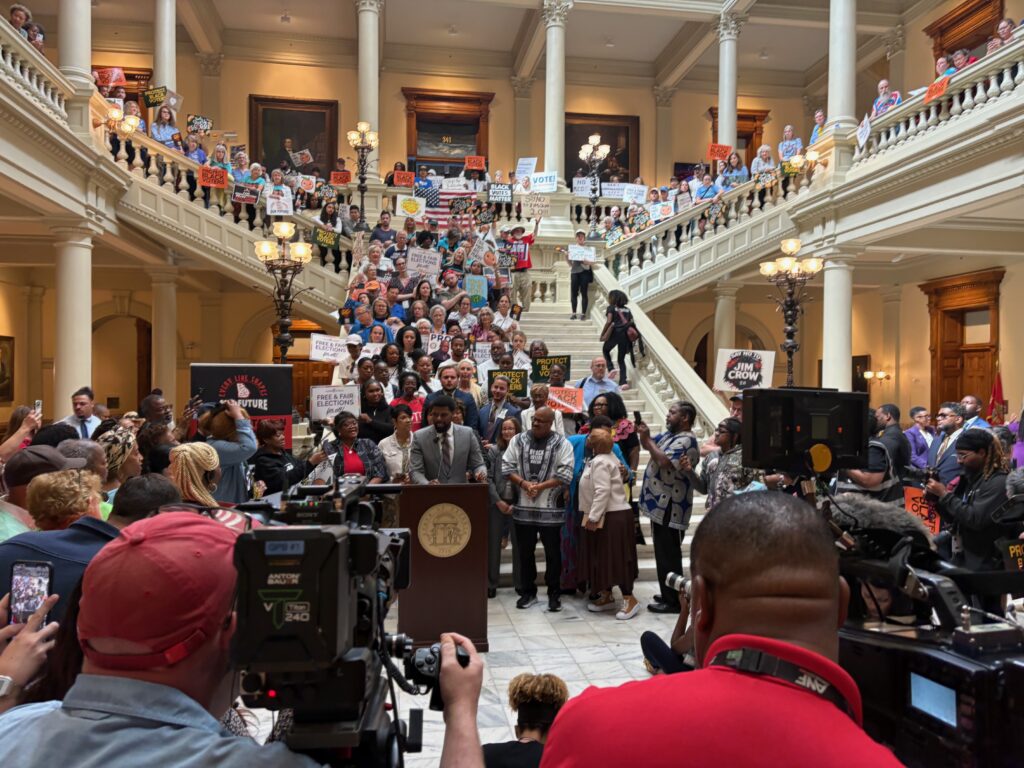
And protesters filled Georgia’s Gold Dome Wednesday, saying Republicans were seeking to cling to power by marginalizing Black voters.
Protesters at the Georgia Capitol on Wednesday, June 17, 2026, opposed redrawing election maps.
Democrats capitalized on their anger, holding a news conference at the Capitol ahead of the Republicans.
Charlie Bailey, chair of the Democratic Party of Georgia, predicted the GOP would suffer a backlash in the November general election if they proceeded.
“If they want to tell the people of Georgia their votes don’t matter as much as their own political power, go ahead and make that bet and see what happens come this November,” Bailey said.
Walker said the Senate had notified Kemp Wednesday morning that the chamber would not be redrawing maps during the special session. Since new maps would not take effect until 2028, Walker said lawmakers should take their time to reconsider them.
Burns tried to close out the news conference, but his voice was drowned out by protesters chanting “Black votes matter.”
ATLANTA — Two current state senators defeated two former state senators in the Georgia runoff for lieutenant governor Tuesday, with Sens. Greg Dolezal, R-Cumming, and Josh McLaurin, D-Sandy Springs, set to face each other in the November general election.
Dolezal defeated John F. Kennedy of Macon, who resigned from the Senate in December to focus on his campaign for the GOP nomination. McLaurin defeated Nabilah Parkes of Gwinnett County, who resigned from the Senate for the same reason in March.
Dolezal campaigned as an ardent supporter of President Donald Trump, noting he was among a handful of senators who called for a special legislative session to investigate Trump’s 2020 election loss to Joe Biden.
McLaurin campaigned as a foil of Trump loyalists and as a skilled legislator, saying he could work effectively across party lines while ridiculing his Republican colleagues for their support of the president.
Whoever wins in November will lead the state Senate and fill in for the governor when necessary.
Voters in both parties also chose nominees for secretary of state.
Republicans picked state Rep. Tim Fleming, R-Covington, over Vernon Jones, a former Democratic lawmaker and DeKalb County CEO who switched parties. Fleming won with nearly two-thirds of the vote.
Democrats chose former Fulton County State Court Judge Penny Brown Reynolds over Fulton County Commissioner Dana Barrett by a similarly wide margin.
The winner of the general election will oversee elections and business registrations and licensing.
Engineer Josh Tolbert defeated businessman Bobby Mehan in the Republican runoff for Public Service Commission District 5, another statewide race. Tolbert campaigned on technical expertise, saying his engineering background would help the five-member commission rein in electricity costs.
In November, Tolbert, of Bremen, will face Democrat Shelia Edwards of Cobb County, who won her party’s primary outright in May.
Democrats also chose nominees for two statewide commissioner posts.
Nikki Porcher defeated Michelle Michi Sanchez for labor commissioner and will challenge Republican incumbent Bárbara Rivera Holmes in the general election.
Democrats also chose Keisha Sean Waites over DeAndre Mathis to challenge Republican John King for insurance commissioner.
The last statewide race on the ballot was close as Fred “Bubba” Longgrear tried to deny incumbent Richard Woods the Republican nomination for state school superintendent.
Woods held a narrow lead in his effort to advance to the general election and defend his seat against Democratic challenger Lydia Powell.