ATLANTA – Religious
organizations and other opponents of legalized gambling dominated a Georgia Senate
committee hearing Wednesday on legislation to let voters decide whether to
bring pari-mutuel betting on horse racing to the state.
For seven
years, Sen. Brandon Beach, R-Alpharetta, has been the driving force behind a proposed
constitutional amendment legalizing horse racing.
An
underlying “enabling” bill accompanying the constitutional change calls for the construction of up three
racetracks in Georgia that would be part of mixed-use developments. One track
in metro Atlanta would require a minimum investment of $250 million, while two
tracks outside the metro region would require at least $125 million.
Beach has
consistently pitched legalizing horse racing in Georgia as a way to boost the
economies of rural communities by creating a job-creating equine industry with
breeding and hay farms.
“If you want
to have a breeding industry, it’s essential you have a racetrack,” Beach told
members of the Senate’s Economic Development and Tourism Committee. “We have no
incentives to breed horses here.”
But opponents
said racetracks would inevitably lead to casinos, which would increase crime
and foster gambling addictions.
“The nose of
the camel’s under the tent,” said Paul Smith of Citizen Impact, an organization
that promotes Christian schools in Georgia. “Once the constitution is changed,
it will make it that much easier to bring casinos into this state.”
Other
opponents said horse racing has declined enough in popularity across the
country that some states have been forced to subsidize the industry with taxpayer
dollars.
But Beach
said his bill would not provide any tax credits to incentivize racetrack
developers to come to Georgia, nor would the state subsidize any Georgia
tracks, even if they struggle financially.
“It’s their
private dollars,” he said. “If they don’t make it, they don’t make it.”
Beach also
noted his bill does not include casinos. However, a constitutional amendment calling
for a statewide referendum to legalize horse racing, casinos and sports betting
in Georgia is expected to be introduced soon in the state House of
Representatives.
The Senate committee
did not vote on the horse racing bill Wednesday and did not schedule a future
vote.
Senate
Majority Leader Mike Dugan, a member of the committee, said he doesn’t believe
there’s enough support in the Senate to muster the two-thirds majority needed
to pass a constitutional amendment.
Dugan,
R-Carrollton, said he’s not convinced legalized gambling would be a huge generator
of tax dollars.
“I would
prefer we not go with the assumption that gambling is a revenue stream for the
state,” he said.
ATLANTA – Legislation
supporters say updates a 1980s state law aimed at protecting farmers from
nuisance lawsuits is running into opposition from environmental groups.
The Georgia
Right to Farm Act of 2020, now before the state Senate, would make it more
difficult for property owners living in areas zoned for agriculture to sue
nearby agricultural operations such as poultry houses or cattle ranches for
offensive smells or runoff from sludge lagoons.
In order to
sue, property owners would have to be located within five miles of the source
of the alleged nuisance. The bill also would require lawsuits to be brought
within two years after a nuisance occurs, compared to four years in the current
law.
Supporters
told members of the Senate Agriculture and Consumer Affairs Committee Tuesday farmers
need more protection against nuisance lawsuits as Georgia’s growing population
brings more people who don’t farm for a living into closer proximity to agricultural
operations.
“Agribusiness
often comes with smells, sights, and dust,” said Will Bentley, president of the
Georgia Agribusiness Council. “We have to decide whether to protect the state’s
No.-1 industry.”
But
opponents said the current Right to Farm Act has worked in the more than 30
years it’s been on the books.
“We’re
trying to fix a problem that I don’t think really exists,” said Damon Mullis,
executive director of the Savannah-based environmental group Ogeechee
Riverkeeper.
Sen. Zahra
Karinshak, D-Duluth, said the proposed changes to the law would make existing
owners of farm properties more vulnerable to large agricultural polluters that
move into their neighborhoods. She questioned the need to change the law when
there’s no data showing whether there has been an outbreak of nuisance lawsuits
in Georgia.
Jody
Sullivan, who owns four poultry houses in Gordon County, told the committee he
has fallen victim to nuisance suits. He said he has spent thousands of dollars
defending himself from several suits filed by non-farming neighbors after he
began raising chickens in 2015.
“It’s
getting hard for us to keep going,” Sullivan said.
Sen. Tyler
Harper, R-Ocilla, said farmers in other states are being hit with lawsuits, and
lawmakers have responded with legislation giving farmers greater legal
protections.
“If one
lawsuit is successful [in Georgia], it would open up the floodgates for a
multitude of lawsuits,” he said.
The
committee could vote on the bill as early as next week.
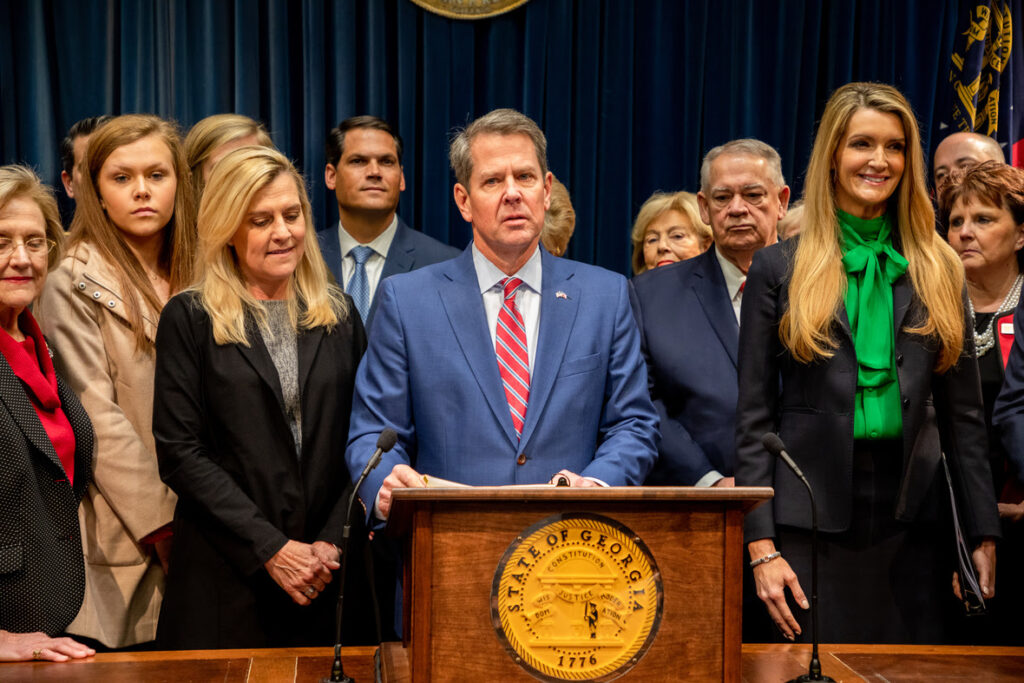
Gov. Brian Kemp appointed Kelly Loeffler (right) to the U.S. Senate last month.
ATLANTA – A Georgia
House subcommittee approved an elections bill Monday that could put Speaker
David Ralston on a collision course with Gov. Brian Kemp.
The legislation
would do away with the so-called “jungle primary” U.S. Sen. Kelly Loeffler,
R-Ga., otherwise would face in a November special election to retain the seat
held by former Sen. Johnny Isakson. Kemp appointed the Atlanta businesswoman to
the Senate last month when Isakson retired due to health problems.
Unless the law is
changed, Loeffler and every other candidate wishing to run for the Senate seat
– Republicans and Democrats – would face off on the same ballot in November. If
no candidate in the likely crowded field receives more than 50% of the vote, a
runoff would be held early next January.
But on Monday, the
Elections Subcommittee of the House Governmental Affairs Committee voted 8-2 to
scrap the jungle primary and treat Loeffler the same as fellow U.S. Sen. David
Perdue, R-Ga., who is seeking re-election to a second term. Under the legislation,
party primaries for both Senate seats would be held in May, and the Republican
and Democratic nominees would face off in November.
Getting rid of the
jungle primary would protect the two-party system in Georgia, said Rep. Shaw
Blackmon, R-Bonaire, the Governmental Affairs Committee’s chairman.
“It benefits the
party process, which is an integral part of our elections process,” he said.
But Rep. Scot
Turner, R-Holly Springs, who voted against the bill, said the measure was
prompted by Ralston’s opposition to Kemp’s appointment of Loeffler. U.S. Rep.
Doug Collins, R-Gainesville, a former member of the Georgia House with close
ties to House leadership, has talked about challenging Loeffler.
“I get really
hesitant when we try to change the law around here because of one person’s
opinion,” Turner said.
Ralston, R-Blue
Ridge, issued a statement defending the bill.
“It stands to
reason that the electoral process for this special election can mirror that of
other offices,” he said. “The underlying principle of this legislation is a
fair, comparable playing field for all those seeking elected office. Surely,
that is something we can all agree on.”
Democrats on the
subcommittee joined Republican leaders in supporting the legislation.
House Minority
Leader Robert Trammell, D-Luthersville, said eliminating the jungle primary
would make the special election less confusing for voters.
“Anytime you have a
general election with one candidate for each party, it provides voters with a
clear opportunity to evaluate the candidates and a clear contrast between the
candidates,” he said.
Rep. Barry Fleming,
R-Harlem, who also voted against the legislation, said he doesn’t oppose
eliminating the jungle primary. However, he said he would have preferred the
issue be taken up in a separate bill.
The jungle primary
provision was added to an underlying bill sponsored by Fleming that dealt with
other election issues.
The legislation now
heads to full House Governmental Affairs Committee.
ATLANTA – Legislation
aimed at increasing the number of in-state students admitted to the University
System of Georgia’s top-tier schools is being introduced in the state Senate.
The bill, sponsored
by Sen. Brandon Beach, would require the university system to make sure at
least 90% of early-action admissions to the University of Georgia, Georgia
Tech, Georgia State University and Augusta University are offered to in-state
students.
“In my eight
years in the Senate, the most calls I get are from parents who say, ‘Can you
help my daughter or son get in Georgia or Georgia Tech?’ ” said Beach,
R-Alpharetta. “I want to take care of our parents, who are hardworking
taxpayers, and our students.”
Since the
advent of the popular HOPE Scholarships program during the 1990s, students have
had a harder time getting into the state’s top public universities.
With growing
demand for admission, colleges have been setting higher standards for incoming
students. It’s not uncommon for high school students carrying a 4.0 grade-point
average or better with high standardized test scores to be denied admission.
“They end up
going to Alabama, Auburn or Clemson,” Beach said.
Beach said
students who attend college out of state often stay there to pursue their
careers, and Georgia loses the benefit of their skills and economic
contributions to the state.
“We’re
losing too many kids,” he said.
At the same
time, Beach said, slots at Georgia’s top-tier schools are going increasingly to
high-achieving out-of-state students.
Senate Bill
282 likely will be assigned to the Senate Higher Education Committee next week
when lawmakers go back into session following a week of budget hearings.
Lance
Wallace, a spokesman for the university system, said the agency does not
comment on pending legislation.
ATLANTA – Georgia set another
record last month with an unemployment rate of 3.2%, down from 3.7% in December
2018, state Commissioner of Labor Mark Butler reported Thursday.
The state hit record low unemployment
for the second month in a row after tying the mark in October.
Those results helped Georgia
close out 2019 on a strong note with an all-time high of 4.65 million jobs. The
state added just fewer than 70,000 jobs during the last 12 months, including
4,000 in December.
“It’s kind of hard to have any
better year than Georgia had,” Butler said. “Georgia’s done a great job
bringing in new business and helping our local businesses around the state grow
jobs.”
Some job sectors were particularly strong last year. The state
added 25,400 jobs in the education and health services sector, 16,600 in
leisure and hospitality, and 10,400 in trade, transportation and utilities.
Georgia’s labor force continued
to grow but struggled to keep pace with job creation and employment numbers.
“We do need our labor force to expand at a faster pace,” Butler said. “Right
now, we are growing jobs three times as fast.”
The labor force grew by just fewer
than18,000 over the past 12 months to reach a record 5.13 million.
With such low unemployment and growth
in the labor force trailing job creation, State Economist Jeffrey Dorfman said
this week the only way Georgia can continue its healthy economic growth is by
attracting more companies from out of state.