ATLANTA – Kennesaw
State University is the latest University System of Georgia institution to
offer a master’s degree in the fast-growing field of cybersecurity.
The
university system’s Board of Regents voted Tuesday to launch a 30-hour master
of science program with a major in cybersecurity at Kennesaw State.
Georgia is a
hotbed in the cybersecurity industry, ranking third in the nation with more
than 115 companies involved in information security generating more than $4.7
billion in annual revenue. Nationally, the U.S. Bureau of Labor Statistics
forecasts a 31.6% increase for information security analysts, far exceeding the
average growth rate for all occupations of about 3.9%.
In
determining whether to start the master’s program, officials at Kennesaw State conducted
a survey of more than 250 industry executives, students and alumni. More than
96% of the students and alumni who responded supported the idea, while more
than 70% indicated an interest in enrolling if the program were offered.
Taking
notice of the growing interest in cybersecurity, several University System of
Georgia institutions have begun similar programs during the last several years.
Georgia Tech and Columbus State University now offer master’s degrees in
cybersecurity, Augusta University has a master’s program in information
security management and master’s degrees in information technology are available
at Georgia Southern University and Middle Georgia State University.
“Cybersecurity
is a large umbrella label for a lot of different specialized degrees,” said
Tristan Denley, the system’s executive vice chancellor of academic affairs. “I
expect we will see both undergraduate and graduate programs grow and flourish.”
Specifically,
students in the new program will learn how to prepare for, respond to and
recover from cybersecurity threats and incidents, manage cybersecurity risk,
lead companies’ cyber operations and learn how to apply the right tools and
strategies to solve real-world problems.
There also
will be a nine-hour foundation pathway for students entering the master’s
program who did not major in fields related to cybersecurity as undergraduates.
Since many
of the program’s enrollees likely will be non-traditional students holding down
jobs, it could take up to two and a half years to complete the degree.
Kennesaw
State will not need additional space or resources to run the program. Tuition will
be set at KSU’s current graduate rate.
ATLANTA – Georgia
tax collections were up 4.5% last month compared to January of last year,
welcome news for state lawmakers trying to come to grips with budget cuts ordered
by Gov. Brian Kemp.
The state
Department of Revenue brought in nearly $2.36 billion in taxes in January, an
increase of $100.8 million over the same month in 2019.
However, the
news wasn’t as positive when it comes to year-to-date tax revenues. During the
first seven months of fiscal 2020, the state collected $14.21 billion, just
0.9% above the same period the year before.
That’s not
nearly enough to keep up with projected revenue growth. With tax revenues
sluggish during most of 2019, Kemp instructed state agencies last August to
reduce spending by 4% during the current fiscal year and 6% in fiscal 2021,
which begins July 1.
The
challenge of making those cuts while preserving vital state programs and
services prompted House Speaker David Ralston to call time out on the 2020
legislative session last week. Members of the House Appropriations Committee
are using the break to take a deeper dive into the governor’s spending proposals
for the various departments.
Individual
income taxes last month nearly mirrored the overall results, increasing by 4.3%
over January of last year. Net sales tax receipts were up by 4.6%, while
corporate income tax collections rose 28.2%, an increase in tax payments
exceeding a rise in refunds.
The Savannah Harbor Deepening project is well past the halfway mark. Photo by Georgia Ports Authority
ATLANTA – The
$4.8 trillion federal budget President Donald Trump submitted to Congress
Monday includes $93.6 million to keep the Savannah Harbor deepening project on
track for completion.
If Congress
appropriates the money, fiscal 2021 would become the fourth year in a row the $1
billion project receives its full complement of federal funding.
“President
Trump continues to make Georgia’s infrastructure projects a top priority,” said
U.S. Sen. David Perdue, R-Ga. “After 20 years of attempts to deepen the port
five feet to accommodate the larger Post Panamax ships, the Trump
administration has [the harbor deepening project] on track for completion.”
“Georgia’s
ports are the lifeblood of our local economies, supporting tens of thousands of
jobs across the state and ensuring that our hometown products have access to
global markets,” added Sen. Kelly Loeffler, R-Ga. “With the inclusion of [this]
critical funding … we are closer than ever to delivering this project and all
its benefits to Georgia and the entire nation.”
The state of
Georgia put in a major portion of the early funding of the harbor project, contributing
the state’s full share of $266 million by 2014, while federal funding of the
project lagged. The feds started putting up more money after the state’s congressional
delegation called on Trump in December 2017 to include the project in his
fiscal 2019 budget request.
“The project
is now well past the halfway mark thanks to continued support by the administration
and the Georgia congressional delegation to see this critical national
infrastructure project through to completion,” said Griff Lynch, executive
director of the Georgia Ports Authority. “Due to this collective effort,
dredging should be completed by the end of next year.”
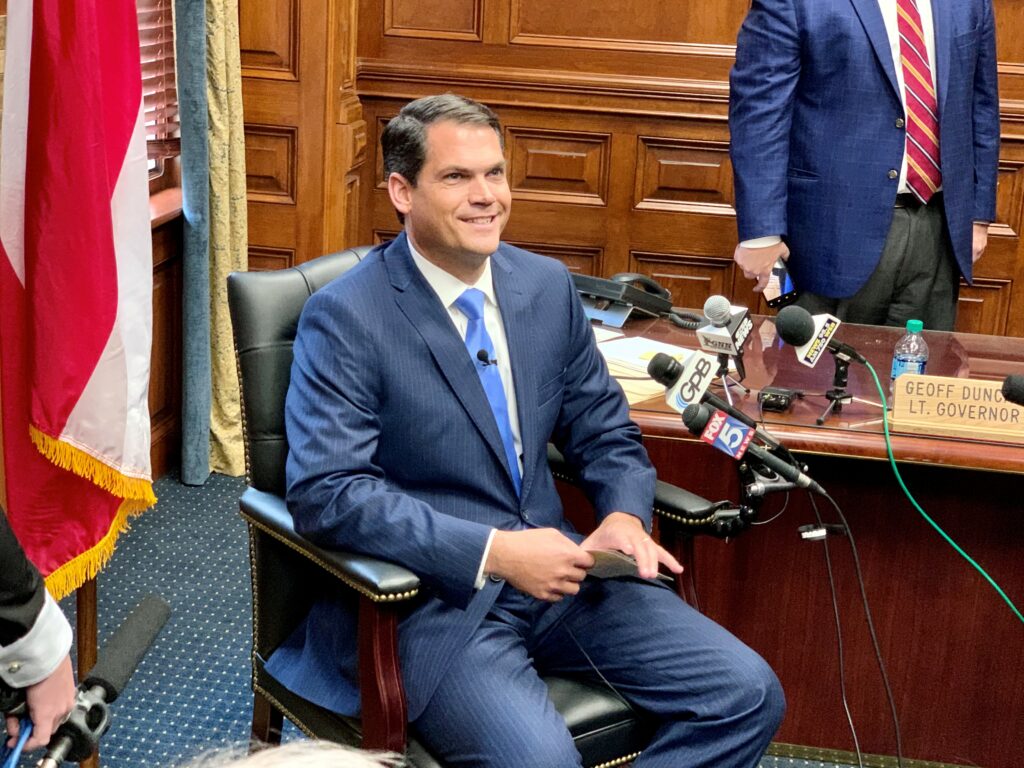
Georgia Lt. Gov. Geoff Duncan (Photo by Beau Evans)
ATLANTA – Lt.
Gov. Geoff Duncan set an ambitious agenda Monday for a high-profile group of
political, business and academic leaders he is looking to for ideas on how to
make Georgia the technology capital of the East Coast.
The Georgia
Innovates Task Force, co-chaired by former U.S. Sen. Johnny Isakson and Georgia
Tech President Emeritus G.P. “Bud” Peterson, held its kickoff meeting to hear
Duncan’s charge to the group and dole out assignments for the work ahead.
“We’re not
looking for short-term sugar highs,” Duncan said. “We want this group to truly
produce meaningful ideas.”
With a
background in business, Duncan has made growing Georgia’s role as a technology
hub a key priority, both during his 2018 campaign and since taking office last
year.
He announced
the formation of the new task force last month and named some of Georgia’s
best-known business leaders to the panel. The list includes Paul Bowers,
chairman, president and CEO of Georgia Power Co.; Marty Flanagan, president and
CEO of Atlanta-based Invesco; and Raphael Bostic, president and CEO of the
Federal Reserve Bank of Atlanta.
The task
force also includes representation from areas of Georgia outside of Atlanta,
including Lori Durden, president of Ogeechee Technical College in Statesboro, and
Barbara Rivera Holmes, president and CEO of the Albany Area Chamber of Commerce.
Peterson
said other states are vying with Georgia to become the technology capital of
the East Coast. But Georgia enjoys some advantages in the competition,
including the presence of the Port of Savannah, Hartsfield-Jackson Atlanta
International Airport, the U.S. Army Cyber Command in Augusta and the federal
Centers for Disease Control and Prevention in Atlanta, he said.
Georgia also
boasts a diverse array of outstanding colleges and universities, Peterson said.
“We can
leverage those institutions to help create an educated workforce that can drive
initiatives like this,” he said.
Peterson
divided the task force into four subcommittees to work on separate aspects of the
technology push including innovation, education and training, entrepreneurship
and initiatives aimed at rural communities.
The
subcommittees are to report back with initial recommendations at the next
meeting of the task force in April. Final recommendations are expected by
mid-summer.
Isakson said
he’s optimistic the panel’s work will pay off.
“If we can
in a timely fashion develop goals and apply our brain power and our dollar
power, we can do a lot of things,” he said.
ATLANTA – Two
recent critical audits of Georgia’s generous film tax credit are helping build
support for legislation calling for greater scrutiny of all of the myriad tax
incentives the state offers to attract jobs.
A bill the
Senate Finance Committee passed unanimously Feb. 3 calls on the governor’s
office to contract with independent auditors to review up to five tax-incentive
programs each year and determine whether their economic impact is worth what
the state spends on them.
The General
Assembly approved a similar measure last year, but Gov. Brian Kemp vetoed it. In
his veto message last May, Kemp argued the audits should be conducted
independently because the state auditor is responsible for preparing fiscal
notes on all proposed tax breaks.
“The
governor made the right choice,” said Sen. John Albers, R-Roswell, chief
sponsor of Senate Bill 302. “We found an area in the bill to have an
independent third party do the audits.”
The audits
of the film tax credit, released last month, faulted the way the program is
administered and asserted the credits have had less economic impact than
supporters have touted.
The audit on
the impact of the film tax credit concluded the Georgia Department of Economic
Development used an inflated multiplier to calculate the dollar value of the program’s
economic impact and reported misleading job numbers.
But Thomas
Cunningham, chief economist for the Metro Atlanta Chamber, told lawmakers Feb.
4 that even the lower economic impact numbers the audit found demonstrate the
tax credit’s value.
The audit
reported Georgia provided $667 million in tax credits to film producers in 2016
– making the credit far and away the most expensive in the state’s arsenal. The
credits generated $4.6 billion that year in return, including direct and
indirect spending, increased tourism and studio construction, the audit found.
That’s
nearly a 7-1 return on investment, Cunningham told members of the House Working
Group on Creative Arts and Entertainment during two days of hearings on the
film tax credit program.
“It looks
like the returns are fairly decent,” he said.
Cunningham
and others defended the film tax credit as a better investment than many other
economic carrots the state offers.
“Here, you
get the spending up front and the tax credits after the fact,” he said. “It’s
not like a typical economic development incentive, [where] you’re giving money
up front and hope you get the jobs later on.”
The second
audit found the film tax credit program is so poorly managed that film
production companies have received credits to which they were not entitled or
more in credits than they had actually earned.
Both state
bureaucrats in charge of the program and representatives of the film industry
who testified during the hearings conceded administration of the credit needs
to be tightened.
Andrew
Capezzuto, general counsel for the Georgia Department of Economic Development, said
one shortcoming in the current program is that it allows film companies to seek
audits of the credits they receive but doesn’t require them.
“We believe
a large majority of the issues identified by … the audits could be resolved by
mandating audits for all taxpayers getting this credit,” he said.
“There are
ways we can tinker with [the program],” added Atlanta entertainment lawyer Stephen
Weizenecker. “But I don’t think we should destroy it or make changes that would
destroy what we’ve created.”
Film executives
shooting productions in Georgia have reason for concern. Given the tight budget
facing the governor and the General Assembly this year, there’s been discussion
of putting a spending cap on the film tax credit.
“We might
need to tailor [the program] a little differently,” said Sen. Chuck Hufstetler,
R-Rome, chairman of the Senate Finance Committee. “We need to get the best bang
for our buck.”
State Rep.
Matt Dollar, R-Marietta, the House working group’s chairman, declined comment
on the possibility of a spending cap on the tax credit. But he said the two
days of hearings highlighted the industry’s impact in a much broader sense than
what could be found in the audits.
“It’s given us a good picture of what this is meaning to Georgians,” Dollar
said.
The industry’s supporters like to point out where Georgia was in terms of the film industry before lawmakers adopted the tax credit. In 2007, the year before passage of the credit, film production in the state accounted for a mere $242 million in economic activity. “We’ve created a new industry out of nothing,” said Brian Robinson, spokesman for the Georgia Screen Entertainment Coalition, a film industry advocacy group affiliated with the Georgia Chamber of Commerce. “There’s a really good story to tell about the economic impact this is having”