ATLANTA – Legislation
aimed at ending the practice of “surprise billing” of medical patients in
Georgia cleared a committee in the state House of Representatives Tuesday.
Lawmakers
have been trying for years to help patients hit with unexpected charges from hospitals
that participate in their insurance plan’s network for health-care services
provided by out-of-network specialists.
“People are
getting into financial trouble and losing everything they have, in some cases,
because of a misunderstanding,” Rep. Lee Hawkins, R-Gainesville, chief sponsor
of the bill, told members of the House Special Committee on Access to Quality
Health Care. “We’re going to end that misunderstanding.”
House Bill
888 would require insurance companies to pay out-of-network physicians either a
“contracted amount” based on rates charged in 2017 for various procedures, or a
higher charge that the insurer proposes.
Disagreements
between the insurer and provider would prompt an arbitration process overseen
by the state Department of Insurance, which would contract with outside private
arbitration companies to decide the final bill.
On Tuesday,
consumer advocates and lobbyists representing hospitals and health-insurance
companies spoke out in support of the legislation.
“It takes
Georgia patients out of disputes between insurance companies and medical
providers,” said Liz Coyle, executive director of Georgia Watch, a consumer organization
based in Atlanta.
But representatives
of physician groups raised concerns that the bill would cover not only emergency
services provided outside of a patient’s network but non-emergency procedures for
which a patient could prepare ahead of time.
“We understand
the need to protect consumers,” said Victor Moldovan, a lawyer representing the
Independent Doctors Association of Georgia. “But what this bill does … is take
the fangs out of the ability of doctors to negotiate their rates.”
Mary Shea
Ross-Smith, a lobbyist for the Kaiser Foundation Health Plan of Georgia, said
she’s concerned the bill would not apply the ban on surprise, or “balance,”
billing to patients forced to go to a non-network medical facility for
treatment in an emergency.
“In that situation,
that member should not be balance billed,” she said.
But Hawkins
said most patients hit with a surprise bill have gone to an in-network facility
only to be charged for services provided by an out-of-network specialist. He suggested
addressing that issue now in order not to further complicate the legislation and
dealing with services provided at out-of-network facilities later.
An
identical bill is pending in the Georgia Senate. The Senate bill, sponsored by
Sen. Chuck Hufstetler, R-Rome, is expected to go before the Senate Health and
Human Services Committee on Wednesday.
ATLANTA – Budget
writers in the Georgia House of Representatives Tuesday restored some of the
spending cuts Gov. Brian Kemp has requested in his mid-year state budget to
help offset sluggish tax revenues.
The $27.4
billion fiscal 2020 mid-year budget members of the House Appropriations
Committee adopted puts back funding for food safety, mental health services,
Georgia’s public defenders and the state’s accountability courts.
Since
receiving Kemp’s budget proposals last month, lawmakers have expressed concerns
that the depth of some of the cuts would hit state agencies that have yet to recover
from the spending cuts they were forced to absorb during the Great Recession
more than a decade ago.
Those fears
were reinforced when state agency heads warned during budget hearings of the
impacts the cuts would have on programs and services.
The list of
worried department heads included Commissioner of Agriculture Gary Black, who
asked lawmakers not to reduce his food safety workforce. On Tuesday, the
appropriations panel added back five food safety inspectors who had been cut from
the mid-year budget.
In the
criminal justice arena, the House committee transferred $1.5 million from the Georgia
Prosecuting Attorney’s Council to the state Public Defender Council to avoid job
losses among Georgia’s public defenders.
The popular
accountability courts then-Gov. Nathan Deal launched several years would see a
$1.3 million cut restored.
Rep. Terry
England, chairman of the Appropriations Committee, said depriving the
accountability courts of the funding they need would send more criminal
defendants to prison rather than managing them through a less costly
alternative.
“They would
certainly wind up with a less cost-effective method of dealing with what
they’ve done,” said England, R-Auburn.
The
Department of Natural Resources, in charge of state parks and environmental
compliance, had funds added back for maintenance and law enforcement following
concerns its budget had not recovered yet from the recession. The DNR was hit
particularly hard when the economic downturn sent tax collections plummeting in
2008.
“We’re
trying to keep them still fully in play,” said Rep. Sam Watson, R-Moultrie,
chairman of the House Appropriations General Government Subcommittee.
Lawmakers
have been particularly worried about the potential impacts of cuts to mental
health services. On Tuesday, the Appropriations Committee reduced proposed reductions
to the number of residential treatment beds and added $2.8 million for behavioral
“ health core” services.
“We’re able
to make some improvements,” said Rep. Katie Dempsey, R-Rome, chairman of the
Appropriations Human Resources Subcommittee. “It’s a very, very good day for
this part of the budget.”
The
committee also added $44,111 to the $200,000 the governor recommended for the Georgia
Access to Medical Cannabis Commission. The General Assembly created the
commission last year to oversee the growth, production and sale of cannabis oil
in Georgia for treatment of a variety of diseases, but it is off to a slow
start.
The full
House is expected to take up the mid-year budget on Wednesday.
Staff
writer Beau Evans contributed to this report.
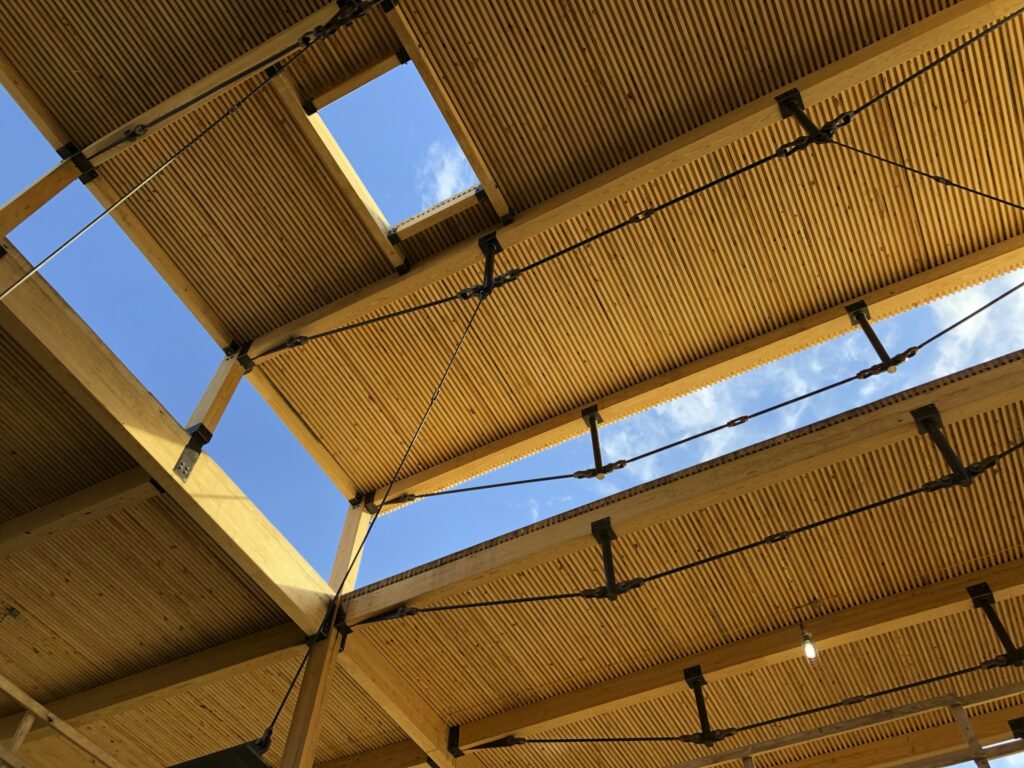
The Kendeda Building on the Georgia Tech campus. Photo by The Miller Hull Partnership
ATLANTA – Georgia’s
timber industry, which already tops the nation in a number of categories, may get
a boost from new technology that lets developers construct mid-rise office
buildings made mostly of wood.
The General
Assembly is considering legislation asking the state Department of Community
Affairs to recommend whether Georgia should adopt a provision in the International
Building Code that allows buildings constructed of “mass timber” to rise as
high as 18 stories. The state building code limits wood office buildings to six
stories.
Other
countries and some states already are taking advantage of the international
provision to put up mid-rise office buildings well above Georgia’s height
limit, said Rep. John Corbett, R-Lake Park, chief sponsor of House Bill 777 and
a timber farmer.
“Out on the
West Coast, Washington and Oregon have done it. Canada has been using it for
some time,” he said. “It’s going to be a good fit for our Southern yellow pine.
It’s a good opportunity for us.”
Georgia
already is the No. 1 state in commercially available timberland, with 22
million acres of privately owned forests. The Peach State also is tops in the
nation in exports of pulp, paper, wood fuel and wood pellets.
Forestry generates
an annual economic impact of $36.3 billion and is Georgia’s second largest
industry, accounting for 148,414 direct and indirect jobs, according to the
Forsyth-based Georgia Forestry Association.
Andy Barrs,
president and CEO of Watkinsville-based Barrs Industries, which owns stretches
of timberland throughout the Southeast, said the science of building with mass
timber has existed for decades. But the market for mid-rise office buildings
made mostly of wood is still emerging, he said.
Builders
glue cross-laminated timbers together to create a strong material that can be
used for floors, ceilings and load-bearing walls, Barrs said.
“They can
cut the pieces exactly, so the preciseness is very high,” he said. “It allows
buildings to occur in urban areas with a smaller footprint. It’s a very efficient
way to build, kind of like Lincoln Logs.”
Bill de St.
Aubin, CEO of Sizemore Group, an architectural firm based in Atlanta, said concerns
over fire protection have prompted some hesitation to use wood in mid-rise
office buildings. But mass timber – unlike the wood used in stick-built
residential construction – is actually more fire resistant than steel, he said.
“The new law
recognizes wood is a protective material,” he said. “Mass timber doesn’t light
easily. … Mass timber is very thick. It’s a really strong material.”
Mass timber
has yet to make significant inroads in Georgia. Some cities passed ordinances
in recent years limiting the height of buildings made of wood, but the General
Assembly passed a bill in 2018 prohibiting local governments from imposing
height restrictions below what the state code provides.
Use of the
technology currently is limited to two buildings in Atlanta. The recently
completed T3 West Midtown building at Atlantic Station consists of a concrete
ground floor and six stories made of wood.
The recently opened 47,000-square-foot Kendeda
Living Building on the campus of Georgia Tech won last year’s top prize for
innovative sustainable design from the Atlanta Regional Commission.
Sizemore
Group currently is building a new church for Our Lady of Lourdes in Atlanta’s
Old Fourth Ward, the city’s oldest African American Catholic church.
“Every
project I do now, I look at mass timber first,” Aubin said.
Andres
Villegas, president and CEO of the Georgia Forestry Association, said the
ability to construction mid-rise office buildings from wood would go a long way
toward sustaining the state’s timber industry.
“It will
give landowners a reason to continue planting trees,” he said. “It’s a great
opportunity for us, especially in Atlanta where we have so much construction
this can be applied to.”
The House
bill calls for the Department of Community Affairs to begin its review of the
International Building Code this summer and complete its work before July 1,
2021.
Villegas
said he’s not surprised by the length of the process.
“It takes a
little time for new technology to be accepted,” he said. “There’s a lag time
that occurs with the international building codes being adopted at the state
level.”
House Bill
777 passed the House Agriculture & Consumer Affairs Committee unanimously early
this month and is expected to before the full House soon.
ATLANTA – The
top executives of the Atlanta Braves, Falcons and Hawks pitched legislation to
legalize sports betting in Georgia Thursday at a luncheon sponsored by the
Atlanta Press Club.
Derek
Schiller of the Braves, Rich McKay of the Falcons and Steve Koonin of the Hawks
said sports betting wouldn’t spur a direct windfall of revenue for their teams.
Rather, the benefit would come from increasing fan engagement, they said.
“Somebody
who bets on a game is 19 times more likely to watch it,” said Koonin, the
Hawks’ president and CEO.
Sports
betting is a relatively recent arrival on the legalized gambling scene. It
wasn’t possible until a U.S. Supreme Court ruling in 2018 struck down a federal
law that banned commercial sports betting in most states.
Since then,
11 states have legalized sports betting, seven others have approved but are yet to launch sports betting and 24
states – including Georgia – are considering legalization legislation.
State Rep.
Craig Gordon, D-Savannah, has introduced a constitutional amendment asking
Georgia voters to decide in a statewide referendum whether to legalize sports
betting.
A separate
“enabling” bill sponsored by Rep. Ron Stephens, R-Savannah, one of the biggest
supporters of legalizing gambling in the General Assembly, contains specifics
on how sports betting would operate in Georgia. For one thing, betting would be
conducted through cellphones and other mobile devices, since Georgia has no brick-and-mortar
betting facilities such as casinos.
“The phone is where a lot of consumption is going on in the digital world,” said McKay, the Falcons’ president and CEO
Stephens’
bill also would prohibit betting on amateur sports, including college games. A
portion of gambling proceeds would go toward education in Georgia.
The
prospects for getting sports betting through the General Assembly this year are
not encouraging. Georgia Senate Majority Leader Mike Dugan, R-Carrollton, said
last month that legalizing gambling is not a priority in his caucus.
Lobbyists
for religious groups oppose legalized gambling in any form – sports betting,
casinos or pari-mutuel betting on horse racing – as an immoral activity that carries
hidden social costs including increased crime and gambling addictions.
But Schiller, the Braves’ president and CEO, said gambling is already going on in Georgia.
“Sports
betting is happening today illegally, and the state of Georgia is receiving no
tax dollars for it,” he said. “It’s really found money that’s not happening
today.”
Schiller
also argued that legalizing sports betting rather than allowing it to go on
illegally would give the state the tools to regulate the activity, including
setting age limits and putting restrictions on the use of credit cards.
ATLANTA – A variety of land conservation, restoration and
parks projects across the state would land the first round of funding through
the Georgia Outdoor Stewardship Act voters approved in November 2018.
A state House subcommittee Wednesday approved 14 projects to
be funded with $20 million raised through a new tax on purchases of sporting goods.
More than 83% of Georgia voters ratified a constitutional amendment creating
the tax.
“We have a growing state,” Mark Williams, commissioner of
the state Department of Natural Resources (DNR), told members of the subcommittee.
“We need to have a place for people to spend time with their families and enjoy
the outdoors.”
State agencies, local governments and nonprofit conservation
groups submitted 58 project applications last year worth more than $78 million.
An advisory board created by the legislation worked with the DNR to select
projects based on their conservation and recreational value and whether the
benefits they would bring would be or regional or statewide significance.
“We had no bad projects,” said Rob Stokes, the program
coordinator for the DNR. “It just got so competitive these are the cream of the
crop for this year.”
Among the projects selected were six the DNR submitted,
including $3.5 million for the first phase of the planned acquisition of the Ceylon
property and $2.6 million to acquire 7,000 acres of undeveloped land at Cabin
Bluff. Portions of both tidal marshland properties in Camden County are slated
to become new wildlife management areas.
Three of the other DNR projects would involve restoration of
longleaf pine forests, including one restoration project related to recovery
from the damage wreaked by Hurricane Michael in October 2018.
Other projects on the list include parks projects in Forsyth
County and the city of Johns Creek, $2.3 million to fund a portion of a planned
canoeing and kayaking trail on the Chattahoochee River that eventually will
connect Lake Lanier with Chattahoochee Bend State Park, and an extension of the
Atlanta Beltline’s Westside Trail.
Under the legislation that created the program, the project
list the House subcommittee adopted Wednesday will go straight to the Georgia
Senate. However, the House will get to weigh in on the $20 million allocated
for the program’s first year as part of the budget process.
AT A GLANCE
Here are the 14 projects to be funded during the first year
of the Georgia Outdoor Stewardship Act:
Applicant Project
name Funding requested
DNR Coastal Resources Division Noyes Cut Ecosystem Restoration $1.7
million
DNR Wildlife Resources Division Cabin Bluff Acquisition $2.6
million
DNR Wildlife Resources Division Ceylon Acquisition Phase 1 $3.5
million