ATLANTA – The
University System of Georgia became fully online this week, with online courses
substituting for in-person instruction due to the coronavirus pandemic, system
Chancellor Steve Wrigley said Wednesday.
Wrigley
praised both the system’s IT staff for setting up the online system and university
faculty for converting their courses to online.
“In highly
unusual circumstances, people have worked very hard not to just deal with them
but to overcome them,” Wrigley told members of the university system Board of
Regents during a special called meeting by telephone to discuss the system’s
response to the public health crisis.
Tristan
Denley, executive vice chancellor for academic affairs, said the system’s internet
traffic nearly doubled on Monday when the online courses began.
“With that
significant increase in traffic, we have monitored it closely to make sure
students didn’t have any difficulty getting into the system,” he said. “It was
very smooth.”
Gov. Brian
Kemp, using emergency powers to deal with the COVID-19 outbreak granted him by
the General Assembly two weeks ago ordered all of Georgia’s public colleges and
universities, technical colleges and public schools closed until March 31, an
order he later extended until April 24.
The
university system has gone a step further by closing all of its campuses for
the remainder of the spring semester.
Wrigley said
most campuses have finished moving students out of their dorms, and the schools
are working to issue refunds for services students have paid for but won’t be
receiving.
On another
front, the chancellor updated the regents on what the university system is
doing to help the state’s public health and emergency management agencies
respond to COVID-19.
On Tuesday, Kemp’s
office announced state health officials are working with the university system
and Emory University on ramping up coronavirus testing in Georgia with a goal
of processing more than 3,000 test samples per day.
University System of Georgia Chancellor Steve Wrigley
Wrigley thanked
the University of Georgia, Georgia Tech, Georgia State University and Augusta University
for participating in the project.
The
chancellor said system campuses also are pitching in with supplies hospitals
need to safety treat a growing number of coronavirus patients, including
personal protective equipment (PPEs), which are in short supply at hospitals
across the country because of the unprecedented demand prompted by the
pandemic.
“We want to
make sure our assets are deployed as effectively as possible,” Wrigley said.
ATLANTA – More
than 120 members of Congress, including three from Georgia, are asking the
Trump administration to prioritize rural hospitals for funding from the $2
trillion economic stimulus package Congress passed last week.
The package
includes $130 billion aimed specifically at the needs of hospitals fighting the
coronavirus pandemic.
The letter, dated
Monday and sent to U.S. Health and Human Services Secretary Alex Azar, is
signed by 41 senators and 81 members of the House of Representatives, including
Republican Sens. David Perdue and Kelly Loeffler of Georgia, and Rep. Austin
Scott, R-Tifton.
“The CARES
Act provides you with the flexibility to deliver assistance where it is needed
most,” the letter states. “Right now, some rural hospitals are reporting they’re
running out of operating funds. This jeopardizes their ability to maintain
health-care services during the COVID-19 outbreak. We cannot afford to ignore
their pressing needs.”
The letter
goes on to assert that most rural hospitals have stopping performing elective procedures
and stopped seeing non-urgent patients in order to deal with those with coronavirus.
The strain that is putting on their finances is leaving some with only days of cash
on hand, money they need for payroll and supplies.
The letter
asks Azar to brief members of Congress on the situation facing rural hospitals
by teleconference by the end of this week.
The stimulus
package includes hundreds of billions of dollars to help U.S. businesses large
and small keep furloughed employees on their payrolls during the coronavirus
crisis. It also will send checks directly to American workers and their families
and deliver assistance to state and local governments suffering from losses in
tax revenue.
ATLANTA – The
Georgia Supreme Court is loosening restrictions governing certain court proceedings
to adjust to the realities of the coronavirus pandemic.
The court declared
a state judicial emergency March 14, ordering courts throughout Georgia to remain
open to carry out critical functions.
Additional
orders issued Tuesday and during the past week amend certain court rules to
allow such things as the use of video conferences and telephone conferences in
certain proceedings that normally require the physical presence of the judge
and the parties to a case. The rules also encourage courts to livestream
proceedings via the internet to give the public access.
“The purpose
of these orders is to enable all our courts to continue conducting essential
court business while protecting citizens, judges, lawyers, and others from
unnecessary exposure to the coronavirus,” Chief Justice Harold Melton said.
The high
court issued five separate orders approving amendments to rules affecting
superior and state courts, probate courts, municipal courts, juvenile courts,
and magistrate courts.
Georgia Power’s Plant Mitchell was retired in 2016.
ATLANTA – Georgia
Power Co. plans to convert coal ash stored at one of its retired power plants
into a component of Portland cement, the Atlanta-based utility announced
Tuesday.
The
beneficial reuse project, a first for Georgia, will be launched later this year
at Plant Mitchell near Albany. About two million tons of stored coal ash at the
site will be removed.
“As part of
our ash pond closure efforts, Georgia Power is always looking for opportunities
to reuse coal ash that are beneficial for our customers and communities,” said
Mark Berry, the utility’s vice president of environmental and natural resources.
“The coal ash beneficial reuse project at Plant Mitchell will save space in
landfills and ultimately serve to help produce a valuable product.”
Coal ash is
the residue left behind after burning coal to fuel power plants. It can contain
a number of toxic chemicals, including lead, selenium and arsenic.
Coal ash was
a controversial topic during this year’s General Assembly session, which was
suspended indefinitely more than two weeks ago because of the coronavirus
outbreak.
Before that,
Democrats pushed legislation that would require Georgia Power to install
impervious liners under 10 of the utility’s 29 ash ponds. Georgia Power plans
to excavate and remove ash from the other 19 ponds.
But majority
Republicans opposed the legislation. Instead, the state House of
Representatives passed three other bills imposing additional regulations on the
disposal of coal ash but stopping short of requiring liners.
Plant
Mitchell was retired in 2016 as part of a Georgia Power plan approved by the
state Public Service Commission. At the completion of the ash conversion
project there, the ash pond site will be restored as usable property.
Separately,
Georgia Power issued an initial request for proposals in January to identify
and pursue other opportunities for the beneficial reuse of coal ash stored at
its power plants across the state. A more detailed RFP is due to be released by
the end of April to qualified bidders.
Additionally,
Georgia Power plans to open a research facility later this year at Plant Bowen
to identify, test and speed the development of beneficial uses for coal ash.
Georgia Power will partner with the Palo Alto, Calif.-based Electric Power
Research Institute on the research center.
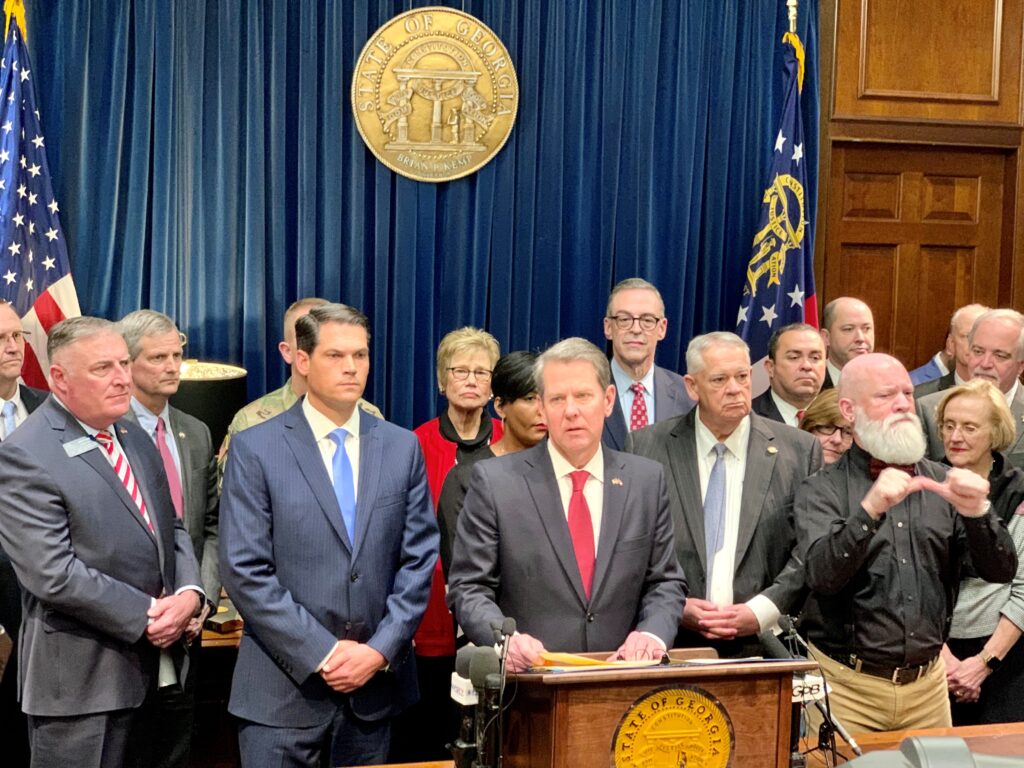
Gov. Brian Kemp provides an update on coronavirus in Georgia earlier in March. (Photo by Beau Evans)
ATLANTA – More
than 100 Georgians have died of coronavirus, the state Department of Public
Health (DPH) reported Tuesday.
As of noon
Tuesday, the number of confirmed cases of the virus had risen to 3,817, of whom
818 were hospitalized. The number of deaths from COVID-19 was up to 108.
The virus
also has invaded the vast majority of Georgia counties, with at least one confirmed
case reported in 139 of the state’s 159 counties.
Fulton
County continued to report more cases than any other county, with 547
coronavirus patients, to 455 for Dougherty County. However, Dougherty County
has suffered 18 deaths from the virus, compared to 17 deaths in Fulton County.
DeKalb County reported the third-highest number of confirmed cases, with 325 as of noon Tuesday. Cobb County reported 272 cases, Gwinnett County 233, Bartow County 129 and Carroll County 122.
Eleven
patients from Cobb County have died from COVID-19, third-highest in the state,
followed by Lee County with six deaths and Athens-Clarke County with five.
More and
more Georgians are being tested for coronavirus. As of noon Tuesday, private
labs had administered 14,260 tests, while 1,921 tests had been conducted by the
DPH.