ATLANTA – Georgia Chief Justice Harold Melton Monday extended the statewide judicial emergency in effect because of the coronavirus pandemic until May 13.
Melton first declared the emergency on March 14 and set it to expire on April 13.
While the emergency declaration orders courts to remain open to deal with cases considered critical to protecting the “health, safety and liberty of individuals,” criminal trials and jury duty have been suspended.
Courts are urged to use teleconferencing and videoconferencing when feasible to avoid spreading COVID-19.
Melton’s order also suggests lawyers avoid creating a backlog of nonessential cases either by moving them forward or agreeing to continuances.
“The threat of this virus is difficult for everyone,” Melton said in a prepared statement. “Court personnel are no exception. We have to ensure that they can safely fulfill their mission.”
The order states that Melton will give notice when he is ready to lift the emergency “at least one week in advance to allow courts to plan the transition to fuller operations.”
ATLANTA – Georgia Tech opened a drive-thru rapid COVID-19 testing site Monday on its Midtown Atlanta campus.
The test site, a partnership between the state Department of Public Health and CVS Health, is operating at a parking deck at 352 Peachtree Place. At full capacity, the site will be able to conduct up to 1,000 tests per day.
The tests, offered by Abbott Laboratories will take about 30 minutes.
“Increased access to rapid testing remains one of our top priorities in order to identify more cases, get Georgians the care they need and prevent further infection in our communities,” Gov. Brian Kemp said. “This unique, public-private partnership will strengthen our testing capability as we continue to take the fight to COVID-19 in Georgia, and we are grateful for CVS Health’s support to stop the spread of the virus.”
As of noon Monday, 7,314 Georgians had tested positive for coronavirus, while 229 had died from the virus.
Health care providers, including nurse practitioners and physician assistants from MinuteClinic, the company’s retail medical clinic, will be onsite to oversee testing. Patients will need to pre-register in advance for a same-day appointment online at www.CVS.com/minuteclinic/covid-19-testing.
For the safety of patients and health care providers on site, no walk-ups will be allowed. Testing is limited to drive-through testing only.
“CVS Health is uniquely positioned to play a vital role in helping support both local communities and the overall health care system in addressing the COVID-19 pandemic,” said Dr. Troyen Brennan, vice president and chief medical officer of CVS Health. “Our ability to help coordinate the availability of rapid COVID-19 testing for Georgia citizens will bolster the state’s efforts to manage the spread of the virus and provide people with on-the-spot test results.”
The tests will be free of charge. Hours of operation will be Monday through Friday from 9 a.m. until 6 p.m., Saturday from 10 a.m. until 5 p.m., and Sunday from 10 a.m. until 4 p.m.
ATLANTA – Coronavirus now has killed more than 200 Georgians, the state Department of Public Health reported Saturday,
As of 11:30 a.m., 201 COVID-19 patients had died from the virus in Georgia. The number of confirmed cases was up to 6,160. Of that number, 1,239 – or 20.1% – were hospitalized.
The 201 deaths are nearly twice the number reported just four days ago, even as the state has ramped up testing and deployed the Georgia National Guard to Albany, the hardest-hit community in the state.
Dougherty County, where efforts to cope with the rapid spread of COVID-19 have drawn national media coverage, deaths from coronavirus have surpassed deaths in much more populous Fulton County. Thirty patients had died in the Albany area as of 11:30 a.m., compared to 26 deaths in Fulton.
Cobb County has suffered 20 deaths from the virus, followed by Clayton County with nine and Athens-Clarke, DeKalb, Gwinnett and Lee counties with eight each.
Testing has picked up in recent days, with 23,846 Georgians tested for COVID-19 as of Saturday and 2,448 tested by the state.
As been the case throughout the course of the pandemic thus far, the most Georgians testing positive for the virus – 59% – are between the ages of 18 to 59. Older Georgians age 60 and above account for 36% of positive tests.
Women outnumber men among those testing positive for coronavirus, 52% to 46%.
A statewide shelter-in-place order imposed by Gov. Brian Kemp took effect early Friday evening. Georgians are supposed to stay at home whenever possible, unless they need to go to the grocery store or pharmacy, or for medical treatment.
There’s also a broad range of exceptions for people who work in industries considered essential and can’t perform their duties from home. Another exception allows for outdoor exercise, as long as people keep at least six feet of distance between each other.
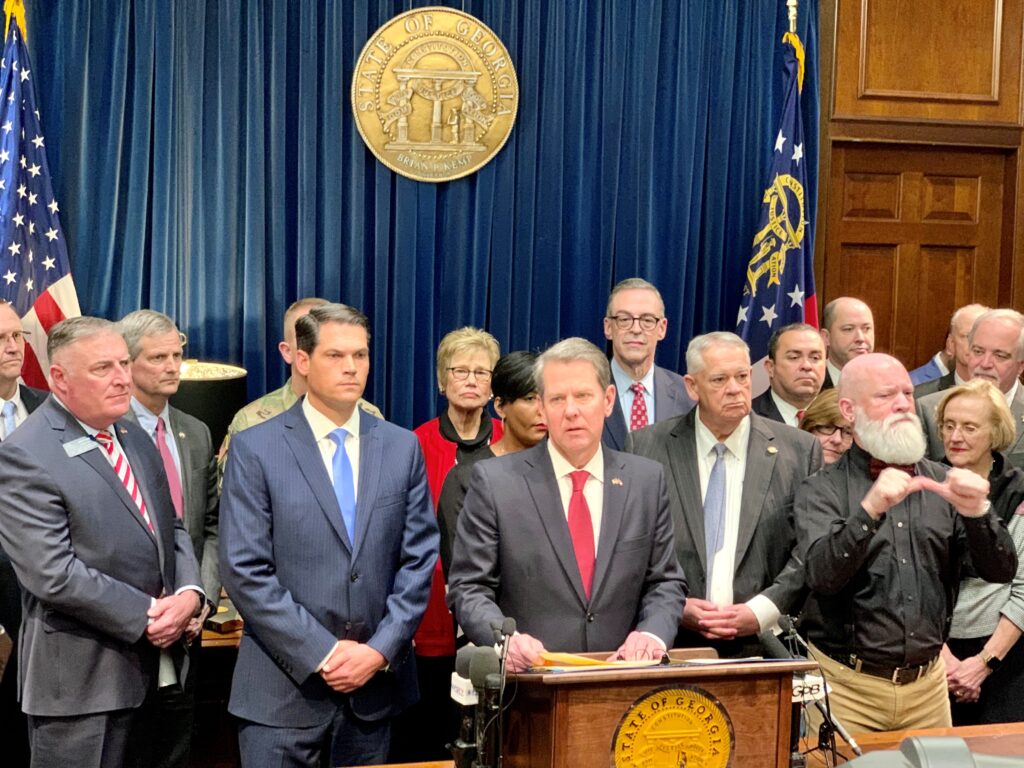
Gov. Brian Kemp gives an update on coronavirus last month. (Photo by Beau Evans)
Gov. Brian Kemp has issued a statewide shelter-in-place order to help prevent the spread of coronavirus. Here are some frequently asked questions surrounding the order and answers supplied by the governor’s office:
How long does the executive order last?
The shelter-in-place order takes effect at 6 p.m. Friday and expires at 11:59 p.m. April 13
What businesses and professionals must cease in-person operations and close to the public during this time?
Bars
Nightclubs
Gyms
Fitness centers
Bowling alleys
Theaters
Live performance venues
Dine-in services at restaurants and private social clubs (Exceptions include take-out, curbside pickup and delivery, as well as dine-in services at hospitals, health-care facilities, nursing homes or other long-term care facilities)
How does the order apply to individuals and families?
All Georgia residents and visitors are required to shelter in place in their residences. “Shelter in place” means remaining in their residences and taking every possible precaution to limit social interaction to prevent the spread or infection of COVID-19.
Are there exceptions?
Yes. A Georgia resident or visitor is not required to shelter in place if they are:
Engaging in essential services.
Working in critical infrastructure.
Engaging in minimum basic operations.
Performing necessary travel.
What are essential services and critical infrastructure workers?
As defined by the U.S. Department of Homeland Security, workers who conduct a range of operations and services that are typically essential to critical infrastructure viability, including staffing operations centers, maintaining and repairing critical infrastructure, operating call centers, working construction, and performing operating functions, among others. It also includes workers who support critical supply chains and enable functions for critical infrastructure. The industries they support represent but are not limited to medical and health care, telecommunications, information technology systems, defense, food and agriculture, transportation and logistics, energy, water and wastewater, law enforcement and public works.
Engaging in essential services means obtaining necessary supplies and services for your household, engaging in activities essential for the health and safety of your household, and engaging in outdoor exercise activities as long as you have at least six feet between people who do not live in your household.
You can go to the grocery store, medical appointments and the pharmacy. You can go pick up food or have food delivered to your house. You can leave your house to buy supplies to clean or maintain your house. You can go outside to exercise. You can also leave your house in an emergency.
The key takeaway is that you need to stay in your house as much as possible, but we recognize there are circumstances when you need to leave. Keep those circumstances rare, consolidate trips as much as possible and use take-out, curbside pickup and delivery service whenever possible to prevent the spread of COVID-19.
Necessary travel means the travel required for someone to conduct or participate in essential services, minimum basic operations or work for critical infrastructure.
Minimum basic operations are limited to:
The minimum activities necessary to maintain the value of a business … provide services, manage inventory, ensure security, process payroll and employee benefits, or for related functions. Such minimum necessary activities include remaining open to the public subject to the restrictions of this order.
The minimum activities necessary to facilitate employees or volunteers being able to work remotely from their residences.
Instances where employees are working outdoors without regular contact with other persons, such as delivery services, contractors, landscape businesses and agricultural industry services.
What does this order mean for church services and funeral services?
No business, establishment, for-profit or nonprofit corporation, organization or county or municipal government is allowed to have more than 10 people gathering in a single location unless there is at least six feet between each person at all times. This rule applies to church services and funeral services.
Can I go to state parks or play sports outside like golf?
Yes. You can visit state parks or play sports outside, including golf, subject to restrictions. Gatherings of more than 10 people are banned unless there is at least six feet between each person at all times. If people congregate in certain areas of a state park or golf course, for example, law enforcement will warn them to disband. If they fail to comply, they may face criminal charges.
What happens if I violate the governor’s executive order?
If you violate any terms of the order, you are committing a misdemeanor, which is a crime in the state of Georgia. For example, if you are not sheltering in place and none of the four exceptions for essential services, minimum basic operations, critical infrastructure or necessary travel applies to your activities, you will receive a warning from law enforcement and risk facing criminal charges if you fail to comply.
How does this order apply to local governments?
No county or municipal to government is allowed to have more than 10 people gathered in a single location unless there is at least six feet between each person at all times. The governor’s order supersedes all local ordinances to the extent they conflict and states that no ordinance can be more restrictive or less restrictive.
ATLANTA – The number of unemployment claims filed in Georgia grew
exponentially last week as the coronavirus pandemic continued to cause massive job
losses.
The Georgia Department of Labor processed 133,820 claims during
the week of March 22 through March 28, an all-time high and significantly above
the 12,140 claims filed during the previous week.
“People are anxious and worried about their health, their families
and how they are going to continue to make it financially during these
uncertain times,” Commissioner of Labor Mark Butler said Thursday. “We are here
to help. … Our team is working overtime, nights and weekends to process the
tremendous volume.”
With a record number of claims being filed, the labor department dispersed
more than $14.5 million in unemployment benefits to 64,022 Georgians during the
week ending March 28.
The $2 trillion economic stimulus package Congress passed last week extends state unemployment benefits by 13 weeks and includes $600 per week in addition to regular state benefits.
The
state labor department signed all of the necessary agreements last weekend to
access funding for this program. The agency is still waiting to receive
guidelines from the U.S. Department of Labor on how to administer the money on
behalf of the federal government.
The
state labor department also is continuing to work
with employers to get Georgians back to work. More than 116,000 jobs are listed
online at www.EmployGeorgia.com for Georgians to access.
Information on filing an unemployment claim, details on how
employers must file partial claims, and resources for other reemployment
assistance can be found on the agency’s webpage at www.gdol.ga.gov