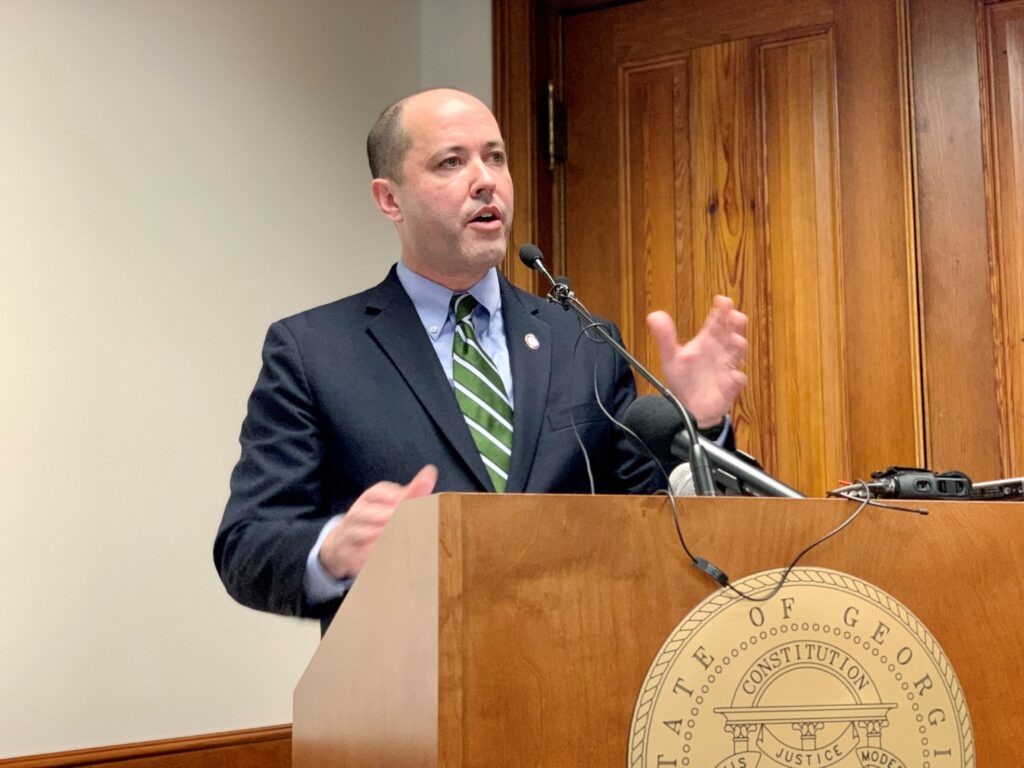
ATLANTA – State Attorney General Chris Carr is warning Georgians to watch out for a growing number of scammers seeking to take advantage of the coronavirus pandemic.
Scam artists are using fraudulent websites, texts and e-mails to steal consumers’ personal or financial information or to install malware on their communications devices.
“Scammers are pursuing different angles related to the coronavirus pandemic to commit identity theft, create chaos and steal people’s money,” Carr said Wednesday. “People should be very wary of messages containing links or requests for their personal or financial information.”
The attorney general’s Consumer Protection Division has received complaints about text messages warning the recipient that someone they’ve been in contact with either has tested positive for COVID-19 or shown symptoms of the virus. The victim is referred to a website that asks for their phone number.
More than 110,000 suspicious coronavirus-related domains have been registered, according to the attorney general’s office.
Another scam that has been reported involves e-mails purported to be from hospitals warning the recipient they may have come into contact with someone who tested positive for COVID-19. The e-mail contains an attachment that, when downloaded, installs malware on the recipient’s device.
Consumers should also watch out for e-mails, text messages and robocalls about COVID-19 stimulus money that appear to come from the U.S. Treasury, but which may actually be coming from scammers impersonating government officials. In these scams, consumers are told that to receive stimulus money they should click on a link or go to a website, where they are then directed to enter their personal and financial information.
The Consumer Protection Division cautions consumers not to click on any links or go to websites that come from unsolicited texts, e-mails or phone calls.
ATLANTA – Gov. Brian Kemp and Georgia’s top legislative leaders jointly announced Wednesday they will extend a statewide public health emergency due to the coronavirus pandemic through May 13.
Kemp first declared a public health emergency back on March 14 as COVID-19 began taking hold in Georgia. Lawmakers ratified the governor’s order two days later during a one-day special session and set the declaration to expire on April 13.
“This measure will allow us to continue to deploy resources to communities in need, lend support to frontline medical providers, and keep preparing as we brace for potential patient surge in our health-care facilities,” Kemp said in a prepared statement. “We deeply appreciate the hard work of Georgians who are sheltering in place, using social distancing, and helping us flatten the curve. We are in this fight together.”
The extension of the public health emergency by Kemp, Lt. Gov. Geoff Duncan – the state Senate’s presiding officer – and Georgia House Speaker David Ralston came as the number of confirmed cases of COVID-19 and the resulting deaths continued to mount.
As of Tuesday night, 9,156 Georgians had tested positive for coronavirus and 348 had died from the virus.
“We must continue our aggressive fight against COVID-19,” Duncan said. “By extending the public health state of emergency, we can ensure Georgians have access to every available state resource during this crisis.”
“The entirety of our state government is working to protect the health and safety of our citizens,” added Ralston, R-Blue Ridge. “While we have difficult days ahead, we continue to coordinate with both local and federal partners in responding to needs as they arise. As Georgians, we will persevere and emerge stronger on the other side.”
Kemp is extending the public health emergency declaration without having to call the legislature back for another special session.
After hours of behind-the-scenes negotiations during the one-day special session last month, the General Assembly passed a resolution authorizing the governor to extend the declaration unilaterally if lawmakers were unable to return to the Capitol this month because of the limit on large gatherings necessitated by the pandemic.
Meanwhile, the state remains under a separate statewide shelter-in-place order that took effect last Friday. That order is due to expire at 11:59 p.m. April 13 unless Kemp acts to extend it.
Kemp, Georgia Department of Public Health Commissioner Dr. Kathleen Toomey, state Emergency Management and Homeland Security Agency Director Homer Bryson, and Georgia National Guard Adjutant General Tom Carden are scheduled to deliver an update on the state’s COVID-19 response efforts Wednesday afternoon.
ATLANTA – The coronavirus pandemic is speeding up Piedmont Atlanta’s plan to open a portion of its new Marcus Tower.
The tower’s sixth, seventh and eighth floors will open next Monday, almost four months ahead of schedule, adding 132 beds for both COVID-19 patients and patients suffering from other maladies. Of those beds, 64 will be designed for intensive care.
“By opening this part of the tower early, we are increasing capacity at a critical time when our community needs it the most,” said Dr. Patrick Battey, CEO of Piedmont Atlanta Hospital. “Getting these beds ready for patients who may need them during the COVID-19 outbreak was the right thing to do, and I am proud of the staff at Piedmont and our partners on the project who made it happen.”
The 16-story tower was originally set to open Aug. 1. But Piedmont’s construction management team worked in concert with Brasfield & Gorrie, CBRE and HKS to accelerate completion of three floors.
“Piedmont exists to serve its communities, and there is no greater way that we can serve them than by increasing our capacity with this state-of-the-art facility during the COVID-19 pandemic,” said Kevin Brown, CEO of Piedmont Healthcare. “Because of the great work our team on the project has performed by already being ahead of schedule, we were able to advance the timeline further to open these ICU and acute-care units and have them ready in case we need them.”
When the rest of the tower opens, it will house the Piedmont Heart Institute, the new Marcus Heart and Vascular Center, the Samsky Invasive Cardiovascular Services Center and the Shaheen Auditorium. The tower ultimately will have a capacity of 408 beds.
The tower was made possible through an initial donation of $75 million from Bernie and Billi Marcus through the Marcus Foundation.
ATLANTA – The state probably has received its last positive revenue report for awhile.
The Georgia Department of Revenue reported Tuesday that tax collections increased by 9.8% last month compared to March of last year. The state brought in $1.83 billion in revenue last month, an increase of $163.5 million over March 2019.
While the coronavirus pandemic was starting to put a serious dent in Georgia’s economy last month, the rosy revenue report for March reflects a lag time between when businesses collect taxes and when they submit them to the state, said David Sjoquist, an economics professor at Georgia State University.
“March numbers are largely collected by firms in February,” he said.
The revenue increase in March was driven largely by individual income tax collections, which rose by 25.5% compared to March of last year. Individual income tax payments were up by 18.3%, while tax refunds plummeted 21.7%.
On the other hand, net sales tax receipts declined for the month by 2.4%. Corporate income taxes rose slightly, by 0.8%.
Sjoquist said the March report likely marks the end of positive revenues for the foreseeable future.
“The numbers next month will be quite a bit lower,” he said.
The General Assembly will have to grapple with the economic damage coronavirus is doing to the state’s bottom line when lawmakers resume a 2020 legislative session suspended indefinitely last month because of the virus.
Legislative leaders already have cast doubts on the state’s ability to continue making ends meet and still afford either the second installment of a $5,000 teacher pay raise Gov. Brian Kemp is recommending or an additional state income tax cut.
The $27.4 billion fiscal 2020 mid-year budget adjustment the General Assembly approved last month already is in place. The real challenge will be finding enough money to fund critical programs and services in fiscal 2021 starting July 1.
Chuck Eaton, chairman, Georgia Public Service Commission
ATLANTA – Georgia’s utility regulating board voted Tuesday to extend the suspension of service disconnections Georgia Power Co. began last month in response to the coronavirus pandemic.
The state Public Service Commission (PSC) unanimously passed a resolution continuing the suspension of disconnections for non-payment of customer bills “due to the continued uncertainty surrounding the duration of [the] COVID-19 response.”
Customers won’t be cut off until the PSC decides to terminate the suspension of disconnections, subject to input from Georgia Power.
“There’s nothing more important right now than making sure everybody has electricity in their home,” commission Chairman Chuck Eaton said before Tuesday’s vote. “We need to be encouraging people to use their homes.”
“We recognize the extraordinary burden the COVID-19 pandemic has put upon our state and our customers,” added Paul Bowers, chairman, president and CEO of Georgia Power. “We commend the commissioners for their vote to extend the disconnect suspension and allow for special customer payment provisions.
“It is going to take all of us continuing to think about how we can support each other to see our communities through this uncertain time.”
The Atlanta-based utility suspended service disconnections on March 14 as the coronavirus crisis was beginning to take hold on Georgia, with businesses significantly reducing their operations or shutting down entirely, resulting in massive worker layoffs.
Cities and counties across the state began ordering residents to stay home unless they needed to shop for groceries or medicines or needed to go to essential jobs they couldn’t perform at home. Those local orders were subsequently superseded by the statewide shelter-in-place order Gov. Brian Kemp imposed late last week.
While the PSC resolution authorizes Georgia Power to dip into its storm damage reserves to help offset the costs of suspending service disconnections, it also acknowledges that won’t be enough to cover all of the financial impact the pandemic ultimately will have on the utility.
Under the resolution, the period during which Georgia Power will be allowed to recover those costs will be determined in the company’s next rate case.
The commission approved a rate increase last December that will raise the average Georgia Power residential customer’s bill by $168 per year.