ATLANTA – The Atlanta Hawks have found an innovative, community-minded way to use State Farm Arena while the coronavirus pandemic has left the building without its usual slate of concerts and sporting events.
The Hawks and Fulton County have announced plans to use the facility in downtown Atlanta as an early voting site. With 700,000-thousand square feet of space, there’s plenty of room to comply with the social distancing requirements that hampered voting before and during the June 9 primaries.
“We always felt we were a community and civic asset,” Hawks owner Tony Ressler said Monday. “Making State Farm Arena the safest, most efficient and largest polling location in Georgia and maybe the country is part of that commitment.”
“We will go from the proverbial worst to first as a result of this collaboration,” Fulton County Commission Chairman Robb Pitts added.
The area will open July 20 for early voting ahead of the Aug. 11 runoffs and in October in advance of the Nov. 3 general election. A portion of the building also will be set aside for counting mail-in-ballots.
In conjunction with Monday’s announcement, MARTA unveiled plans to reopen its rail station adjacent to State Farm Arena, which has been closed since the COVID-19 outbreak began because of the cancellation of events at the arena and nearby Mercedes-Benz Stadium. The station has undergone a deep cleaning and needed repairs during the last three months.
Georgia Secretary of State Brad Raffensperger praised the Hawks and Fulton County for stepping up to improve the voting experience after the long lines and other problems that beset Atlanta during the primary voting.
“The partnership between Fulton County and the Atlanta Hawks is a great example of how the public sector and the private sector can work together to address the issues we saw on June 9,” he said. “Looking forward, we are hoping to build more of these partnerships with the private sector and civic groups to support voter access during this unprecedented pandemic.”
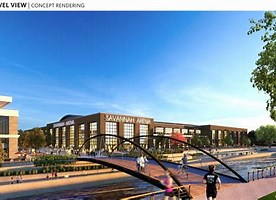
The General Assembly earmarked $70 million toward the planning expansion of the Savannah Convention Center.
ATLANTA – Despite cutting spending by $2.2 billion, the General Assembly found enough money in next year’s state budget to plow more funds into building projects across Georgia.
The final version of the $25.9 billion fiscal 2021 budget lawmakers adopted late last week doubles the bond financing for a series of projects on university, college and technical college campuses. But it does so by zeroing out the funding for other projects.
Throughout the budget review process, the legislature left alone the largest project in the $1.13 billion bond package for the coming fiscal year: a $70 million expansion of the Savannah Convention Center in Gov. Brian Kemp’s original budget recommendations.
But the budget that emerged from a joint House-Senate conference committee last Thursday doubled the bond commitments for the following projects:
$5 million for Phase III renovations at the Driftmier Engineering Center at the University of Georgia’s main campus in Athens.
$4.9 million to design, construct and equip Phase II of the Greenblatt Library at Augusta University.
$4.8 million for renovations to the Dublin Center and Library building on the Dublin campus of Middle Georgia State University.
$4.5 million for renovations to the Memorial College Center on the Armstrong campus of Georgia Southern University in Savannah.
$3 million to renovate the Williams Center at Georgia Southern University in Statesboro.
2.5 million to design the Humanities Building at the University of West Georgia in Carrollton.
$2.25 million to renovate the Georgia Veterans Education Career Transition Resource Center at Chattahoochee Technical College’s Marietta campus.
$2 million to design, construct and equip the Andalusian Interpretive Center at Georgia College & State University in Milledgeville.
$2 million to design, construct and equipment the Science Building Chemistry Lab at Kennesaw State University.
$1.3 million to design the Performing Arts Center at Valdosta State University.
$800,000 to design the Nursing and Health Science Simulation Lab at Albany State University.
An even more generous General Assembly increased from $6 million in the governor’s original budget to $20.1 million the funding to build the Lake Lanier Conference Center in Hall County. The money earmarked for that project rose at every step of the budget review process.
On their own, budget conferees also put up $6.7 million in bond financing for site acquisition, design and construction of the Center for Education and Entrepreneurship at Southern Crescent Technical College in McDonough.
The conferees agreed to $10.24 million the state House of Representatives had added to the bond package for infrastructure improvements to the Georgia World Congress Center in downtown Atlanta.
On the down side, lawmakers zeroed out the funding for some major projects, including $30.7 million that had been slated to go toward expanding Technology Square on the Midtown Atlanta campus of Georgia Tech.
Stone Mountain took a huge hit, losing the full $10.24 million that was to have gone for Phase II renovations at the Evergreen Conference Center & Resort. Another $3.56 million for campground renovations at Stone Mountain Park was axed.
On the coast, the conference committee removed $3 million in bonds for an expansion of the campground at Jekyll Island.
ATLANTA – The Georgia Supreme Court cleared the way Monday for the planned $5 billion redevelopment of an area of downtown Atlanta known as The Gulch.
In a unanimous decision, the court ruled the issuance of up to $1.25 billion in bonds to support the largest mixed-use development in the Southeast was “sound, feasible and reasonable.”
A group of city taxpayers known as Redlight the Gulch had sued to stop the project, arguing the sales tax revenue the redevelopment likely would generate wouldn’t be enough to pay back the bonds, leaving taxpayers holding the bag.
But the state Supreme Court upheld a lower court opinion that the evidence in the case justified holding the issuance of the bonds to be legally valid.
“While not all Atlantans, including the intervenors in this case, share the city’s vision for The Gulch, that does not mean that the project is illegal,” Chief Justice Harold Melton wrote for the court. “As the trial court pointed out, the job of the courts is not to question the advisability or estimate the popularity of the city’s decisions regarding the development of The Gulch.”
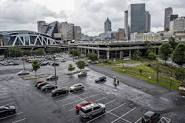
The Gulch consists of a series of sunken rail yards and parking lots that has languished for decades and is best known as a popular site for tailgate parties before and after football games at adjacent Mercedes-Benz Stadium.
Christened Centennial Yards, the ambitious mixed-used project will contain 12 million square feet of hotels, offices, retail shops and residences.
The 2020 General Assembly session wrapped up on Friday night.
ATLANTA – By the time the 2020 General Assembly gaveled to a close Friday night, lawmakers had dealt with two issues they couldn’t have dreamed of when they came to the Capitol in January.
A hate crimes bill was alive in the legislature at the beginning of the session, having passed in the Georgia House of Representatives last year. Legislative budget writers came in knowing they would have to make some spending cuts to offset sluggish tax revenues last year.
But both issues took on a far greater sense of urgency because of circumstances no one under the Gold Dome had anticipated at the start of the session.
The hate-crimes bill was stalled in the state Senate until the fatal shooting of Ahmaud Arbery, a 25-year-old black man who was gunned down during a pursuit by two white men near Brunswick in February, an incident that didn’t come to public attention until a video of the incident surfaced in April.
Balancing the budget became a much heavier lift in March when Gov. Brian Kemp issued a shelter-in-place order to discourage the spread of COVID-19. Businesses across Georgia closed their doors and laid off workers, and the state’s economy spiraled into a deep recession.
Mixed in with the uncertainty of the global pandemic was a suspension of the legislative session in mid-March. The legislature didn’t return to Atlanta until three months later for a home stretch that saw the General Assembly in session on 11 of 12 days, with only Father’s Day off for lawmakers to catch their breaths.
“It was a challenging session,” House Speaker David Ralston, R-Blue Ridge, said minutes after the final gavel fell Friday night. “So many things happened during the suspended time. When we left here, we didn’t know how long we’d be gone.”
When the legislature did return, it was to an atmosphere of street protests over the deaths of Arbery and two black men who died at the hands of white police officers: George Floyd in Minneapolis and Rayshard Brooks just down the street in Atlanta,
With that as a backdrop, lawmakers spent much of the resumed session negotiating passage of a landmark hate-crimes bill.
Under legislation Gov. Brian Kemp signed Friday, prison time could be meted out for those who terrorize or physically harm others based on their race, color, religion, nationality, sexual orientation, sex, gender, or whether they have a physical or mental disability.
The bill, sponsored by Rep. Chuck Efstration, R-Dacula, was hustled though both chambers in the General Assembly last Wednesday, prompting the legislature’s longest serving member, Rep. Calvin Smyre, to call it his best piece of work.
“I’ve had a lot, a lot, a lot of moments in my career,” said Smyre, D-Columbus, who co-sponsored the bill. “But today is my finest.”
But passage of the bill didn’t come without some serious bumps along the way. Senate Republican leaders, wary of protesters homing in on law enforcement as the focus of their anger, moved to include police officers and other first responders as protected classes alongside race and gender.
Last-minute negotiating led Senate lawmakers to strike a compromise that kept the first-responder protections in place but moved them to a separate bill that also passed out of the General Assembly.
Lawmakers also reached across the aisle to pass second-chance legislation allowing Georgians to clear minor offenses off their criminal records to help them secure jobs and housing.
The bill by Sen. Tonya Anderson, D-Lithonia, would allow Georgians with certain first-time misdemeanor and non-violent felony convictions in Georgia to petition superior courts to have those records shielded from public view.
Other efforts to move criminal justice reform in the legislature fell short as Democratic lawmakers filed more than a dozen bills this month to repeal the state’s stand-your-ground and citizen’s arrest laws, prohibit police officers from racial profiling, ban no-knock search warrants and punish wayward district attorneys.
Ralston said he found elements of those bills worthy of consideration. But he said the legislature ran out of time to give them the serious debate they deserved.
“We were so focused on the budget and the hate-crimes bill, I thought it wasn’t feasible to take them on,” he said.
Ralston said he has asked Efstration’s House Judiciary Committee to hold hearings this summer with an eye toward proposing additional criminal-justice and policing reform measures during next year’s session.
While the legislature disposed of the hate-crimes bill in the middle of last week, it took until the final hours of the session to pass a scaled-back $25.9 billion fiscal 2021 state budget.
Legislative budget writers imposed 10% spending cuts on state agencies across the board. But after drawing down $250 million from the state’s reserves and getting the welcome news that the recession has had a bit less impact on tax collections than expected, lawmakers found enough money to cancel the furlough days that were looming over teachers and state employees.
“As Georgia’s economy reopened and revenues rebounded slightly … Georgians and Georgians were resilient,” said Senate Appropriations Committee Chairman Blake Tillery, R-Vidalia. “We will continue to weather this storm.”
The final version of the budget restored or lessened spending cuts in a number of areas, including education, health care and public safety. In some cases, the legislature was able to plug in gaps in state funding with available federal dollars.
But minority Democrats complained the 2020 session was a lost opportunity to tap into additional sources of revenue that could have reduced the impact of the spending cuts. Proposals to substantially increase Georgia’s tobacco tax and reduce the size of the tax credits the state hands out to lure new businesses died during the session’s final stages.
“Although the state budget is not as dire as expected, it still devastates citizens across the state of Georgia,” said Rep. Debra Bazemore,” D-South Fulton. “This will be especially difficult, as well as add insult to injury during this pandemic where people have lost or are on the verge of losing their homes and cars or are unable to feed their family.”
Beyond hate crimes and the budget, lawmakers crafted protections for businesses and health-care providers fearful of lawsuits brought by people who contract coronavirus on their premises.
Among the last bills emerging from the session was a measure to shield businesses, hospitals, doctor’s offices, sports teams and other enterprises from lawsuits against all but the most serious negligence cases.
Supporters hailed the measure as needed legal protection for businesses struggling to rebound amid the pandemic, while opponents argued it would leave workers in the lurch.
Lawmakers also moved to extend broader unemployment benefits to people struggling amid the coronavirus pandemic and to offer up tax credits for companies that produce personal protective equipment.
With health care on the minds of many amid the pandemic, Georgians may be able to rest a little easier without having to worry about receiving a huge and unexpected hospital bill if they have to go to the emergency room.
Legislation to curb the practice of “surprise” billing cleared the General Assembly after being touted as a top priority for Republican leaders. It requires health-care insurers and providers to work out costs for medical procedures between themselves, leaving patients out of the mix.
Also in the health-care arena, the legislature expanded Medicaid coverage to new mothers in Georgia to six months post partum and funded the initiative with $19.7 million.
Also topping the legislative agendas for influential Capitol-goers like the governor were bills to reduce the number of standardized tests Georgia students need to take each year and limit participation in the state’s popular dual enrollment program.
On the environmental front, the legislature increased the fee for the disposal of coal ash at landfills from $1 per ton to $2.50 to discourage out-of-state companies from bringing their coal ash waste to Georgia.
Lawmakers banned the burning of railroad ties treated with harmful creosote used in the production of electricity and cracked down on discharges of cancer-causing ethylene oxide, a chemical used to sterilize medical equipment.
Environmental groups also helped kill the so-called Right to Farm Act, which would have limited the ability of property owners to file nuisance lawsuits against farm operations that move into their neighborhoods.
ATLANTA – The Georgia House of Representatives gave final passage Friday night to a $25.9 billion fiscal 2021 budget scaled back by the economic impact of the coronavirus pandemic on state tax collections.
House lawmakers approved the spending plan 104-62 in one of the final actions the House took before adjourning the 2020 legislative session. The state Senate had signed off on the budget on Thursday.
While lawmakers reduced state spending by $2.2 billion during the year starting July 1, the cuts in the final version of the budget were not as deep as had been feared.
When Georgia businesses began shutting down in March to discourage the spread of COVID-19, Gov. Brian Kemp and legislative leaders told state department heads to begin preparing to reduce their budgets by 14%.
But after receiving the latest revenue reports showing a lower decline in tax revenues than had been expected, Kemp revised the across-the-board cuts first to 11%, then to 10% earlier this week.
That allowed legislative budget writers to avoid some key reductions, including eliminating furlough days for teachers and employees across state government, House Appropriations Committee Chairman Terry England, R-Auburn, told his legislative colleagues before the vote.
Despite a $950 million cut in the K-12 student funding formula, the budget still fully funds student enrollment growth in Georgia’s public schools, equalization grants for low-wealth school districts and student transportation, England said.
The budget also spared the state Department of Labor from absorbing any reductions, acceding to a request by Commissioner of Labor Mark Butler, who argued successfully that his agency is being forced to process a deluge of unemployment claims resulting from the recession.
The joint House-Senate conference committee that worked out the final budget deal also restored cuts to behavioral health services and to the state’s accountability courts, which have been credited with reducing Georgia’s incarceration rate.
Rural hospitals in Georgia, which have had trouble making ends meet for years, will receive additional grant funds.
“Putting the brakes on elective surgery [during the COVID-19 crisis] has impacted rural hospitals dramatically,” England said. “We’re set in a way to help those hospitals.”
Both during Thursday’s Senate debate and again in the House on Friday, minority Democrats argued the General Assembly should have looked for sources of additional revenue as well as cutting spending. Legislation to increase the state’s tobacco tax from 37 cents per pack to $1.35 failed to reach the floor of either legislative chamber.
The Georgia Budget and Policy Institute (GBPI) released a statement after Friday night’s vote criticizing that over-reliance on spending reductions.
As these cuts go into effect and Georgia’s schools, health care institutions and more are impacted, GBPI urges lawmakers to return in January and raise revenues so that our state can recover from COVID-19 and eventually prosper,” said Jennifer Owens, the group’s senior vice president.
The budget now heads to Gov. Brian Kemp for his signature.