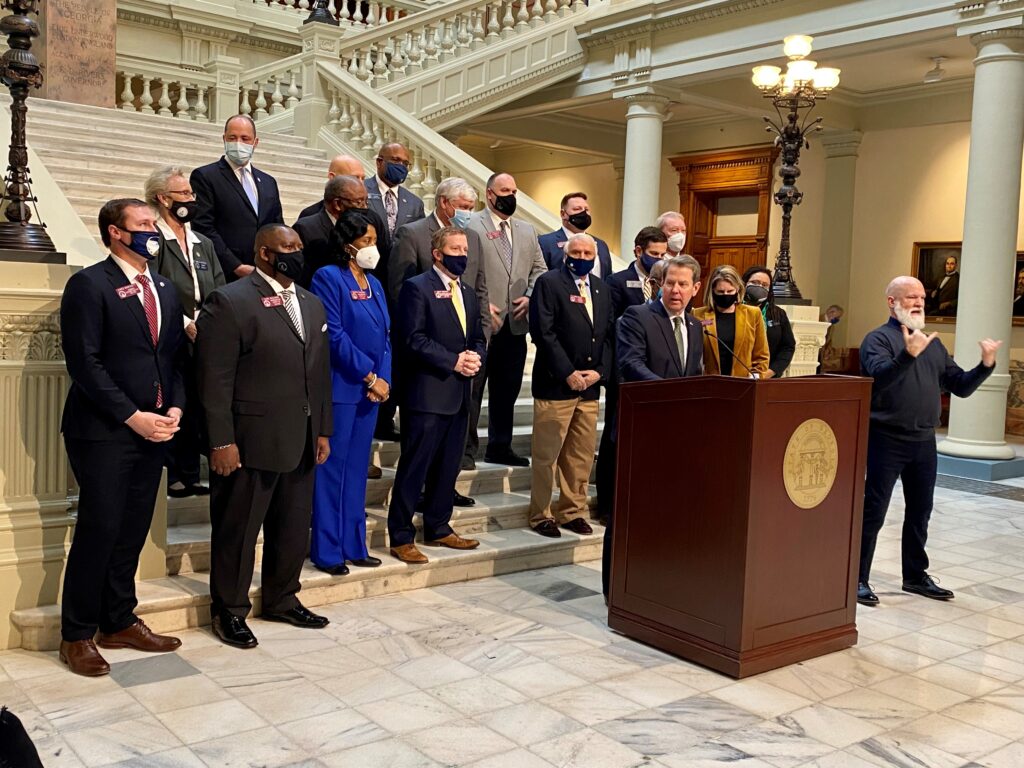
Gov. Brian Kemp and state lawmakers detailed proposed changes to Georgia’s citizen’s arrest law on Feb. 16, 2021. (Photo by Beau Evans)
ATLANTA – Legislation to overhaul Georgia’s Civil War-era citizen’s arrest law inspired by the murder of Ahmaud Arbery last year passed the state House of Representatives unanimously on Monday.
House Bill 479, which now heads to the Georgia Senate, is a follow-up to the hate-crimes law the General Assembly passed last June in the aftermath of the death of George Floyd, a Black man from Minneapolis, at the hands of a white police officer.
Arbery, a 25-year-old Black man, was gunned down while jogging near Brunswick in February 2020 by two white men. The two, now facing murder charges along with a third white man, have claimed they were attempting to make a citizen’s arrest.
“Ahmaud’s death was not in vain because we’re going to bring change,” Rep. Bert Reeves, R-Marietta, the bill’s chief sponsor, said on the House floor before Monday’s vote. “Every single one of us has an opportunity to take part in Ahmaud’s legacy.”
Rep. Calvin Smyre, D-Columbus, the House’s longest serving member, said the citizen’s arrest legislation is the natural next step to the hate crimes law.
“Last year, Georgia removed a dark cloud from over the state,” he said. “Now, is the time for us to remove that cloud again.”
Reeves’ bill would do away with a state law in effect since 1863 that lets private citizens arrest someone who commits a crime in their presence or during an escape attempt. It still would permit off-duty police officers and business owners to detain suspects they believe to have committed a crime on their property.
The legislation would not affect Georgia’s self-defense and stand-your-ground laws, which require different legal standards for allowing people to use reasonable force to protect themselves.
“It’s an old bill that’s outdated. We have no need for it,” said Rep. Don Hogan, R-St. Simons Island, who represents the House district where Arbery’s murder occurred.
“This is the right thing to do,” he added. “It’s supported by the community in Glynn County.”
The bill has the backing of Gov. Brian Kemp and the legislative leaders of both parties.
“Our overhaul of the citizen’s arrest statute strikes a critical balance between protecting the lives and livelihoods of our families, our friends, and our neighbors, and preventing rogue vigilantism from threatening the security and God-given potential of all Georgians,” the governor said after Monday’s vote.
ATLANTA – A bill letting some family members visit Georgians in hospitals or nursing homes during health emergencies like coronavirus cleared the state House of Representatives Monday after an emotional debate.
The legislation, which passed 113-57 and now moves to the Georgia Senate, was revised numerous times as it went through the chamber’s Human Relations and Aging Committee to address safety concerns expressed by hospital and nursing home administrators.
Under the scaled-back version of the measure the House passed, “legal representatives” designated to make decisions – which could include a family member – would be allowed to visit a hospital patient for up to one hour a day.
“Essential caregivers” – which also could include a relative – could visit nursing home residents for up to two hours daily.
From a practical standpoint, supporters said legal representatives or caregivers would pose no more of a health threat to the patients or residents they visit than the many facility staff who regularly come into their rooms.
“If we can have the myriad of staff coming and going into these facilities, why can’t that one legal representative come in for one hour a day … that person who can help them make decisions and understand what they’re going through?” said Rep. Jesse Petrea, R-Savannah, the Human Relations and Aging Committee’s chairman. “That’s what this bill does.”
House Speaker David Ralston, R-Blue Ridge, supported the bill from an emotional standpoint. In a rare appearance in the well of the House, Ralston described how a young husband called him last summer asking if the speaker could help him gain permission to visit his dying wife, who was in the hospital. Ralston was powerless to help.
“He said ‘goodbye’ on FaceTime,” Ralston told his House colleagues. “I hope you will send a message … to the people whose pleas and hurt and heartbreak we’re trying to touch in some way.”
But the bill’s opponents argued hospitals and nursing homes have imposed necessary visiting restrictions to keep residents and patients safe.
“This is a feel-good, tug-at-your-heartstrings bill,” said Rep. Debra Bazemore, D-Riverdale, the House’s deputy minority whip. “However, I trust the medical professionals when they warn that to keep our loved ones healthy and safe, we will have to endure some precautions.”
Rep. Ed Setzler, R-Acworth, the bill’s chief sponsor, said he took the concerns of health-care professionals into account in working through the multiple revisions he made to strengthen the measure’s protections.
“We’ve taken all this feedback and boiled this down to the core essentials,” he said. “This bill gives the patient the right to have their next of kin at their bedside to make critical decisions.”
ATLANTA – Owners of convenience stores and restaurants featuring coin-operated amusement machines (COAMs) would be able to sell gift cards to players under legislation the Georgia House of Representatives passed Monday.
The use of gift cards would go a long way toward cleaning up the industry by discouraging the illegal cash payouts that have long plagued COAMs, said Rep. Alan Powell, R-Hartwell, chairman of the House Regulated Industries Committee and House Bill 544’s chief sponsor.
Powell’s bill, which the House passed 110-54, also includes regulations aimed at ensuring fair competition among the companies that own the machines and the retail businesses that house them, prohibiting machine owners from offering inducements to retailers to house their machines and imposing late fees when license holders fail to renew their licenses.
“This tightens up all controls,” Powell said. “Anybody would have to be dumb as mud to do [cash] payouts.”
The Georgia Lottery Corp., which has overseen the COAM industry since 2013, is currently conducting a pilot project selling gift cards at 198 locations. Powell’s bill would expand the gift card program statewide.
Under existing law governing the industry, the companies that own the machines receive 45% of the proceeds, and the retailers where the machines are located get 45%. The lottery gets the remaining 10% and dedicates it to the HOPE Scholarships program.
COAMs are a big business in Georgia. Players of the games spent more than $3 billion in the Peach State during the last fiscal year. After players redeemed prizes valued at $2.1 billion, that left $900 million in net revenue for COAM license holders, the retailers and the state to divide.
Some House Democrats argued Monday the state’s 10% share of that pie – $90 million – isn’t enough to justify permitting COAMs in Georgia.
“Ten percent is grossly too low,” said Rep. Winfred Dukes, D-Albany. “If we’re going to give [COAM companies] an opportunity to come into this state, you’ve got to give me more money. … The children of our state are being short-changed.”
Rep. Stacey Evans, D-Atlanta, expressed hope the state’s share of COAM proceeds would be raised when the bill moves over to the state Senate.
“This industry … attracts things we don’t want in our community. It’s a very addictive form of gambling,” she said. “[But] we’re willing to accept the ills if we get a benefit for our citizens. … Let’s make sure we’re not giving away something for nothing.”
ATLANTA – The Georgia House of Representatives and state Senate are at loggerheads over how Georgians should tell time.
The House passed legislation last Friday calling for the Peach State to observe daylight saving time all year.
That followed action the Senate took the week before to put Georgia on standard time permanently.
The one thing both chambers agree on is that the state should stop switching from standard time to daylight every March and back again to standard each November.
“There are some really serious health and safety reasons for eliminating time change,” Rep. Wes Cantrell, R-Woodstock, told his House colleagues shortly before they voted 112-48 to put Georgia on daylight time all year. “Our bodies are meant to adjust slowly to differences in the amount of daylight as the Earth rotates.”
Cantrell cited studies showing an increase in pedestrians being hit by cars during the two weeks after standard time kicks in during the fall because it suddenly gets dark an hour earlier.
Immediately following “spring-forward” in March, heart attacks go up, medical errors increase and even prison sentences handed out by judges increase, all tied to sleep deprivation, he said.
“ ’Spring forward’ sounds a lot nicer than it is,” he said.
Cantrell argued that going on daylight time all year would be better than switching to standard time permanently.
“More sunlight in the evening is good for our health,” he said. “It’s good for the economy. People prefer to shop in the daylight.”
But Sen. Ben Watson, R-Savannah, sponsor of the Senate bill to switch to standard time, said observing daylight time during the winter would lead to dark mornings. The sun wouldn’t come up until almost 8:30 a.m. in December, prompting concerns for the safety of children going to school, he said.
The other advantage to Watson’s bill is that, if it passes and is signed into law by the governor, it could take effect with the next switch to standard time this November.
The House bill, on the other hand, could only move Georgia to daylight time permanently if Congress passes legislation giving states that option.
Watson’s bill includes a provision to make the switch from standard to daylight if and when federal lawmakers allow it.
ATLANTA – The Georgia House of Representatives overwhelmingly passed legislation Friday tightening monitoring requirements for ash generated by coal-burning power plants.
But the 161-2 vote came despite concerns some House Democrats expressed over the way the state regulates coal ash ponds.
House Bill 647, which now moves to the state Senate, would require groundwater monitoring at ash ponds that have been closed to continue for 50 years after the closure is completed. A bill the House passed last year that didn’t make it through the Senate would have limited the monitoring to 30 years.
Coal ash contains contaminants including mercury, cadmium and arsenic that can pollute groundwater and drinking water. Long-term exposure has been linked to a variety of cancers.
Atlanta-based Georgia Power has been working since 2015 on a multi-year plan to close all 29 of its coal ash ponds at 11 power plants across Georgia to meet both state and federal regulations for handling coal ash. While the utility plans to excavate and remove the ash from 19 of those ponds, the other 10 are to be closed in place.
For the most part, minority Democrats voted for the bill Friday in the Republican-controlled House. But several complained that Georgia Power is not being required to liners for the 10 ponds that are being closed in place to prevent contamination of drinking water supplies serving communities near the plants.
The utility is being sued by residents of Juliette who claim coal ash stored in an unlined pond at nearby Plant Scherer has contaminated groundwater around the site.
Contamination from coal ash also has turned up on property offsite from Georgia Power’s Plant McDonough in Cobb County.
Rep. Debbie Buckner, D-Junction City, said the state’s disposal requirements for coal ash are less stringent than for disposal of household garbage, which must be stored in lined landfills.
“An estimated 92 million tons [of coal ash] are being stored in Georgia in unlined ponds,” she said. “These toxic substances can seep into groundwater or flow into streams and cause disastrous contamination.”
“Lengthening the monitoring period acknowledges there is a problem with capping storage [ponds] rather than removing and excavating the material,” added Rep. Karla Drenner, D-Avondale Estates.
But Rep. Timothy Barr, R-Lawrenceville, who chairs the House subcommittee that reviewed the bill this week, said both the U.S. Environmental Protection Agency and the Georgia Environmental Protection Division classify coal ash as a “non-toxic” waste.
“Emotionally, we don’t do what we feel is right but look to the science,” he said. “The EPA and EPD are the experts.”