The Port of Savannah is increasing container capacity at its Garden City Terminal.
ATLANTA – The Georgia Ports Authority’s governing board has approved a $205 million expansion of the Port of Savannah that will increase its container capacity by 20%.
Board members signed off on the project Monday as the port was reporting a record February. The port moved 390,804 twenty-foot equivalent units (TEUs) of cargo last month, up 7.2% compared to February of last year.
“Right now, we are moving container volumes that we did not expect to see for another four years,” said Griff Lynch, the authority’s executive director. “We are expediting capacity projects that will increase the speed and fluidity of cargo handling at the Port of Savannah.”
The Peak Capacity project will add 2,100 new container slots, enough to accommodate 650,000 TEUs of annual capacity. The work will be done in two phases, with the first opening in September.
“Georgia’s container trade has experienced unprecedented growth over the past six months,” board Chairman Will McKnight said. “The addition is among several that will address the needs of port users experiencing a sharp increase in demand, while also preparing Savannah to take on additional businesses over the long term.”
The board also approved the renovation of Berth 1 at the Port of Savannah on Monday, which will increase capacity by an estimated 1 million TEUs per year by June 2023. Altogether, the projects will bring the Garden City Terminal’s annual capacity to 6 million TEUs.
ATLANTA – Legislation prohibiting local governments in Georgia from regulating poultry plant processing waste narrowly passed the state House of Representatives Monday.
The House voted 92-69 to pass Senate Bill 260, just one more than the minimum of 91 votes needed to approve bills in the 180-member legislative chamber. The state Senate passed the measure 39-15 earlier this month.
The bill is a follow-up to legislation the General Assembly passed last year setting rules and regulations for the spreading of poultry plant processing waste on farm fields and imposing penalties on violators, Rep. Robert Dickey, R-Musella, chairman of the House Agriculture & Consumer Affairs Committee, said on the House floor Monday.
“We have some bad actors,” he said.
The bill requires a buffer of at least 100 feet, the widest in state law, Dickey said.
But opponents said residents in several counties in northeastern Georgia who live near waste impoundments have complained about foul odors emanating from them. They specifically cited problems in Oglethorpe, Wilkes and Elbert counties.
“This is supposed to be liquid,” said Rep. Mary Frances Williams, D-Marietta. “[But] sometimes, they include poultry byproducts like chicken carcasses and offal.”
Williams said the 100-foot buffer in the bill is about equal to six to eight car lengths.
“How would you feel about having this kind of smell six to eight car lengths from your front door?” she asked her House colleagues. “The smell is awful. It’s been a problem people have complained bitterly about.”
Rep. Rebecca Mitchell, D-Snellville, objected to the state prohibiting local governments from regulating the wastes.
“We should trust our local agricultural communities to make responsible decisions for their residents,” she said.
House Republicans came to the bill’s defense.
Rep. Steven Meeks, R-Screven, said the state Environmental Protection has been proactive in shutting down violators of the regulations
Rep. Sam Watson, R-Moultrie, chairman of the House Rural Caucus, said farmers need poultry plant waste as an alternative to commercial fertilizer, which has almost doubled in price recently.
“This bill will help our poultry industry, which is vital to this state,” Dickey said.
Because of changes Dickey’s committee made to the bill, it must now return to the Senate before gaining final passage.
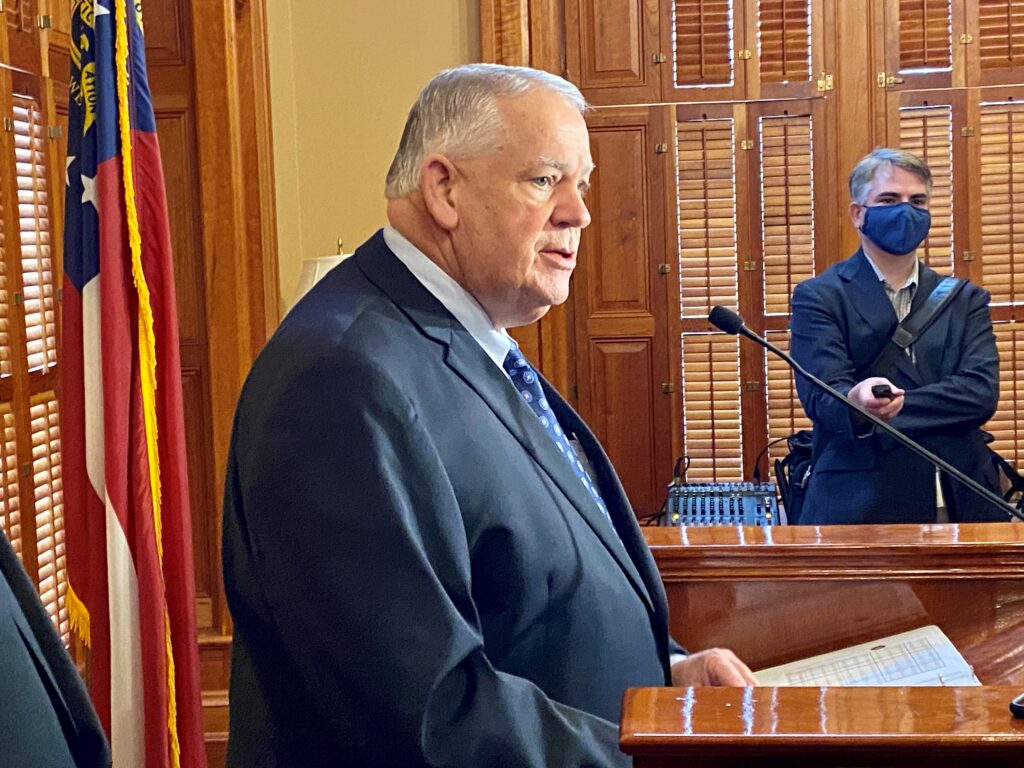
Georgia House Speaker David Ralston (Photo by Beau Evans)
ATLANTA – The Georgia House of Representatives gave final passage Monday to legislation that would let state employees and teachers take up to three weeks of parental paid leave.
The House passed the bill 153-8 just days after the state Senate approved it unanimously. It now heads to Gov. Brian Kemp for his signature.
House Speaker David Ralston, R-Blue Ridge, unveiled the bill last year as one of his top priorities for the 2020 General Assembly session. But it got sidetracked after lawmakers took a three-month break because of the coronavirus pandemic.
When the legislature returned to the Gold Dome last June, the Senate stripped paid parental leave from the bill and substituted a measure reducing lawmakers’ salaries. The House refused to support the change, and the bill died.
The legislation would apply to parents following the birth of a child of their own, an adopted child or a foster-care placement. Full-time employees would become eligible for paid parental leave after six months on the job.
About 246,000 state employees and teachers in Georgia would be eligible for paid parental leave.
ATLANTA – Georgians would be able to buy cocktails to- go under legislation that cleared the General Assembly Monday.
The state House of Representatives voted 120-48 to pass a bill that originated in the Georgia Senate that would let Georgians buy up to two mixed drinks in to-go cups holding a maximum of three ounces of liquor in each. Georgia already allows to-go sales of beer and wine.
Supporters in both the House and Senate, which passed the bill early this month, pitched the measure as a way to help restaurants battered by the coronavirus pandemic.
“Even when we’re fully out of this pandemic, the eating habits of Georgians have changed. Georgians will eat out differently,” Rep. Kasey Carpenter, R-Dalton, said on the House floor before Monday’s vote. “This bill will give us the flexibility to meet that change.”
The bill, which now goes to Gov. Brian Kemp’s desk, would not let customers buy only mixed drinks. They would have to buy food along with their take-out drink order.
To-go drinks would have to be in tightly sealed containers without holes for straws and be sealed so securely it would be easy to tell whether they had been opened.
They also would have to be stored in a glove box, locked trunk or behind the back seat while driving.
The Distilled Spirits Council of the United States released a statement after Monday’s vote praising final passage of the Georgia bill.
“The COVID-19 pandemic has devastated Georgia’s hospitality businesses, and it will take years for them to fully recover,” said Jay Hibbard, the group’s senior vice president of state governmental relations. “Cocktails to-go has already proven to be a vital part of their survival during COVID-19 and will only provide increased stability in the months and years to come.”
More than 30 states plus the District of Columbia allow restaurants and/or bars to sell cocktails to-go.
ATLANTA – Two tax bills left for dead in the General Assembly have been resurrected in the waning days of this year’s legislative session.
The Georgia House of Representatives late Friday overwhelmingly passed legislation that originated in the state Senate as a two-page bill.
However, as Senate Bill 6 went through the House Ways and Means Committee, two much longer bills that appeared headed for failure were attached to it, making them eligible for passage during the last two days of the session next week. The measure has now grown to 31 pages.
The original Senate Bill, introduced by Sen. John Albers, R-Roswell, calls for outside audits of up to five state tax credits each year to determine whether they’re creating enough jobs or generating enough economic development in general to make them worth their impact on the state’s revenue.
“This is a great opportunity for us to look at [tax credits] that are performing well … and others that may need to be tweaked or changed,” Albers declared back in January when his bill went through the Senate Finance Committee.
Another tax bill that has been added to Albers’ measure also originated in the Senate as a project of Sen. Chuck Hufstetler, R-Rome, the Finance Committee’s chairman.
Senate Bill 148 would create two review panels to study Georgia’s tax and revenue structure and draft legislation to rein in wasteful spending on tax breaks.
A similar review the state undertook at the beginning of the last decade led to tax reforms that eliminated Georgia’s “birthday” tax on motor vehicles, phased out the state sales tax on energy used in manufacturing and expanded an income tax exemption for married couples filing jointly.
“Georgia did something that worked really well back in 2010,” Hufstetler told his Senate colleagues last month before they passed it unanimously. “It’s time to do that again.”
But the House shot down Hufstetler’s bill overwhelmingly last week with only 20 lawmakers voting “yes” and 139 opposing it.
However, those 20 supporters included several Republican leaders, notably House Speaker Pro Tempore Jan Jones, R-Milton; Majority Leader Jon Burns, R-Newington; and Ways and Means Committee Chairman Shaw Blackmon, R-Bonaire. Their influence allowed it to be brought back on Friday attached to Albers’ bill.
The House also strongly supported a third tax bill that originated in that chamber and passed that chamber overwhelmingly but has struggled in the Senate.
House Bill 587 includes a smorgasbord of new tax credits billed by supporters as a way to help businesses across Georgia struggling through the coronavirus pandemic.
The Georgia Economic Renewal Act of 2021 would offer tax credits to manufacturers of medical devices and pharmaceuticals, the aerospace industry, boat repair companies along the coast, performing arts venues and short-line railroads.
“Our economic renewal and recovery will create jobs and spur growth in several industries in Georgia,” House Speaker David Ralston, R-Blue Ridge, declared on the House floor early this month.
The Senate has yet to bring the bill to the floor for a vote. In an opinion column published by Hufstetler’s hometown newspaper, the Rome News-Tribune, the senator cited a fiscal note on the bill indicating the proposed tax breaks combined would cost the state almost $1 billion.
“In Georgia, we collect about $14 billion in income taxes a year, but we give out about $10 billion in sales tax exemptions and tax credits,” Hufstetler wrote. “Think about how low the income tax rate in Georgia could be if we phased out most of these credits.”
That bill, too, is now attached to Senate Bill 6, which creates a conundrum for lawmakers as it heads back to the Senate.
They will have to decide during the last days of this year’s General Assembly session whether to support legislation that on one hand seeks to bring additional scrutiny to Georgia’s tax credit largesse and adds an expensive set of new tax breaks on the other.