ATLANTA – Legislation aimed at legalizing online sports betting in Georgia is a casualty of the controversial election law overhaul majority Republicans pushed through the General Assembly last week.
A constitutional amendment asking voters whether to bring legal sports betting to Georgia and a separate “enabling” bill outlining how the industry would operate failed to reach the floor of the state House of Representatives on the final night of this year’s legislative session.
Both measures had cleared the Georgia Senate early last month.
Supporters blamed passage of the omnibus election reform bill for poisoning the well for Democrats, whose support was critical to passing sports betting.
The Georgia chapter of the NAACP released a statement on Wednesday urging lawmakers not to vote for any legalized gambling legislation.
“That killed it,” state Rep. Ron Stephens, R-Savannah, who was carrying the sports betting legislation in the House, said Thursday. “After that, a lot of issues fell by the wayside.”
Stephens and other Republicans worked to win Democrats’ support for sports betting by agreeing to dedicate a portion of the proceeds to need-based scholarships, a key priority for Democrats.
But the goodwill between GOP supporters of sports betting and Democratic lawmakers faded after Gov. Brian Kemp signed an election reform bill Democrats labeled as voter suppression. The Georgia NAACP is among the groups challenging the legislation in a federal lawsuit.
“If they expect to earn our support on corporate issues that will make rich people wealthier, our expectation is that they, too, work with us on uplifting our community through meaningful policy objectives,” the Rev. James Woodall, state president of the Georgia NAACP, wrote in a statement.
Senate passage of sports betting had begun building momentum for the legislation in the House. It marked the first time in a decade of trying that supporters of legalized gambling had gotten a bill through either of the two chambers.
But the tide appeared to be turning by Wednesday morning, when Sen. Jeff Mullis, chief sponsor of the sports betting measures, took to the Senate floor to complain that House Democrats were blocking his legislation.
“They are leaving tens of millions of dollars on the table for need-based [scholarships] funding for people who really need it,” said Mullis, R-Chickamauga.
Rick Lackey, an Atlanta-based real estate developer behind three proposed casino resorts scattered across Georgia, suggested sports betting failed because the legislation didn’t include legalizing casino gambling.
He said casinos would bring in far more tax revenue for need-based scholarships, health care and other uses the state might have for gambling proceeds than sports betting. Also, online sports betting wouldn’t create jobs, while casinos would generate thousands of temporary construction jobs and permanent jobs after mixed-use casino resorts open for business, he said.
“It’s like comparing penny pitching to Blackjack,” Lackey said.
Lackey pointed out that a constitutional amendment to legalize sports betting, casinos and pari-mutuel betting on horse racing is still alive in the Georgia House for consideration next year.
But Stephens said he’d rather see the General Assembly pursue sports betting first.
“Sports betting is supposed to be the easy one,” he said. “It would give us momentum as we move into the other stuff.”
The General Assembly has passed a bill to hire a chiel labor officer over the objections of Georgia Commissioner of Labor Mark Butler.
ATLANTA – The General Assembly wants to hire a chief labor officer despite objections from Georgia Commissioner of Labor Mark Butler that the position represents an unnecessary encroachment on his jurisdiction.
The state Senate voted 29-20 Wednesday night to create the position of chief labor officer after months of complaints from jobless Georgians waiting for unemployment compensation checks. That’s the bare minimum of votes needed to pass a bill in the 56-member body.
The Georgia House of Representatives had passed the measure 142-22 earlier in the evening.
Under the bill, the chief labor officer’s job would be to keep lawmakers up to date on financial audits of the labor department.
Lawmakers have been bombarded throughout the coronavirus pandemic with complaints from constituents reporting delays in receiving benefit checks and the lack of response from the agency when they call to ask about their cases.
Legislators trying to run interference with the department for their constituents haven’t gotten satisfaction, House Majority Whip Trey Kelley said on the House floor Wednesday night.
“We’re just having trouble getting information on how claims are being processed,” said Kelley, R-Cedartown.
Commissioner of Labor Mark Butler spoke out against the bill as it went through the committee review process. He argued that hiring an untrained person lacking knowledge in how the department operates would do nothing to speed up the processing of an unprecedented deluge of claims resulting from the pandemic.
The bill also creates uncertainty over who would be in charge of the agency, a statewide elected official put there by Georgia voters or an appointee, Butler said.
A late change added to the bill would require the labor commissioner to submit periodic reports to the General Assembly on the disposition of unemployment claims.
“We’re going to hold them accountable to make sure they’re progressing, so we can give [legislators] information they can give to their constituents,” said Rep. Tom Kirby, R-Loganville, a member of the House Industry and Labor Committee.
The fiscal 2022 state budget the General Assembly passed Wednesday night includes $198,916 to fund the new position.
The job is meant to be temporary, expiring at the end of next year unless it’s renewed by the legislature.
The bill now heads to Gov. Brian Kemp for his signature.
ATLANTA – Georgia lawmakers left the Gold Dome early Thursday after passing legislation loaded with business tax breaks and firing a shot across the bow of Delta Air Lines for criticizing a controversial election law overhaul.
The General Assembly sent to Gov. Brian Kemp’s desk a bill that would provide new or expanded tax credits to medical equipment and pharmaceutical manufacturers, performing arts venues, companies that repair expensive yachts and short-line railroads.
Other beneficiaries of the package would include developers of “mega-site” corporate projects and the aerospace industry, a tax credit aimed primarily at Marietta’s Lockheed plant.
Supporters pitched the legislation as a way to help businesses hurt by the economic impact of COVID-19.
However, a joint House-Senate conference committee that negotiated the final version of the bill scrapped a controversial grant program aimed at rural Georgia. The state approved an initial round of funding for the program known as CAPCO early in the last decade, but critics argued its impact on creating jobs has never been evaluated in Georgia or proven effective elsewhere.
Proving they can both give and take away in the same bill, the conference committee also included legislation introduced early in this year’s session by Sen. John Albers, R-Roswell, requiring the state to conduct periodic audits of tax credit initiatives.
The measure calls for independent auditors to review up to five tax credit programs each year to determine whether their economic impact justifies the loss of state tax revenue.
“This is a large bill,” Albers said on the Senate floor Wednesday. “It brings checks and balances. It has us measure the return on investment, and it keeps Georgia the No.-1 place to do business.”
Meanwhile, leaders in the Republican-controlled state House of Representatives took aim at Atlanta-based Delta in separate tax legislation after CEO Ed Bastian released a statement on Wednesday arguing a GOP-backed elections reform bill lawmakers passed last week will it make it harder for Georgians to vote, particularly in minority neighborhoods.
“Since the bill’s inception, Delta joined other major Atlanta corporations to work closely with elected officials from both parties,” Bastian wrote in an open letter to Delta employees. “We had some success in eliminating the most suppressive tactics that some had proposed. However … the final bill is unacceptable and does not match Delta’s values.”
House Speaker David Ralston, R-Blue Ridge, took offense at Bastian’s statement.
“Some of the language reflected a complete lack of understanding of the bill,” Ralston said shortly after midnight Thursday after the House had approved legislation to take away a state sales tax exemption on jet fuel that primarily benefits Delta. “I was disappointed in that.”
However, the General Assembly’s bark proved worse than its bite when the state Senate declined to consider the removal of the tax break before adjourning the 2021 session, ending the threat.
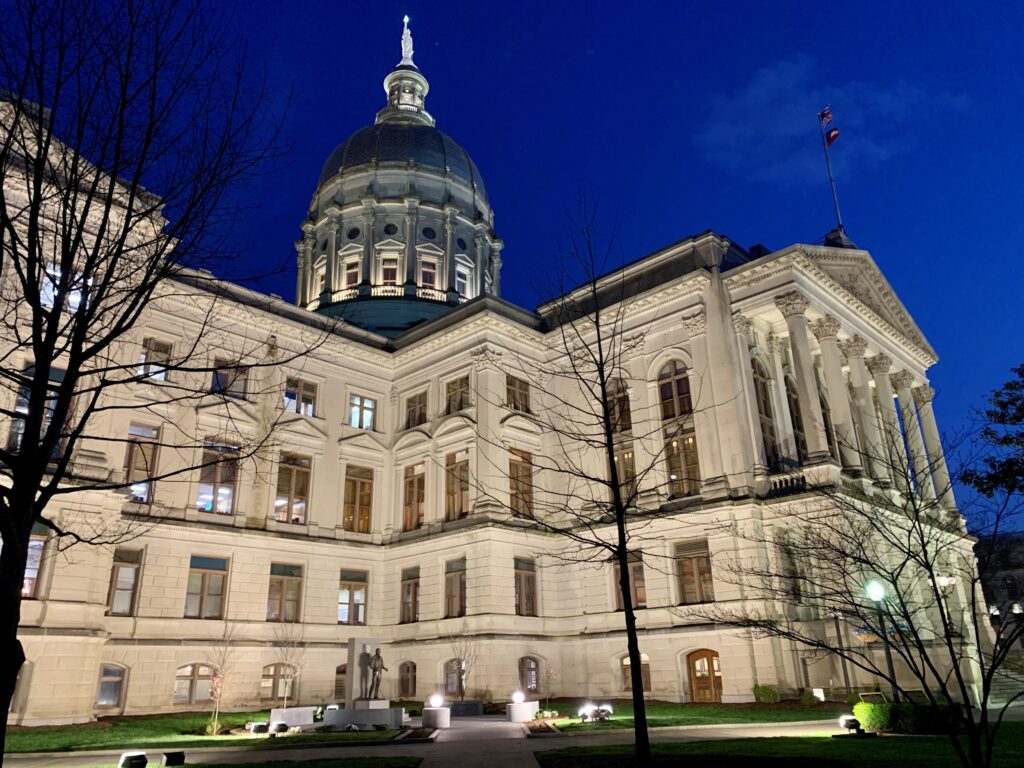
The Georgia Capitol at night (Photo by Beau Evans)
ATLANTA – The General Assembly signed off on Gov. Brian Kemp’s $27.2 billion fiscal 2022 state budget Wednesday night during the waning hours of this year’s legislative session.
The Georgia Senate passed the budget unanimously early in the evening. The state House of Representatives followed suit 148-21 several hours later, less than one hour before lawmakers adjourned after 40 days under the Gold Dome.
While the state is expecting to receive $4.6 billion in federal COVID-19 relief funds through President Joe Biden’s American Rescue Plan, Senate Appropriations Committee Chairman Blake Tillery also credited Gov. Brian Kemp’s decision to reopen Georgia’s pandemic-buffeted economy earlier than many states for easing the budget process.
House and Senate budget writers were able to restore a large portion of the 10% across-the-board spending cuts they were forced to make last year at the height of the pandemic.
“There is no chance this budget would have run this smoothly had Governor Kemp not reopened Georgia when he did,” said Tillery, R-Vidalia.
Chief among the restored funds in the new budget, which takes effect July 1, is $567.5 million in “austerity” cuts to Georgia public schools the General Assembly imposed last year.
The spending plans also adds about $40 million more for mental health services than Kemp recommended in the budget he submitted to lawmakers in January.
Another $10 million would be used to expand the deployment of rural broadband in Georgia. Those funds are in addition to $20 million included in the fiscal 2021 mid-year budget the governor signed in February.
Lawmakers provided pay raises to help retain employees in state agencies that have suffered from high turnover, including the departments of Agriculture, Banking and Finance, Driver Services, Corrections and Juvenile Justice.
The joint House-Senate conference committee that negotiated the final version of the budget allocated $36.7 million in bond funding to a new convocation center at Georgia Southern University that will be named in honor of the late state Sen. Jack Hill R-Reidsville, and his late wife Ruth Ann. Both died within weeks of each other last spring.
Lawmakers also approved $21 million in bonds for a conference center at Lake Lanier Island, $5 million to renovate the Christenberry Field House at Augusta University and $3.5 million to design the planned Gateway Building on the campus of Georgia Gwinnett College.
Sen. Elena Parent, D-Atlanta, questioned why the budget still includes $382 million in austerity cuts to K-12 education.
Tillery said the $6.9 billion Georgia schools expect to get from the American Rescue Plan will more than make up that shortfall.
House Appropriations Committee Chairman Terry England, R-Auburn, said the influx of federal funding is timely. But he left his House colleagues with a warning.
“Federal funds are never permanent,” he said.
The budget now goes to Kemp’s desk for his signature.
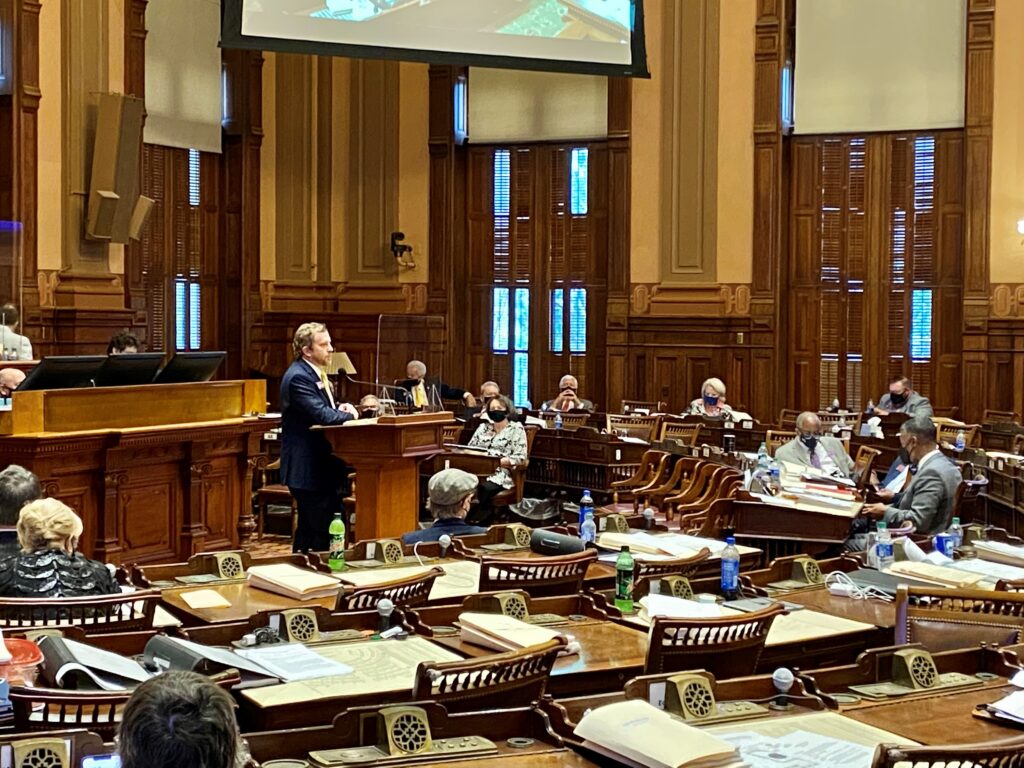
Rep. Bert Reeves, R-Marietta, speaks about his bill largely repealing citizen’s arrests in Georgia just before its final passage in the state House of Representatives on March 31, 2021. (Photo by Beau Evans)
ATLANTA – Legislation repealing Georgia’s 150-year-old citizen’s arrest law gained final passage in the General Assembly Wednesday.
On the final day of this year’s legislative session, the state House of Representatives unanimously passed a bill supported by Gov. Brian Kemp and legislative leaders as a follow-up to the hate-crimes law the General Assembly enacted last year.
The measure stems from the shooting death last year of Ahmaud Arbery, a Black jogger who was cornered near Brunswick by two white men in pickup trucks and shot dead. The defendants have cited the citizen’s arrest law in their defense.
Under the bill, owners of retail shops and restaurants would still be permitted to detain shoplifters on their premises.
It would also allow police officers who are off-duty or outside their jurisdiction to make arrests if they witness a crime or have knowledge a crime was recently committed.
Repealing citizen’s arrest would not affect the state’s stand-your-ground law, Georgia Rep. Bert Reeves, R-Marietta, told his House colleagues Wednesday.
“Everything we can do as a culture, society and General Assembly to educate our citizens on what is self-defense and what is not will make our communities safer,” he said.
Carl Gilliard, D-Garden City, who worked with Reeves on the bill, said citizen’s arrest in Georgia dates back to the Civil War. Georgia now has a chance to overcome that history, he said.
“Georgia would be the first state in the nation to repeal this law,” Gilliard said.
The legislation now goes to Kemp for his signature.