ATLANTA – The 4,800 members of Middle Georgia EMC will be the latest to benefit from a series of broadband projects cropping up across rural Georgia.
The utility, which serves all or parts of seven counties, announced Tuesday it will invest $36.7 million with Kansas City-based Conexon Connect to bring high-speed internet fiber to 100% of its members’ homes and businesses within two years. The first customers will be connected as early as the first quarter of next year.
“We grew up with a party line telephone and one-channel TV,” Randy Crenshaw, president and CEO of Middle Georgia EMC, said during a ceremony in the Dooly County seat of Vienna announcing the project. “Now, we’re introducing high-speed broadband.”
Expanding deployment of broadband service in rural Georgia has been a bipartisan priority of the state’s political leaders.
The General Assembly passed legislation two years ago clarifying in state law that electric membership cooperatives (EMCs) are legally permitted to attach internet fiber to their utility poles.
Then last year, lawmakers approved a bill giving the state Public Service Commission (PSC) the task of deciding how much the EMCs could charge telecommunications providers for pole attachments. In December, the commission approved an offer by the EMCs to charge only $1 per year during the next six years for new pole attachments in rural areas lacking broadband service.
The state is also stepping up the investment of public dollars in rural broadband. Between them, the fiscal 2021 mid-year budget and the fiscal 2022 spending plan the General Assembly adopted during this year’s legislative session earmarked $30 million for rural broadband projects.
While state and local policy makers have long recognized the need for expanding broadband connectivity in rural communities, the coronavirus pandemic has emphasized the point by forcing students out of classrooms to try to learn at homes without internet, said Jason Shaw, a member of the PSC representing South Georgia.
“The pandemic has truly painted the ‘digital divide’ picture our kids are going through,” he said. “They deserve to be able to do the same things as kids in metro Atlanta.”
Jonathan Chambers, a partner with Conexon, said bringing broadband service to rural areas will help stem population losses those communities have suffered in recent years.
“You need infrastructure for people to have job opportunities, in order to get education, in order to get today’s health care,” he said.
Conexon Connect will build a 1,900-mile fiber network providing high-speed internet access to Middle Georgia EMC members in Dooly, Houston, Macon, Pulaski, Turner, Wilcox and Ben Hill counties.
The Middle Georgia EMC project is the third Conexon has underway in the Peach State.
Earlier this month, Conexon and Washington EMC announced a $54.5 million plan to bring broadband to more than 12,000 homes in Baldwin, Emanuel, Glascock, Hancock, Jefferson, Johnson, Laurens, Warren, Washington and Wilkinson counties.
Last February, Conexon unveiled a $210 million project to serve all 80,000 customers of Central Georgia EMC and Southern Rivers Energy in all or parts of 18 counties.
Shaw said 15 EMCs across Georgia are either forming partnerships with fiber-optic companies to expand broadband service or are working on feasibility studies that could lead to future projects.
“We’ve made a lot of strides,” he said. “But we’ve got a long way to go.”
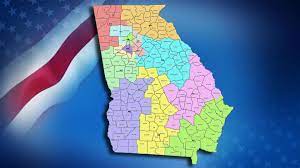
The 2010 Census divided Georgia into 14 congressional districts.
ATLANTA – Georgia will not be allocated additional congressional seats by the U.S. Census during the coming decade for the first time since the 1980s.
The first 2020 Census numbers released Monday by the U.S. Census Bureau show Georgia will retain the same 14 U.S. House districts the Peach State was awarded following the 2010 Census. Combined with the state’s two U.S. senators, that will give Georgia 16 electoral votes for the 2024 and 2028 presidential elections.
Georgia is among 37 states that will neither gain nor lose congressional seats, Ron Jarmin, the Census Bureau’s acting director, told reporters during a news conference. Only 13 states will gain or lose seats, the smallest shift since 1941, he said.
The state of Texas will gain two congressional seats, while five other states – Colorado, Florida, Montana, North Carolina and Oregon – will gain one each.
Each of seven states – California, Illinois, Michigan, New York, Ohio, Pennsylvania and West Virginia – will lose one seat.
Jarmin said the relatively small number of states adding or losing congressional seats reflected the second slowest population growth in history for the nation as a whole.
The U.S. population as of April 1, 2020, stood at 331.4 million, up 7.4% over the 2010 Census.
The South was the nation’s fastest growing region during the past decade, with a population increase of 10.2%. The West was next at 9.2%. The Northeast and Midwest grew at much slower rates, 4.1% and 3.1% respectively.
Utah was the fastest growing state in the U.S., with a population increase of 18.4%. Among just three states that lost population during the last decade, West Virginia’s 3.2% decline was the largest.
Georgia remains the nation’s eighth-most populous state with a population of 10.7 million, up from 9.7 million a decade ago.
U.S. Secretary of Commerce Gina Raimondo said the 2020 Census was hampered not only by the coronavirus pandemic but by wildfires in the West and a particularly active hurricane season.
The Census Bureau originally expected to release the first numbers by the end of last month but was delayed.
“2020 brought unprecedented challenges,” Raimondo said. “The Census Bureau had to quickly adopt its operations to confront these challenges head on.”
The 2020 Census – the 24th once-a-decade population count in U.S. history going back to 1790 – was the first to be conducted online.
Jarmin said two-thirds of Americans completed the census on their own between January and March of last year. Census takers were sent out in person to contact those who did not respond online, with an emphasis on historically undercounted areas, he said.
The General Assembly will use local data the Census Bureau will release later this year to redraw Georgia’s congressional and legislative district boundaries to reflect shifts in population within the state.
Georgia had 10 congressional districts throughout the 1970s and 1980s. Rapid population growth led the Census Bureau to allocate an 11th House seat to Georgia following the 1990 Census, 13 seats after the 2000 population count and 14 seats following the 2010 Census.
A 720,000-pound water tank is placed atop the Unit 4 containment vessel at Plant Vogtle. Credit: Georgia Power Co.
ATLANTA – Georgia Power Co. has achieved two important milestones in the construction of two additional nuclear reactors at Plant Vogtle, the Atlanta-based utility announced Monday.
Hot functional testing has begun on the first of the new reactors, Unit 3, at the plant south of Augusta. That’s the final series of major tests the reactor must pass prior to initial fuel load.
Hot functional testing is conducted to confirm whether the reactor is ready for the loading of fuel.
During the next six to eight weeks, operators will use the heat generated by Unit 3’s four reactor coolant pumps to raise the temperature and pressure of plant systems to normal operating levels. At that point, the unit’s main turbine will be raised to normal operating speed, allowing operators to exercise and validate procedures required prior to fuel loading.
Meanwhile, all modules for both units 3 and 4 have now been set with the lifting into place of a 720,000-pound water tank atop Unit 4’s containment vessel, the last major crane lift at the project site.
The tank, which stands 35 feet tall, will hold about 750,000 gallons of water ready to help cool the reactor in case of an emergency.
Unit 3 was due to go into service this November but could be delayed by a month or more, according to an announcement from Georgia Power last month. Unit 4 is scheduled to begin operations late next year.
Expected to cost about $14 billion when the Georgia Public Service Commission (PSC) approved the project in 2009, the price tag of the nuclear expansion has nearly doubled primarily due to the bankruptcy of Westinghouse Electric, the original prime contractor.
The project’s critics have long argued Georgia Power should pursue renewable energy more aggressively and stop investing in nuclear power.
Both Georgia Power executives and members of the PSC have countered that Georgia must be able to rely on a diverse range of power-generating options to keep electric rates affordable.
The first two nuclear reactors built at Plant Vogtle went into service during the late 1980s.
ATLANTA – A University of Georgia graduate student was charged Friday with cyberstalking and extortion through interstate threats aimed at a Massachusetts woman.
Gary E. Leach, 23, of Athens, is accused of obtaining private video calls from the victim by surreptitiously recording the calls, as well as photographs of a sexual nature from the victim. He then allegedly threatened to share the material with her family if she did not continue to send him content of a sexual nature.
Leach is alleged to have used anonymous Instagram accounts to contact and harass the victim, including accounts featuring nicknames for the victim and several variations of the username “u.kno_who.”
While communicating with the victim, he allegedly indicated to her that he had engaged in similar conduct with other Instagram users, some of whom also did not know they were being recorded.
The charge of stalking by electronic means provides for a sentence of up to five years in prison, three years of supervised release and a fine of $250,000. Extortion by interstate threat of injury to reputation carries up to two years in prison, one year of supervised release and a $250,000 fine.
ATLANTA – Efforts to reform Georgia’s coin-operated amusement machines (COAM) business will have to wait until next year.
Legislation aimed at cleaning up the industry by offering game winners redeemable gift cards as an incentive to stop illegal cash payouts fizzled on the last night of this year’s General Assembly session.
The bill fell victim to a lack of consensus about whether and how to reform the COAM business.
During the 2021 legislative session that wrapped up at the beginning of this month, the gaming companies that own the machines not only disagreed with the convenience store owners who house the games. The two groups couldn’t even reach agreement within their own ranks.
“You’ve got folks fighting each other. We don’t think that’s good for the industry,” former Georgia House Majority Whip Edward Lindsey, a lawyer representing Norcross-based COAM supplier Lucky Bucks, said during a state Senate committee hearing. “We ought to be taking a little extra time before we move forward.”
While the COAM business is perceived as a poor relation to the Georgia Lottery, the industry has become the biggest revenue-raiser for the Georgia Lottery Corp. since the lottery took it over in 2013, state Rep. Alan Powell, the bill’s chief sponsor, said in a recent interview.
Last year, the machines brought in more than $90 million in proceeds to the lottery under a formula that dedicates 10% of those earnings to the state, and another $12 million in license fees.
“It’s been growing every year because people like to play these games,” said Powell, R-Hartwell.
At the same time, the industry has been plagued by retailers awarding illegal cash payouts to winners, Powell said. Under state law, winners are only supposed to receive merchandise or gasoline sold at the convenience store.
Powell’s bill calls for awarding gift cards to game winners as an incentive for retailers to stay away from cash prizes. As an enforcement mechanism, the measure also would fine violators and – more importantly – ban them from future participation in the COAM business.
“These gift cards should help clean up the paying out of cash in this industry,” Rep. Stacey Evans, D-Atlanta, said during a House floor debate on the bill.
The House passed Powell’s bill on the last night of the General Assembly session. But it had not reached the Senate floor for a vote before lawmakers adjourned minutes after midnight.
The reticence of the Senate to take up the bill on the session’s last night reflected opposition to the legislation aired during a lengthy hearing the Senate Regulated Industries Committee had held the week before.
A key complaint from both senators and lobbyists was over another issue plaguing the COAM business: the payment by gaming companies of illegal inducements to retailers to install a company’s games in their convenience stores.
“Most of the operators in the state want to see it done right,” Powell told committee members. “[But] some of the master license holders continue predatory practices when it comes to inducements or back-door methods of trying to take retailers from [each] other.”
Powell’s bill called for going after the offering of illegal inducements by providing for judicial review of complaints rather than having them heard by the Georgia Lottery Commission.
“It’s not right that if a case is made by the lottery against a retailer or master license holder, it goes to a hearing officer appointed by the … lottery commission,” he said. “There needs to be due process for the sake of fairness and what’s right.”
But state Sen. John Kennedy objected to shifting management of the COAM industry away from the lottery. Kennedy, R-Macon, chaired a Senate study committee on the COAM industry last year and sponsored a bill of his own on the issue this year.
“This bill takes tools away from the lottery that it currently has,” added Paul Oeland, senior counsel for Stockbridge-based United Gaming.
Others who testified before the committee objected to moving forward with the gift card provision.
Lindsey said the lottery commission has yet to assess the results of a pilot project it launched last year testing the concept.
“The gift card ought to be put on pause until after the pilot program is finished,” he said.
On the other hand, Emily Dunn, an amusement game operator from Blue Ridge, gave the gift card a strong endorsement.
“The card is convenient. It is easy to use for players. It is transparent. It is easy to track and audit,” Dunn told the committee. “You cannot track cash. You can track a card.”
The months-long “interim” period before the 2022 General Assembly convenes next January will give the various parties time to try and work out their differences.
“That bill is alive and well over [in the Senate],” Powell said. “A senator or two has reached out to me to say they want to carry it next year.”