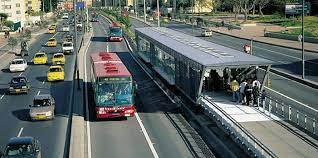
The U.S. Senate infrastructure bill could help fund MARTA’s plans to build bus-rapid transit lines.
ATLANTA – The nearly $1 trillion infrastructure bill now before the U.S. Senate would be a good fit for public transit in Georgia, officials with Atlanta’s MARTA bus and rail system said Tuesday.
The legislation, which contains $550 billion in new spending, would increase funding for MARTA and other transit agencies across the country by 65%.
A key provision in the bill for transit systems would raise the project eligibility for federal Small Starts program grants from $300 million to $400 million. The federal share of those projects would increase from $100 million to $150 million.
Most of MARTA’s capital projects are expected to cost between $300 million and $400 million.
The first two MARTA capital projects in the pipeline to receive federal support if Congress passes the bill are a planned bus-rapid transit line (BRT) in Clayton County connecting College Park, Riverdale and Morrow, and the Campbellton Corridor, either a BRT or light-rail line to be built in southwest Atlanta. Both already have secured matching local funds.
“We have at least a dozen projects on our wish list that need federal funding, and this bill will have a major impact on eligibility and amount awarded per project,” MARTA General Manager and CEO Jeffrey Parker said.
The Senate bill also would raise federal formula funds for transit, increasing MARTA’s annual share from about $108 million to $140 million.
The legislation also provides additional support for transit systems to transition to zero-emission electric buses, modernize bus and rail fleets and improve accessibility for seniors and passengers with disabilities.
The infrastructure bill enjoys rare bipartisan support in the Senate and, thus, stands a good chance of passing. However, its fate in the House is uncertain amid Speaker Nancy Pelosi’s attempts to link it with a larger bill boosting funding for “human infrastructure” including child care, health care and climate change measures.
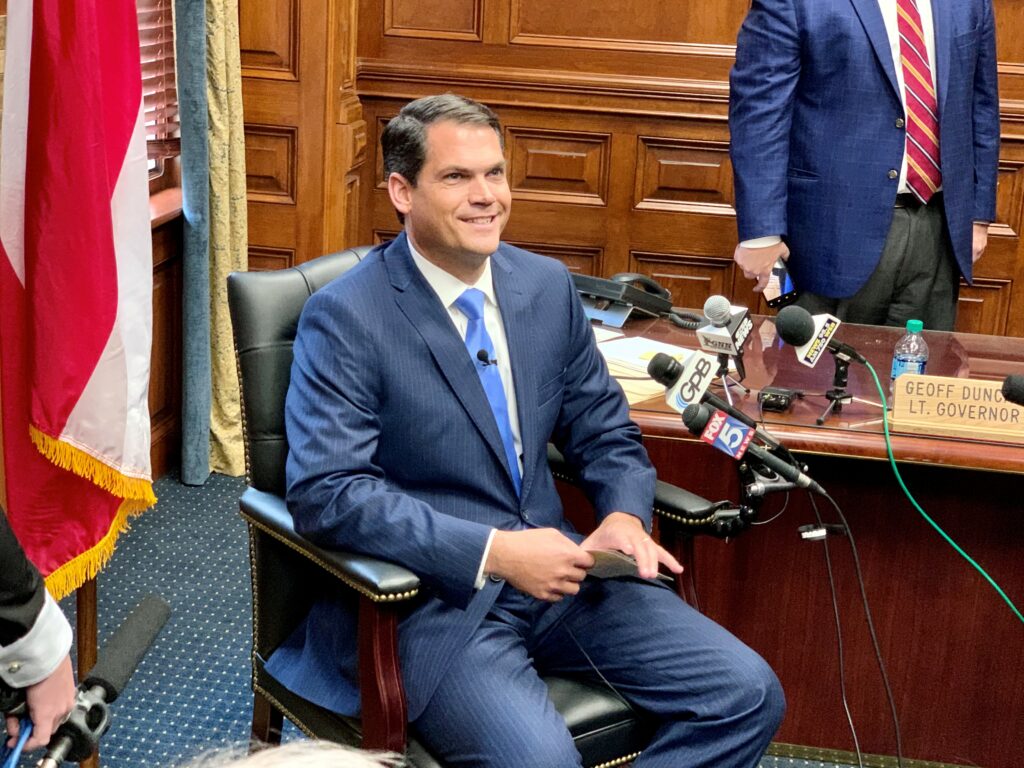
ATLANTA – Lt. Gov. Geoff Duncan is leaving elective office next year to try to restore bipartisanship to the search for solutions to the problems facing America, the Republican from Cumming told a business audience Monday.
“Both sides are guilty of trying to politicize every issue,” Duncan said during a luncheon speech before the Rotary Club of Atlanta. “It’s this type of mindset that drove me in a new direction.”
Duncan announced in May he would not seek a second term as Georgia’s lieutenant governor to focus on creating a national nonprofit called “GOP 2.0” aimed at rebuilding the Republican Party in the aftermath of former President Donald Trump’s ongoing claims of widespread voter fraud following his defeat last November.
“It’s not about winning elections,” Duncan said Monday. “It’s about creating a movement that lets us focus on real problems with real solutions.”
Duncan was outspoken after Trump’s loss to Democrat Joe Biden about the need for the GOP to move on from 2020 and stop dwelling on lawsuits charging election fraud that were dismissed in court after court. On Monday, he called the controversies that swirled after Election Day a “post-election disaster” that was unnecessary.
While Duncan puts together his new organization, he vowed to continue working on the key challenges facing Georgia during his last 17 months in office.
He plugged a proposal he unveiled last month calling for a $250 million state income tax credit to raise money for fighting crime. The money raised through donations made in exchange for the tax credit would go to police officer pay raises, to hire more officers and to increase training.
“Crime is something that’s been politicized way too much,” Duncan said. “[But] crime affects Democrats and Republicans equally.”
Duncan also pledged to continue his efforts to make Georgia the technology capital of the Southeast. He launched a public-private partnership last year dedicated to that goal.
“Every business in the 21st century is a technology company,” he said. “We want to make sure they have a safe home here in Georgia.”
ATLANTA – Georgia Agriculture Commissioner Gary Black is telling University of Georgia football icon Herschel Walker to put up or shut up in next year’s Republican race for the U.S. Senate.
Walker, former President Donald Trump’s pick to challenge incumbent Democratic Sen. Raphael Warnock, has been hinting he may run for the seat but hasn’t made a firm decision.
Black, who is already in the race, has released a TV ad contrasting his Georgia background with the fact that Walker now lives in Texas.
The ad starts with a video showing Walker in front of car with a Georgia license plate, saying he’s ready to “run with the Big Dogs.” The spot then cuts to Black standing beside and then getting into a tractor.
“For fun, my ride’s a tractor, and I’ve had Georgia plates all my life,” Black said.
While some potential Republican Senate candidates are on the sidelines waiting to see whether Walker will run, Black and two others haven’t hesitated to get into the contest.
Latham Saddler, an Atlanta banking executive and former Navy SEAL officer, and Kelvin King, a small business owner and Air Force veteran from Atlanta, have joined Black in declaring their candidates for the GOP Senate nomination.
Black and Walker attended the University of Georgia together during Walker’s freshman season.
“If my old classmate from UGA wants to join the conversation here in Georgia, I welcome hearing his ideas,” Black said. “But it takes more than pretending to change your car tags. Move here, pay taxes here, register and vote in some elections, and learn what Georgians have on their minds.”
ATLANTA – Christmas is coming early this year for local governments, businesses and nonprofits in Georgia struggling to recover from the coronavirus pandemic.
Starting Aug. 1, the state will be accepting applications for $4.8 billion in federal funding earmarked for Georgia in the American Rescue Plan, a $1.9 trillion COVID-19 stimulus bill Congress passed in March. The state will get the money in two installments of $2.4 billion each, one this year and one in 2022.
Three committees of state lawmakers and high-level leaders of executive branch agencies will begin meeting in September to sift through the requests and allocate the money in mid-October.
It promises to be a daunting task, said Georgia House Appropriations Committee Chairman Terry England, who will sit on all three committees.
“We may have literally thousands of applications to look at,” said England, R-Auburn.
The committees will have some help. The Governor’s Office of Planning and Budget (OPB) will review each funding application to make sure it complies with guidelines set by the U.S. Treasury Department, England said.
“The guidelines are out there,” he said. “OPB has a special website set up for [applicants] to look at.”
It’s no coincidence that two of the three committees are dedicated specifically to considering funding applications for broadband and water and sewer projects. The third committee will review proposals aimed at addressing the pandemic’s economic impact.
“Broadband and water and sewer are the only infrastructure [projects] specifically authorized in the federal legislation without strings attached,” said Clint Mueller, legislative director for the Association County Commissioners of Georgia (ACCG).
A significant caveat applicants must follow is to request funding only for one-time projects. It was important enough that Gov. Brian Kemp included it in his prepared statement appointing the members of the three committees.
In the case of an infrastructure project, that means construction costs but not operational expenses. Local governments asking for funds to cover employee pay raises should make them one-time bonuses, not ongoing salary increases.
“There’s a lot of concern that people spend it right, that they don’t incorporate it in their budgets and when the money goes away, they can’t keep it going,” Mueller said.
The American Rescue Plan (ARP) money for broadband and water and sewer projects comes in addition to significant funding already available from other sources.
Kemp allocated $30 million in state funds this year to expand broadband connectivity in rural Georgia. Also, the Federal Communications Commission’s Rural Digital Opportunity Fund has set aside $326.5 million for Georgia over the next 10 years.
On the private sector side, local electric membership cooperatives (EMCs) across the state are partnering with telecom providers to bring high-speed internet to rural communities for the first time.
“Funding is one of the major barriers to broadband expansion, so the additional resources come at a great time as momentum builds for providing adequate internet service to every part of the state,” said Jason Bragg, vice president[DW1] of government relations for Georgia EMC. “EMCs are appreciative of Governor Kemp’s willingness to allocate ARP funds toward the critical issue of broadband access.”
State investment in water and sewer projects also has risen substantially. The Georgia Environmental Finance Authority approved $475 million in loans to cities, counties and local water and sewer authorities during fiscal 2021, which ended June 30, more than double the $192.3 million in loans the agency floated during the previous fiscal year.
Mueller said he expects fast-growing counties will account for most of the funding requests for water and sewer projects.
Broadband projects that seek to combine taxpayer funding with private partners including EMCs are most likely to win approval for ARP money, he said.
Mueller said smaller counties could be at a disadvantage in the process because of the red tape involved in submitting applications for funding.
“Smaller counties don’t have the staff resources to keep up with all of that,” he said.
England said one way around that problem would be for smaller cities, counties and nonprofit organizations to consolidate their applications under a larger umbrella.
“Some cities and counties don’t have grant managers,” he said. “ACCG or GMA (the Georgia Municipal Association), with their resources, could pool those together and make an application on their behalf. That’s what I hope we’ll see on some of these.”
State Rep. Calvin Smyre, D-Columbus, the longest serving member of the Georgia House, said he’s been contacted by a lot of nonprofits interested in applying for ARP money to help fund their activities.
“You cannot leave out social justice and community-based projects,” said Smyre, who will serve on the committee to review applications aimed at the pandemic’s economic impact. “I think you’ll see those bubble up.”
Smyre said he expects a competitive process when the committees sit down to review the applications.
“Everybody was affected by the pandemic,” he said. “Their resources were hit. This is an opportunity to fund some of these programs.”
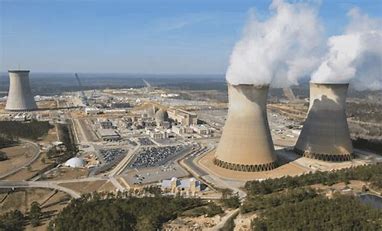
The cooling tower of a third nuclear reactor at Plant Vogtle looms in the distance.
ATLANTA – Georgia Power’s nuclear expansion at Plant Vogtle is being delayed again due to “productivity challenges” and additional time needing for testing and quality assurance, the Atlanta-based utility announced Thursday.
Under the new schedule, the first of two new nuclear reactors being built at the plant south of August isn’t expected to go into service until the second quarter of next year. The second reactor won’t be ready until the first quarter of 2023. That amounts to a three- to four-month delay for each reactor.
The total capital cost of the project also is going up by $460 million, Georgia Power announced.
“Georgia Power is focused on safety and quality as we complete this project,” said Chris Womack, chairman, president and CEO of Georgia Power. “[The Vogtle nuclear expansion] remains a critical investment for the state to provide low-cost, reliable and emissions-free electricity for the state of Georgia for 60 to 80 years.
“This is too important to our customers, our state and our nation for us not to get it right, and we will.”
The first of the two new reactors at Plant Vogtle originally was to be completed in 2016, with the second reactor to go into service one year later. But the project has encountered a number of delays, due in part to the bankruptcy of Westinghouse Electric, the original prime contractor.
The cost of the project has nearly doubled from the original estimate of $14 billion approved by the Georgia Public Service Commission (PSC) a dozen years ago to about $26 billion.
Georgia Power is partnering with three other utilities on the project. The company’s share of the total capital cost is now an estimated $9.2 billion.
However, Georgia Power has not sought approval of any capital costs above the $7.3 billion share previously approved by the PSC. There also are special protections in place for customers during construction, including a reduction in Georgia Power’s return on investment for the project.
“We knew building the first new nuclear units in the U.S. in more than 30 years would be challenging,” Womack said. “The project has endured extraordinary circumstances during construction, including the pandemic.”
There was one bit of positive news for the project on Thursday. Georgia Power announced hot functional testing of the first of the two new reactors has been completed, meaning the unit is 99% complete.
During hot functional testing, plant systems achieved normal operating pressure and temperature, without nuclear fuel, to verify the successful operation of reactor components and systems together.
The total project, included the second reactor, is now 93% complete, Georgia Power announced.
The project’s opponents have long argued Georgia Power could have avoided the uncertainties of the nuclear expansion by putting more investment into renewable energy sources.
But utility officials continue to maintain the Vogtle expansion is the most cost-effective and reliable long-term deal both for Georgia Power’s shareholders and its customers.