ATLANTA – Georgia will use $5.8 million in federal coronavirus relief aid to market a tourism industry that suffered losses during the pandemic, Gov. Brian Kemp said Thursday.
Travel spending, tourism jobs and overall economic impact from tourism have all declined during the pandemic, but the damage could have been worse.
Visitation to Georgia during fiscal 2020 nearly matched the record set during the previous fiscal year, as domestic overnight and day trips to and within Georgia helped offset the loss of international visitors and conventions.
Tourism generated 410,000 jobs statewide in fiscal 2020 and produced an economic impact of $53.72 billion. The Georgia Department of Economic Development has yet to release figures from fiscal 2021, which ended June 30.
The influx of COVID-19 relief funds to the agency’s tourism division will help build on the success of the state’s tourism recovery marketing campaign launched earlier this year,called Ready. Set. Georgia.
“This funding will help Georgia’s travel and hospitality industry compete in a highly competitive marketing landscape,” Kemp said.
The state’s travel website also is performing well. ExploreGeorgia.org has recorded 15 consecutive months of record-breaking traffic, with more than 11 million visits during fiscal 2021, an increase of 59% over the previous fiscal year.
“Georgia is a beautiful, diverse state,” state Commissioner of Economic Development Pat Wilson said. “Despite the challenges of the last year, with additional funding … there are optimistic signs that point to a tourism industry well positioned for future success.”
This story available through a news partnership with Capitol Beat News Service, a project of the Georgia Press Educational Foundation.
ATLANTA – Georgia Secretary of State Brad Raffensperger is turning up the heat on the Justice Department over its lawsuit challenging controversial election law changes the General Assembly adopted last March.
Raffensperger announced Wednesday he has filed a Freedom of Information Act request (FOIA) with the federal agency to release any records of contacts it may have had with civil and voting rights organizations in light of the lawsuit.
“We believe there’s potential they’ve been following orders from [2018 Democratic gubernatorial nominee] Stacey Abrams and others,” Raffensperger said. “We think something is going on.”
The FOIA request calls for the release of communications between the Justice Department and 62 individuals and organizations, including Fair Fight Action, a voting rights group Abrams founded; the American Civil Liberties Union; the Southern Poverty Law Center; and Perkins Coie, a law firm that represents Democrats in voting cases.
The lawsuit, filed in June, accuses Georgia of violating the federal Voting Rights Act by denying or abridging the right of Black Georgians to vote based on their race or color by, among other things, reducing access to absentee voting.
The law, which the Republican-controlled legislature passed along party lines, replaces the signature-match verification process for absentee ballots with an ID requirement.
Raffensperger accused the Justice Department of unfairly singling out Georgia. For example, the new law’s requirement that Georgians wishing to vote by absentee ballot submit a driver’s license number or some other form of identification is the same provision imposed by the state of Minnesota, he said.
Likewise, the new law’s provisions for early voting in Georgia are less restrictive than current laws in New York, New Jersey and Delaware that are not being taken to court, he said.
“We’re being held to a higher standard than most other states,” he said. “We want Georgia treated the same as everyone else.”
Lauren Groh-Wargo, CEO of Fair Fight Action, dismissed Raffensperger’s FOIA request as political gamesmanship.
“The latest nonsense from Brad Raffensperger is more grandstanding and another sad move by a very desperate man,” she wrote in a Twitter post.
ATLANTA – Georgia has scored another victory in the decades-long tri-state water wars with Alabama and Florida.
In a decision issued late last week, the U.S. Army Corps of Engineers granted Georgia’s request for water allocation from Allatoona Lake, which supplies Cobb County and the city of Cartersville.
The Corps’ decision on the Allatoona Lake supply came less than a month after a federal judge ruled in Georgia’s favor in a lawsuit challenging Georgia’s use of water from Lake Lanier.
“This is a generational pivotal moment for metro Atlanta that secures our water supply for decades to come,” said Katherine Zitsch, managing director of natural resources for the Atlanta Regional Commission. “[It] significantly increases our drought resiliency … [and] will encourage further smart infrastructure investments and efficient water use in the region.”
Both the Army Corps’ decision on Allatoona Lake and the court ruling on Lake Lanier stem from federal lawsuits the state of Alabama filed claiming the Corps was allocating too much water to Georgia at its expense.
The U.S. Supreme Court also sided with Georgia in a ruling in April rejecting a lawsuit the state of Florida filed alleging the water Georgia takes from the Chattahoochee River Basin has ruined the oyster industry in Apalachicola Bay.
The decision by the Corps on Allatoona Lake, dated Aug. 27, cited the building of the $100 million Hickory Log Creek Reservoir as a factor in its approval of the water allocation request submitted by the Cobb County-Marietta Water Authority and the city of Cartersville.
The 411-acre reservoir in Cherokee County, which opened in 2013, conserves water by providing upstream storage.
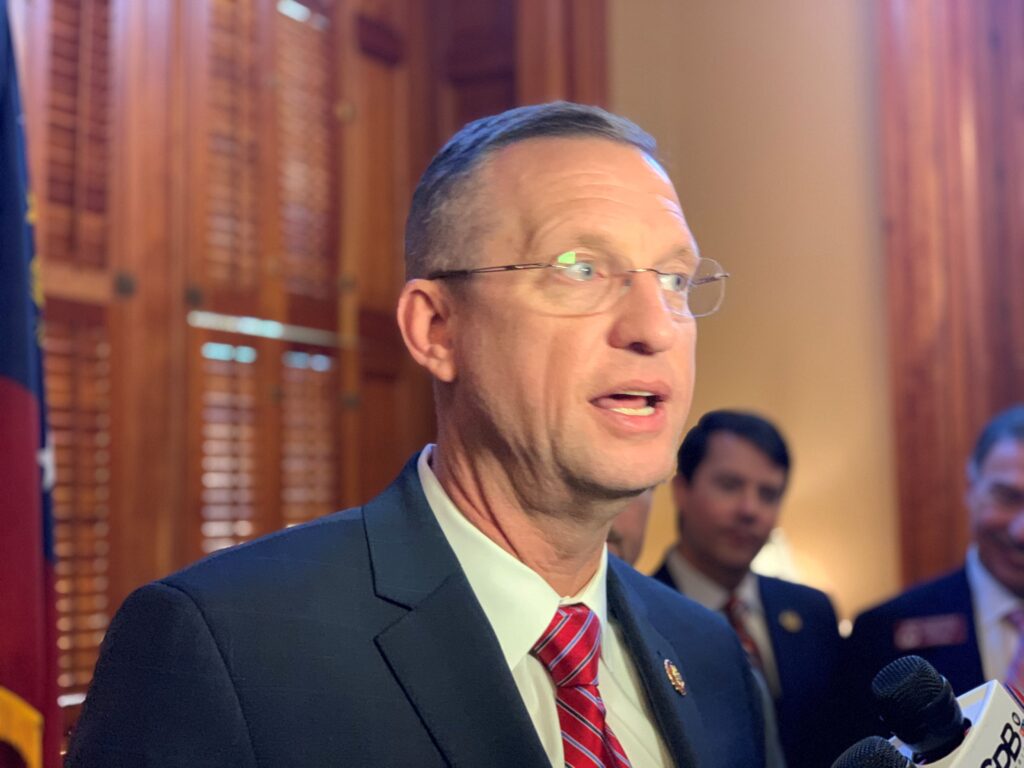
Former U.S. Rep. Doug Collins (Photo by Beau Evans)
ATLANTA – Former U.S. Rep. Doug Collins has endorsed Georgia Agriculture Commissioner Gary Black for U.S. Senate.
Black, who is seeking the Republican nomination to challenge Democratic Sen. Raphael Warnock next year, picked up Collins’ support during a campaign event Tuesday at Black’s farm in Commerce.
Collins, R-Gainesville, left Congress last year to run for the Senate in a crowded contest eventually won by Warnock.
“Gary Black is somebody who will stand up for our values in Georgia,” Collins told a crowd of Black’s supporters. “We’re in desperate need of new leadership in Washington, D.C. … We need people who have the integrity Gary Black has.”
In the House, Collins was among the staunchest backers of former President Donald Trump, defending the president during impeachment hearings the House held in late 2019.
At Trump’s urging, University of Georgia football great Herschel Walker jumped into the Senate race last week. But that didn’t dissuade Collins from endorsing Black.
“I don’t care who else is running,” Collins said Tuesday. “I support Gary Black.”
The event at Black’s farm drew nearly 400 attendees and included a speech by former Gov. Nathan Deal, who endorsed Black in July.
Georgia Public Service Commissioner Bubba McDonald also spoke, and U.S. Rep. Andrew Clyde, R-Athens, spoke to the audience by phone from Washington.
Pete Skandalakis (Photo credit: Newnan Times Herald)
ATLANTA – The partial shutdown of the court system in Georgia during the coronavirus pandemic is contributing to the crime wave plaguing Atlanta and other cities, a representative of the state’s prosecutors said Tuesday.
“We have to get our courts operating again,” Pete Skandalakis, executive director of the Prosecuting Attorneys’ Council of Georgia, told members of a legislative committee. “If we get COVID under control, jails will be able to hold people longer.”
Georgia House Speaker David Ralston asked the House Public Safety & Homeland Security Committee last spring to hold hearings this summer to examine what’s behind a rise in violent crime across the state – particularly in and around Atlanta – and look for solutions.
A crime wave that began during the early months of the pandemic last year in Atlanta and other large U.S. cities has picked up momentum this year. Gov. Brian Kemp responded in April by forming a multi-agency Crime Suppression Unit to work with local police departments to address the worrisome trend.
Col. Chris Wright, commissioner of the Georgia Department of Public Safety, told the committee Tuesday the unit is making progress.
Since April, members of the unit have made 10,953 traffic stops resulting in 7,618 citations, he said. They have made 285 arrests for driving under the influence and 207 for reckless driving while arresting 188 people on warrants, including 11 murder suspects, he said.
Wright said the agency’s board voted last week to make the Crime Suppression Unit permanent and assign 10 state troopers to full-time duty with the unit in metro Atlanta.
But Skandalakis said there’s a limit to what law enforcement can do to fight violent crime when a lack of indictments and jury trials has created a backlog of pending criminal cases. The backlog is causing jails to become overcrowded with suspects awaiting trial, which forces authorities to release repeat offenders charged with violent crimes on bond, he said.
“We can’t arrest our way out of the problems occurring today,” he said. “With the pandemic, we’ve had a perfect storm of repeat offenders with access to firearms.”
Rep. Alan Powell, R-Hartwell, said the delay in prosecuting cases is promoting a lack of accountability in the criminal justice system.
“It’s creating a general level of disrespect,” he said. “Many people think there’s no consequences for their actions.”
But there have been some successes. Atlanta Police Chief Rodney Bryant testified Tuesday that the level of gun violence in the city went down after his department, working with the FBI and the Georgia Bureau of Investigation, launched Operation Phoenix targeting the most violent offenders.
Another initiative aimed at crime around nightclubs also has paid off, Bryant said.
“We have begun to see the level of violence, especially downtown and in Buckhead, take a hit,” he said.
Several witnesses who appeared before the committee Tuesday said more state funding to hire more prosecutors and law enforcement officers would help.
Kemp recently committed up to $7 million from the Governor’s Emergency Fund to help finance the Crime Suppression Unit.
Ralston has proposed putting $75 million toward boosting law enforcement and mental health services in Georgia.
Lt. Gov. Geoff Duncan, who presides over the state Senate, is calling for a $250 million tax credit to raise funds for crimefighting.